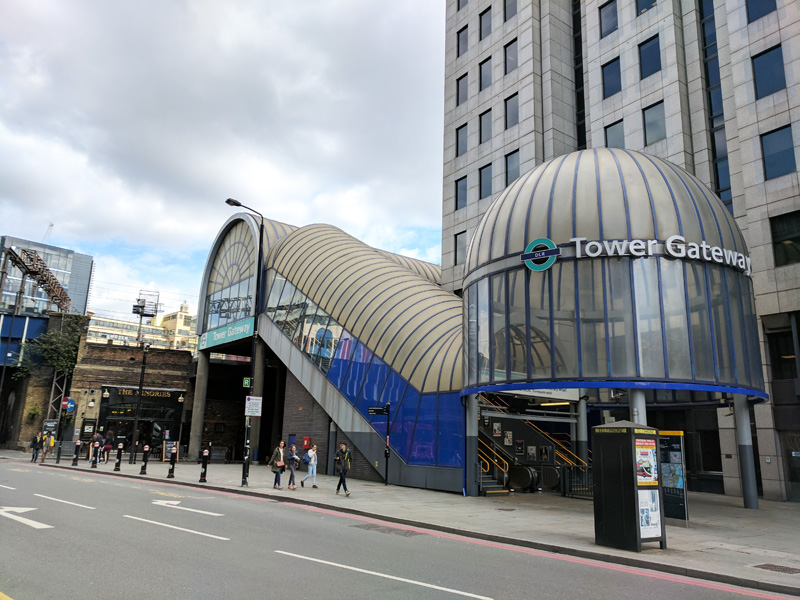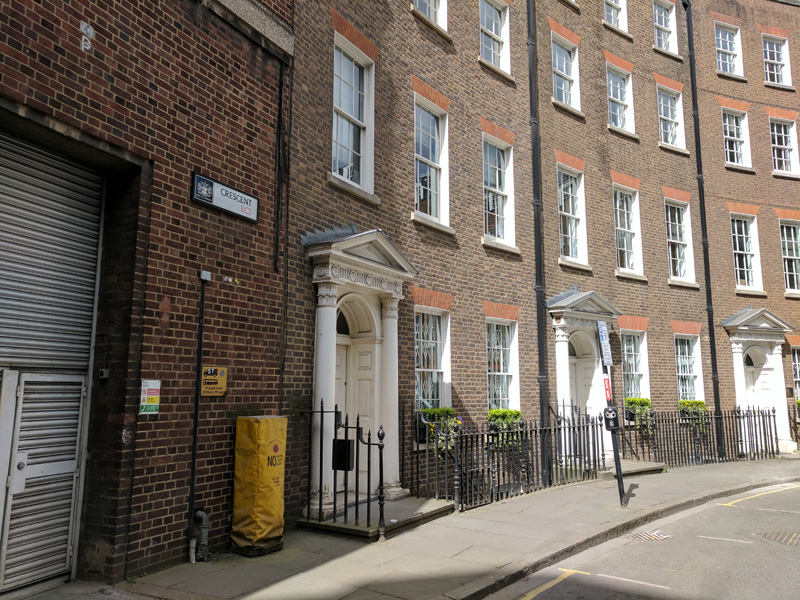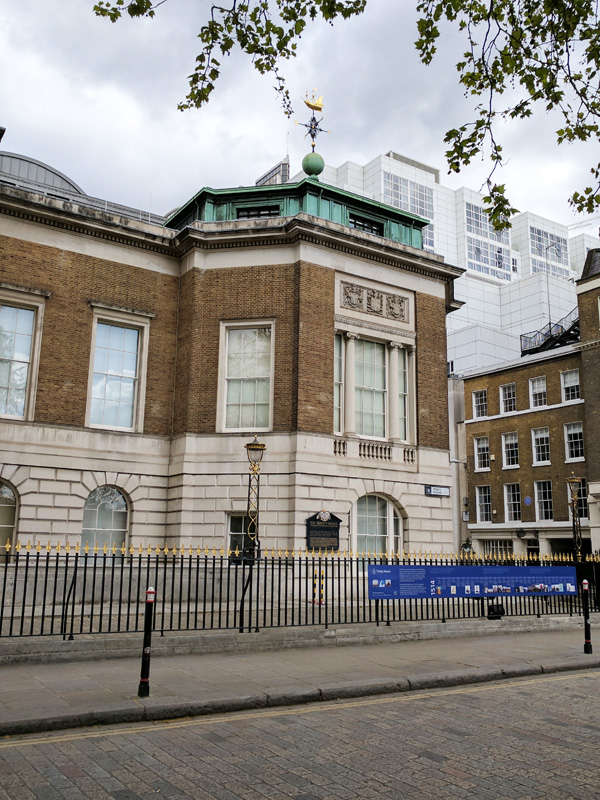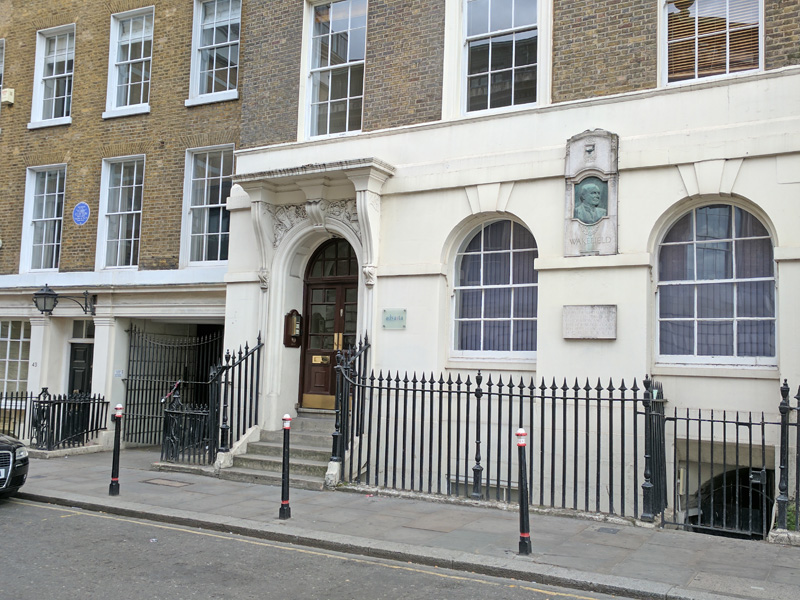
Day 78 – Whitechapel High Street – Commercial Road – Prescot Street -Leman Street

Continuing north from where we left off last time, but with a much less ambitious itinerary, today’s excursion sees us back in the East End. We’re visiting Aldgate East and Whitechapel, specifically the area bounded to the north by Commercial Road (A13) and to the south by Cable Street and stretching from Mansell Street to Cannon Street Road west to east.
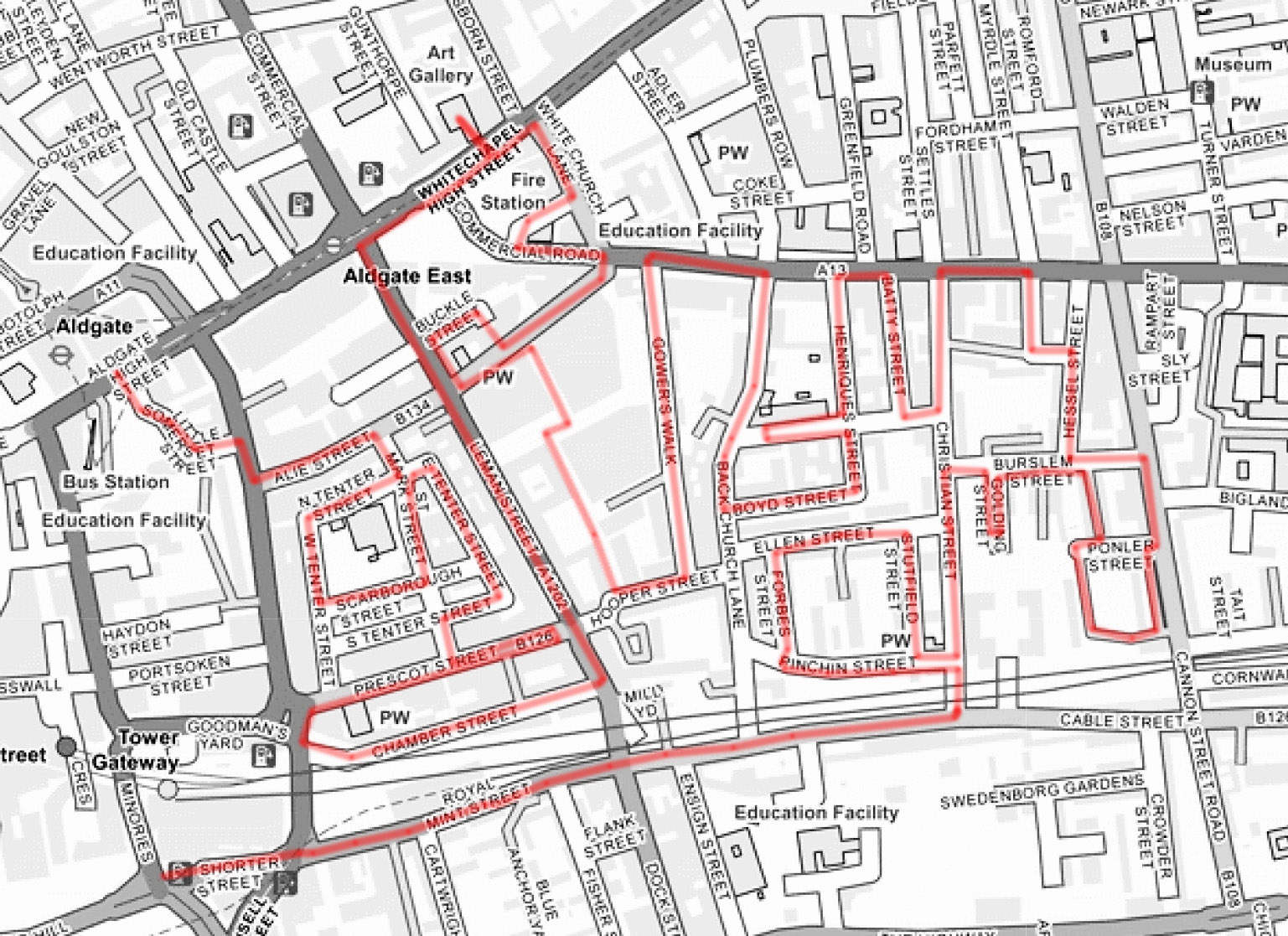
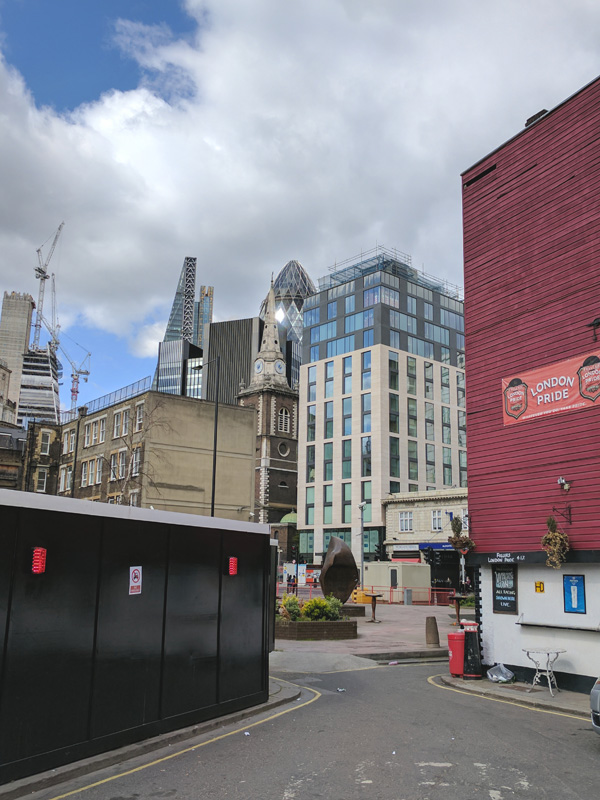
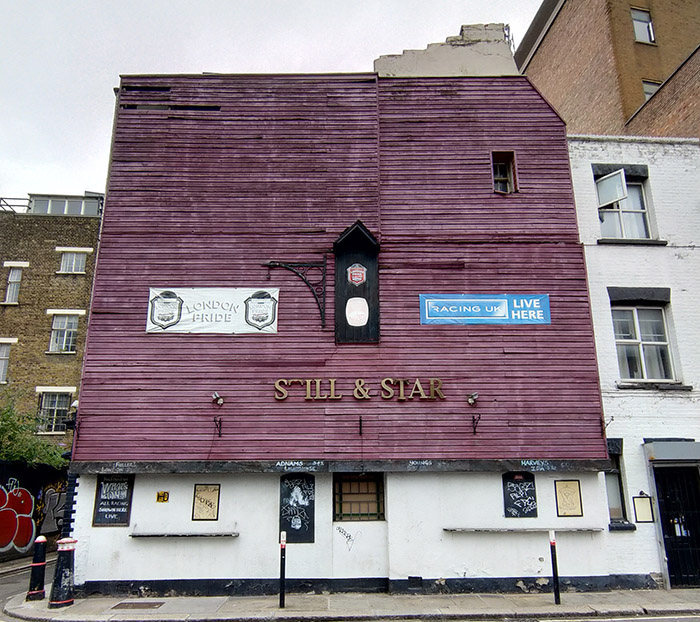
We start today’s journey at Aldgate tube station, crossing the road to cut through Little Somerset Street to Mansell Street, which replicates a very small part of the route we undertook on Day 20. This takes us past the Still and Star pub which at the time of that previous visit in 2017 was still a going concern. However, it was closed in 2020 and a application to demolish it and build an office development on the site was approved by the City of London (inside whose boundaries it just about lies). As you can see from the pictures below that development has yet to get underway; not unrelated to the pandemic I suspect. The loss of almost any pub is to be mourned but the demise of The Still and Star is especially sad as it was believed to be the sole example in the City of London of what is sometimes described as a ‘slum pub’ – in other words, a licensed premises converted from a private house. The name is also unique; apparently the pub originally had its own still, which was housed in the hayloft above, while ‘star’ refers to the Star of David, witnessing the Jewish population of Aldgate in the nineteenth century.
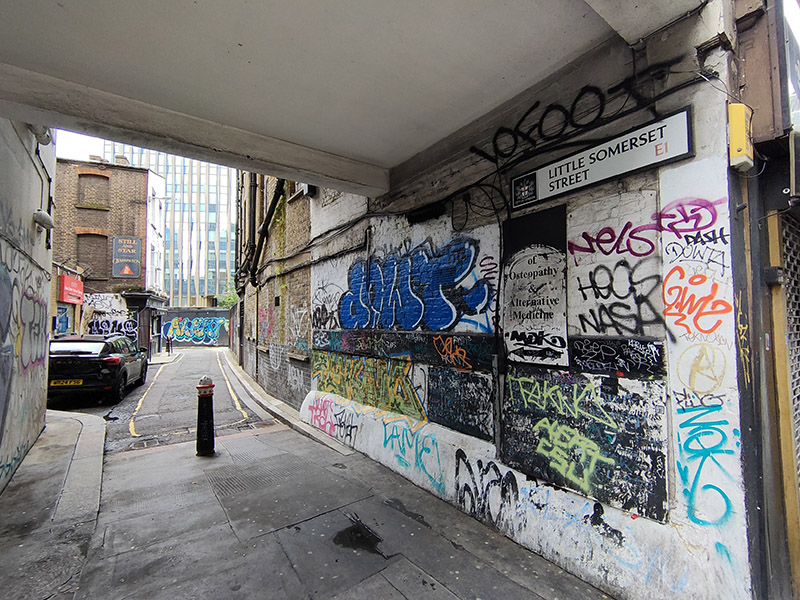
Mansell Street marks the actual boundary between the City of London and the borough of Tower Hamlets. Historically this was a pretty sharp dividing line but in recent years the office blocks and smart residential complexes have been encroaching beyond that line and starting to slightly change the tenor of an area that has for decades been home to a predominantly working class Bangladeshi community.

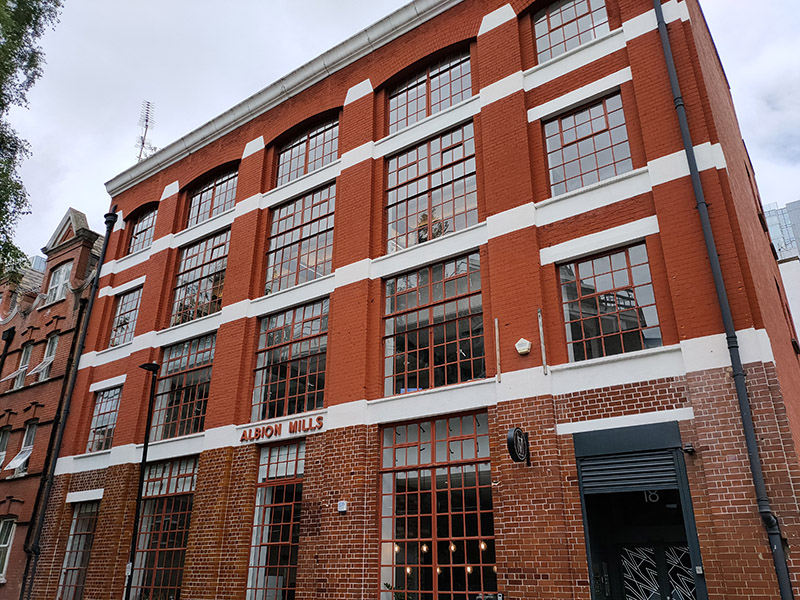
On the other side of Mansell Street we head east along Alie Street then turn right into a web of streets comprising Mark Street, North Tenter Street, West Tenter Street, East Tenter Street, South Tenter Street and Scarborough Street. The five-bay, four-storey, brick-faced warehouse at 18 East Tenter Street was built in 1905 for Israel Hyman and Sons, rag merchants. The architect was Gilbert Henry Lovegrove (1878–1951), a biographer of Sir John Vanbrugh, the builder S. Goodall of Stoke Newington. By the 1940s the building was being used as a ladies’ clothing factory called Albion Mills, a name that has been retained for its current incarnation as an office block.
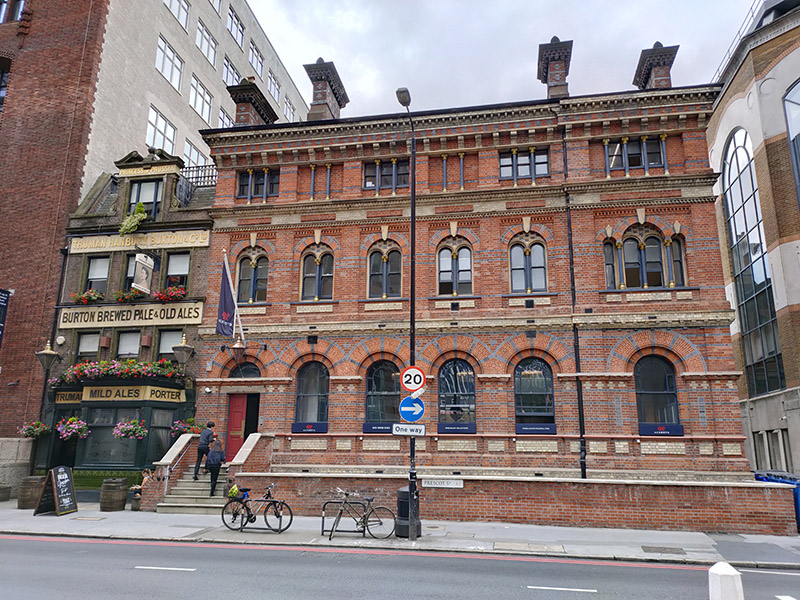
We leave the various Tenter Streets behind via Mark Street onto Prescot Street, coming face to face with the erstwhile Whitechapel County Court, designed by Charles Reeves and Lewis G Butcher and built in 1858-9 in the then-popular Italianate style. Next door to this stands the Princess of Prussia Pub. The present building dates from 1913. Its predecessor, built in the mid 18th century, became a pub in the same year the County Court opened (and subsequently provided most of its trade) and was named in homage to the marriage of Princess Victoria (one of Queen Victoria’s daughters) to Frederick William, Crown Prince of Prussia one year earlier.
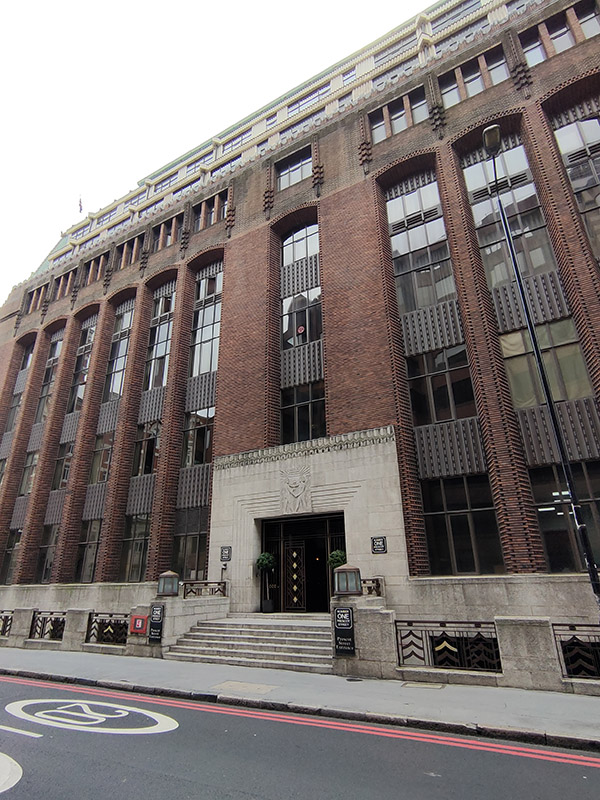
No. 1 Prescot Street is the imposing Grade II listed former Cooperative Wholesale Society building, once known as The Tea House. It was built between 1930 and 1933 to a design of architect, L G Ekins and is a rare example in Britain of the German Expressionist style of architecture. That rarity is hardly surprising in retrospect. Ironically, although this area suffered considerably in the Blitz, the Tea House survived intact.
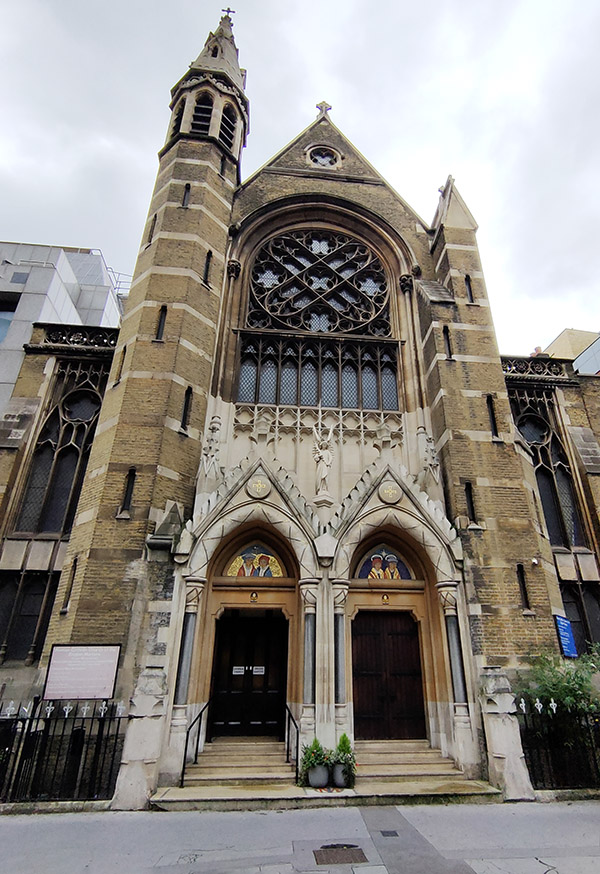
In the mid 1700s, Prescot Street was briefly home to the London Infirmary before it became the London Hospital (now the Royal London Hospital) and moved elsewhere in Whitechapel. The building, which no longer stands, was subsequently occupied by The Magdalen House for Reception of Penitent Prostitutes. An old alleyway, Magdalen Passage, in between the old County Court and the HQ of the Royal College of Psychiatrists, survives to commemorate the name. Further to the west at no.30 stands The Roman Catholic English Martyrs Church, designed by Edward Welby Pugin. The foundation stone was laid by the then Archbishop of Westminster, Cardinal Henry Manning in 1873.
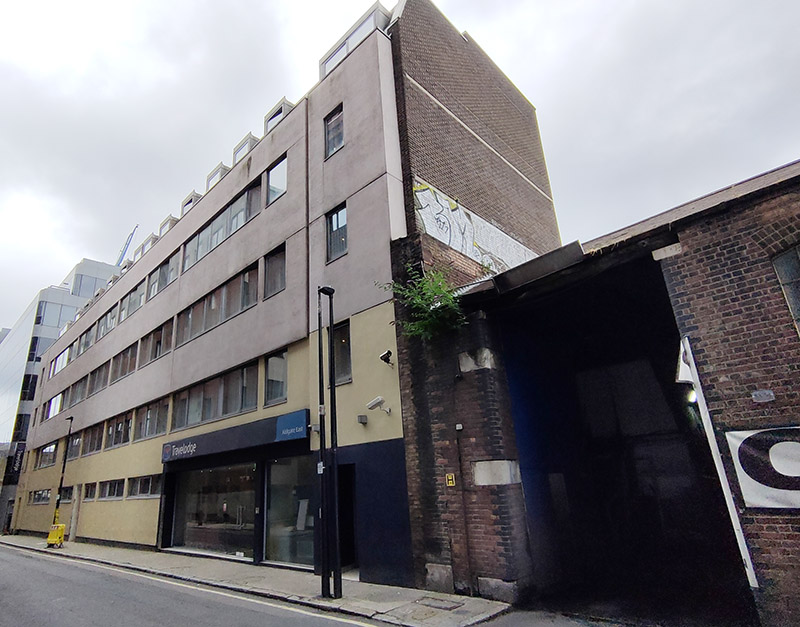
At the western end of Prescot Street we turn the corner and continue our eastward trajectory along Chamber Street which runs parallel to the DLR line and boasts, in the face of some stiff competition, the least inviting Travelodge I have yet to encounter (they’re so unproud of it it doesn’t even show up on Google maps).
At the end of Chamber Street we turn left onto Leman Street, named after Sir John Leman (1544 –1632) a merchant from Beccles (near Lowestoft) who served as Lord Mayor of London in 1616 and who used the proceeds from his trading in dairy products to purchase and build on this part of Aldgate.
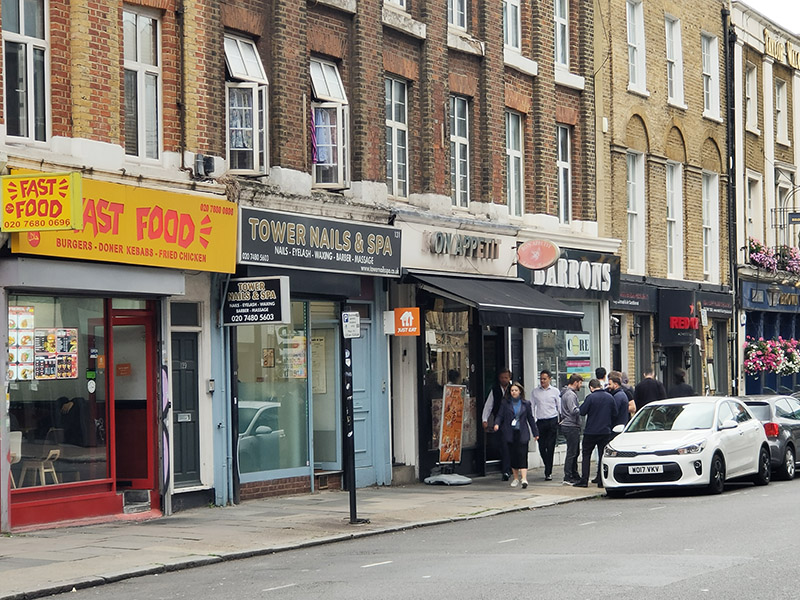
The southern end of Leman Street

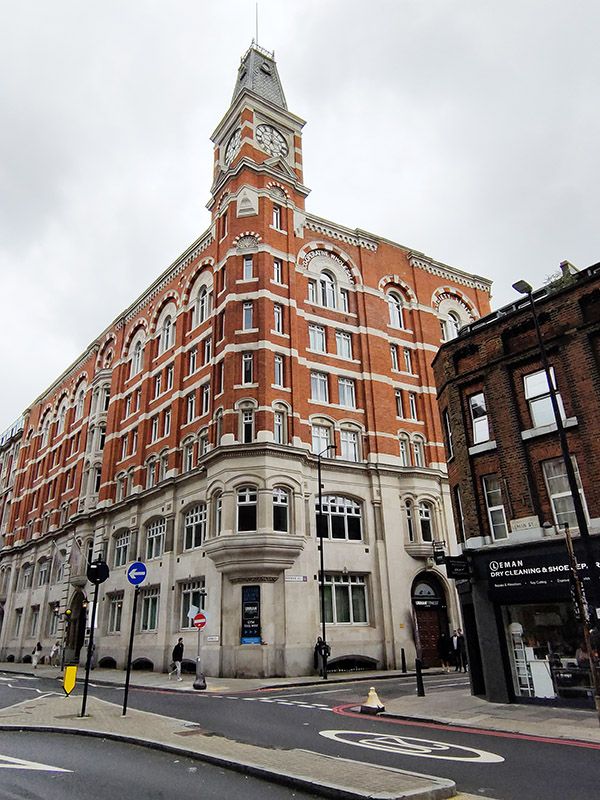
Prior to the construction of No.1 Prescot Street, the Cooperative Wholesale Society (what we now know as the Co-Op) had built an impressive London headquarters at 99 Leman Street in 1885-87. At the formal opening of the building, the CWS announced that it should “be their aim to make this beautiful building a common home for all the various movements having for their object the interest and advancement of the working people“. The building incorporated a sugar warehouse and so in time became known as Sugar House. In recent years it has been converted into luxury apartments which are listed at the kind of prices that would formerly have been unheard of in this area.
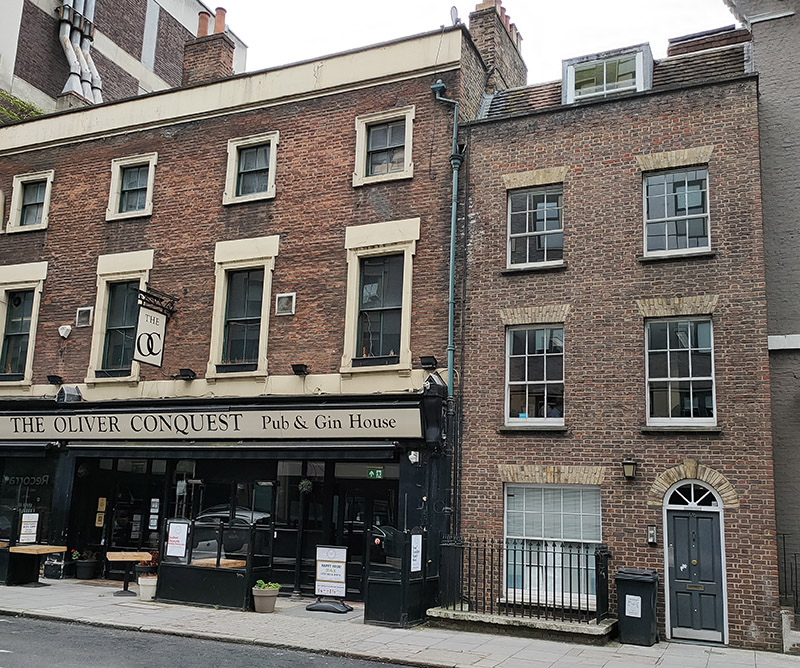
Further north on Leman Street is the Oliver Conquest pub. This dates from the mid 19th Century and was originally called the The Garrick as it was attached to the first Garrick Theatre, which was situated behind the pub. Benjamin Oliver Conquest was the theatre manager there in the early part of the 19th Century hence the name (nothing to do with Oliver Cromwell’s ravages of Ireland thankfully). This is another Grade II listing.
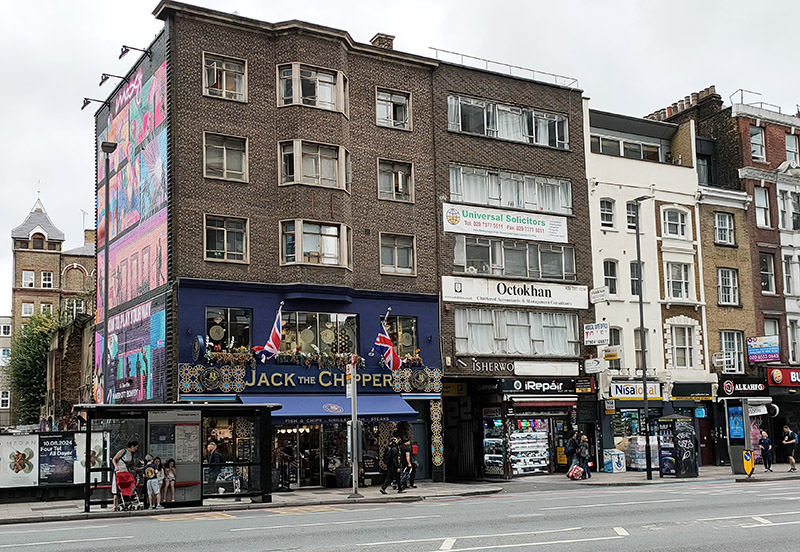
At the top of Leman Street we turn right onto Whitechapel High Street where we’re immediately confronted by another example of shameless association with the area’s most infamous character.
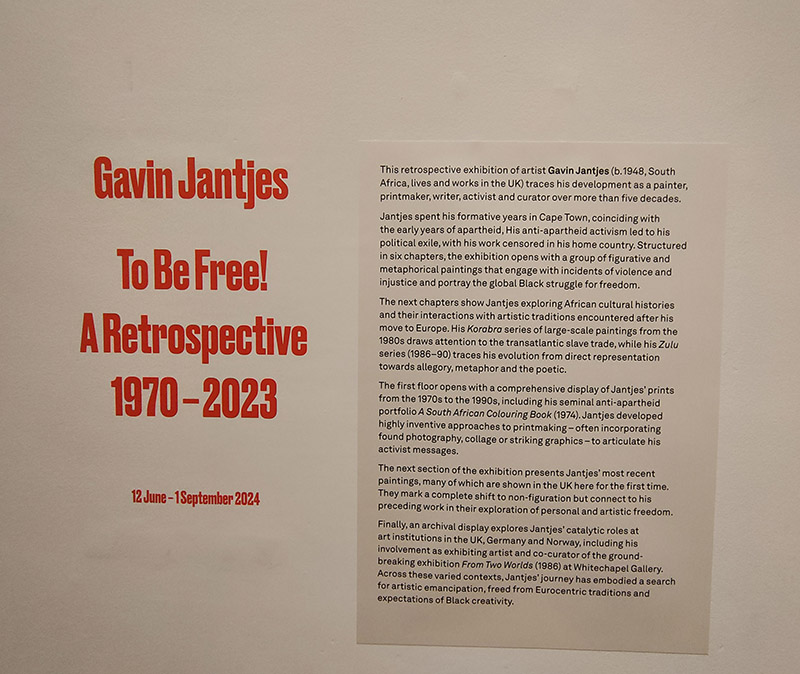
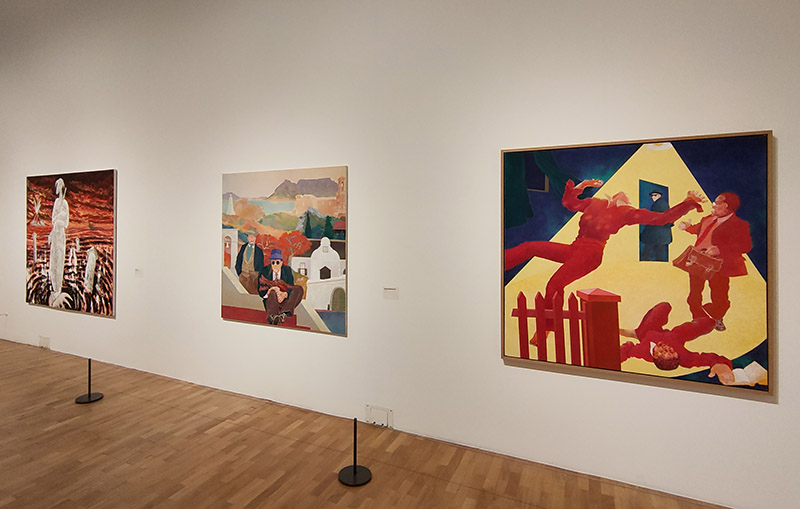
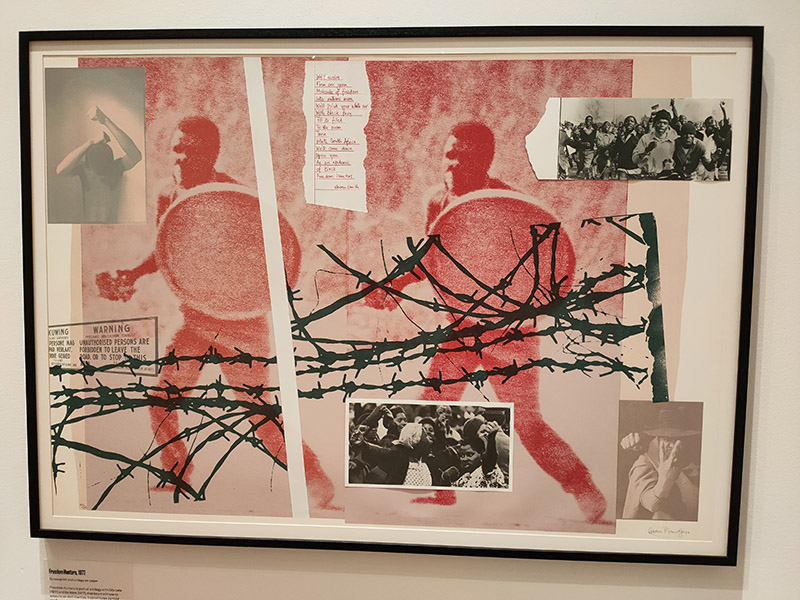
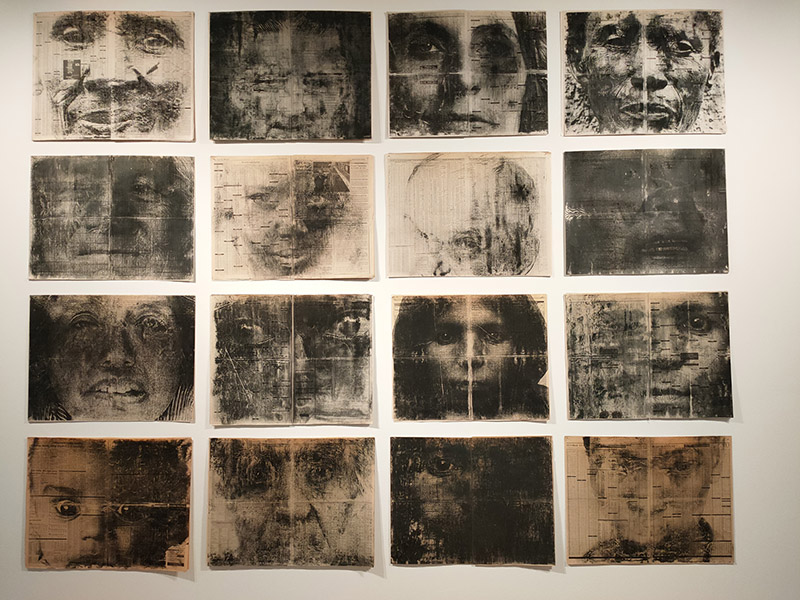
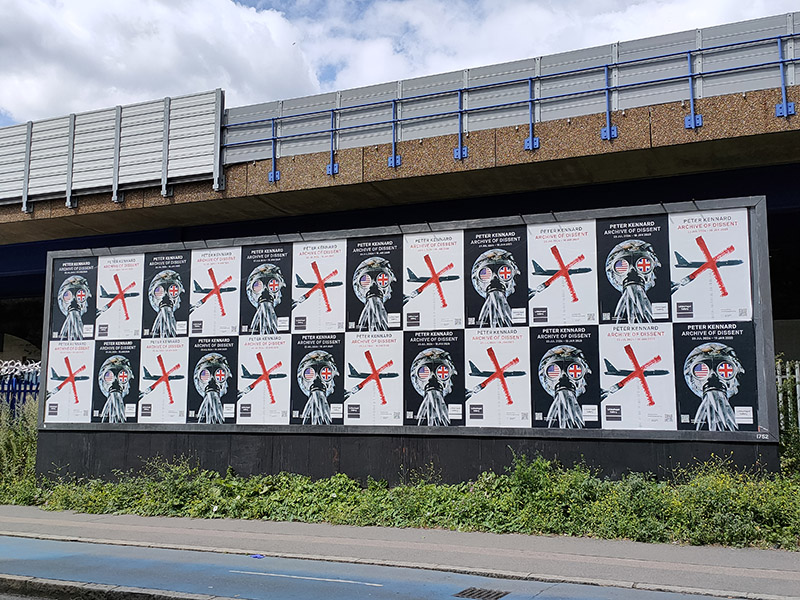
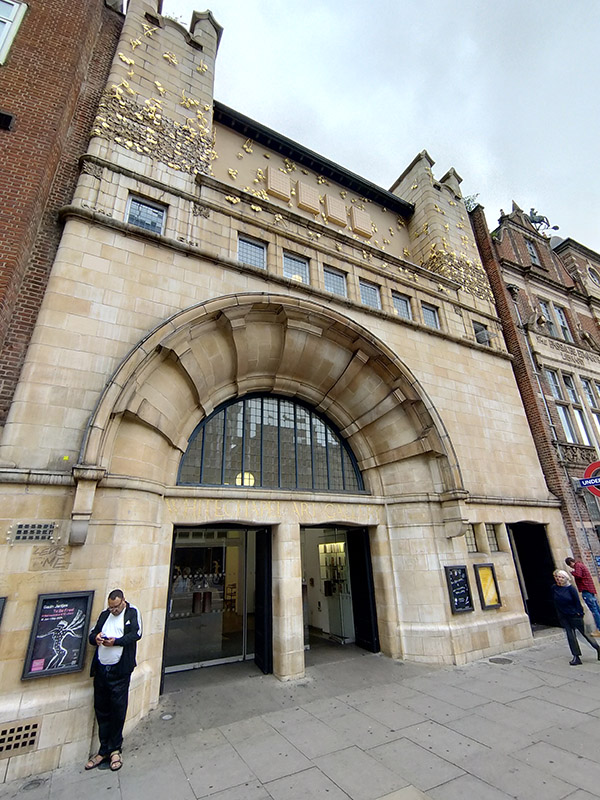
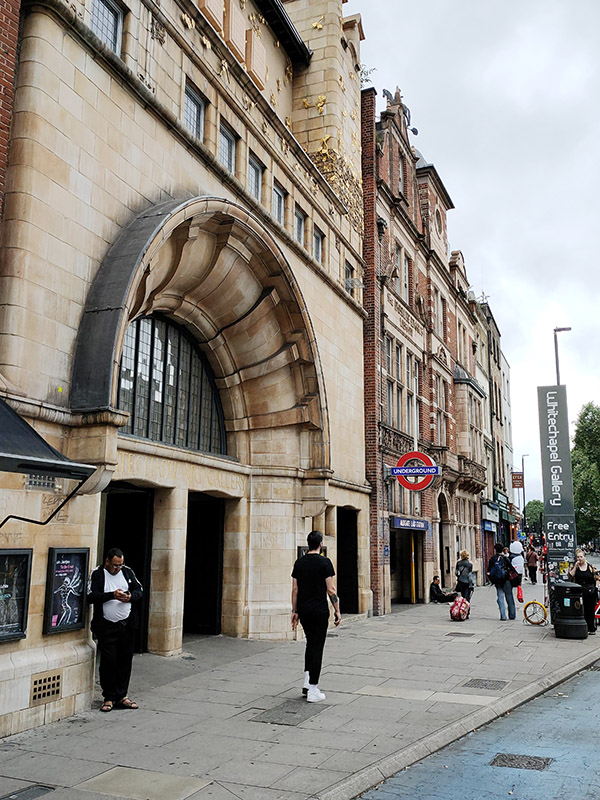
Fortunately, we only have to travel a a short way further for something altogether more edifying. Straddling one of the entrances to Aldgate East tube station, The Whitechapel Gallery was founded in 1901 to present “the finest art of the world for the people of the East End, London”. As a regular visitor over the last three decades I would say it’s made a pretty good fist of keeping to that aim. In 1939, Pablo Picasso’s iconic painting, Guernica, was presented at Whitechapel Gallery, during its only visit to Britain, and the Gallery has consistently premiered ground-breaking shows from artists as diverse as Barbara Hepworth (1954), Jackson Pollock (1958), Gilbert & George (1971), Frida Kahlo (1982) and Sonia Boyce (1988). In 2009 the gallery approximately doubled in size by incorporating the adjacent former Passmore Edwards library building. Its current exhibitions include Gavin Jantjes: To Be Free! A Retrospective 1970 – 2023 (until 1st September 2024) and Peter Kennard: Archive of Dissent (until January 2025). Both are worth seeing and the latter is free to visit.
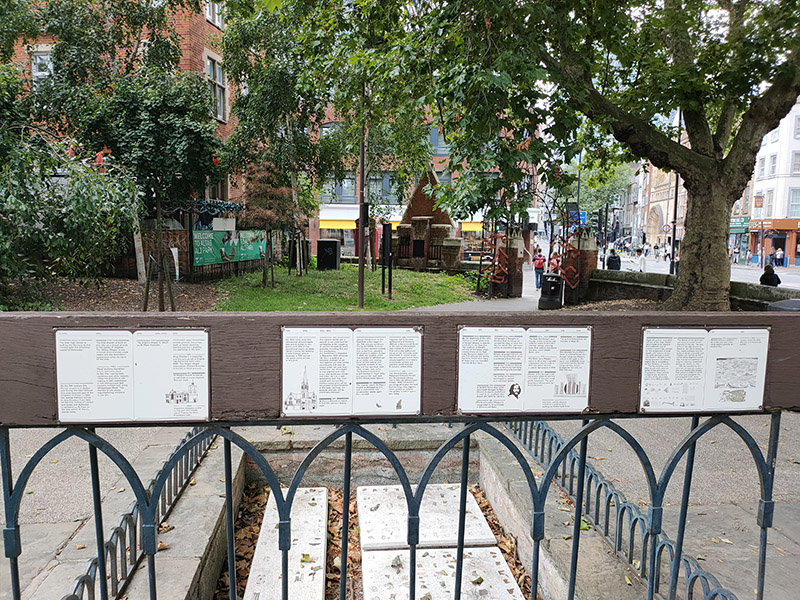
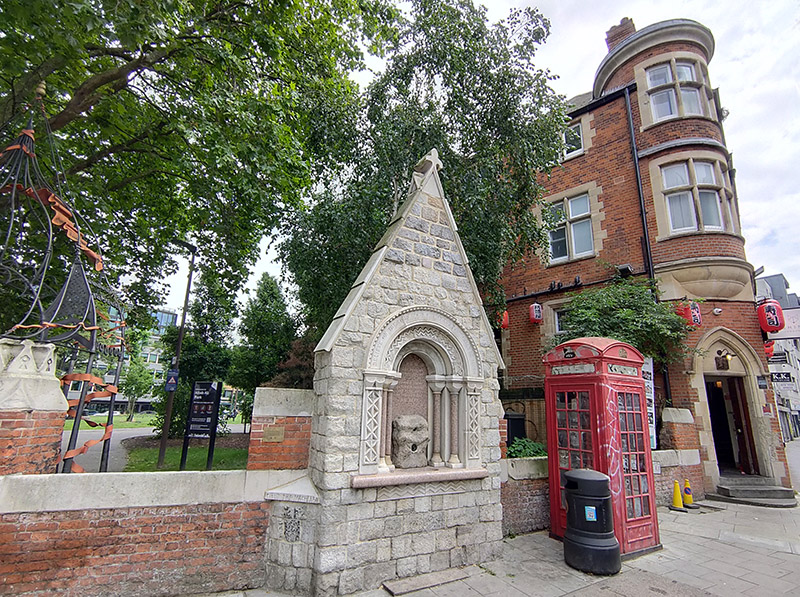
Beyond the gallery, to the east, is what was once the site of St Mary Matfelon church, popularly known as St Mary’s, Whitechapel. Reputedly, the church was covered in a lime whitewash, which gave rise to the district becoming known by the name, Whitechapel. Last rebuilt in the 19th century, the church was firebombed during the Blitz leading to its demolition in 1952. The site, including the church’s nave’s stone footprint and the graveyard – headstones removed – was subsequently turned into a public park. The park was renamed Altab Ali Park in 1998 in memory of Altab Ali, a 24-year-old British Bangladeshi leather clothing worker, who was murdered on 4 May 1978, in the adjacent Adler Street, by three teenage boys as he walked home from work. Ali’s murder was one of the many racist attacks that occurred in the area at that time. At the entrance to the park is an arch created by David Petersen, developed as a memorial to Altab Ali and other victims of racist attacks. 
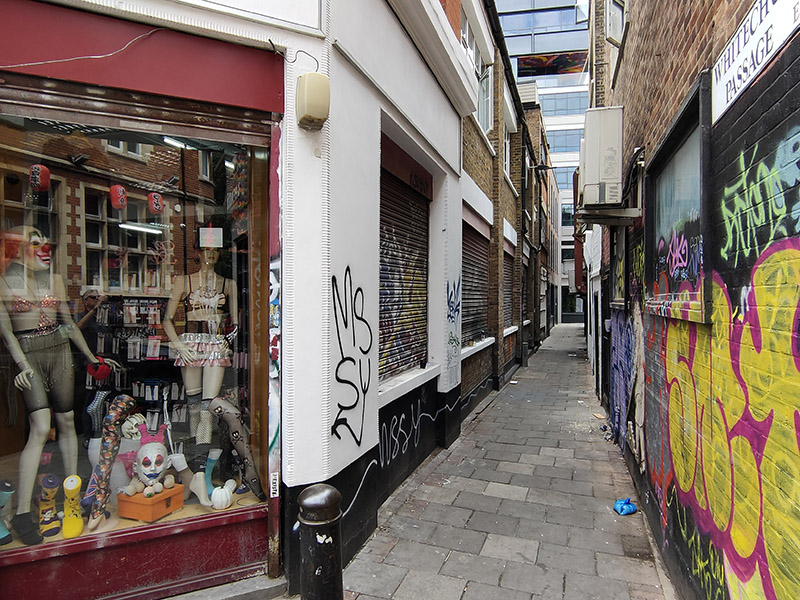
From here we turn southward down White Church Lane, striding swiftly past one of the most disturbing shop windows I’ve seen in a long while (if not ever).
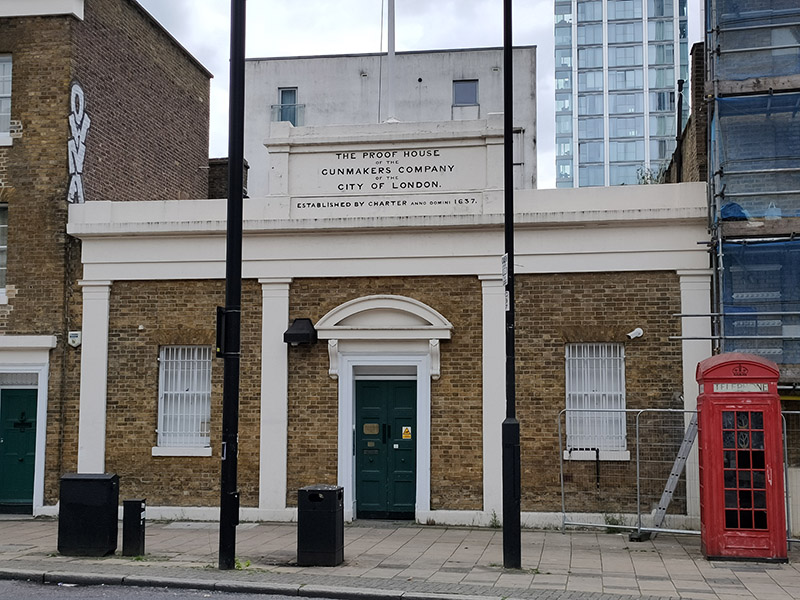
After a brief nod to Assam Street on the left we turn right down Manningtree Street which takes us onto the Commercial Road. At nos.48 -50 Commercial Road is the Proof House which is operated by the Worshipful Company of Gunmakers who have been at this location since 1675 (just 38 years after being granted their charter) though these buildings date from the 19th century. The Proof House has statutory powers to test and regulate the safety of firearms and no gun can be legally sold in the United Kingdom without having undergone proof. It also ensures and certifies that guns wanted for display purposes, rather than use, have been made permanently unusable in the manner required by law and investigates accidents caused by firearms malfunction.
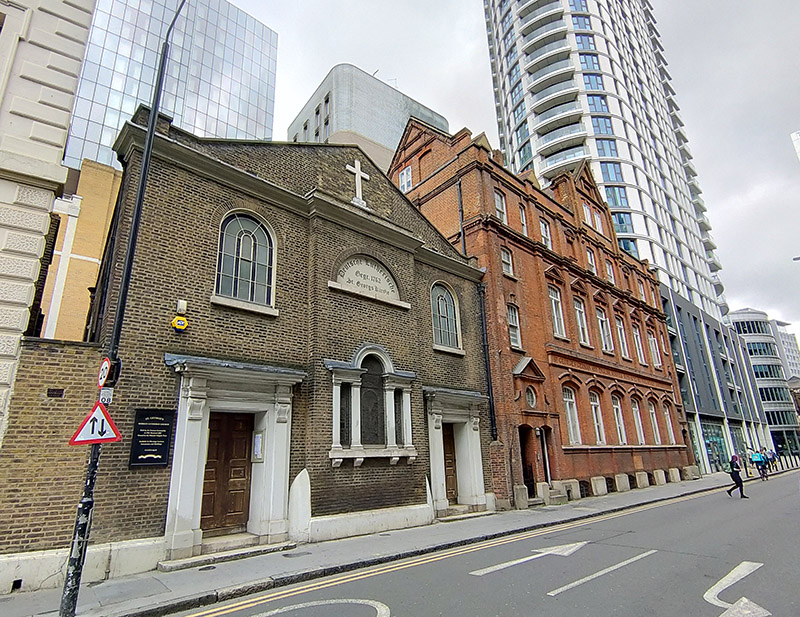
We head away from Commercial Road almost immediately via another stretch of Alie Street. A diversion onto Buckle Street takes us back to Leman Street from where we re-enter Alie Street at the site of St George’s German Lutheran Church. This is the oldest surviving German Lutheran church in the United Kingdom although it ceased to be a place of worship for yer actual German Lutherans in 1995. The founder was Dietrich Beckman, a successful sugar boiler who put up half the money required to buy the site and erect the church. This area of Whitechapel had many sugar refiners of German descent in the nineteenth century and they constituted most of the original congregation.
The area to the south of Alie Street was historically known as Goodman’s Fields and the name has been resurrected for the seven acre food, drink, health and entertainment destination created here on the site of an old postal sorting office within the last few years alongside 1000 new residential properties. There are two gyms, an escape room venue and a Curzon Cinema together with open spaces adorned with sculptural commissions. It looks like it’s been beamed here from another part of London altogether but all those properties have been sold.
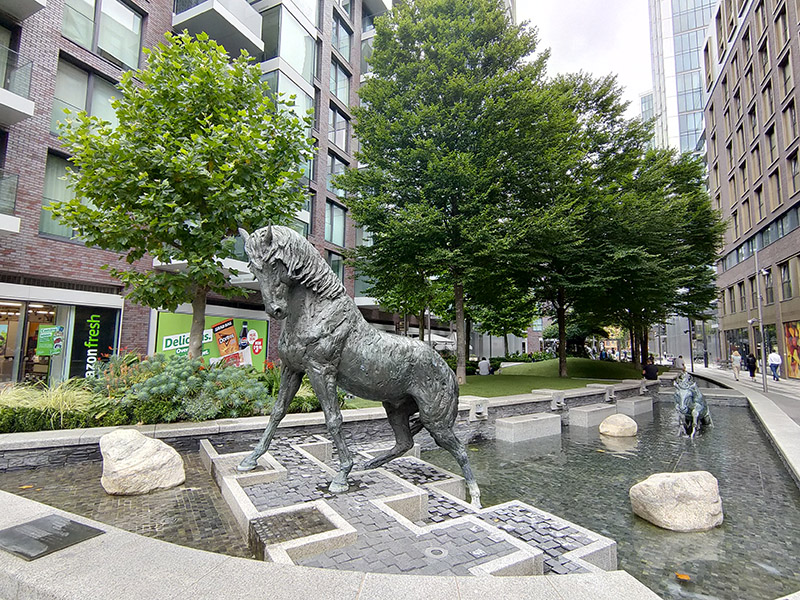
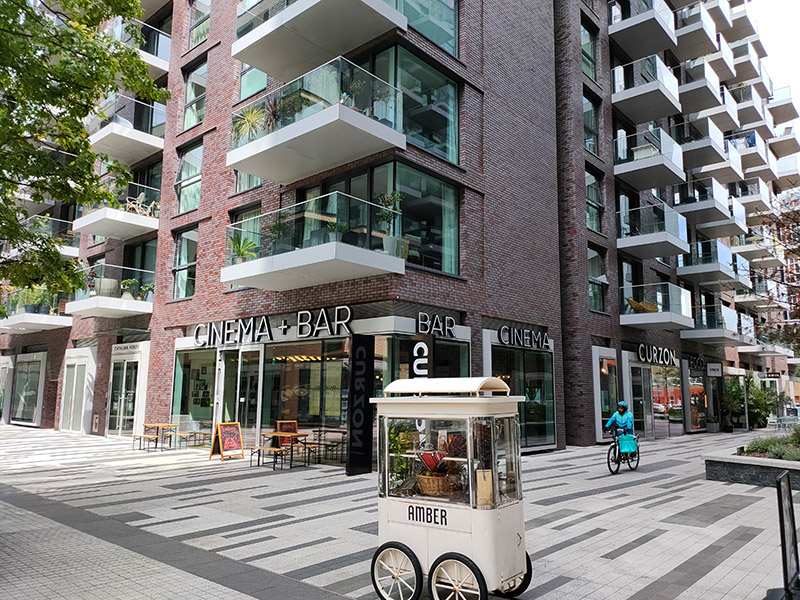
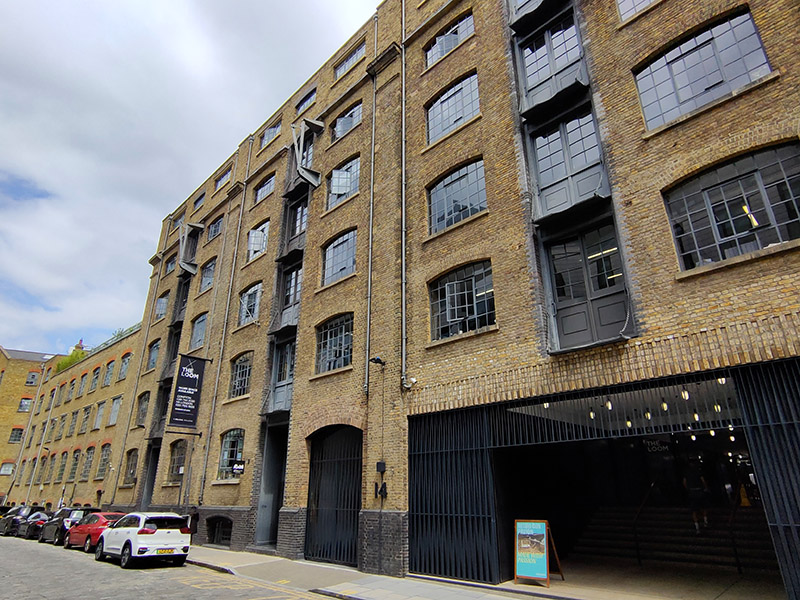
After a stroll through Goodman’s Fields we emerge onto Hooper Street where we turn east and then make our way back to Commercial Road via Gower’s Walk. A former Victorian wool warehouse here has been converted into (or reimagined as) 110,000 sq ft of modern and characterful work space for entrepreneurs, innovators and creative minds known as The Loom.
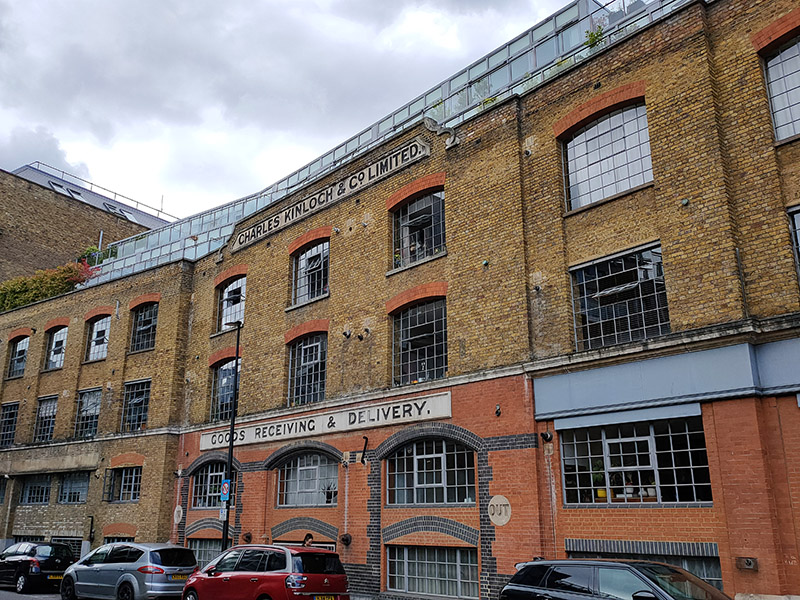
On returning to Commercial road we turn right then right again onto Back Church Lane. By the junction with Boyd Street stands another repurposed warehouse. This one, originally the property of Charles Kinloch & Co Ltd, wine and spirit merchants, is now apartments.
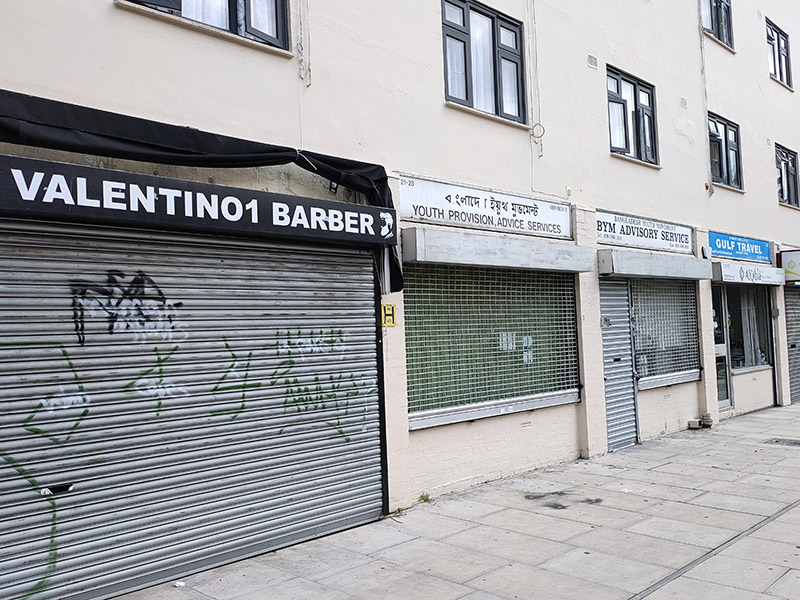
Boyd Street doglegs into Henriques Street where this parade is perhaps another indicator of change in the air.
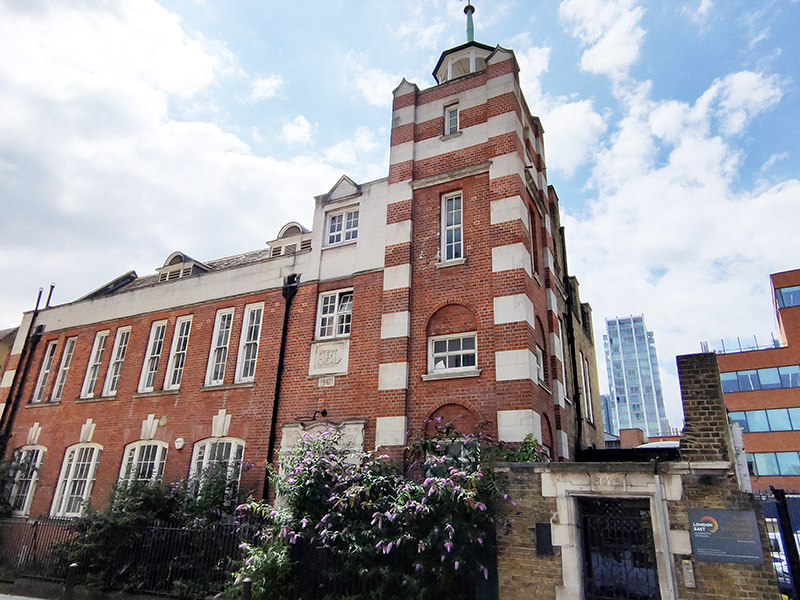
Also on Henriques Street is a building of 1903 vintage that started life as the London School Board Combined Skills centre. In 2010 it was repurposed as An Information and Communications Technology (ICT) centre for young people, and named the Tommy Flowers Centre after the Post Office engineer (1905 – 1998) who in WW2 designed and built Colossus, the world’s first programmable electronic computer, to help decipher encrypted German messages and who was born in Tower Hamlets. After the war Flowers applied for a loan from the Bank of England to build another machine like Colossus but was denied the loan because the bank did not believe that such a machine could work. He couldn’t argue that he had already designed and built many of these machines because his work on Colossus was covered by the Official Secrets Act. Sadly, the Tommy Flowers Centre hasn’t survived in its original guise; for a time it became part of the Tower Hamlets Pupil Referral Unit but at present it appears to be disused.
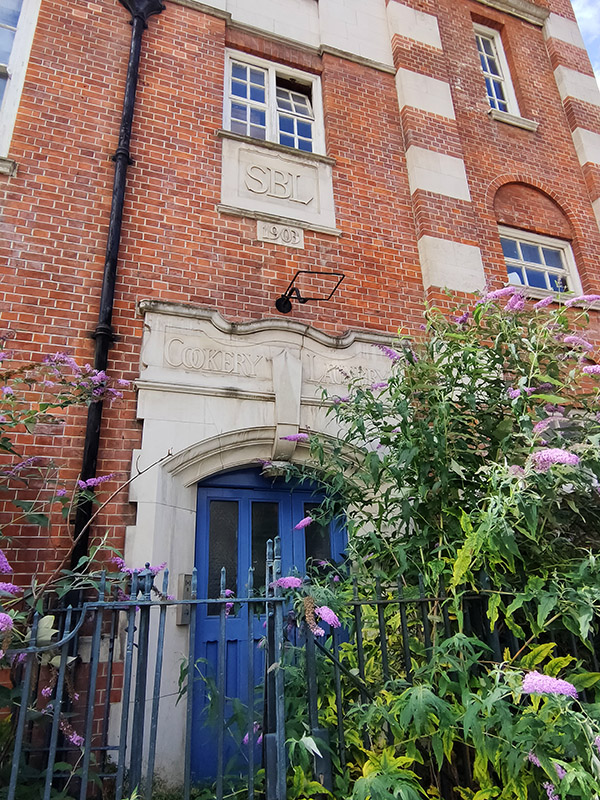
Next street leading south from Commercial Road after Henriques Street is Batty Street which ends at Fairclough Street where we turn east onto Christian Street ( a road out of place and time if ever there was).
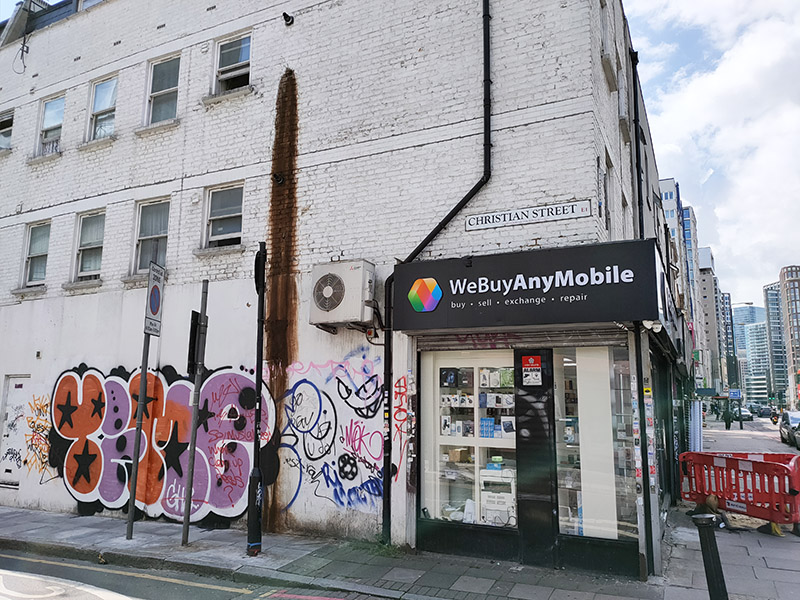
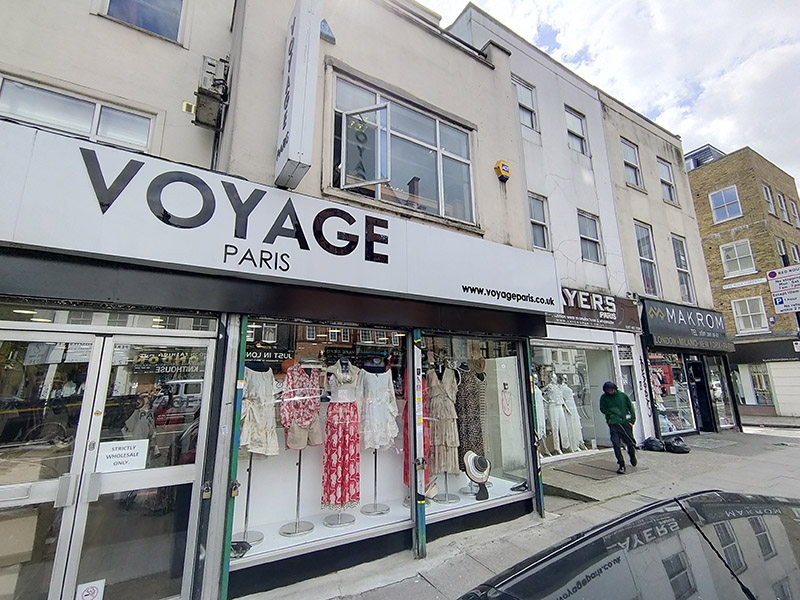
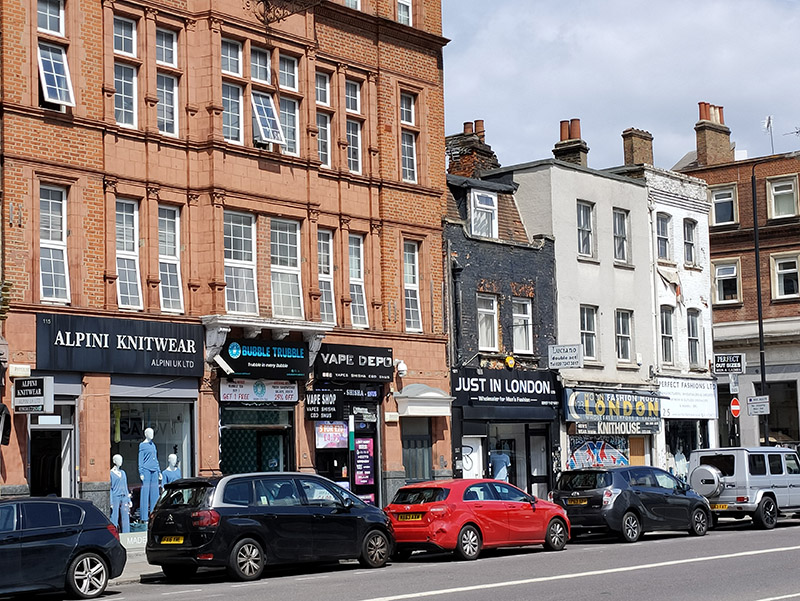
As I’ve probably mentioned before, this part of the East End has had a longstanding association with the garment industry going back to the tailor’s shops of the 19th century Jewish immigrants. Nowadays it’s the Bangladeshi community that has taken on the rag trade mantle and this is in full evidence on Commercial Road in the form of the numerous wholesale fashion outlets that cluster on both sides. Some of these, mainly on the south side, appear to be more than a little disingenuous regarding their international associations. If any of their import or export business actually involves Paris (or New York or Milan) I’d eat one of those frocks. By contrast the operators based on the north side (bottom picture below) are happy to proclaim their parochialism.
We do one more loop in and out of Commercial Road before we leave it behind. This takes in Umberston Street, Amazon Street and Hessel Street before leading us south on Cannon Street Road. Between 1883 and 1913 this was home to one of the eponymous schools originally established by the philanthropist Henry Raine (who we encountered in the previous post).
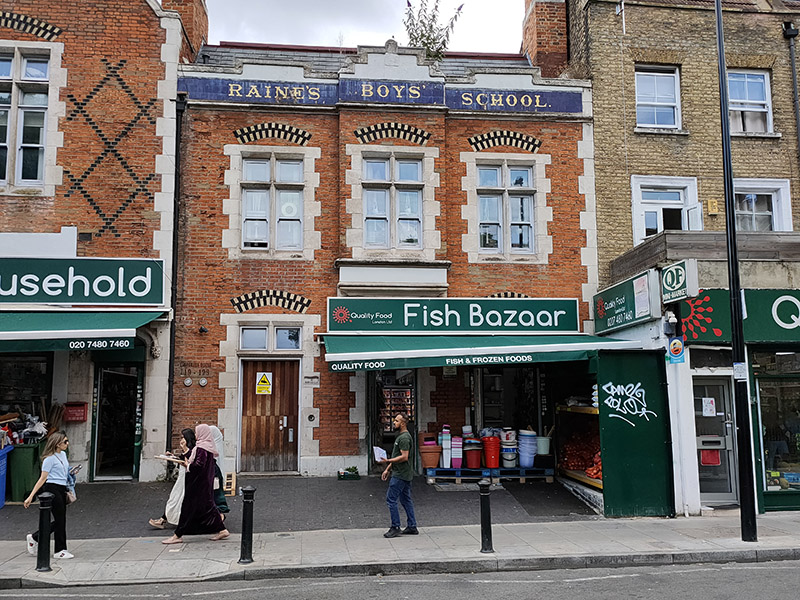
Two thirds of the way to the intersection with Cable Street we turn right onto Ponler Street and then do circuit of Estate Road which unsurprisingly encompasses a social housing estate. I would have expected this to include Walford House (nothing to do with Eastenders) which lies immediately to the west but it transpires this includes some now-private flats which astonishingly (for those of you who live outside of London have a current market value of around £200k.
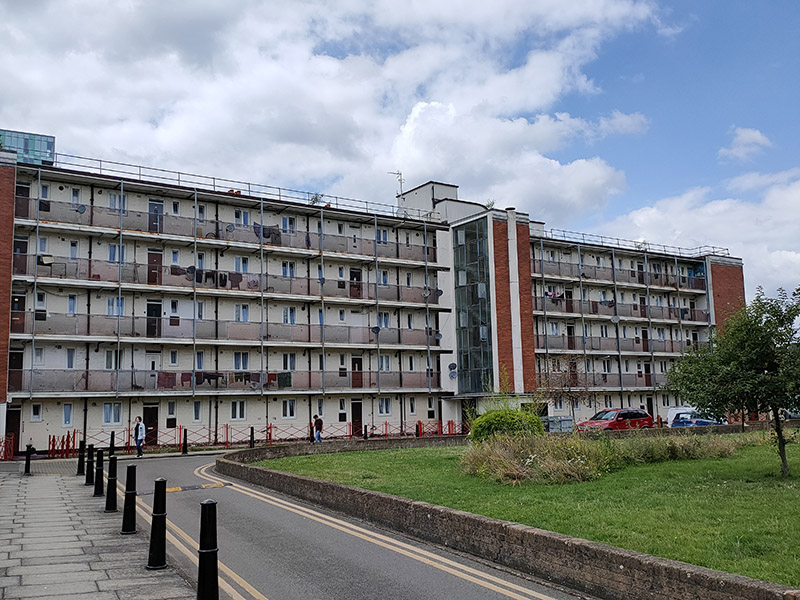
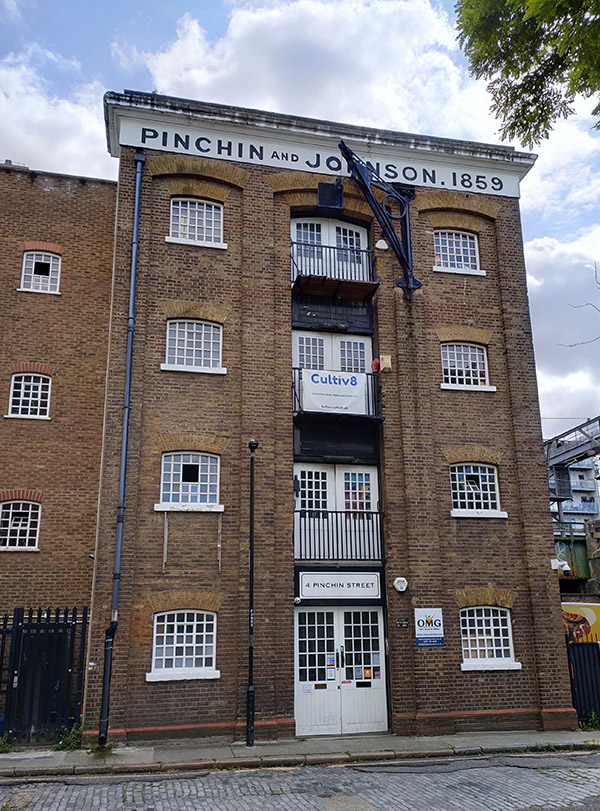
There follows a sequence of streets with nothing of note to report. To the east of Christian Street we have Langdale Street, Burslem Street, Wicker Street and Golding Street and, to the west, Ellen Street, Strutfield Street and Forbes Street. The latter brings us out onto Pinchin Street which again runs parallel to the DLR line. Here we find a warehouse used by the firm of Pinchin Johnson & Associates Ltd from 1859. Pinchin Johnson was a major supplier of paints and coatings to industry and consumers in the first half of the 20th century and was one of the original constituents of the FT 30 index when this was set up in 1935, although the company had been in existence for 100 years by then. In 1960, PJA was acquired by Courtaulds who, in 1968, merged it with the International Paint business they had acquired earlier in the year.
And that’s us done for the day save for a long stroll along Cable Street and Royal Mint Street back to Tower Hill. (And for the first time in a long while we’ve managed to come in under 3,000 words).

Day 40 – Aldgate – Tower Hill – Fenchurch Street

Shifting slightly further to the east for this excursion which starts out where we left off a couple of months back on Aldgate High Street then heads south down to Tower Hill, stopping short of the Tower itself, before snaking west and north through the City. Because this walk took place on Easter Sunday the area was atypically quiet apart from the inevitable tourist throng near the Tower and, less obviously, in the vicinity of the Gherkin.

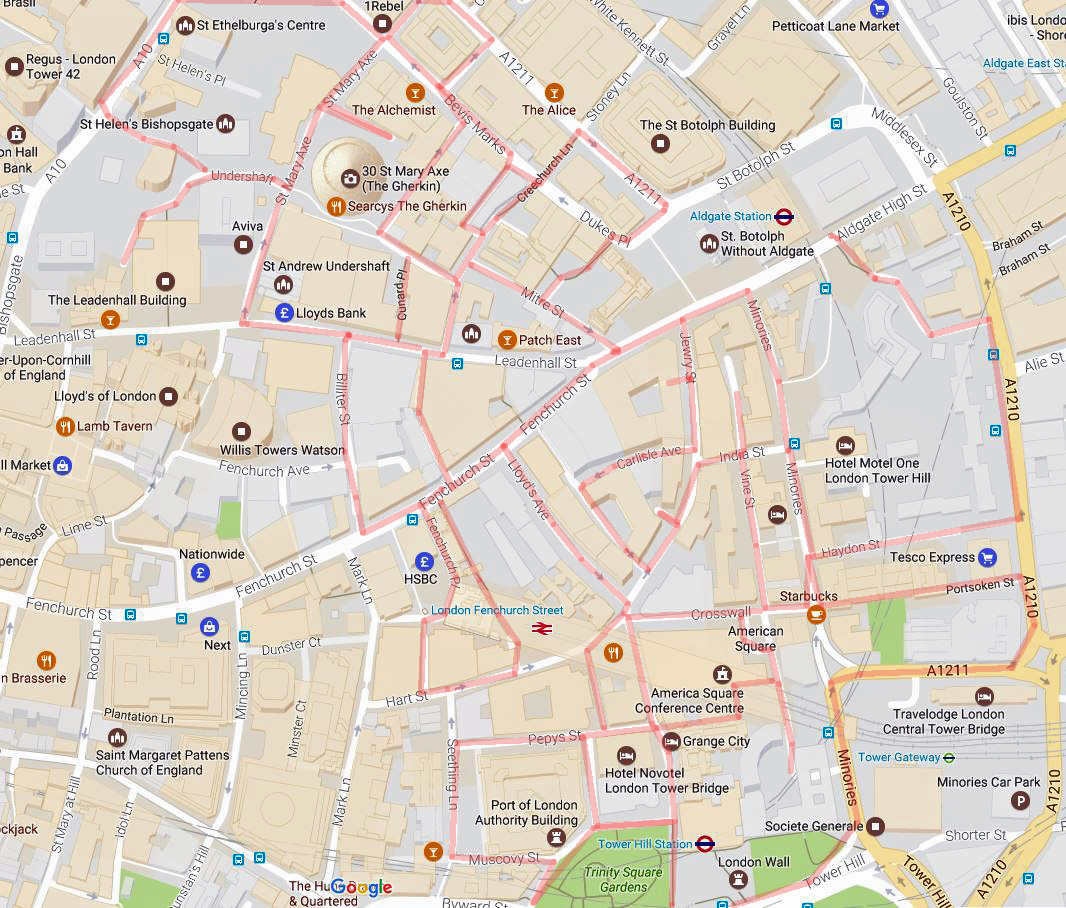
Day 40 Route

So we set out on Aldgate High Street  opposite Aldgate tube station and proceed south down Little Somerset Street. Looking behind us gives a background glimpse of what’s to come later.

IMG_20170416_112536

Reaching Mansell Street we continue south turn right along Haydon Street and then when this adjoins onto the Minories head northward to return to Aldgate High Street opposite the church of St Botolph without Aldgate. This is the second time we’ve encountered St Botolph; he was “without Bishopsgate” a few posts back. In fact there were four medieval churches built in London in honour of this particular saint, all of which stood by one of the gates of the London Wall (more of that later). Aldersgate is the other one of those that survives while the church at Billingsgate wasn’t rebuilt after the Great Fire. St Botolph’s was often referred to as the “Church of Prostitutes” in the late Victorian period. To escape arrest by the police the local ladies of the night would parade around the island in a sea of roadways on which the church stands.

IMG_20170416_113557

Turn south again, this time down Jewry Street which is the site of the Sir John Cass Foundation. John Cass (1661 – 1718) was both a Sheriff and Alderman of the City of London and in 1710 set up a school for 50 boys and 40 girls which originally occupied buildings in the churchyard.  After his death, despite his will being incomplete and contested, his wish to leave the majority of his estate to the school was upheld though it took thirty years. So the Foundation came into being in 1748 and in 1899 a Technical Institute was created alongside the school and this moved into the new-build premises on Jewry Street, becoming the Sir John Cass College in 1950.

After nipping briefly into Saracens Head Yard we take the next right turn, Carlisle Avenue, which takes us into Northumberland Alley which meets its end at the wonderfully-named Crutched Friars. Crutched Friars is one of the alternative names of the Roman Catholic order Fratres Cruciferi (Cross-bearing brethren). Crutched refers to the crucifix-surmounted staff which they carried about with them. Next up, turning north again, is Rangoon Street, which is barely more than an alcove, before we switch eastward down India Street. Turn right next down Vine Street (not the one which forms part of the Orange set of properties in Monopoly – that’s over near Piccadilly) then veer off to the left, down Crosswall which takes us into Portsoken Street. This latter skirts one side of a charming small park wedged in amongst some less than charming buildings.

IMG_20170416_114946

At the end of Portsoken Street we swing round Mansell Street and Goodman’s Yard to loop back onto Minories and then turn south under the railway bridge and past Tower Gateway station, one of the two western termini of the DLR.

IMG_20170416_115538

So we’re now onto Tower Hill and moving west parallel to the north side of the Tower of London. Here there is one of the most substantial surviving sections of the London Wall built around the city  by the Romans in around 200 AD. In total the wall was about 4km long enclosing some 330 acres and including the four city gates (mentioned previously) with a further entrance to the legionary fortress at Cripplegate.

Turn north into Cooper’s Row and head up past Trinity Square Gardens back to Crosswall (whose name now makes perfect sense). Duck through American Square onto the southern section of Vine Street which seems to lead nowhere but then suddenly and bizarrely emerges into a crescent of replica Georgian houses (some rebuilt immediately post WW2 others as part of a 1980s redevelopment) called, simply and literally, Crescent.

IMG_20170416_120510

Double back and cut through a series of alleyways leading out onto Cooper’s Row again. Cross over and proceed west along Pepys Street before turning south down Savage Gardens. This returns us to Trinity Square, to No. 10 Trinity Square in fact, which links neatly back to the previous post for this is the first permanent HQ of the Port of London Authority. It was built in the Beaux Arts style by John Mowlem & Co to a design of Sir Edwin Cooper and was opened by then Prime Minister, David Lloyd-George, in 1922. The façade of the building is interspersed with Corinthian columns and high above the front entrance is a sculpture of Old Father Thames, holding his trident and pointing east in homage to the trade between nations. In 1946 the General Assembly of the United Nations held its inaugural reception here, in what is now known as the UN ballroom. In the 1970’s the PLA moved out to Tilbury and no. 10 was renovated; becoming the home of insurance broker Willis Faber until 2008. Two years after they left a Chinese Investment company bought the Grade II-listed building and after a six year multi-million pound renovation it was brought back to life as a Four Seasons Hotel. In the interim it had a walk-on part in the James Bond Skyfall film as a location for a meeting between M (Dame Judi Dench) and Gareth Mallory (Ralph Fiennes).
This slideshow requires JavaScript.

Moving on clockwise round the square we come first to Trinity House which is the home of the organisation that began life as The Corporation of Trinity House (or to give it its full name The Master Wardens and Assistants of the Guild Fraternity or Brotherhood of the Most Glorious and Undivided Trinity and of Saint Clement in the Parish of Deptford Strond in the County of Kent), under Royal Charter of 1514 with a remit to regulate pilotage on the River Thames and provide for aged mariners. Today Trinity House is the UK’s largest maritime charity dedicated to safeguarding shipping and seafarers as well as incorporating the General Lighthouse Authority (GLA) for England & Wales. The GLA is responsible for a range of aids to navigation from lighthouses to radar beacons but, confusingly, is separate from HM Coastguard (which looks after all aspects of search and rescue).

The building itself dates to 1796 and was designed by architect Samuel Wyatt.
IMG_20170416_121211

On the east of the square at no.43 is a blue plaque commemorating Reverend Philip “Tubby” Clayton (1885 – 1972), founder of the international Christian movement Toc H. And next door at no.41 is a memorial to Viscount Wakefield of Hythe (1859 – 1941) who founded the Castrol lubricants company and was a Lord Mayor of London and also Tubby’s mate.

IMG_20170416_121349

We now take a stroll through Trinity Square Gardens which is dominated by the Merchant Navy Memorial. The original, post WW1, section was designed by Sir Edwin Lutyens with sculpture by Sir William Reid-Dick and was unveiled by Queen Mary on 12 December 1928.  It commemorates almost 12,000 Mercantile Marine casualties who have no grave but the sea, including almost 1,200 lost when the Lusitania was sunk in 1915. The WW2 extension, which commemorates almost 24,000 casualties, was designed by Sir Edward Maufe, with sculpture by Charles Wheeler and was unveiled by Queen Elizabeth II on 5 November 1955.

This slideshow requires JavaScript.

Leaving the gardens on the west side we find ourselves back outside Ten Trinity Square, which as I mentioned is now a Four Seasons hotel having opened a mere three months back in January 2017. On impulse born of curiosity I decide to head inside for a lunchtime cocktail at the Rotunda bar. I have the place to myself pretty much and the very amiable bartender rustles me up a concoction called (appropriately) a Shivering Timbers which will set me back £15 plus service. Still it’s just about worth it to take in the elaborately refurbished interior (and make a luxurious and desperately need toilet stop). As well as the hotel the building incorporates 41 private residences and a private members’ club. At the time of speaking £440 a night for the cheapest room doesn’t include access to the spa and swimming pool as these won’t be open for a few more weeks.

This slideshow requires JavaScript.

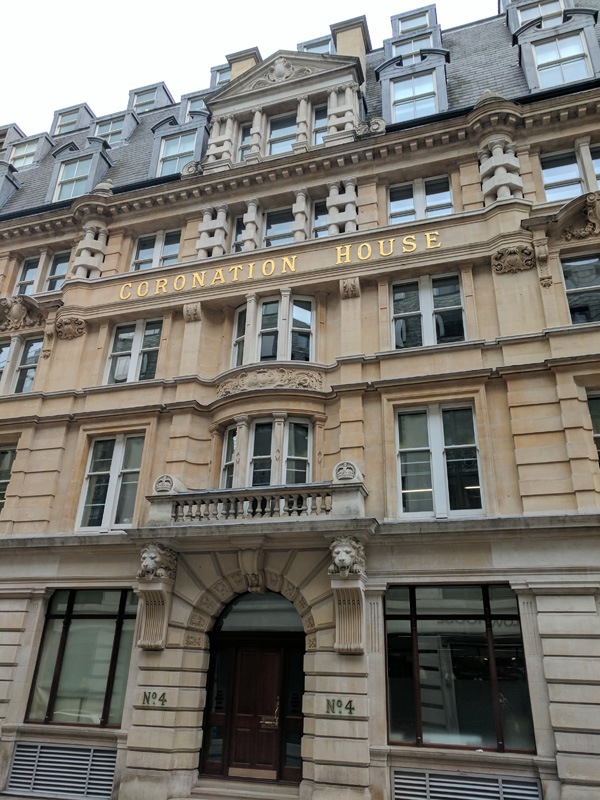
Leaving the hotel, head west along Muscovy Street and then turn north up Seething Lane before returning eastward along Pepys Street and via another section of Savage Gardens find ourselves back on Crutched Friars. From here we continue north up Lloyds Avenue most of the buildings on which were built under a redevelopment of derelict East India Company warehouses at the turn of the 20th century. Coronation House at no. 4, built in 1904,  eventually became absorbed into the Lloyd’s Register building which stood on the corner with Fenchurch Street.

IMG_20170416_131130

Lloyd’s Register (not to be confused with Lloyds of London) began life in 1760 in a London coffee house as a marine classification society. Nowadays it operates as a global provider of risk assessment and technical consultancy services across numerous industrial sectors but is still wholly owned by the charitable Lloyd’s Register Foundation.

It moved into the premises at 71 Fenchurch Street, designed by Thomas Colcutt, in 1901. Almost 100 years later it moved again – just a few yards further along Fenchurch Street – to a glass, steel and concrete skyscraper designed by the Richard Rogers Partnership (who of course had previously been responsible for the much better known Lloyd’s of London building – of which we shall hear more another time).

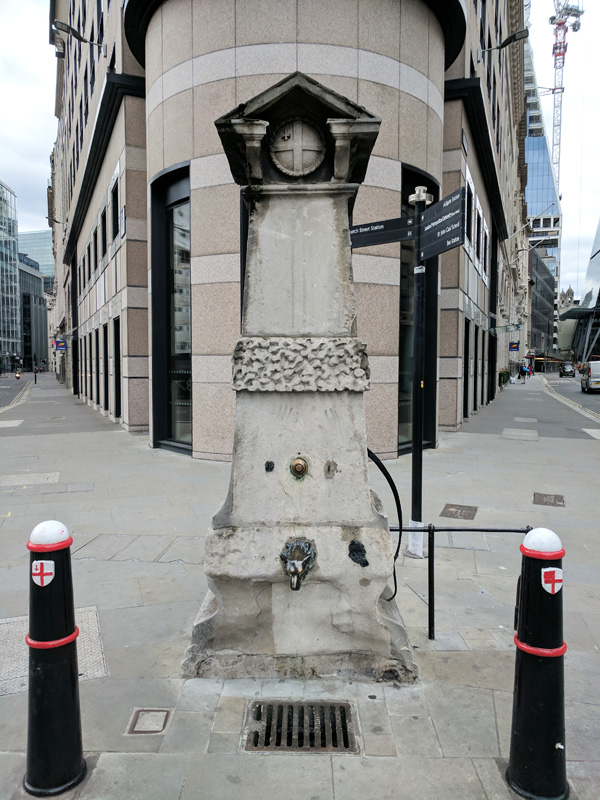
We’re going east again now on Fenchurch Street and at the junction with Leadenhall Street where it turns into Aldgate High Street we find the Aldgate Pump. This historic water pump, which has stood on this spot since 1876, marks the start of the A11 road that eventually leads to Norwich. It’s also considered by many to be the symbolic start of the East End. The wolf’s head is supposed to commemorate the last wolf shot in the City of London though there appears to be no record of when that might have been.

IMG_20170416_131442

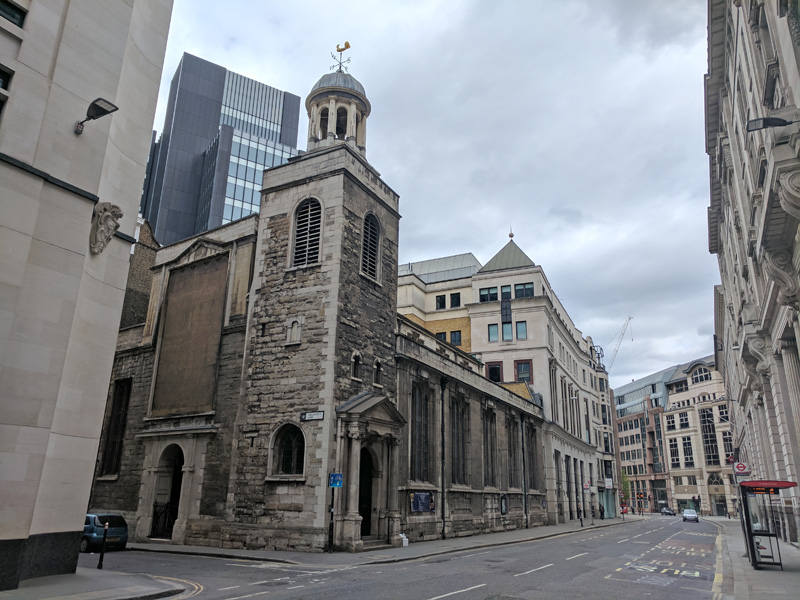
Moving on we make a sharp left into Mitre Street and then cut through St James’s Passage to join Dukes Place. Turn the corner and we’re on to Houndsditch. Head up here as far as Creechurch Lane which we follow back across Dukes Place as far as the junction with Heanage Lane which we take back up to Bevis Marks (which Dukes Place merges into and which gets several mentions in Dickens’s Old Curiosity Shop). From here we take the next right, going north, Goring Street to return to Houndsditch. Turn left then left again down the top section of St Mary Axe to revisit Bevis Marks. Turn south this time and then loop round Bury Street past Cunard Place and back onto the lower stretch of Creechurch Lane. Here on the corner with Leadenhall Street stands the actual Cree Church, the Church of St Katharine Cree to be precise. The church was founded in 1280 and the present building dates from around 1630. It is the only remaining Jacobean church in London having survived both the Great Fire and the Blitz practically unscathed.

IMG_20170416_133106

Crossing over Leadenhall Street we squeeze through the alley known as Fenchurch Buildings and having traversed Fenchurch Street again navigate a couple more alleys in the form of St Katharine’s Row and French Ordinary Court which take us round the back of Fenchurch Street Station and onto Hart Street. Turning west we reach another medieval church that eluded the clutches of the Great Fire, St Olaves. This one dates all the way back to 1450 in its present form (more or less – it wasn’t so lucky in the Blitz and had to be extensively restored after the war). The fabulously macabre entrance to the churchyard was a 1658 addition. The church is dedicated to the patron saint of Norway, King Olaf II and the Norwegian connection continued during and after WW2 when King Haakon VII of Norway worshipped here in exile and then in 1954 presided over the rededication ceremony. Samuel Pepys was buried here in 1703 and it is also, weirdly, recorded as the last resting place of the pantomime character Mother Goose (?). Her internment apparently took place in 1586 according to the parish registers and the event is commemorated by a plaque on the outside of the church.

This slideshow requires JavaScript.

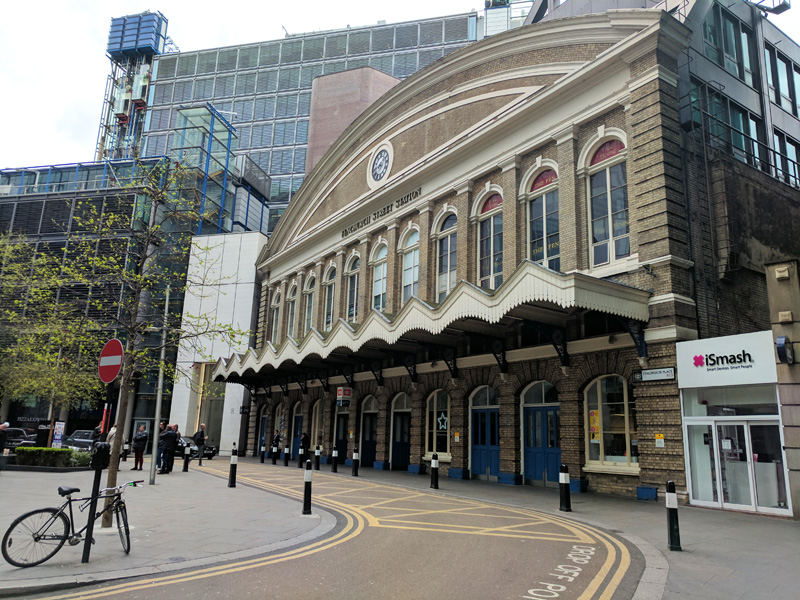
Leaving St Olaves behind we move northward again next, up New London Street into London Street (both doing less than nothing to deserve such names) and round Fenchurch Place to the front of Fenchurch Street Station, gateway to Essex. The station opened in 1841 initially to serve the London and Blackwall Railway but was reconstructed after just 13 years when the London, Tilbury and Southend Railway began operations. It’s one of the smallest termini in London and uniquely has no interchange with the underground.

IMG_20170416_134003

Back on Fenchurch Street we continue west for a bit and then proceed north up Billeter Street resurfacing on Leadenhall Street. Keep the westerly trajectory before turning north again up the bottom-most section of St Mary Axe. On the right here is yet another of the City churches that survived the double whammy of the Great Fire and the Blitz. The present St Andrew Undershaft was built in 1532 in the Perpendicular style (a subdivision of Gothic, so-called because of its fondness for vertical lines). The church’s name derived from the shaft of the maypole that was set up opposite the church – though only until 1547 when it was seized by a mob and destroyed as a “pagan idol” (now that’s a show I’d like to see).

IMG_20170416_134926

Continuing north we arrive at the foot of St Mary Axe’s most famous resident, no. 30 more commonly known as “The Gherkin”.  The Gherkin, designed and engineered by Norman Foster and Partners and the Arup Group respectively, was completed in December 2003 and opened in April 2004. 41 storeys and 180 metres tall, it stands on the site of the former Baltic Exchange which was irretrievably damaged by the IRA bomb of 1992. It has a floor area of just over half a million square feet including a restaurant on the 39th floor. In November 2014 the building was bought by the Safra Group, controlled by the Brazilian billionaire Joseph Safra, for £700m (£150m than the price originally anticipated). The sculpted head you can see below is another work in the Sculpture in the City 2016 series; “Laura” by Jaume Plensa.

This slideshow requires JavaScript.

After a circuit round the base of the Gherkin we meander off to the west again down the dead end that is Undershaft. Doubling back and then turning left down Great St Helens we pass in front of St Helen’s Bishopsgate which, you’ve guessed it, also survived the Great Fire and the Blitz (it’s almost like there was some kind of divine providence at work here). Wasn’t so fortunate when it came to that IRA bomb in 1992 however; that took the roof off and also destroyed one of the City’s largest medieval stained glass windows. The church started out as a priory for Benedictine nuns in the early 13th century and was Shakespeare’s parish church when he lived in the area in the 1590s. The artwork on display outside the church, Shan Hur’s “Broken Pillar #12” has been left in place from the 2015 Sculpture in the City collection.

This slideshow requires JavaScript.

At the end of Great St Helens we emerge onto Bishopsgate and head north towards Liverpool Street station. Final point of interest on today’s journey stands at no.110 bounded on its other three sides by Camomile Street, Outwich Street and Houndsditch. Completed in 2011 the building was originally known as the Heron Tower after its owners Heron International but in 2014 its primary tenant pressed for the name to be changed to the pitifully naff Salesforce Tower. The City of London eventually ruled that it should officially be called simply 110 Bishopsgate. Whatever its name the building stands 230 metres tall (including the 28 metre mast) with 46 floors. It currently holds the record as the City of London’s tallest structure, having eclipsed Tower 42 when construction reached the 44th floor.

Situated on floors 38 and 39, Sushi Samba restaurant is one of the top restaurant destinations for the young, aspiring (and easily impressed) denizens of the Home Counties and for those without a head for heights, the lobby contains a 70,000 litre aquarium.

IMG_20170416_134711

And I think that’s us finally done for this time around (and I really expected this one would reverse the trend for longer and longer posts).


Day 34 – Bishopsgate – Middlesex Street – Finsbury Circus

Today’s walk sees us back east again; first of all south of Spitalfields in the streets taken over by the stalls of Petticoat Lane market then skirting Aldgate before heading back into the City across Bishopsgate and west into Finsbury Circus.

day-34-route

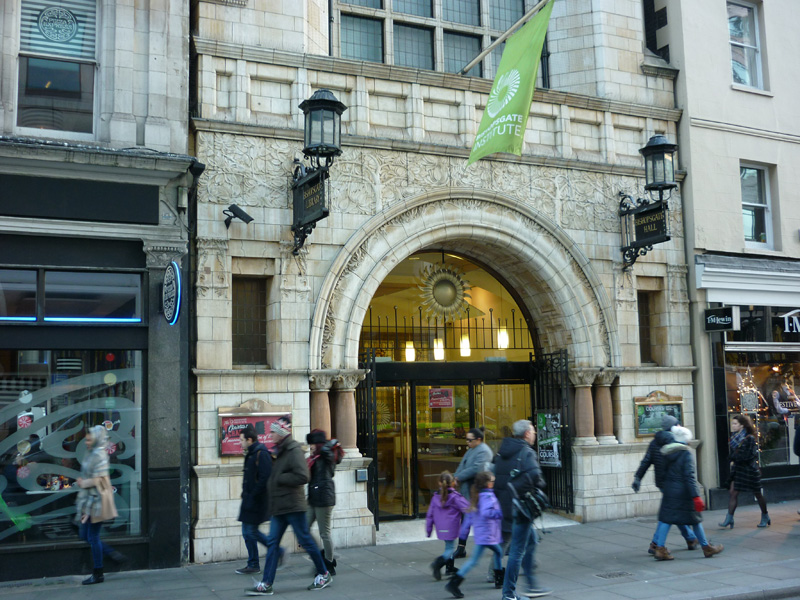
We kick things off on Liverpool Street, which runs south of the eponymous mainline station. This takes us into Bishopsgate where, passing the front entrance of the station and crossing the road, we arrive at the Bishopsgate Institute.  Since the 1st of January 1895, when it was established using funds from charitable endowments made to the parish of St Botolph without Bishopsgate, the Institute has operated as a public library, public hall and meeting place for people living and working in the City of London. The architect behind this now Grade II-listed building with its elements of styles ranging from Byzantine to Art Nouveau was Charles Harrison Townsend (1851-1928). Today, in addition to being a venue for a disparate selection of cultural events, the Institute is best known for its adult education course covering over 120 different subjects.

p1060200

Turning right down Artillery Lane we head into the area between Bishopsgate and Commercial Street which is a twilight mix of the rapidly vanishing old East End and new upscale development. Dip in and out of Brushfield Street (which borders Spitalfields) using Fort Street, Stewart Street and Gun Street before heading further south down Crispin Street. On the east side here is a massive new development on the site of the old Fruit and Wool Exchange, something else we have our old friend Boris Johnson to thank for. On the other side of the street the historic painted signwriting for the Donovan Brothers paper bag making business, which they set up here in the 1830’s, still survives. As does the family business itself though it now operates out of the New Spitalfields Market in Leyton.

p1060202

A couple of doors along is Lilian Knowles House which now provides accommodation for post-graduate students of the LSE and is named after a former Professor of Economic History but was once the Providence Row night refuge for homeless women and children. Anecdotally, it is believed that Jack the Ripper’s final victim, Mary Jane Kelly, lived and worked here – she was found murdered in a nearby alley which no longer exists.

p1060203

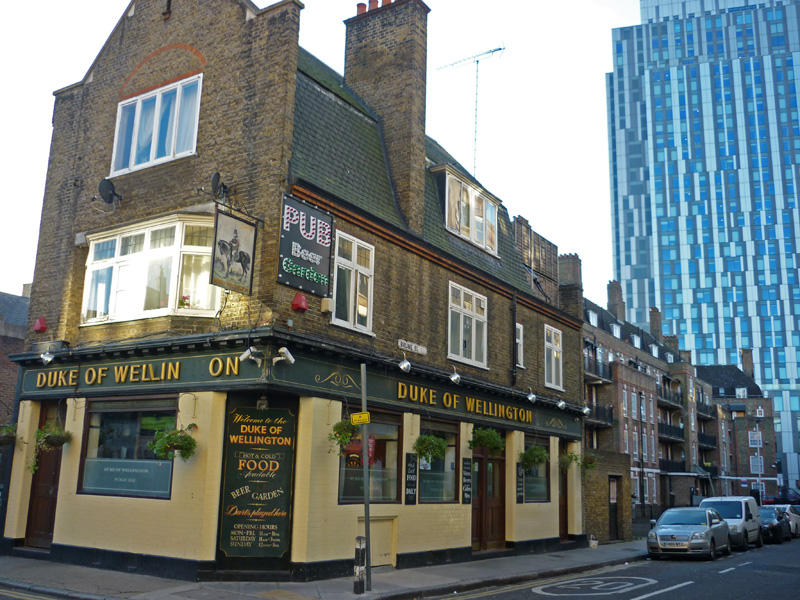
From here we turn east down White’s Row then dip briefly south down Toynbee Street before taking a right into Brune Street. On the corner here is the Duke of Wellington pub which I mention because (a) it’s one of the few pubs in this part of the world that has a beer garden (of sorts), when I worked in the City we would occasionally trek all the way over here in the summer for that reason alone and (b) I’m surprised it’s still here.

p1060205

On the north side of Brune Street is the ceramic-tiled facade of the soup kitchen established here in 1902 to serve impoverished members of the local Jewish community. Amazingly, the facility existed right up until 1992. In earlier times it was providing groceries to up to 1,500 people a day.

p1060206

After a quick visit to Tenter Ground, at the end of Brune Street we turn left down Bell Lane then right into Cobb Street and right again into Leyden Street. On the bend where this turns into Strype Street is tucked away the 1938-built Brody House, a rare surviving example of thirties architecture in this part of town. The street itself was named after the clergyman and historian John Strype (1643 – 1737 good innings !) who in 1720 produced a new survey of London which revised and expanded the pre-Great Fire original by John Stowe (1525 – 1605) published in 1598.

Next we’re out onto Middlesex Street and bang in the midst of Petticoat Lane Market. There has been a clothing market here, in the heart of the area that has been home to the various iterations of the garment industry for centuries, since the mid 1700’s. And the name of the market has endured even though the street ceased to be called Peticote (or Petticotte) Lane in the reign of William IV c.1830. Today the Middlesex Street section of the market is only open on Sundays (this walk took place on a Sunday) whereas the Wentworth Street stalls are in situ six days a week. It’s still predominantly clothing up for sale and the majority of vendors and customers these days are drawn from the local Bangladeshi community. It’s remains a vibrant place but (and it’s hard to avoid being snotty about it) the merchandise on offer is basically an ocean of tat.

This slideshow requires JavaScript.

Check in on the remaining section of Cobb Street then navigate the Wentworth Street section of the market before turning northward into Toynbee Street with its unkempt charms and note of blind faith (see left side of top right photo).

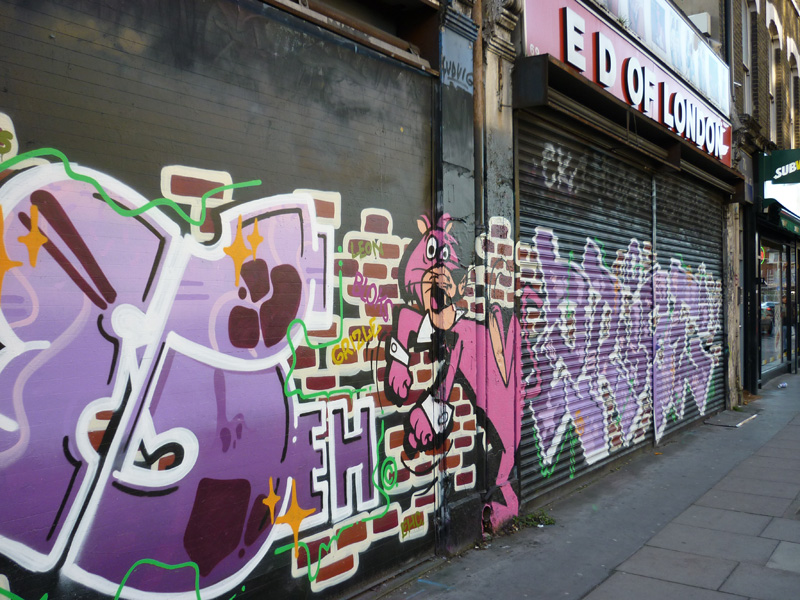
At the apex with Commercial Street we turn south again past a welcome nostalgia tug in the form of a graffiti-ed Snagglepuss. Out of the same Hanna Barbera stable as Yogi Bear, Snagglepuss actually appeared first in the Quick Draw McGraw Cartoon Show in 1959 (so he’s precisely the same vintage as me). “Heavens to Murgatroyd!”

p1060220

Turn back into Wentworth Street and then continue south towards Aldgate East via Old Castle Street, Pommel Way and Tyne Street. On the former is a vestige of the Public Wash House that was completed in 1846 and construction of which therefore started prior to the passing of the Baths and Washhouses Act by parliament in the same year. That was down to the “Committee for Promoting the Establishment of Baths and Wash-Houses for the Labouring Classes” founded in 1844 under Robert Cotton, the then Governor of the Bank of England.

p1060224

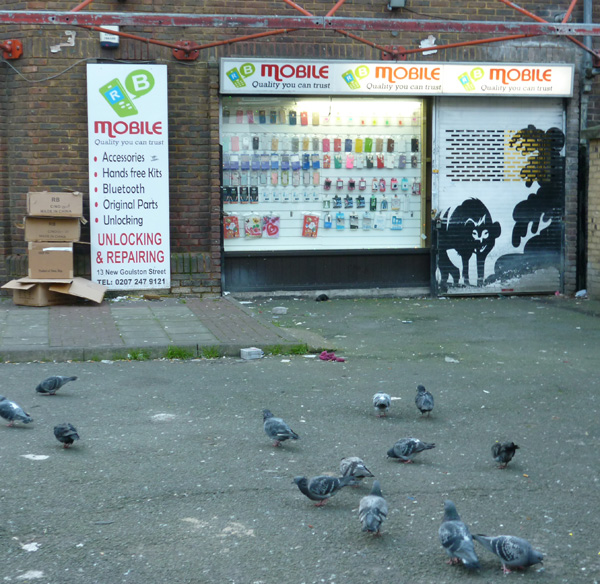
Moving on we head back towards the market up Goulston Street where these pigeons seem blissfully unaware of the danger lurking in the background;

p1060225

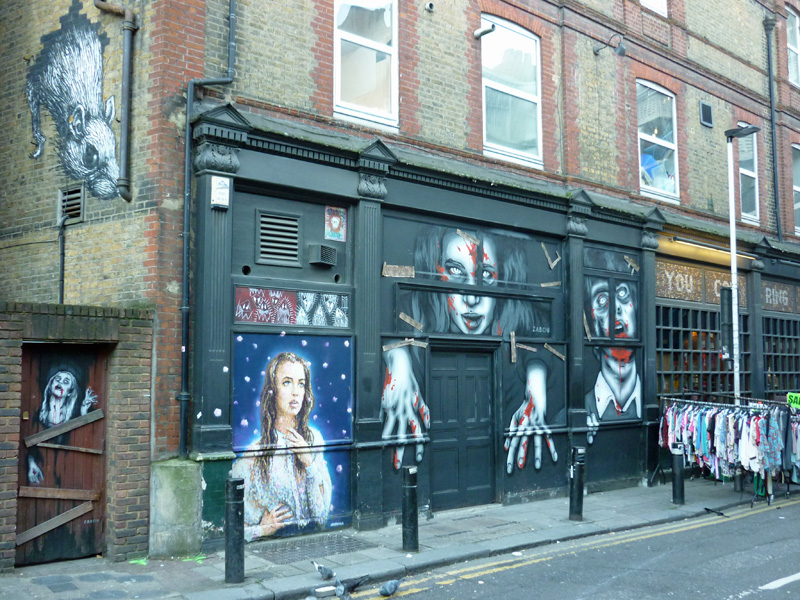
before cutting west down New Goulston Street which has some more striking street art. The rat crawling out of the brickwork is by graffiti artist ROA, and the horror themed building facade was created by Zabou specifically for Halloween 2016.

p1060226

Then we’re back on Middlesex Street again and turning south down towards Aldgate again we stop in the shadow of this condemned sixties’ block and turn the corner into St Botolph Street. St Botolph, the patron saint of wayfarers, lived and founded a monastery in East Anglia in the 7th century. Unusually for a Saint he lived to a ripe old age and died of natural causes.

p1060227

Nothing special about this other than the fact that it’s pretty much the last man standing in terms of the post-war concrete boxes round here being demolished and their sites redeveloped. Next up, in rapid succession, we traverse Stoney Lane, White Kennett Street (named after an 18th century Bishop of Peterborough), Gravel Lane and Harrow Place. This funky fire escape brings the next pause for breath at the end of Clothier St cul-de-sac.

p1060228

Cutler Street, which was once the site of the largest tea warehouse in the city, leads into Devonshire Square. Rather confusingly this is both the name of the road feeding into and the original Georgian square itself and also the name of the mammoth 2006 office, retail and residential redevelopment of the Cutler Gardens Estate (land owned by the East India Company back in the day). Even further back than that, the end of the 10th century in fact, the land was supposedly given by King Edgar to thirteen of his knights on condition of them each performing three duels; one on land, one below ground and one on water. Sounds pretty apocryphal to me but the creator of this work on the edge of one of the courtyards was obviously a believer.

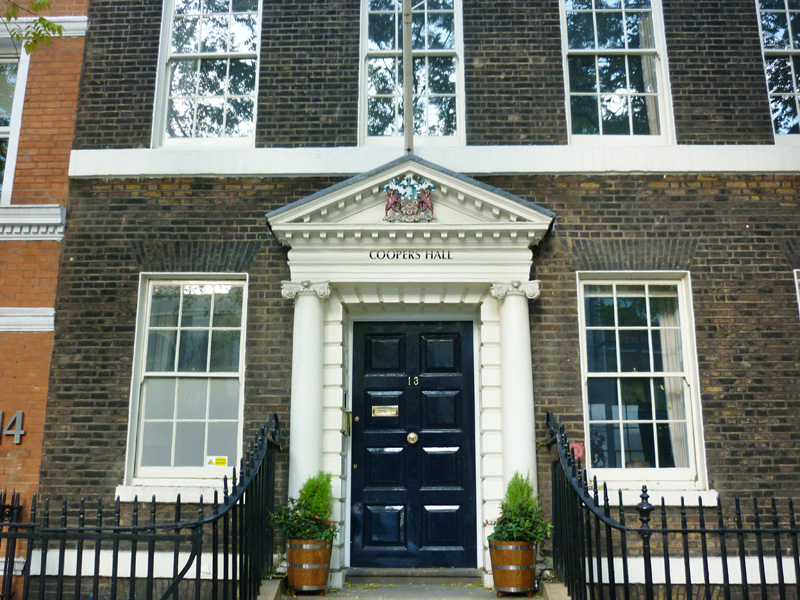
The original square is the site of Coopers Hall home to the smallest of the London Livery Companies, The Worshipful Company of Coopers. The origins of this Company go back to the 11th century, barrel-making being one of the oldest of all the trades I guess. Not one of the most highly respected though unfortunately; apparently there is a hierarchy of Livery Companies and the Coopers only rank 36th.

p1060233

From the square we loop round Barbon Alley and Cavendish Court to arrive in Devonshire Row which takes us back into Bishopsgate. On the way the spaces created by impending new developments allow for some interesting views of the ones that have recently been completed.

Turn north on Bishopsgate then east along New Street which dog-legs left and then merges into Cock Hill. At the top here we turn left into the highly insalubrious Catherine Wheel Alley which snakes back to Bishopsgate. This is named after the Catherine Wheel pub, which was reputedly the haunt of notorious highwayman thief Dick Turpin, and stood for more than 300 years before it was demolished in 1911. The name of the pub derives from the instrument of torturous execution linked with the martyrdom of Saint Catherine of Alexandria in the 4th century. Consequently, the name of the alley was briefly changed at one point to Cat and Wheel Alley in order to placate Puritans who objected to the association of a filthy, crime-ridden alley with a martyred saint.

p1060237

Swiftly moving on, we finish off the rest of Middlesex Street then do a circuit of Sandy’s Row, Frying Pan Alley and Widegate Street before returning once more to Bishopsgate. Frying Pan Alley, perhaps unremarkably, gets its name because it once housed a shop selling pots and pans that had a huge cast iron frying pan suspended from chains as its sign.

We’re crossing over Bishopsgate next and heading south past Liverpool Street Station again. We turn right into Bishopsgate Churchyard which actually runs through the churchyard of the Church of St Botolph without Bishopsgate. As is so often the case it seems, the presence of a church on this site dates back to Saxon age. The original Saxon church was replaced twice, with the third version even surviving the Great Fire, before that was demolished in 1725, and the present church was completed four years later to the designs of James Gould, under the supervision of George Dance (the Elder). It is aisled and galleried in the classic style, and is unique among the City churches in having its tower at the East End, with the chancel underneath. Having got through WWII with the loss of just one window, the church fared less well during the IRA bombing campaign of the early 1990’s. The explosion on 24 April 1993 opened a hole in the roof and took out all the doors and windows. It was three and half years before the church was returned to its former state.

St Botolph’s was the first of the City burial grounds to be converted into a public garden. At the time this was strongly opposed but today it is treated as a welcome place of retreat from the bustle of the City. For the more energetic there is also a netball and tennis court there now.  The church garden also hosts St. Botolph’s Hall, once used as an infants’ school, but now a multipurpose church hall available for hire. Either side of its front entrance stand a pair of Coade stone figures of a schoolboy and girl in early nineteenth century costumes and nearby is the tomb of Sir William Rawlins, Sherriff of London in 1801 and a benefactor of the church.

The free standing partially-opened door you can see in the photos below is the work “Ajar” by Gavin Turk, erected in 2011 as part of the Sculpture in the City programme.


This slideshow requires JavaScript.

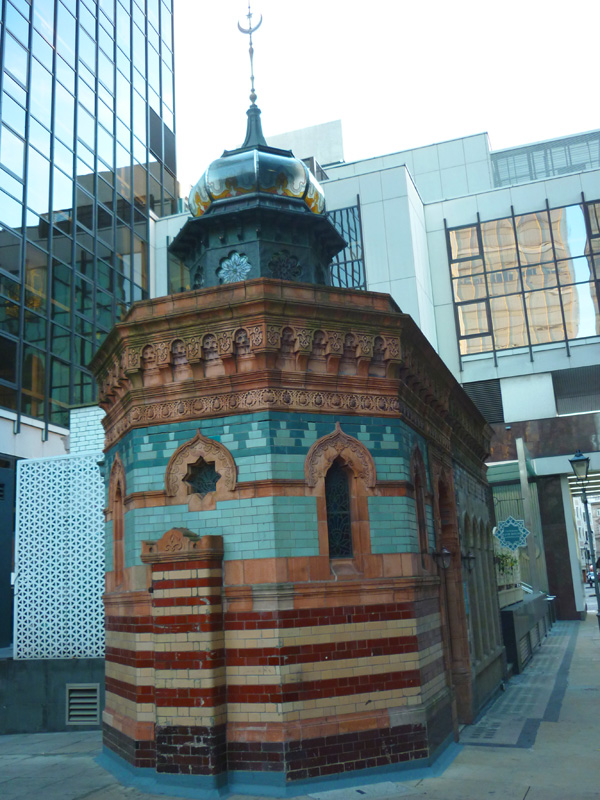
Just beyond the churchyard is one of the most striking buildings in the City, the Turkish Bathhouse built by Henry and James Forder Nevill in 1895. The baths themselves were underneath the Moorish-style kiosk you see below; which as well as being the entrance originally housed water tanks. The baths were open from seven in the morning until nine at night and  a ‘plain hot-air bath, with shower’ cost 3/6d (17.5p in new money) and the ‘complete process’ 4/- (with reduced prices after 6pm). Also available were perfumed vapour, Russian vapour, Vichy, and sulphur vapour baths. There were scented showers, together with ascending, descending and spinal douches. Sounds terrifying. The baths closed in 1954 and the building was used for storage up to the 1970’s when it was converted into a restaurant for the first time. It is currently an events venue, catering for up to 150 guests at a time (it has a lot in common with the Tardis).

p1060246

The adjacent pub has outside TV screens for the convenience of its smoker clientele so I was able to freeze my nuts off watching the last 15 minutes of Bournemouth 4 Liverpool 3.
p1060247


Hurrying on (to try and thaw out) I emerge onto Old Broad Street turn right up to Liverpool Street then back down Blomfield Street to New Broad Street (which completes the loop back to its Old namesake). New Broad Street, with its masonry-faced late Victorian and Edwardian blocks on either side, is a designated conservation area and no-through road. In the distance is the Heron Tower, one of the new mega-skyscrapers constructed in the City since the turn of the millennium. More of that another time.

p1060248

Turn right on Old Broad Street this time down to London Wall and then head west past All-Hallows-on-the-Wall church. This one also traces its origins back to the 12th century when a church was built here on a bastion of the old Roman wall. The current church was built in 1767, again replacing one which had survived the Great Fire only to fall into dereliction. The new build was the work of George Dance the Younger (son of the George Dance associated with St Botolph’s).

p1060249

Back up Blomfied Street and a swing to the left and we arrive at our final destination of the day, Finsbury Circus. The circus was created in 1815-17, following demolition of the second iteration of the Bethlem Hospital that previously stood on the site, with central gardens, including a sweep of lime trees, also designed by the junior George Dance. None of the original early 19th century houses survive, all having been replaced by offices. Several of those replacement buildings are listed including Lutyens House (Nos.1-6 Finsbury Square), designed by Sir Edwin Lutyens, 1924-7 (listed grade II*); London Wall Buildings (No.25), designed by Gunton and Gunton, 1901 (listed grade II); and Salisbury House (No.31), designed by Davis and Emmanuel, 1901 (listed grade II). Salisbury House is now yet another upscale hotel. Up until recent times the centre of the gardens was occupied by a bowling green of 1925 vintage and a pavilion built in 1968, when the bowling green was enlarged, as a bowling pavilion and wine bar, to the south. To the west of the bowling green was a bandstand that was erected in 1955 and restored in the 1990s. Whether any of this remains now is extremely moot since the gardens were commandeered for the construction of a 42m deep temporary shaft to provide access for construction of the additional Crossrail station at Liverpool Street. Just as I was thinking I might have to consider taking up Lawn Green Bowls in the not too distant future.

This slideshow requires JavaScript.