Day 85 – Jamaica Road – Spa Road – St James’s Road – Southwark Park Road

South of the river once more for today’s outing, but only just. We’re east of Tower Bridge in Bermondsey, exploring the highs and lows of the area between Southwark Park Road and the Thames; an area intersected by both the Jamaica Road and the Kent-bound rail lines out of London Bridge. In common with the other parts of South London visited recently this locale is heavy on public housing estates but unlike them it still has a wide selection of functioning pubs. The weather was warmer than I had dressed for and I had added to the usual navigational challenge by employing a map that was at least 15 years out of date. (The one below is not much better but at least handy if you need to know where the EV charging points are).
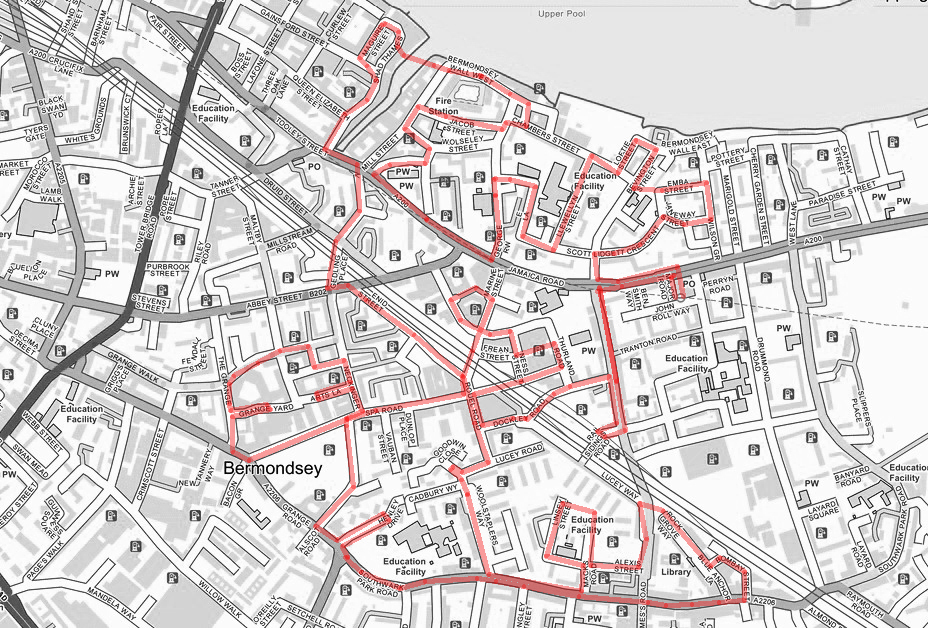
We kick things off by heading west on Jamaica Road from Bermondsey Tube Station past Major Road (which seriously belies its name) and Ben Smith Way. As we turn south onto St James’s Road we pass the first of those pubs I mentioned, the inter-war mock-Tudor style Gregorian.
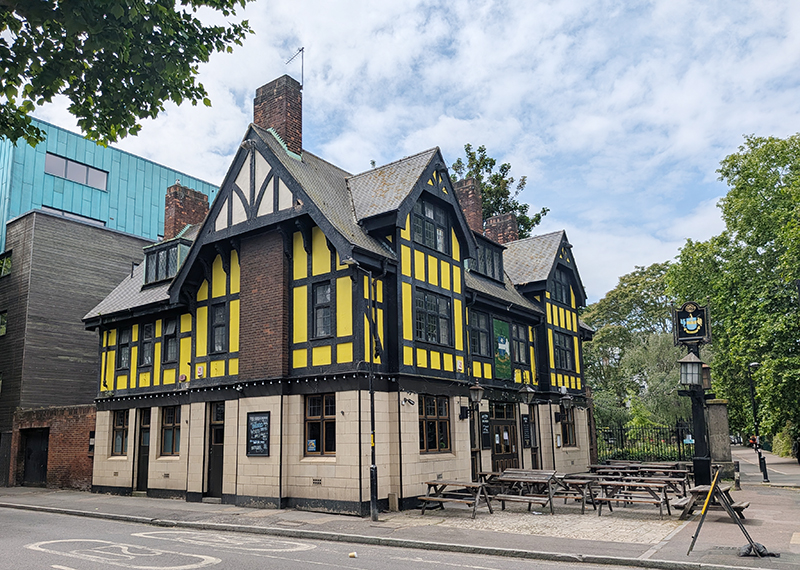
Further up the road just before we reach the railway is the St James of Bermondsey which dates back to around 1870. This one-time Watneys pub was done up and renamed (from the St James Tavern) in 2014. It’s changed hands a couple of times since then including a brief ownership by one of the breweries on the so-called Bermondsey Beer Mile. That informal collection of microbreweries and taprooms alongside the railway viaduct roughly covers the distance from Tower Bridge Road to St James’s Road.
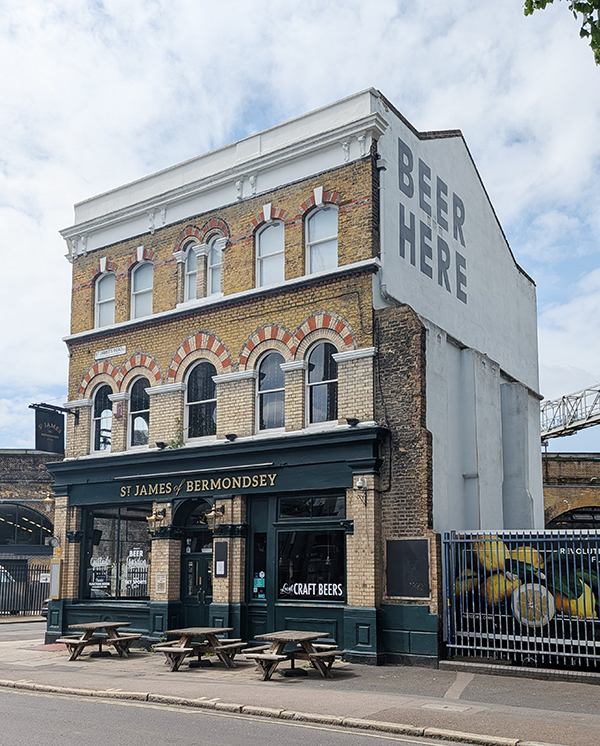
Railway Sidings Road is the first of many routes under the viaduct taken during the course of today. This viaduct is one of a series of nineteen brick railway viaducts between London Bridge station and Deptford Creek, which together make a single structure 3.45 miles in length. The structure carries the former London and Greenwich Railway (L&GR) line and consists of 851 semi-circular arches, the longest run of arches in Britain.
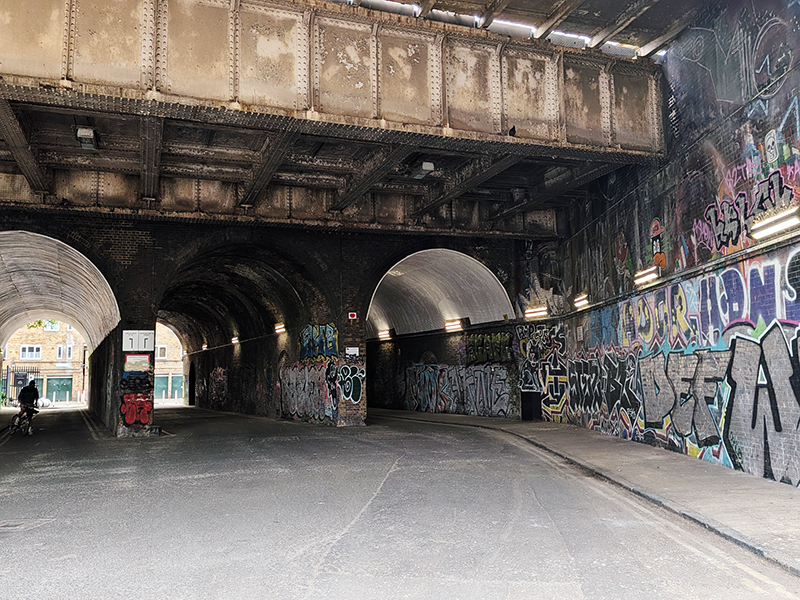
We don’t carry on having reached the other side however. Instead we double back and follow Dockley Road beneath the rails.
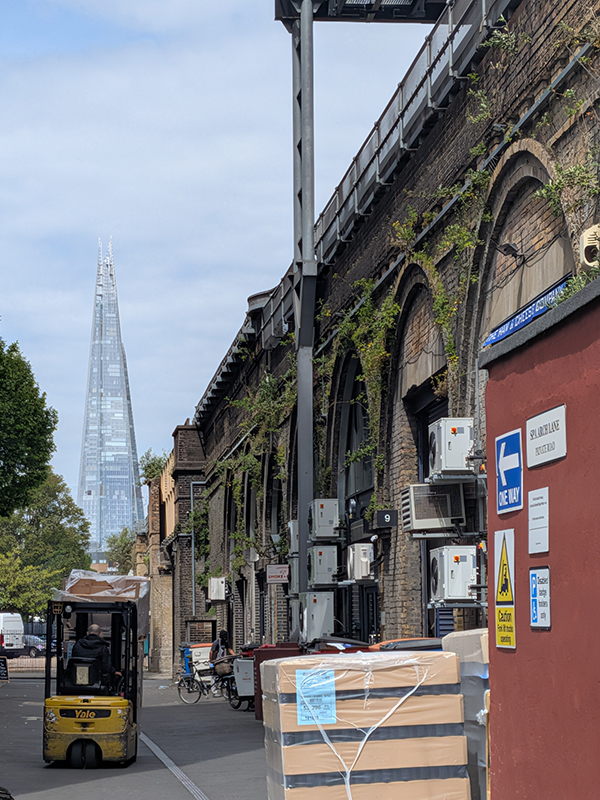
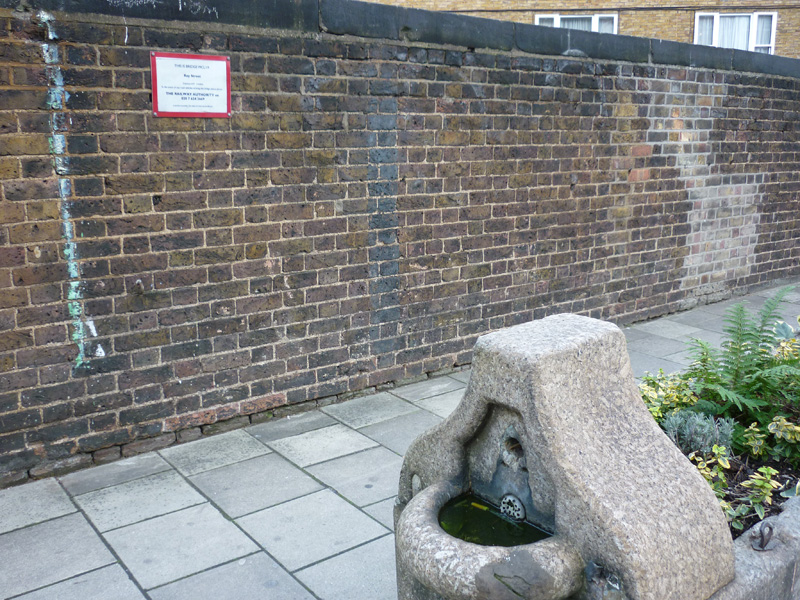
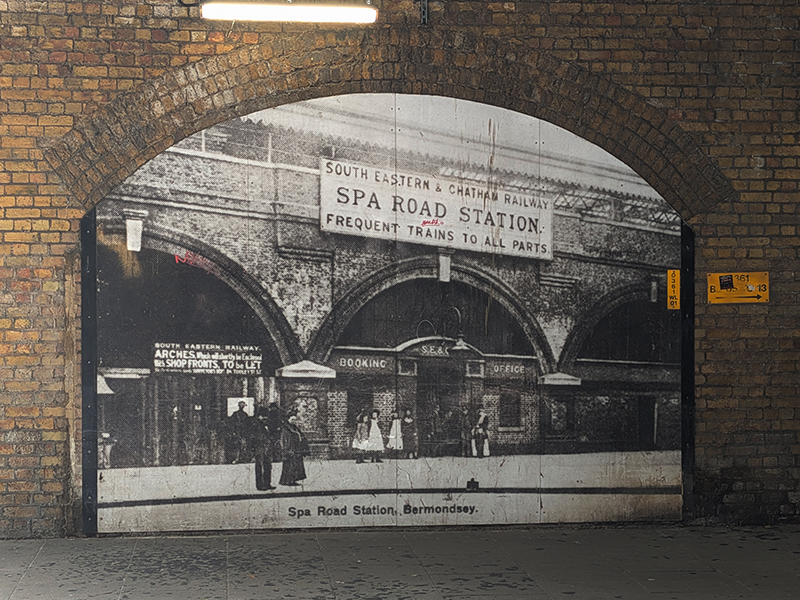
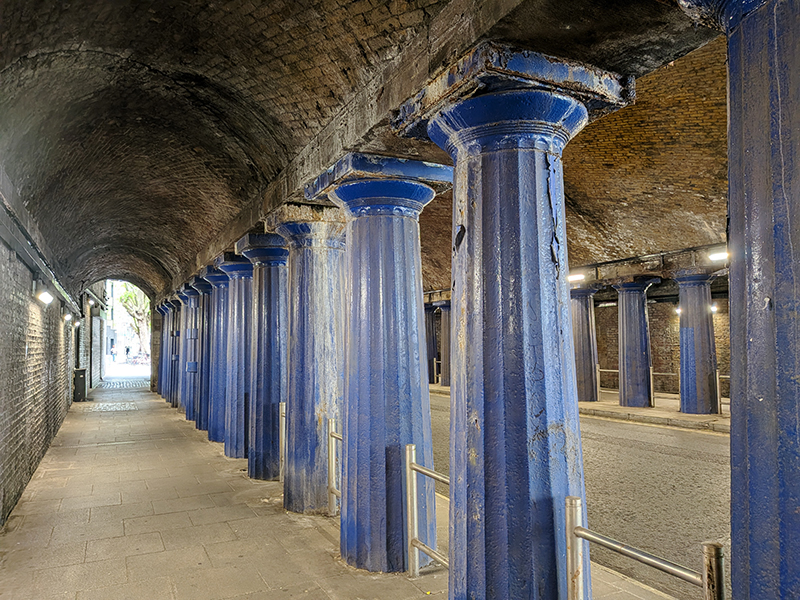
On Rouel Road we turn right down to Spa Road and make a return visit under the viaduct. As attested by the blown-up photograph mural beneath the bridge, this was once the site of Spa Road station the original terminus of the L&GR, the capital’s first railway. Opened in 1836, the station underwent several ownership changes, was rebuilt, changed its name, and relocated before closing in 1915 due to cost-saving measures during World War I. The tunnel is still supported by the original blue painted cast iron columns that line either side of the roadway.
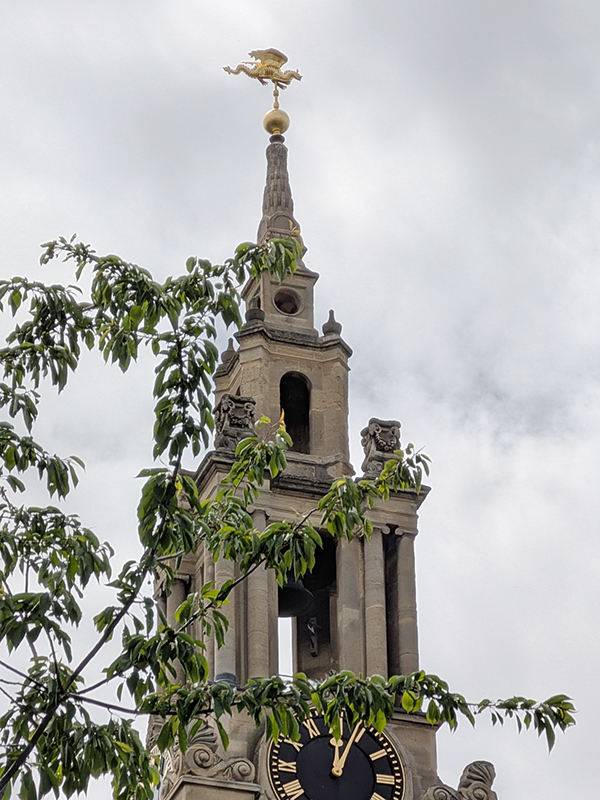
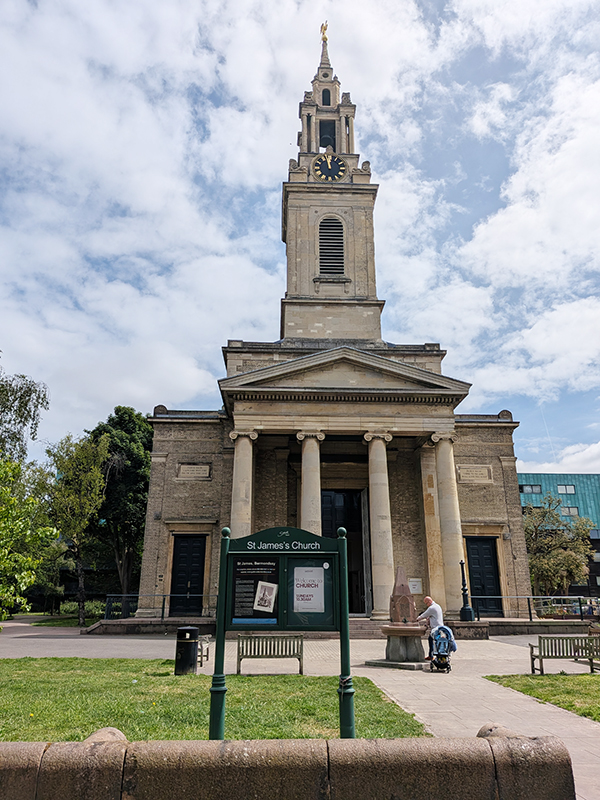
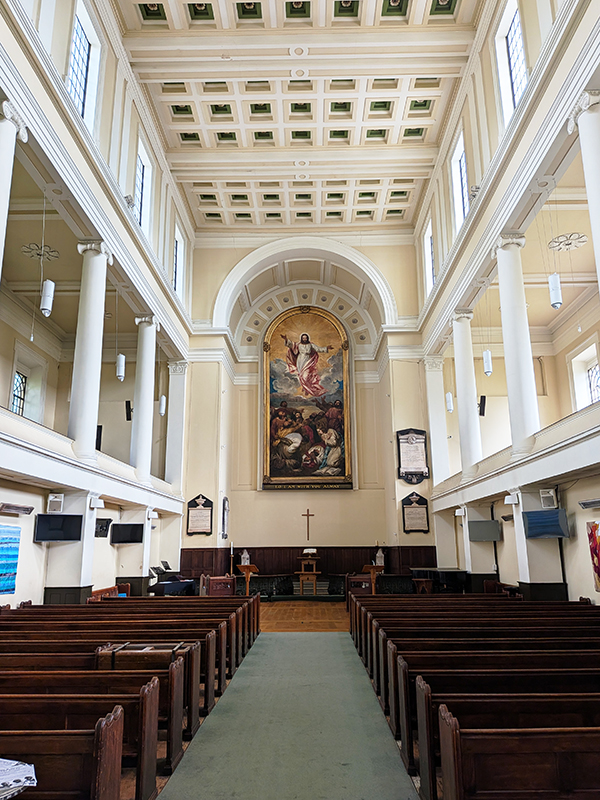
We look in on Ness Street then continue east to Thurland Road off of which stands St James Anglican Church. After the Battle of Waterloo a Commission was set up to build churches as a means of giving thanks and commemorating the victory. A sum of £1m was initially granted for their construction, in Acts of 1818 and 1824. South London secured seven of these so-called Waterloo Churches and group of Bermondsey churchmen successfully lobbied for a grant to build one of those seven having acquired the land on which St James was built. James Savage, the architect, modelled the church on the style of Greek Temples with galleries round three sides and the organ in the west. The bells were cast by the famous foundry of Mears of Whitechapel, from cannon left behind by Napoleon at Waterloo and a four-faced striking clock, costing £160, was put in the tower. The church was consecrated in 1829.
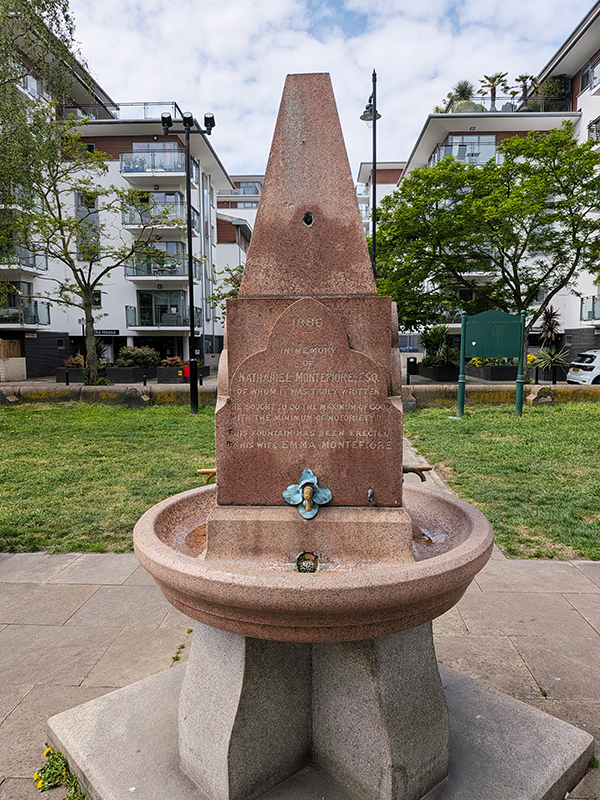
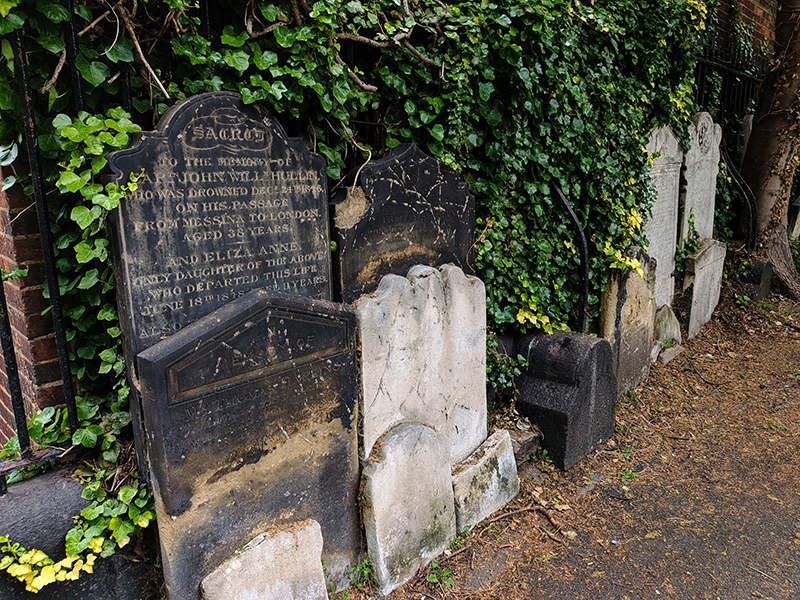
Sadly, I have been unable to find any further information about the death by drowning of a Captain John Hullin on Christmas Eve 1846, as recorded on one of the gravestones piled up at the back of the churchyard. There is no record of a shipwreck on that date although the straits of Messina (between Sicily and the Italian mainland) are known for their jeopardy. The Nathaniel Montefiore (1`819 – 1883), commemorated by the drinking fountain was a surgeon and philanthropist who practised at Guy’s Hospital. He died of a cold caught while attending a funeral in Berlin ( I suspect that wasn’t the inspiration for the Len Deighton novel).

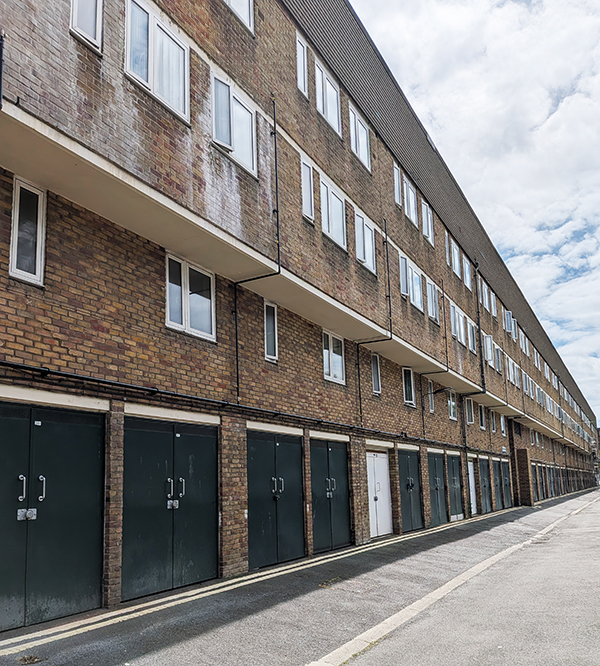
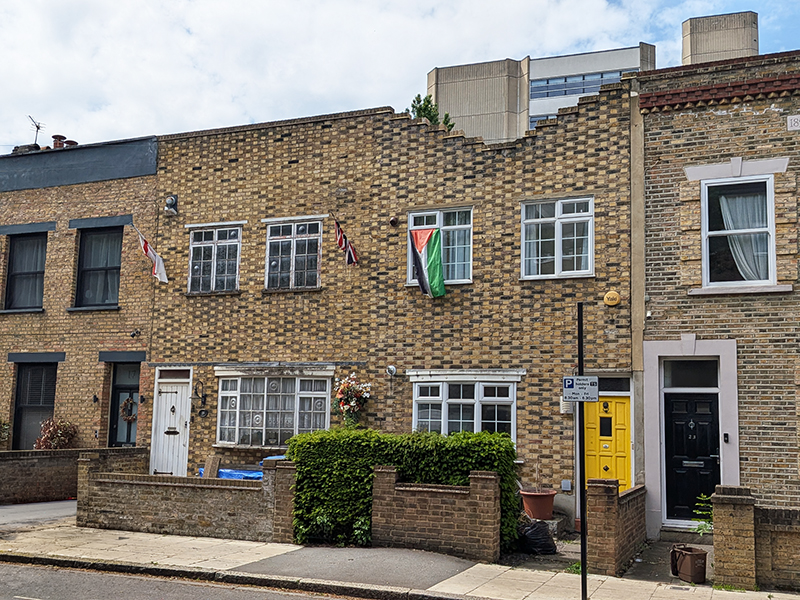
After leaving the grounds of the church we follow Frean Street (named for the Peak Frean biscuit factory that once existed nearby), Sun Passage, Old Jamaica Road and Marine Street back under the railway to Rouel Road. Heading south via Lucey Road and Yalding Road takes us past part of the Rouel Road Estate which is a particularly unlovely example of post-war public housing. In fact most of the housing estates in this area suffer in comparison with those encountered elsewhere in South London (so far at any rate). More England flags round here than I’ve been used to seeing as well; including this unlikely juxtaposition.
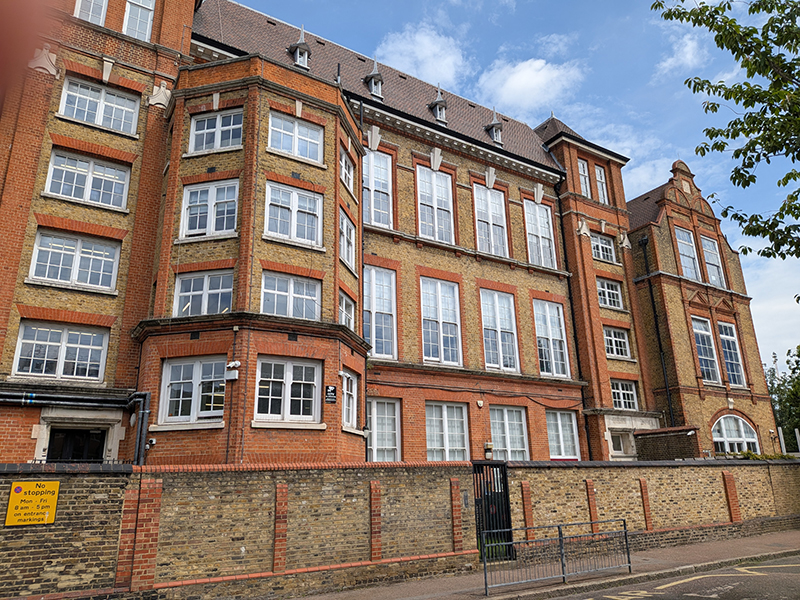
Arriving on Southwark Park Road we make our way east as far as Linsey Street which runs north into Alexis Street where we find the original school building of St James CofE Primary. This was constructed in 1877 as a London School Board facility and designed by the renowned architect E.R. Robson as part of the LSB’s massive push to educate inner-London children. Known affectionately as a “three-decker,” its classic Victorian layout stacked infants on the ground floor, junior girls on the first floor, and junior boys on the second. Nowadays, the building supplements the school’s main campus which is off Old Jamaica Road.
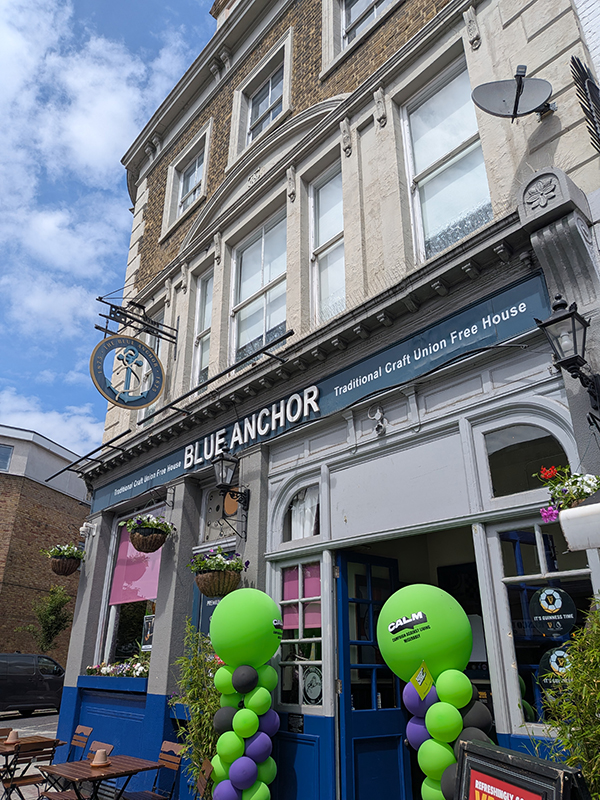
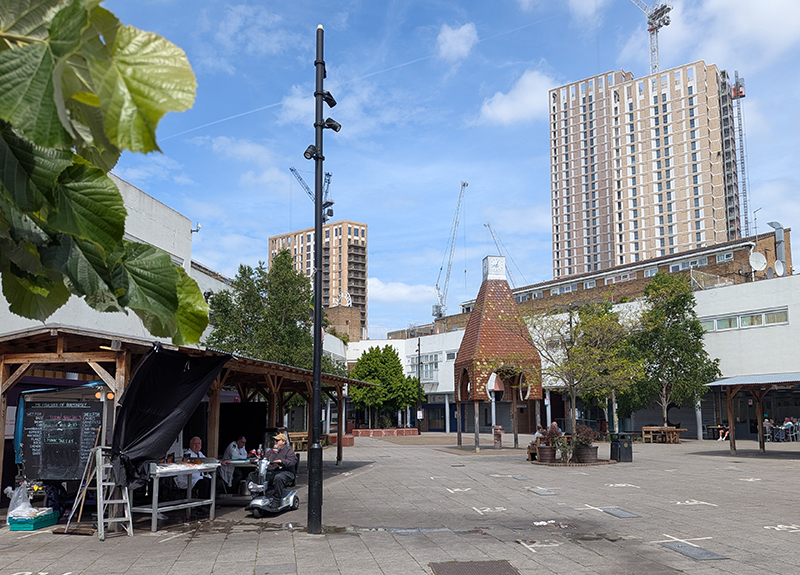
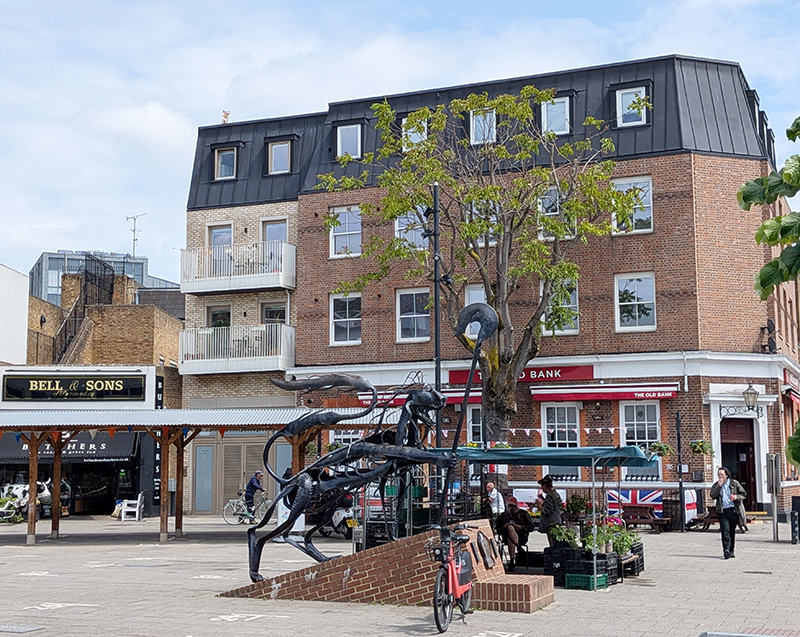
We round the corner into Macks Road then cut across the Rouel Road community garden to the top end of St James’s Road from here we make our way back to Southwark Park Road via Blue Anchor Lane and Bombay Street. As we make the return journey east we pass the Blue Anchor pub, the current incarnation of which has stood here since 1878. Prior to that the site was host to a “Blew Anchor” tavern as far back as at least 1695. Just beyond The Blue Anchor lies the Blue Market which has existed here for well over a hundred and fifty years; originally lining Southwark Park Road but moved to this purpose built square in 1976. Following regeneration in 2011 one of the access points, Hannah Orchard Walk, was named after a lady who worked in the market for more than eight decades starting in 1921. Despite the plaque proclaiming that the funding from the Mayor of London is “promoting a better and more prosperous London” reality doesn’t really bear that out. The market has room for 24 stallholders but there are reportedly only around 10 here on a regular basis and on this Thursday “Mr Fish Sole of Bermondsey” is holding the fort on his own. The pub on the square, The Old Bank, which is festooned with rather more flags of St George than warranted by the impending World Cup, is apparently popular with Millwall supporters (coincidence I’m sure). The statue, a representation of the Bermondsey Lion was created by Kevin Boys for Southwark Council and in 2011.
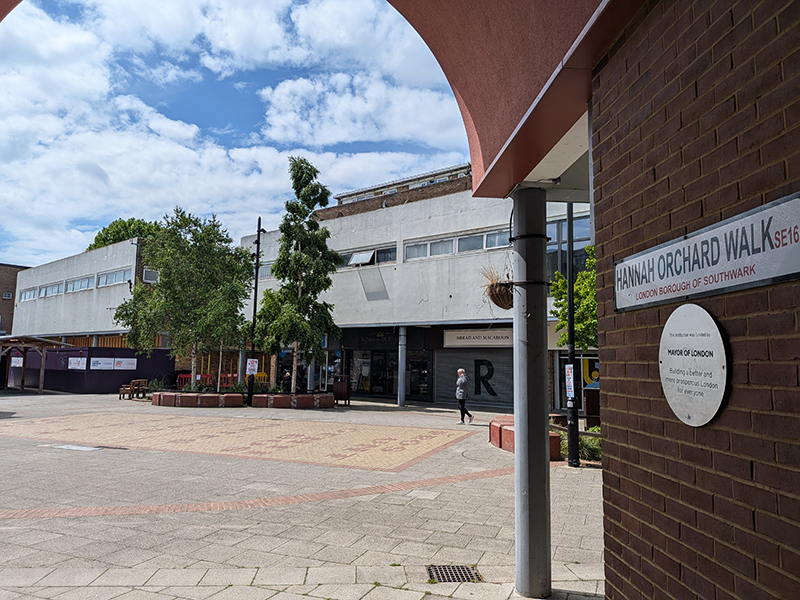
Back in the day it was was said that you could buy anything Down the Blue’ and by fair means or foul, goods bound for the local factories found their way to the Blue Market, drawing legions of eager shoppers to the area. To a rather lesser extent the first part of that could be said to still hold true today.
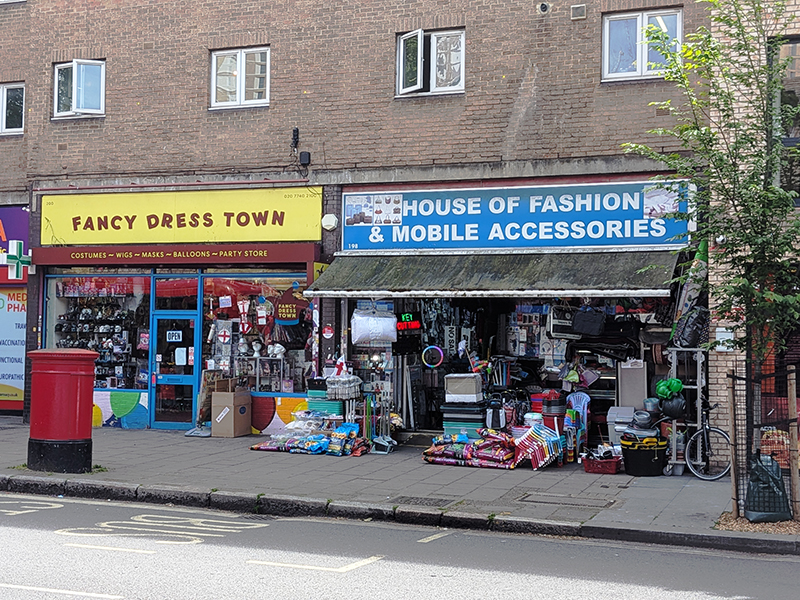
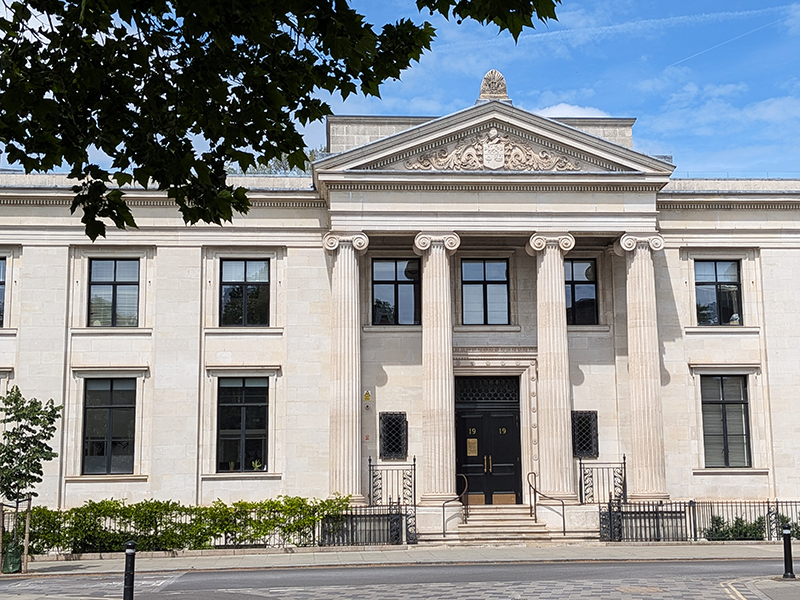
It’s a bit of a trek back along Southwark Park Road before, notwithstanding a detour into Henley Drive, we finally turn north again on Alscot Road which runs alongside Bermondsey Spa Gardens before hitting Spa Road opposite the former Bermondsey Town Hall. Built on the site previously occupied by Bermondsey Public Baths. The building was designed by Henry Tansley in the Greek Revival style and completed in 1930. The design involved a symmetrical main frontage with nine bays; the central section including a large three-bay, full-height, tetrastyle Ionic order portico. Internally, the main atrium on the ground floor featured a grand staircase and Doric order marble columns which supported an elliptical landing on the first floor and an elliptical domed ceiling above. The new building took over the role of headquarters of the Metropolitan Borough of Bermondsey during WWII but ceased to be the local seat of government when the enlarged London Borough of Southwark was formed in 1965. The Grade II listed building continued to be used as additional workspace by Southwark Council until 2010 before being converted into a block of apartments known as “Bath House Lofts” in 2014.
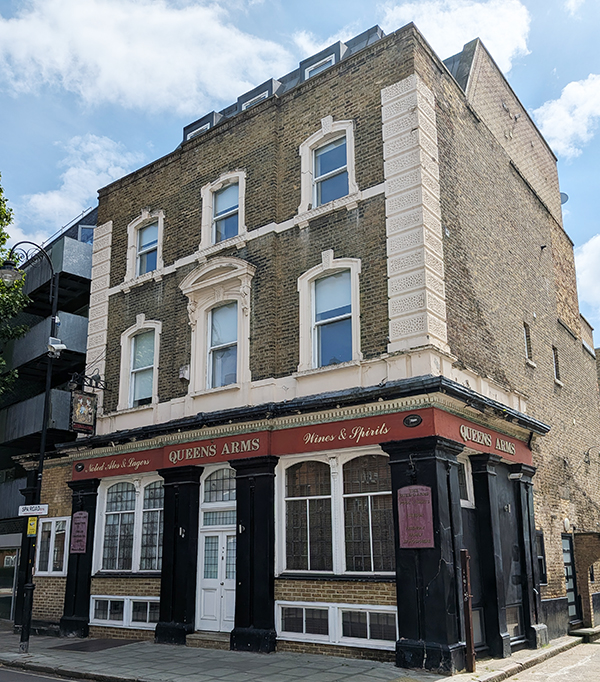
According to CAMRA, The Queens Arms, a short way to the east on Spa Road was converted into flats in 2016. If so, nothing has been done to disguise its pubbiness, which dates back to the early 19th century.
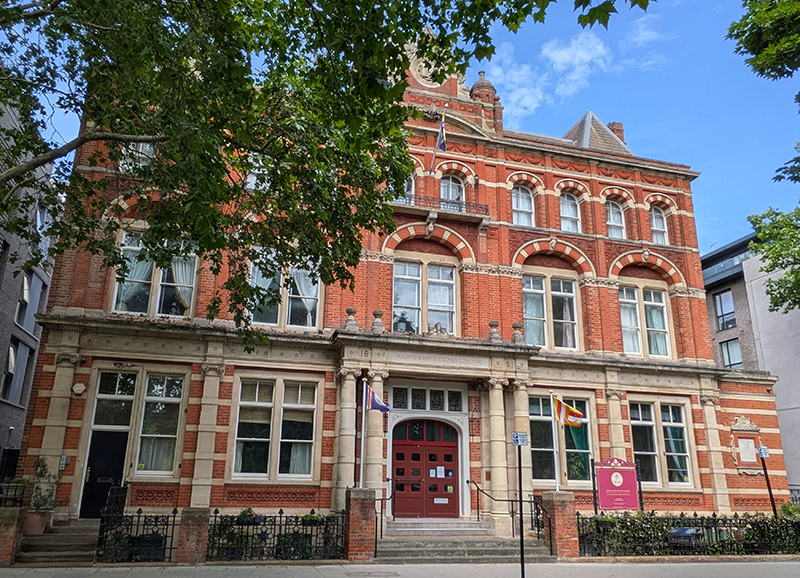
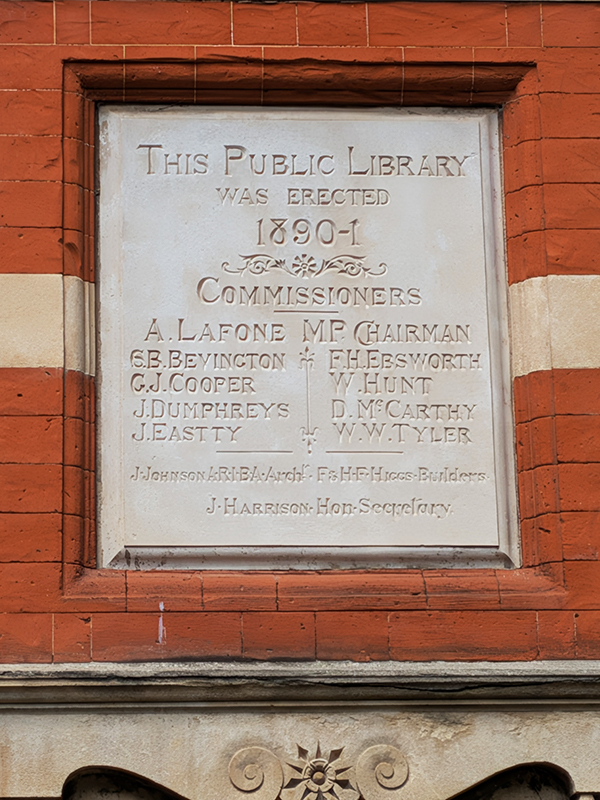
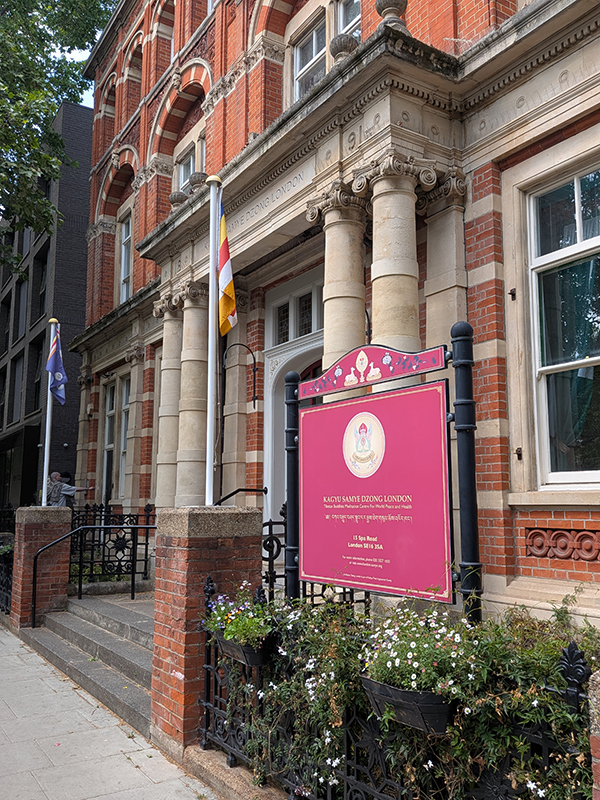
From here we make a circuit westward involving Neckinger, Grange Walk and The Grange to bring us back to Spa Road at its western end. En route we also take in several streets threaded through a development more recent than the map I was working from – Arts Lane, Limasol Street, Bakery Street and Woodmill Street. Just up from the old Town Hall is the original Bermondsey Public Library, also Grade II listed. This was built 1890-91 and was the work of John Johnson, architect and F and H Higgs, builders. It is in Flemish bond (a traditional bricklaying pattern created by alternating headers – the short end of the brick and stretchers – the long side within the same course) with terracotta and stone trim.  This was one of the first free public libraries in London and remained operational as such until the 1980s after which it was used as office space by London Borough of Southwark. In 2009 it was sold to the Kagyu Samze Dzong London Buddhist community to be used as a Tibetan Buddhist Meditation Centre for World Peace & Health.
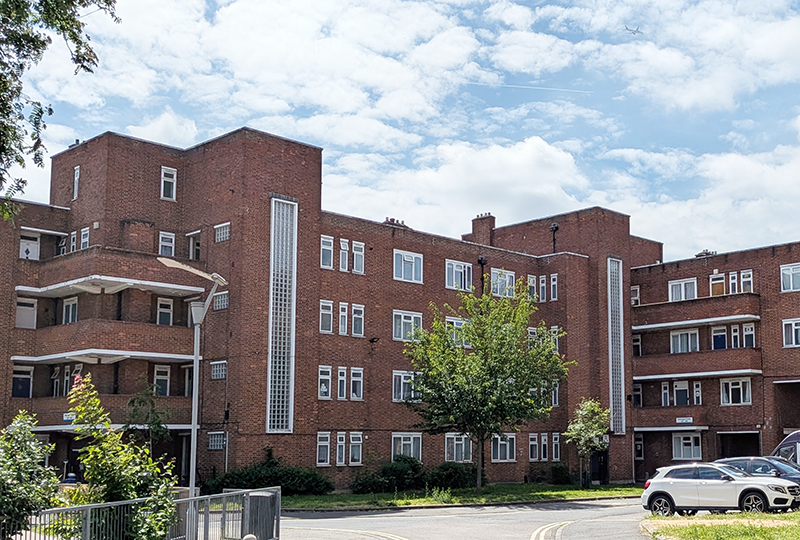
Having covered the full extent of Spa Road we follow Enid Street southwest alongside the railway viaduct again, a stretch that is one of the main components of the Bermondsey Beer Mile. On the other side of the street lies the Neckinger Estate. The estate was built in 1938 by the Bermondsey Borough Council to provide affordable housing for local workers and occupies the site of historic tanneries and the 18th-century Neckinger Mills. It gets its name from the River Neckinger, a tidal tributary of the Thames, the remains of which are subterranean apart from the final few hundred metres that flow into St Saviours Dock (see further on).
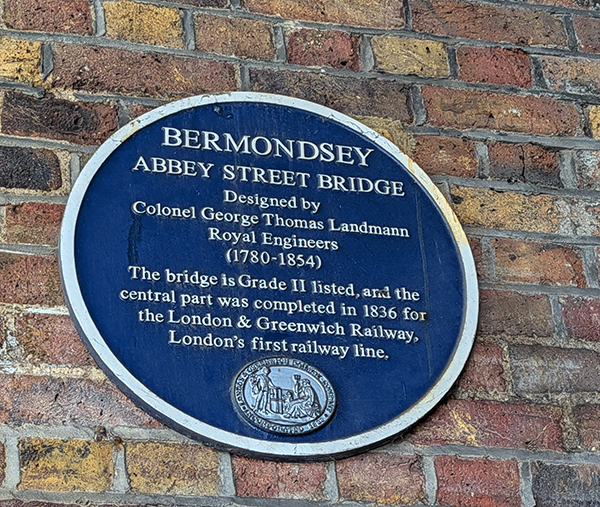
At the end of Enid Street we emerge onto Abbey Street at the southern entrance to the tunnel underneath the Abbey Street Bridge, another of those that were built in 1836 to carry the London and Greenwich Railway.
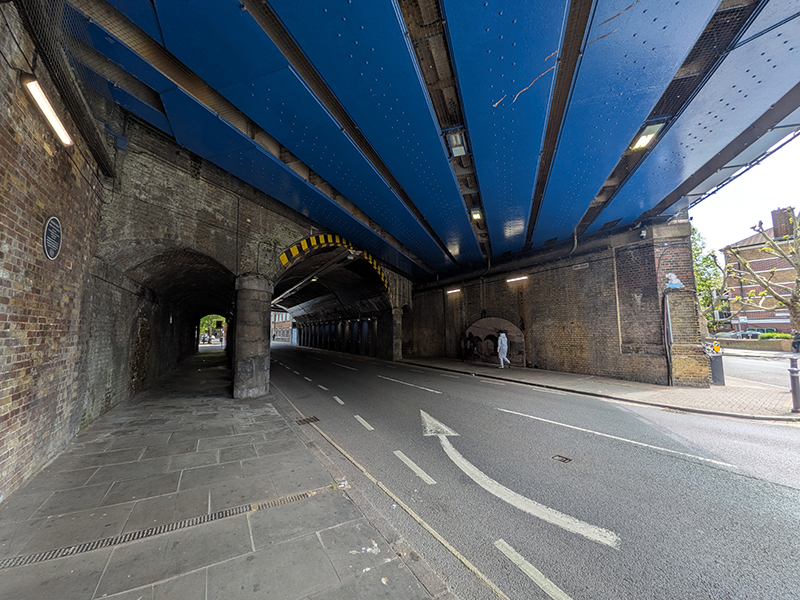
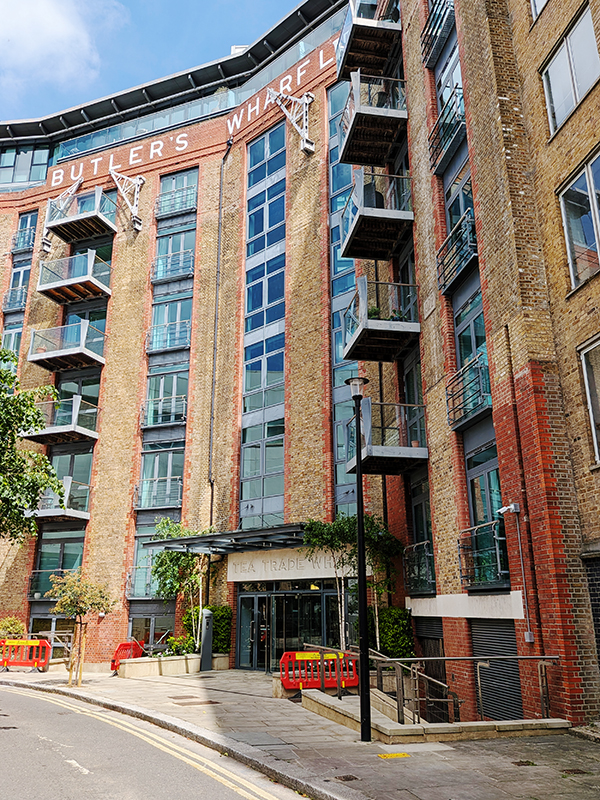
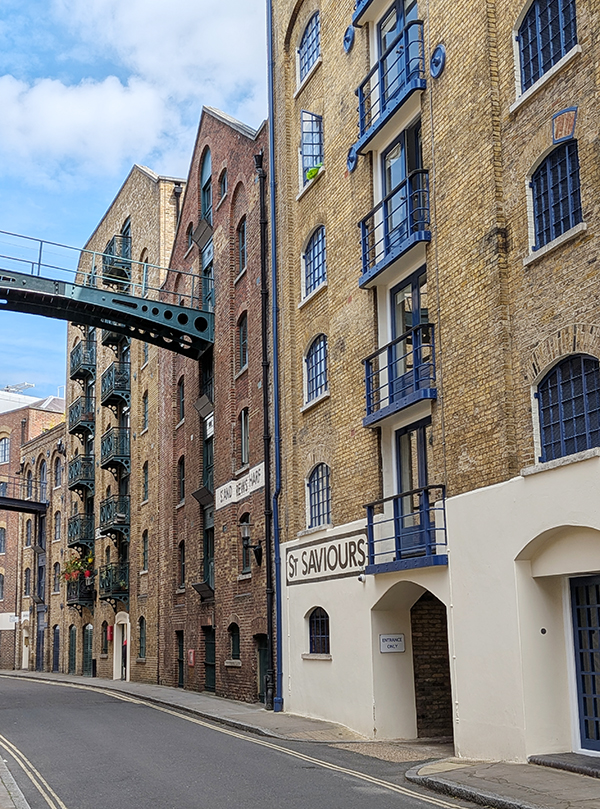
We don’t cross under the bridge however; we turn left instead and then immediately right into Gedling Place which takes us under the railway to Druid Street where we continue into Sweeney Crescent and make our way down to Jamaica Road. After a short westward stint on Jamaica Road we turn north and follow Shad Thames down to the river. In the 19th century, this street and its neighbour, Maguire Street, were home to the largest warehouse complex in London. From the mid-1980’s onward, as with Wapping on the other side of the river, the wharves have been converted to house upmarket apartments and associated restaurants and leisure facilities. Originally built in 1873, the warehouses here stored huge quantities of tea, coffee, spices and other commodities, which were unloaded and loaded onto river boats. For this reason, the area became known as the ‘larder of London’. During the 20th century, the area went into decline as congestion and containerization forced shipping to unload goods further east, and the last warehouses closed in 1972. In 1989, the Design Museum, brainchild of Terence Conran, opened its doors in a converted banana warehouse in Shad Thames. In 2016, however, it moved to a new location in Kensington. Among the most striking features of Shad Thames are the walkways which criss-cross the street high overhead. Most of them now connect the Butlers Wharf building and the Cardamom Building and were originally used as bridges to roll barrels and the like between warehouses.
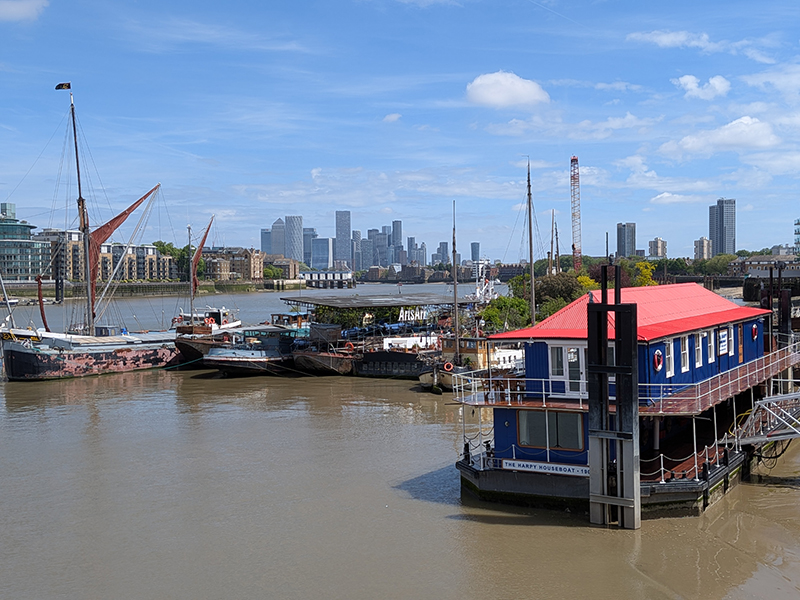
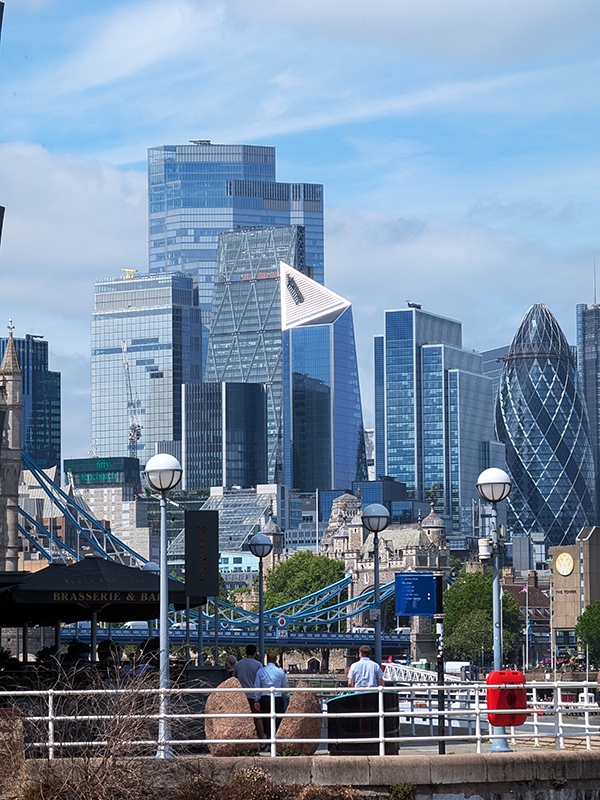
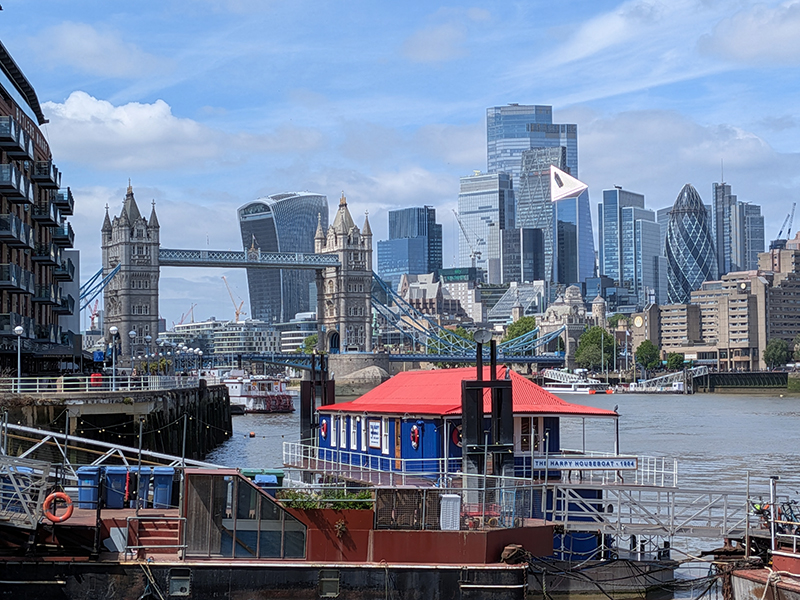
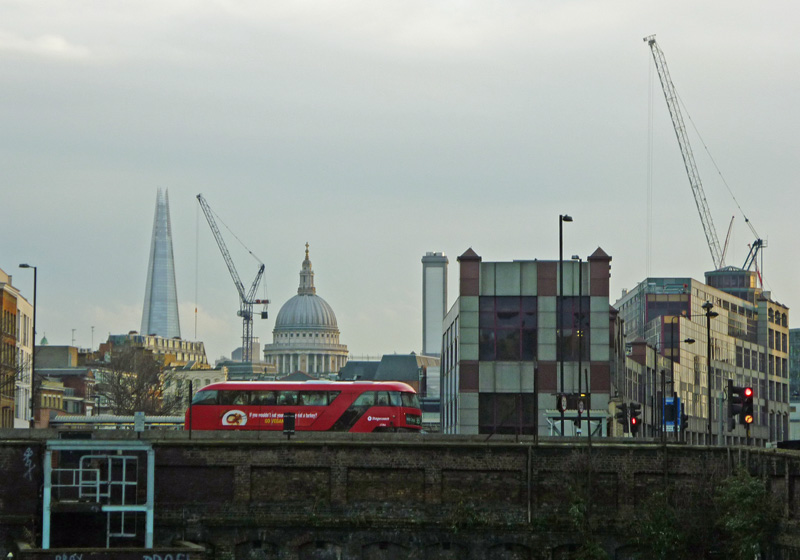
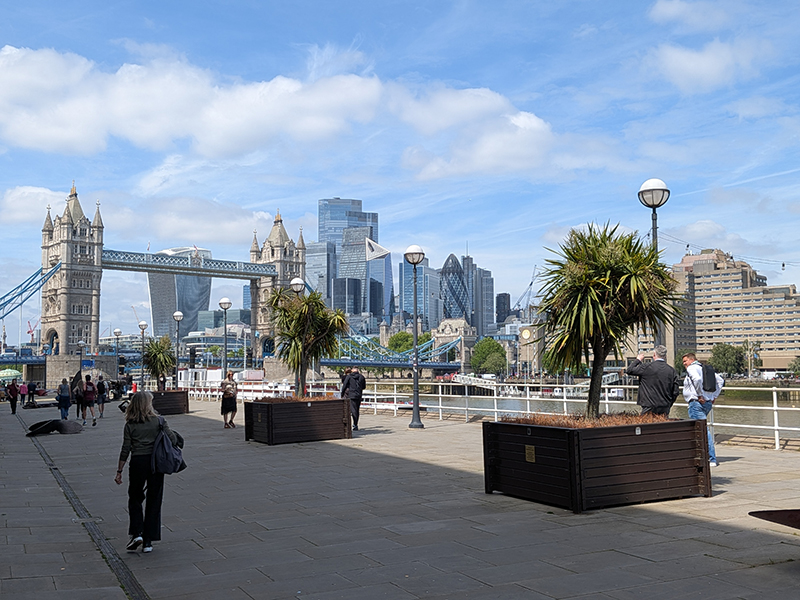
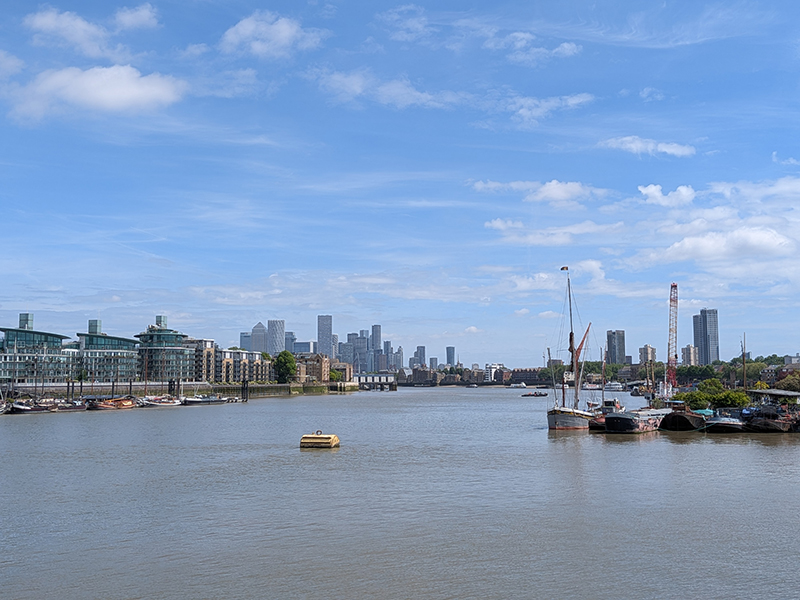
Having reached the river we are afforded panoramic views of Tower Bridge and the City to the west and Canary Wharf to the east.
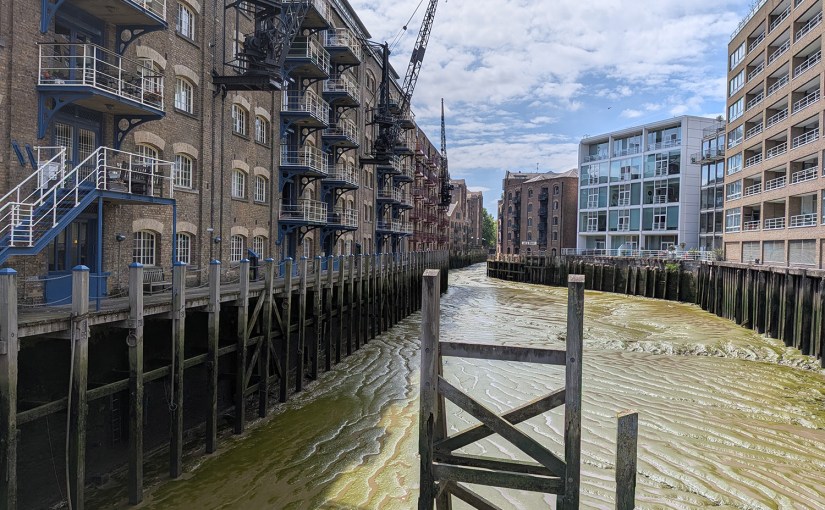
A few paces further downstream we arrive at St Saviours Dock where what is left of the River Neckinger dribbles out into the Thames. The river’s name translates to “Devil’s Neckerchief” or hangman’s noose, likely referencing the gibbets where pirates were executed. In 1995 a hydraulic cable stay bridge was installed across the dock to connect up the Thames Path, and we duly take advantage of that today.
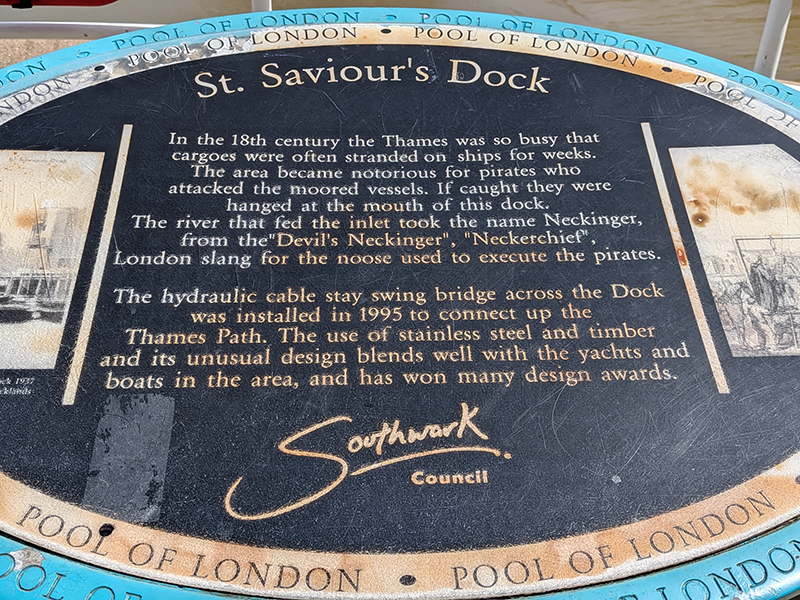
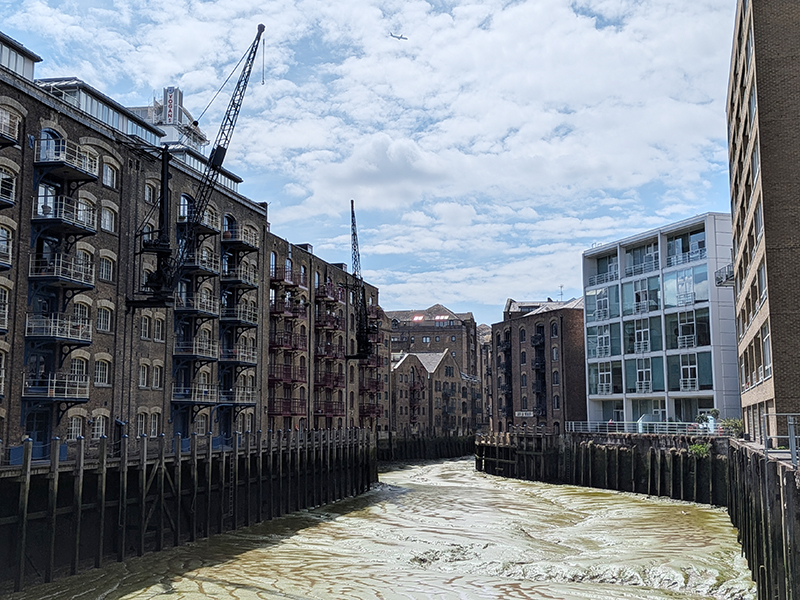
As we proceed parallel to the river along Bermondsey Wall West we pass St Saviours House, a former factory that was also, inevitably, converted into apartments. What was once manufactured in this building is seemingly unascertainable but the area was once a real hub of industry, in particular the production of biscuits.
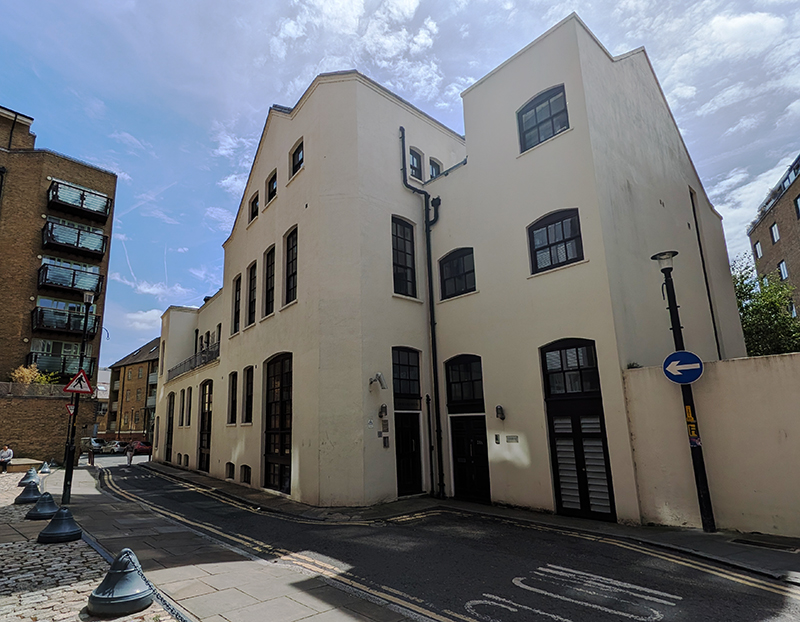
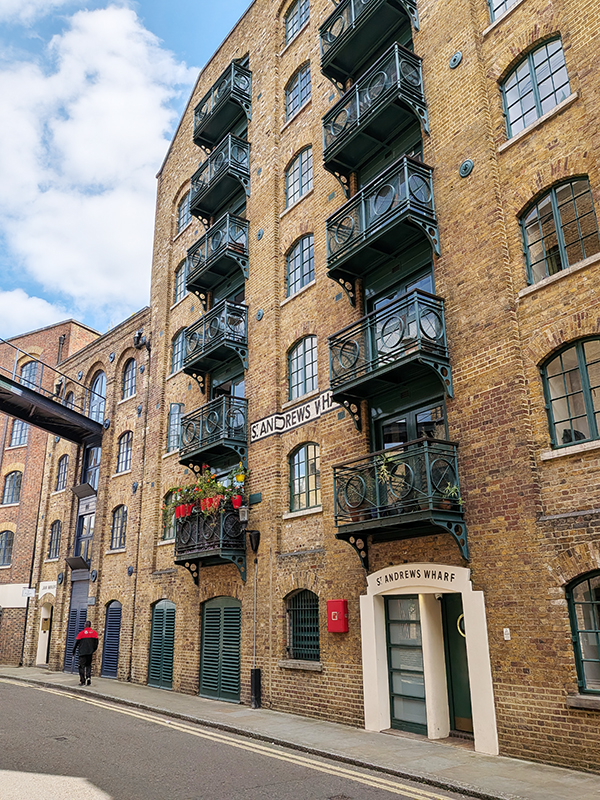
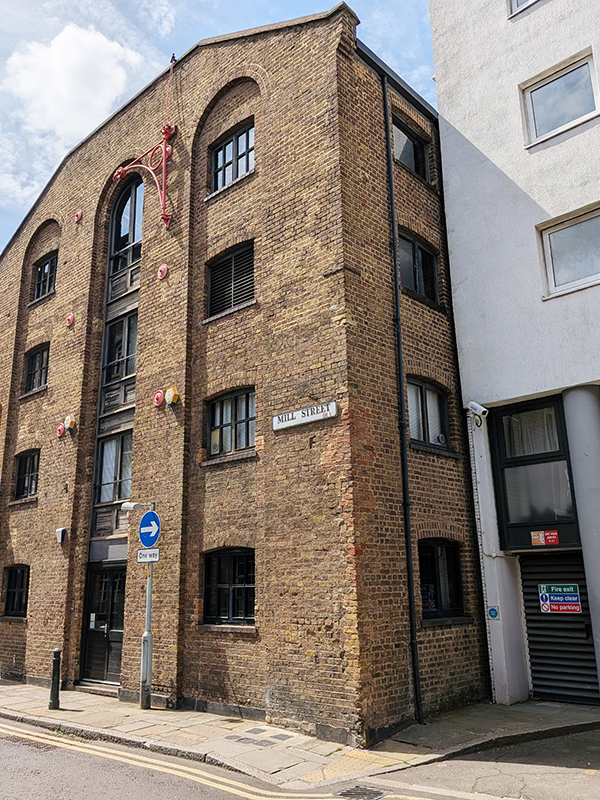
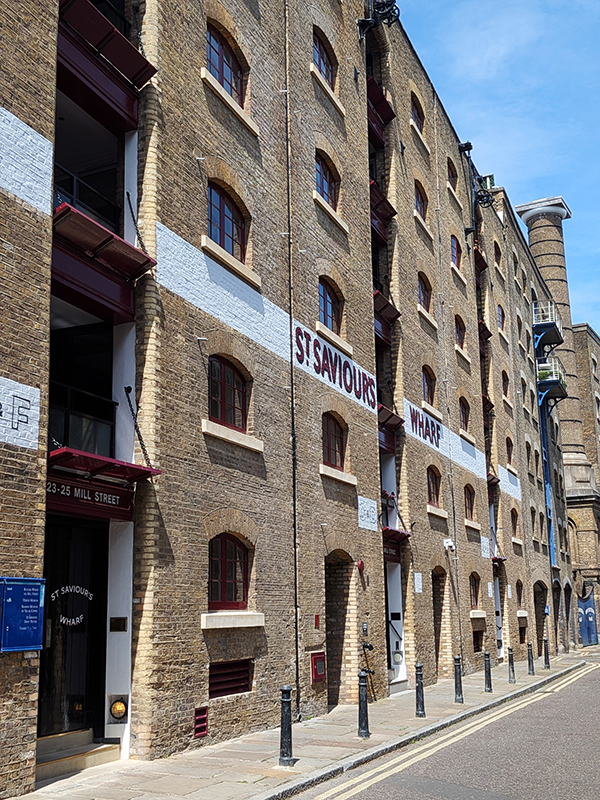
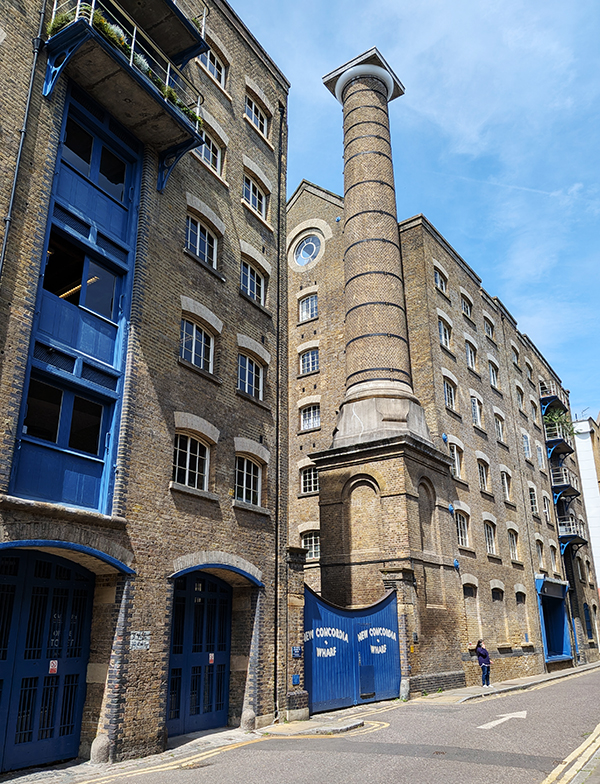
By way of Flockton Street, Chamber Street and Jacob Street, which was once home the Spillers dog biscuit factory, we double back to Mill Street which runs along the back of St Saviours Wharf and New Concordia Wharf on the eastern bank of St Saviours Dock. Both these warehouses are Grade II listed; the former was built around 1860, the latter, constructed c.1882, also included a cornmill (hence the water tower and chimney). Conversion of both buildings occurred in the early 1980’s. The area to the east of Mill Street was once known as Jacob’s Island and was a notorious slum in the first half of 19th century. Charles Dickens used Jacob’s Island as the setting for Bill Sikes’ lair where the Oliver Twist villain is cornered and meets his demise at the end of the novel.
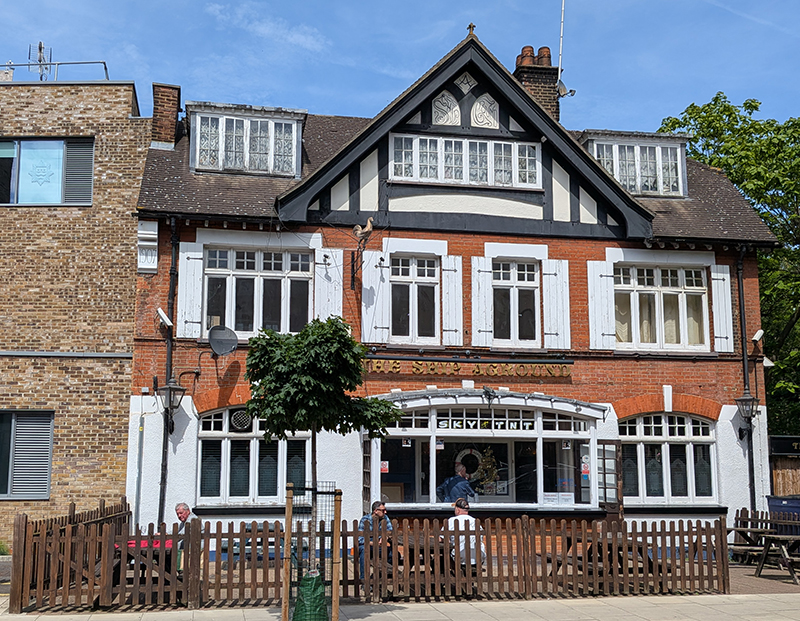
Leaving Mill Street via Wolseley Street we finally reach our pub of the day, the unassuming The Ship Aground. This former Courage house is situated next to Bermondsey Fire Station and featured in the 90’s TV series London’s Burning. They don’t do food so I had to make do with crisps to accompany my half a cider. The staff were very friendly (though it’s always a bit disconcerting to be referred to as my lovely by someone half your age) and the toilet was pretty smart too.
Having finished my drink I head back up to Jamaica Road on Parkers Row and Dockhead (careful with the typing there). W.R Jacobs, the (originally Irish) company responsible for the eponymous crackers, Club biscuits and Twiglets, had a factory that occupied the site between Dockhead and Wolseley Street. This site closed down in 1989 but the company, which is now part of United Biscuits, itself owned by a Turkish-based conglomerate, still produces 55,000 tons of snacks and biscuits annually from its factory in Aintree, Liverpool.

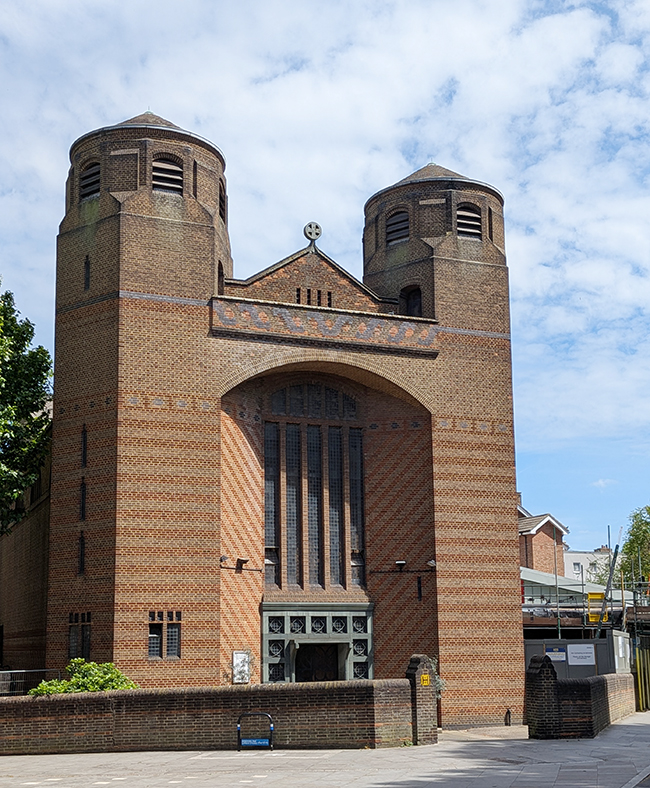
In between Dockhead and Jamaica Road lies the Roman Catholic, Most Holy Trinity Church. The original Catholic chapel here, the Dockhead Mission, was built in 1773 but only lasted seven years before being demolished in the Gordon Riots. More than 50 years later, in 1837, a replacement was built in the Early English Gothic style. That church was then destroyed by a German V-bomb in 1945. The present church, another Grade II listing, was the final work of architect Harry Stuart Goodhart-Rendel (1887-1959), a prolific designer of Roman Catholic churches. Construction began in 1957 but the church wasn’t consecrated until 1960 by which time Goodhart-Rendel had passed on. The church, with its yellow and red brick polychrome patterns, was completed by the successor practice of F.G. Broadbent and Partners.
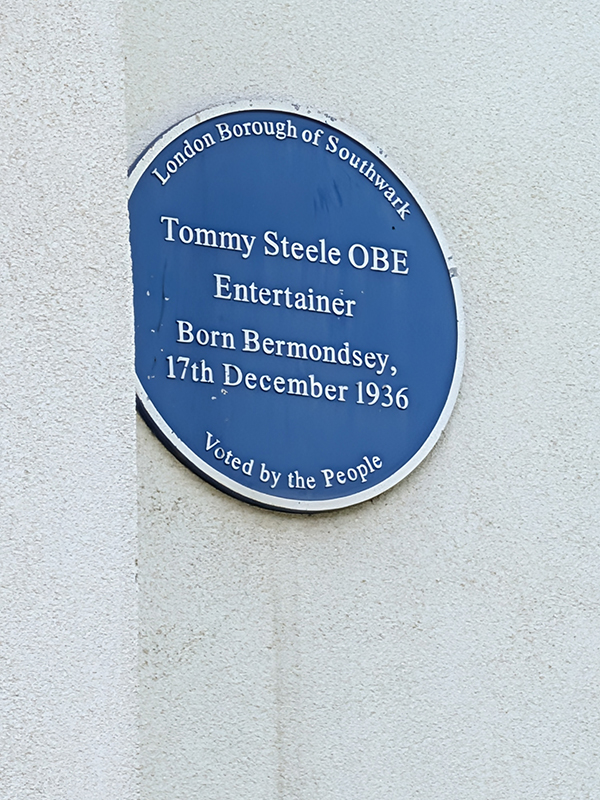
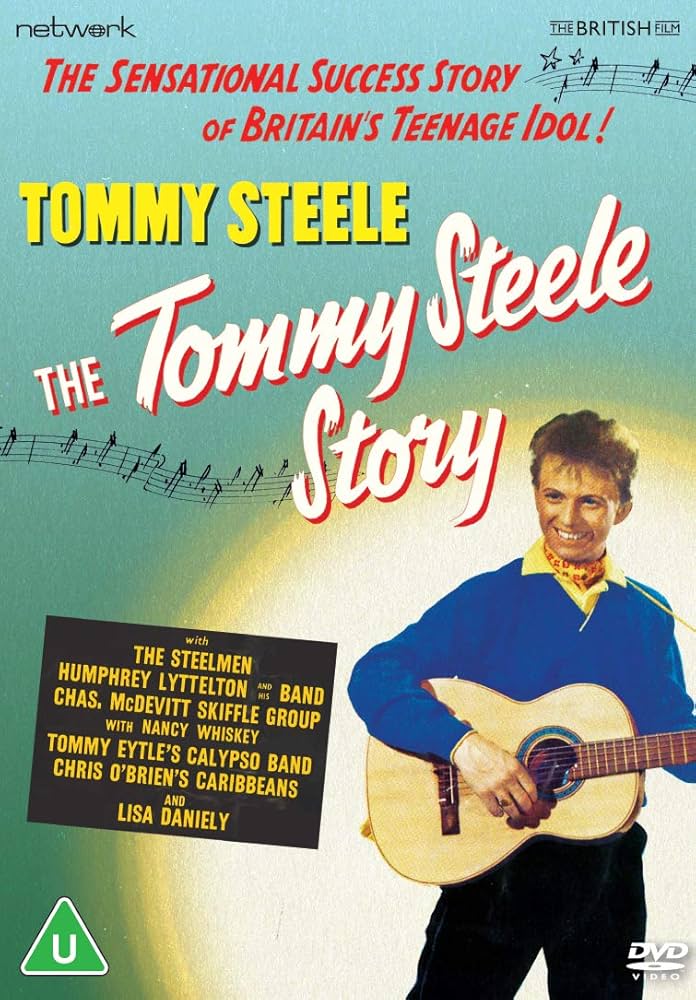
About 200 metres east on Jamaica Road we turn north again on George Row. On the side of Nickleby House is a Southwark Council blue plaque marking the fact that the all-round entertainer (Sir) Tommy Steele (1936 – ) was born in Bermondsey (though nobody seems to be sure where exactly). He was born as Thomas Hicks but by the time he had his first hit record, “Rock With The Caveman” in 1956, he had adopted the stage name. A series of chart smashes followed in quick succession as Steele became Britain’s first teen idol and bona-fide rock n’ roll star (notwithstanding the tameness of his material). So rapid was his rise to fame that as early as 1957 a biographical film documenting it, “The Tommy Steele Story”, was produced. Steele shifted away from rock and roll in the 1960s, becoming an all-round entertainer. He originated the part of Kipps in Half a Sixpence in the West End and on Broadway, reprising his role in the 1967 film version. As an actor, he went on to appear in the films The Happiest Millionaire (1967) and Finian’s Rainbow (1968) and as the lead in several West End productions of Singin’ in the Rain

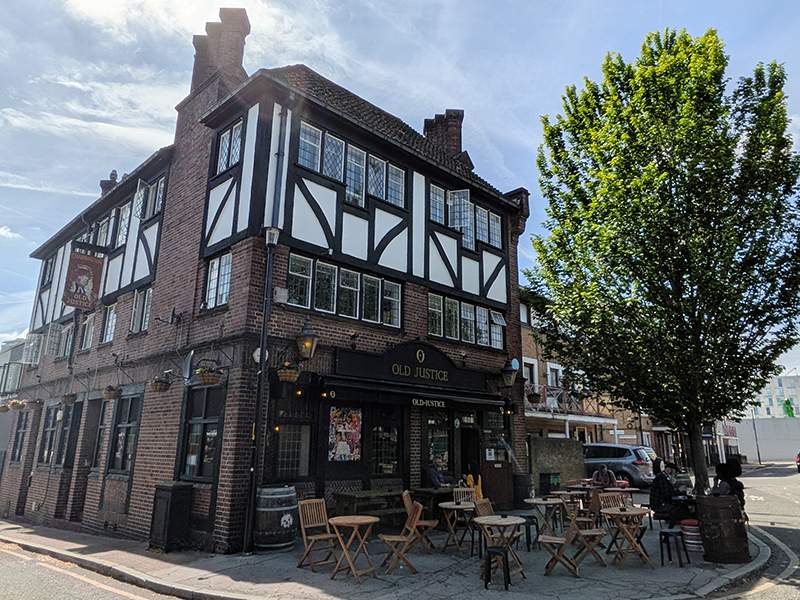
We work our way further east via Sugar Lane, East Lane, Scott Lidgett Crescent, Lewellyn Street, Chamber Street (once more) and Loftie Street before alighting on Bevington Street. Just round the corner on Bermondsey Wall East is one final pub, The Old Justice, another of those 1930s neo-Tudor style jobs. The architect was Sidney C Clark, regarded as one of the most accomplished inter-war pub architects. In 2017 planning permission was refused for the conversion of the pub to flats and it was Grade II-listed shortly after. Subsequently the building owner began unlawfully ripping out the historic interior but following enforcement action by Southwark Council, listed building consent was granted in 2021 for reinstatement of the interior. After a five year hiatus the pub reopened in 2023. It was famously used as a backdrop for Paul McCartney’s music video for No More Lonely Nights, a fact commemorated by the plaque which is just about visible in the photo below (next to the lamp on the right – squint !)
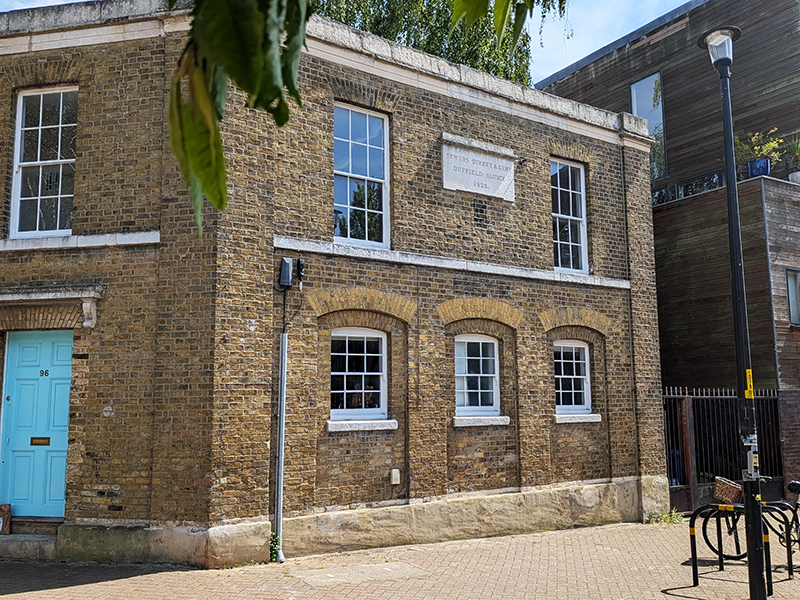
Opposite the pub is a former office block that is all that remains of a sewer pumping station constructed by the Surrey and Kent Commission of Sewers in 1822. At the time, this part of London was still part of Surrey, and this particular commission can be dated to 1554, as its Letters Patent were granted by Queen Mary following a series of “gret wyndes and fluddes”. Sewers at the time were more about draining water to prevent flooding in low lying areas than the removal of human waste. Land Registry documents relating to a sale of the building in 1992 indicate that the sewers remain under the building and are still used by Thames Water.
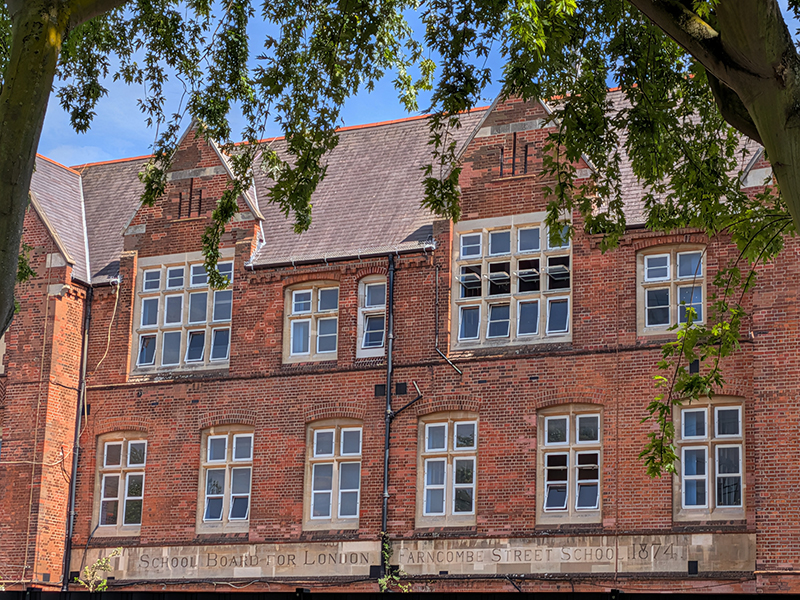
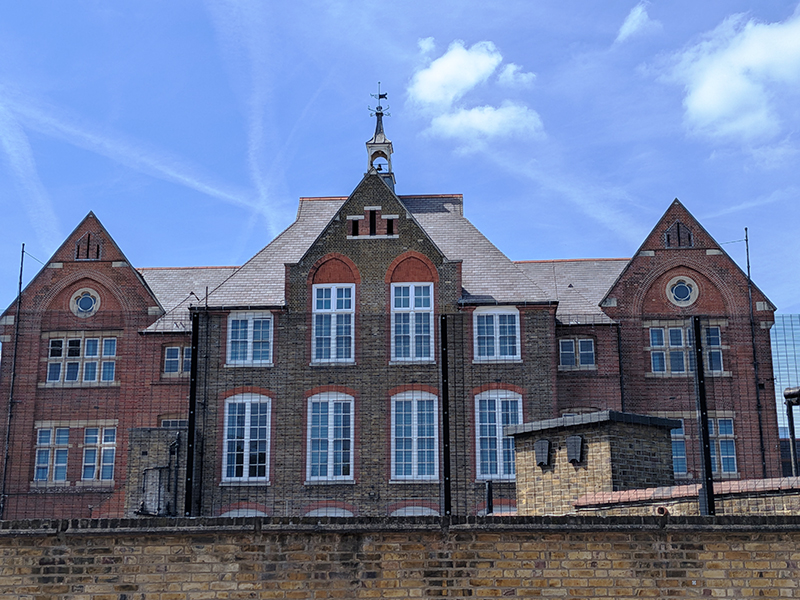
Farncombe Street leads up to another primary school dating back to the Victorian era that is still used for that purpose today. Farncombe Street Board School was built in 1874 by the London School Board in the ecclesiastical Gothic Revival style popular at the time and is yet another Grade II Listing because of this. The steeply pitched outer gable ends have stone quatrefoils with three light slits above, while the whole building is capped with a cupola containing the school bell, itself capped with a weather vane. Today the school has around 250 pupils with a more or less 50/50 gender split. Almost half the children don’t speak English as a first language notwithstanding which the proportion of them deemed to meet the expected standard for reading and writing is significantly above the national average.
For the last leg of today’s journey we move from Farncombe Street into Emba Street then on to Wilson Grove and back to Jamaica Road via Janeway Street and repeat visits to Scott Lidgett Crescent and Bevington Street. 100 metres to the east and we’re back at Bermondsey Tube Station.
Day 49 – Piccadilly – St James’s Square – Pall Mall

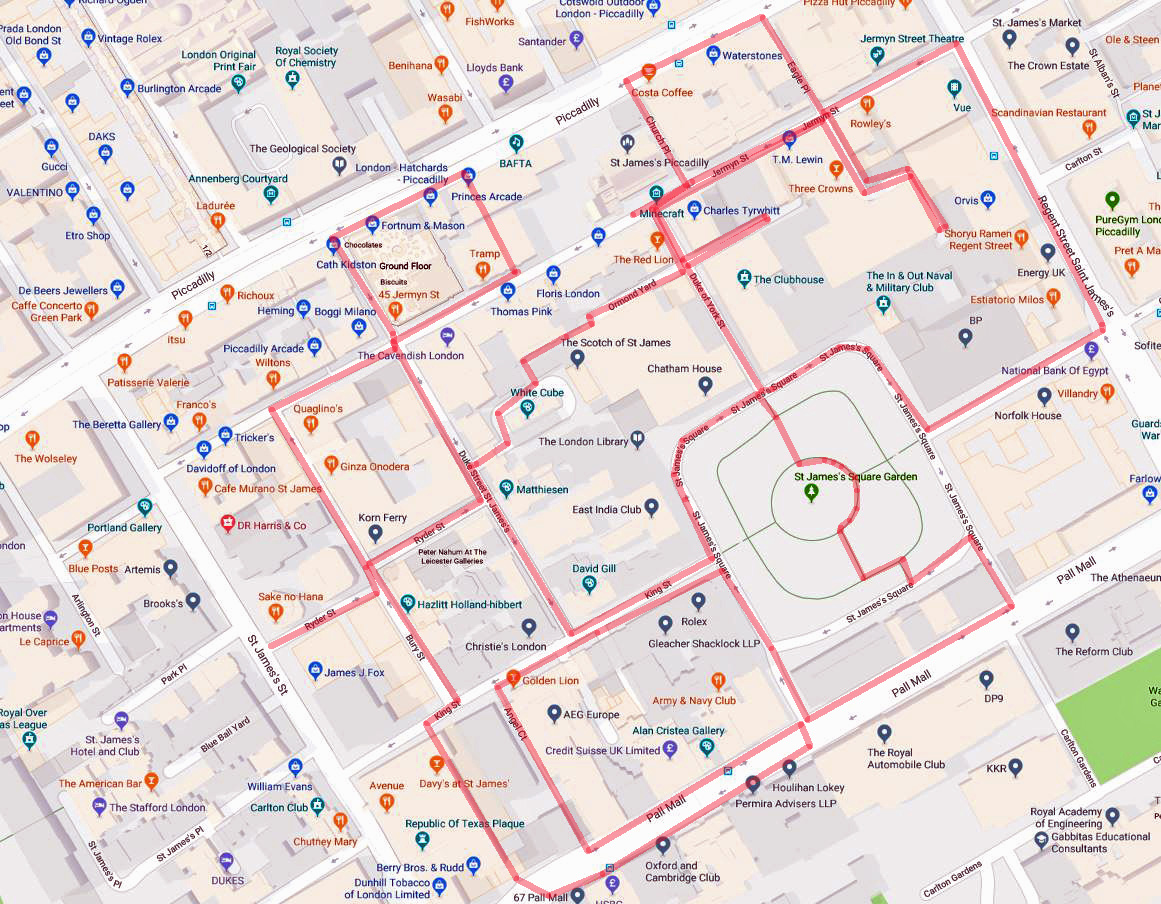
First excursion of the year and not a long one but this small area between Piccadilly and Pall Mall (yellow to pink on the Monopoly board) is rich in historical and social significance. From Fortnum and Mason to the Royal Automobile Club, St James’s (where nearly 50% of the property is owned by the Crown Estate) still clings to an aura of privilege and old money. It also contains the former residences of two women who, in very different ways, have played an important role in shaping the evolution of this country – Ada Lovelace and Nancy Astor.

Day 49 Route

Starting point today is St James’s Church on Piccadilly. This was consecrated in 1684 having been built to the order of Henry Jermyn, Earl of St Albans to the serve the new residential development of St James’s Square. And wouldn’t you know it but the architect was the ubiquitous Christopher Wren accepting a rare gig outside of the City of London. The reredos and the marble font were created by master carver of the age, Grinling Gibbons (there’s a forename that’s ripe for revival surely). And that font was where William Blake was baptised in December 1757. St James’s is well known as a classical music venue and I was fortunate enough that my visit coincided with a lunchtime recital by the prizewinning Greek pianist, Konstantinos Destounis. The church is also very actively involved in highlighting social and political issues and is currently host to Suspended, an installation by artist Arabella Dorman which highlights the plight of refugees attempting to flee from persecution and famine to the safety of European shores.

This slideshow requires JavaScript.

We exit the church onto Jermyn Street, turn left and then return to Piccadilly via Church Place. Heading east towards Piccadilly Circus we pass Waterstones flagship store which occupies the Grade I listed building that came into being in 1936 as Simpsons of Piccadilly, at the time the largest menswear store in Britain. The building was designed by the modernist architect, Joseph Pemberton (1889 – 1956) and much of the interior was the work of Laszlo Moholy-Nagy (1895 – 1946), one of the most influential professors at the Bauhaus school of art in 1920’s Berlin.

IMG_20180126_143436

A right turn down Eagle Place takes us back onto Jermyn Street where we continue east onto Regent Street St James’s (or Regent Street South if you’re pushed for time). The Lumiere London art festival had taken place the previous weekend and the area around Piccadilly had featured several of the installations, including this light projection onto the old Swan & Edgar building.

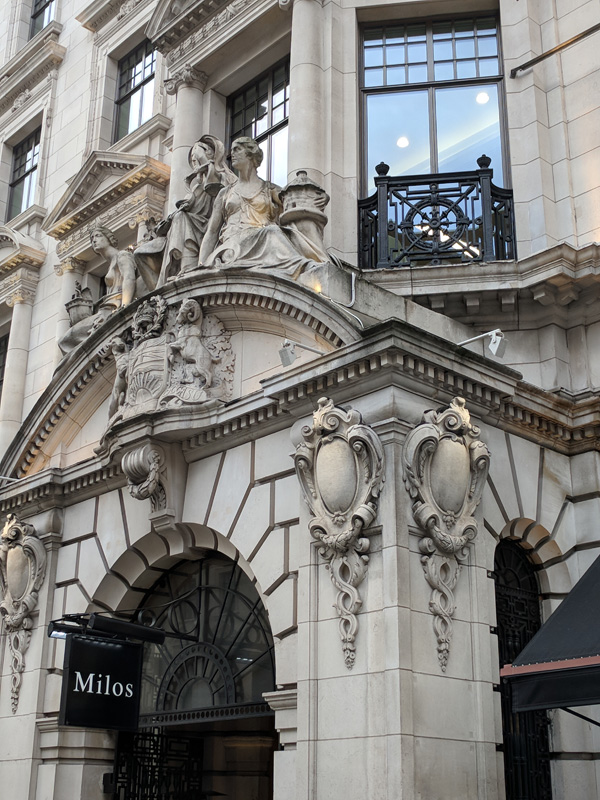
We drop down to the end of Regent Street St James’s where no. 1 with its ornate carved frontage, home of the Greek restaurant Estiatorio Milos, stands on the corner with Charles II Street.

IMG_20180126_143850

Charles II Street runs west into St James’s Square.  As already mentioned the square was laid out in the late 17th century by Henry Jermyn, the 1st Earl of St Albans one of the most influential courtiers of the Restoration period. The houses on the square quickly became some of the most desirable properties in London and by the 1720’s seven dukes and seven earls were among the residents. A century or so later the clubhouses arrived and the square lost a bit (but only a bit) of its cachet. Turning right to proceed anticlockwise around the square we pass the BP head office at no. 1, a turn of the 21st century building they acquired in 2001. The original house at no.3 next door was owned by at least three separate dukes at different times but was replaced in the 1930’s by this office block.

IMG_20180126_144349

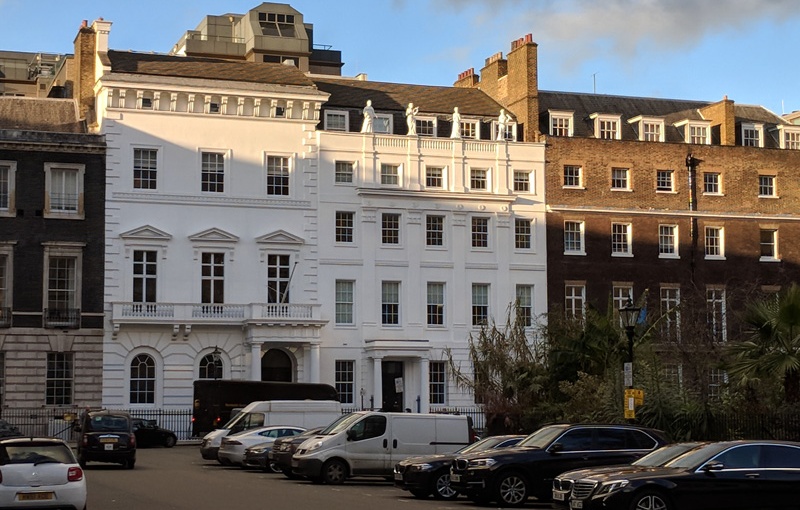
Then at no.4 we have an original Georgian House built 1726-28 by Edward Shepherd and the only one on the square to retain its garden and mews house at the rear. It is now the Naval and Military Club but was once one of the homes of Nancy Astor, Viscountess Astor (1879 – 1964) the first woman to sit as an MP in the House of Commons. Nancy Witcher Langthorne Astor, to give her her full name, was an American citizen who moved to Britain at the age of 26 when she married, for the second time, to Waldorf Astor heir to the massive fortune of the Astor family with its origins in the 18th century US fur trade and New York real estate. Their primary home was the 375 acre Cliveden Estate in Buckinghamshire, a wedding gift from Waldorf’s father. Waldorf had enjoyed a promising political career prior to WW1 but when he succeeded his father’s peerage to become the 2nd Viscount Astor he was automatically shunted off to the House of Lords. This left the way open for Nancy to contest the vacant seat and she duly won the November 1919 by-election. She was in actual fact not the first woman to be elected to parliament, that milestone was achieved by Constance Markievicz in 1918 but as she was an Irish Republican she was barred from taking her seat. I think it’s fair to say that Lady Astor’s success is now viewed as purely a symbolic one. Her political accomplishments were largely negligible although she remained an MP until 1945.  Her personal ideology was also pretty suspect in many ways – she had not been a strong advocate of women’s suffrage and held strong anti-Catholic and anti-Semitic views. However, while she and many of her circle were in favour of appeasement suggestions that the “Cliveden set” were pro-fascist appear to be exaggerated.
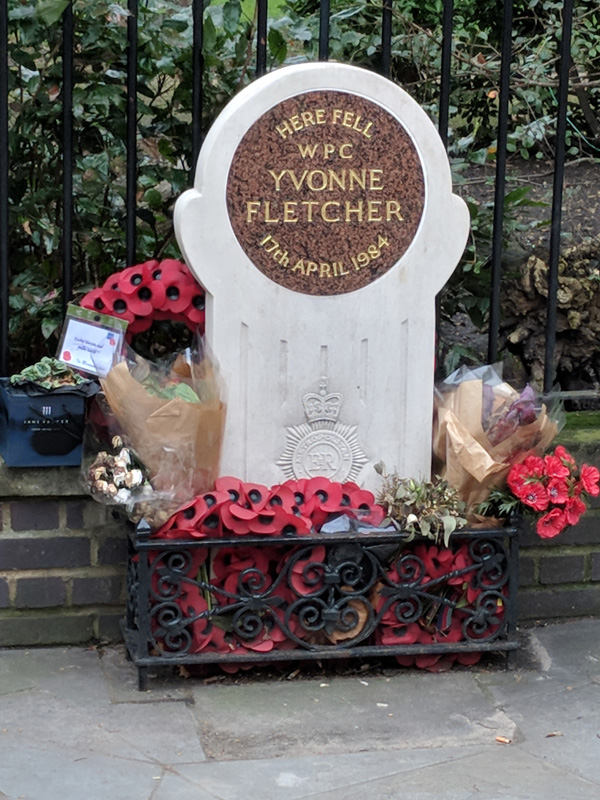
Across the road from no.4, just outside the gardens, is a memorial to WPC Yvonne Fletcher who on 17 April 1984, at the age of 25, was killed by a shot from the Libyan People’s Bureau (Embassy) which at the time occupied no.5. WPC Fletcher was on duty monitoring a demonstration against the Gaddafi regime, eleven of the participations in which were also wounded. Although diplomatic relations between the UK and Libya were severed no-one was ever brought to account for the murder. Two years later US fighter planes conducted bombing raids on Libya having taken off from UK air bases with the acquiescence of Margaret Thatcher.

IMG_20180126_144407

We leave the square temporarily via Duke of York Street off to the right of which is the now (thanks to the eponymous book and TV series) infamous Apple Tree Yard. You’d be hard pushed to find anywhere quite so unappealing as a venue for a spot of alfresco hanky-panky but then that’s probably the point. Though I’m pretty certain the scenes in the TV series weren’t actually filmed here anyway. The yard’s other claim to fame is that it was home to the office where Sir Edwin Lutyens designed the enclave of New Delhi (within the metropolis of Delhi) to replace Calcutta as the seat of the British Colonial Government in 1912. This was marked in 2015 by the installation of a sculptural work in granite by the artist Stephen Cox.

Back on Duke of York Street it’s a short hop up to Jermyn Street again for a quick eastward foray to tick off Babmaes Street before retracing our steps to Ormond Yard which is opposite Apple Tree Yard and ends in a small passage that cuts through To Mason’s Yard. Bang in the middle of Mason’s Yard is the White Cube Gallery which was constructed here on the site of an old electricity subs-station (and is the first free-standing structure to be built in the historic St James’s area for more than 30 years). In its architectural style the White Cube aims for a spot of nominative determinism though White Orthotope would be nearer the mark (this is also true of its sister gallery, White Cube Bermondsey). It’s a good old space inside and usually showcasing something worth a visit. Current exhibition by Korean artist, Minjung Kim, which just opened today is a case in point.

This slideshow requires JavaScript.

To the west Mason’s Yard leads out onto Duke Street St James’s where we head south as far as King Street which takes us east back to St James’s Square. This time we go clockwise round the square (if you see what I mean). First stop is no. 16 which was formerly the East India Club and displays a black plaque commemorating the official dispatch of the news of the victory at Waterloo carried by Major Henry Percy. After initial delivery to the Prime Minister and Secretary of State for War at Grosvenor Square, Major Percy continued on to this address to lay two captured French Imperial Eagles before the Prince Regent who was attending a soirée here.

IMG_20180126_151229

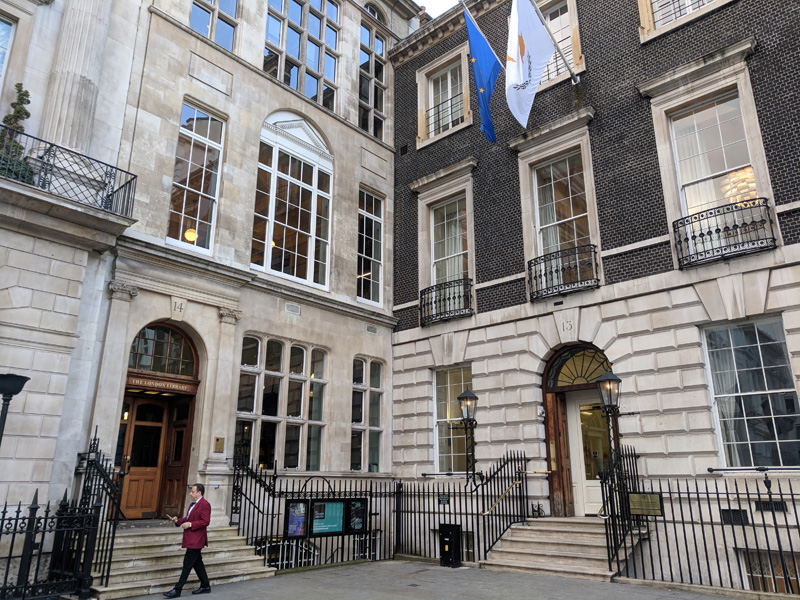
At no. 14 is the London Library the world’s largest independent library created at the instigation of Thomas Carlyle (who objected to some of the policies of the British Museum Library). It opened in 1841 and moved to St James’s Square four years later. Alfred Lord Tennyson served as President, from 1855 to 1892, as did T.S. Eliot who, on his appointment in 1952, declared  “whatever social changes come about, the disappearance of the London Library would be a disaster to civilisation”. Today the library is home to over a million books covering more than 2,000 subjects and stored on 17 miles of shelves. Membership costs £525 a year.

Next door at no.13. is the only Embassy on the square – the High Commission of Cyprus.

IMG_20180126_151259

Turning the corner onto the north side we reach, at no.12, the former residence of the other woman I mentioned in the preamble, Augusta Ada King-Noel, Countess of Lovelace (1815 – 1852) better known, simply, as Ada Lovelace. Part of Ada’s fame rests upon the fact that she was the only legitimate child of Lord Byron – by his wife Annabella Milbanke, Lady Wentworth. But far more important than that is her contribution to the fields of mathematics and science. As a teenager, Ada’s mathematical prowess, led her to form what came to be a long working relationship and friendship with Charles Babbage (1791 – 1871) the man who first came up with the concept of the computer, or Analytical Engine as he called it. However it was Ada who recognized that such a machine could have potential applications beyond pure calculation and published the first program intended to be carried out by the “computing machine”. For this she is regarded by many as effectively the world’s first computer programmer. Her personal life though was not a happy one; her relationships with men were fraught and complicated and she took to gambling with disastrous results – losing more than £3,000 on the horses in her early thirties. And she was always haunted by her father who had to all intents and purposes abandoned her at birth. In any event she never saw him again during his eight remaining years of life. But when Ada died of uterine cancer at the age of 36, the same age Byron had been, she was buried, at her request, next to him at the Church of St Mary Magdalene in Hucknall, Nottinghamshire.

Two doors further along at no.10 is Chatham House aka the Royal Institute of International Affairs, the world-famous independent policy institute. In 1919 British and American delegates to the Paris Peace Conference, under the leadership of Lionel Curtis, conceived the idea of an Anglo-American Institute of foreign affairs to study international problems with a view to preventing future wars. In the event, the British went ahead on their own, founding the British Institute of International Affairs in July 1920. Chatham House is immortalised for originating the Chatham House Rule – When a meeting, or part thereof, is held under the Chatham House Rule, participants are free to use the information received, but neither the identity nor the affiliation of the speaker(s), nor that of any other participant, may be revealed. Or, more succinctly, “what’s said in the room stays in the room”. No.10 (appropriately enough) is also celebrated for being the home at various times of three separate British Prime Ministers – William Pitt the Elder (PM from 1766-68), Edward Stanley, Earl of Derby (PM for just 299 days in 1852 and 1 year and 243 days between 1866 and 1868) and William Ewart Gladstone (PM for most of the 2nd half of the 19th century).

See what I mean, just this one corner of the square has elicited the best part of 1,000 words. Anyway, once past no.10, we turn south through the middle of the gardens. In the centre is an equestrian statue of William III erected in 1808 and at the southern end is a small pavilion with a memorial to architect John Nash (we’ve met him more than once on previous journeys) who supervised the design and layout of the gardens.

Back on the east side of the square is no.31, Norfolk House, which was U.S. General Dwight D. Eisenhower’s headquarters during World War II, and where Operation Torch and Operation Overlord were planned.

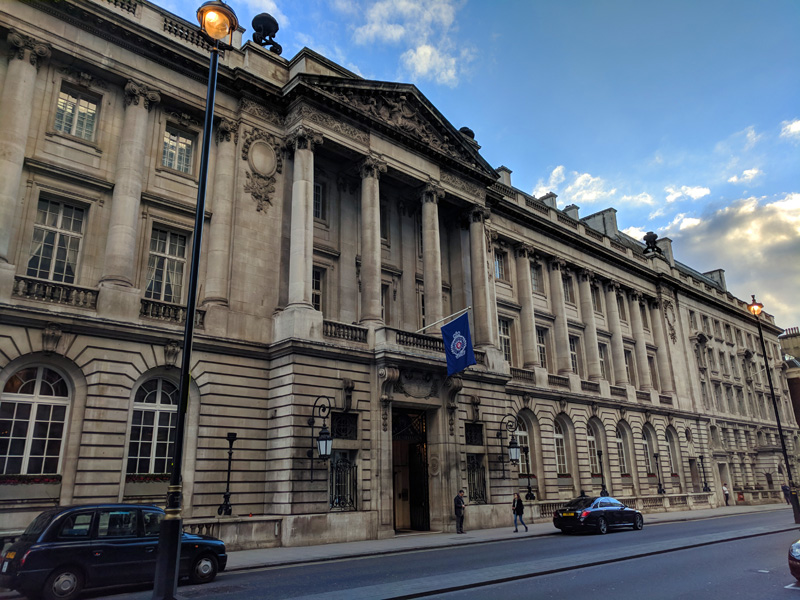
We leave the square again briefly, exiting onto Pall Mall from the south-east corner. Across the road is the Royal Automobile Club, founded in 1897 by Frederick Richard Simms with the primary purpose of promoting the motor car and its place in society. The Royal part of the monicker was granted by King Edward VII in 1907 (Victoria would have had no truck with these new-fangled automobile things). Today it’s a glorified private members’ (including women) club with Edwardian Turkish baths that were renovated in 2003–4, an Italian marble swimming pool, squash courts (including a doubles court), a snooker room, three restaurants, two bars, and a fully equipped business centre. It is now completely divorced from the motoring services group, the RAC, which it once owned.

IMG_20180126_152113

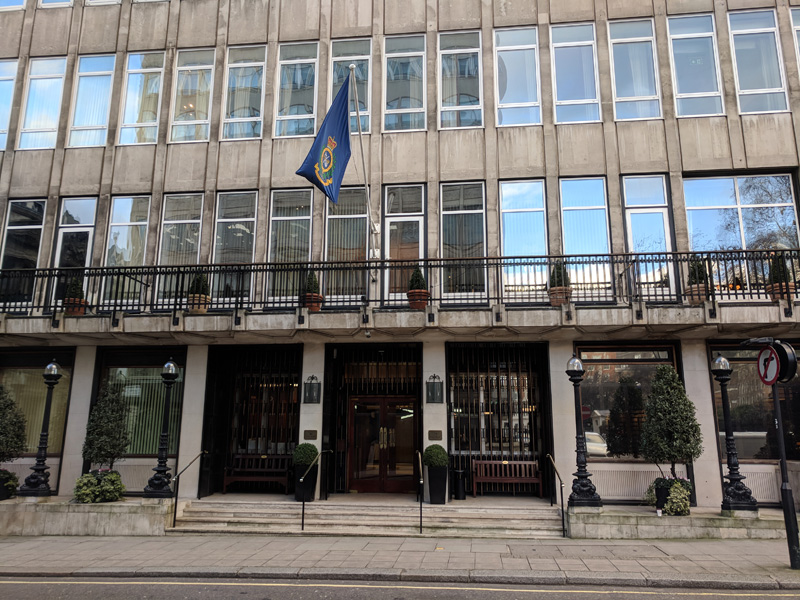
We head back into the square for a final time past another bastion of London clubland (of the cigars and brandy rather than ecstasy and glo-stick variety), the Army and Navy Club. This one has been around since 1837 and its first patron was the Duke of Wellington and the current one is the Queen – nuff said. The club is colloquially known as ‘the Rag’ – if you want to know why check out the link. I think I need to move swiftly on before I go all champagne socialist.

IMG_20180126_152220

We leave the square for the final time back along King Street heading west. On the north side is the global HQ of fine art auctioneers, Christie’s, where they have been since 1823.

IMG_20180126_152626

On the south side we pass Cleveland Place and Rose & Crown Yard before taking the next turning, Angel Court. The following picture is of the middle of those three and I took it and flipped it to b&w purely on account of the striking quality of the mannequin figure in the window.

IMG_20180126_152553

On the corner of Angel Court and King Street, the Golden Lion pub occupies the site where the St James’s Theatre, which staged the first performances of Oscar Wilde’s two best known plays, once stood. Further down Angel Court is a set of, now rather forlorn looking, commemorative reliefs by E. Bainbridge Copnall. The reliefs were commissioned for the office block that replaced the theatre, which was demolished itself in 1986.

Back on Pall Mall we head east initially along the north side then double back west on the south side. Pall Mall was constructed in 1661 and takes it’s name from the game of pall-mall which was a bit similar to croquet and was introduced to England by James I. London’s first pall-mall court was built in St James’s Field where St James’s Square now stands. As we return along the south side we pass no.82 which is adorned with a blue plaque marking this as a former residence of the artist Thomas Gainsborough (1727 – 1788) and no.80 which has one noting that Nell Gwynne (1650 – 1687) once lived in a house on the site. And at no.71 is the Oxford and Cambridge Club where. I imagine, the real metropolitan elite meet and greet.

We switch back northwards up Crown Passage which, if you ignore the rubbish bags, has a charming touch of the olde-worlde about it…

IMG_20180126_153416

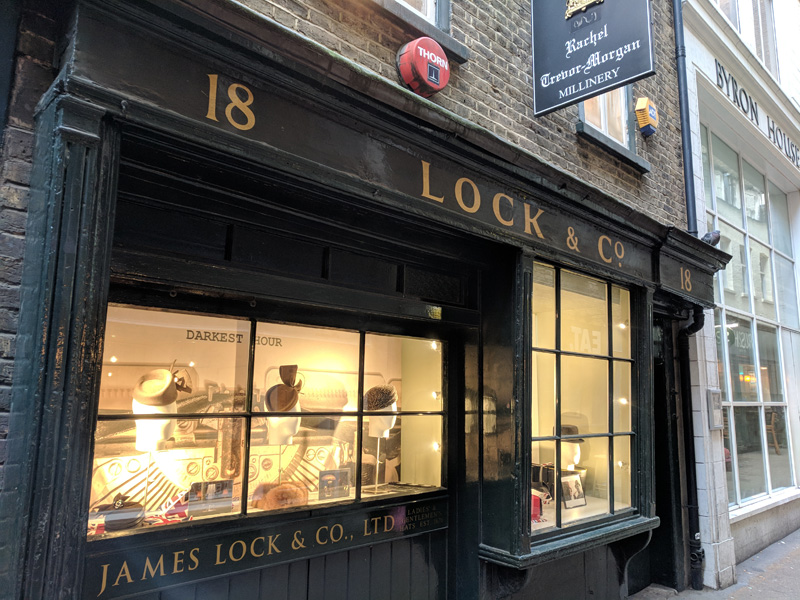
…there’s even a Milliner’s for goodness’ sake (that’s someone who makes hats in case there happens to be anyone under the age of forty reading)

IMG_20180126_153507

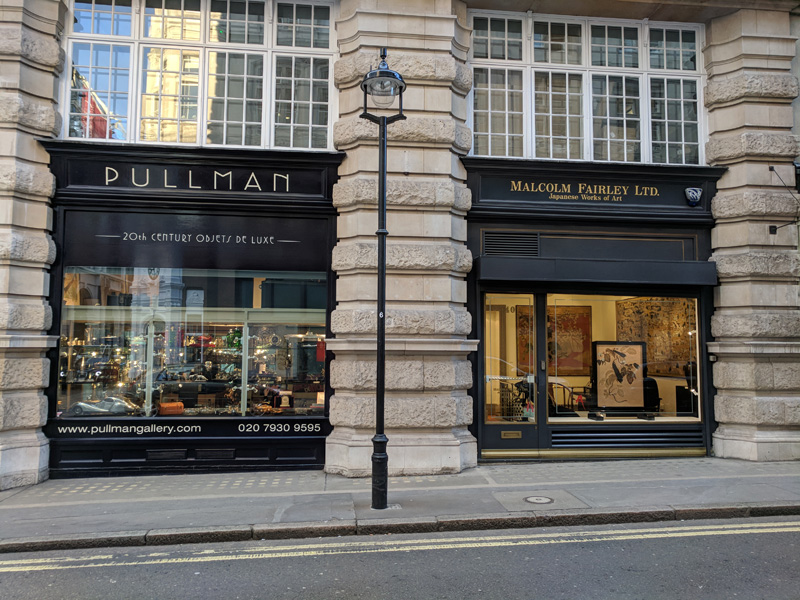
So now we’re back on King Street from where a quick right then left takes us into Bury Street. The area of St James’s is particularly known for its galleries. Not the sort I tend to frequent that show contemporary art (though as we’ve seen there are a couple of those) but the ones that specialise in just about every niche in the fine arts and antiques firmament – from old masters to maps to Japanese art and armour and weaponry as you can see below.

IMG_20180126_153659

IMG_20180126_154015

We turn east off Bury Street along Ryder Street back to Duke Street St James’s where we continue north and then turn the corner into Jermyn Street past the Cavendish Hotel. In its present form The Cavendish is a particularly unlovable example of 1960’s concrete pragmatism. Its predecessor was built in the early 1800’s, taking on the Cavendish name in 1836. In 1902 the Cavendish was bought by one Rosa Lewis (1867 -1952), who had worked her way up from kitchen maid (aged 12) to be head chef of the Duc d’orleans at Sandhurst. She was also engaged as a dinner-party cook by Lady Randolph Churchill, the Asquiths and many of the hostesses who entertained Edward VII. Rosa originally put her husband, the grandly named ex-butler Excelsior Tyrel Chiney Lewis, and his sister Laura in charge of the hotel. But within two years their spending and his drinking were out of control so Rosa divorced him and threw the pair of them out. Once she was in charge the hotel flourished and expanded. She was known for her generous spirit – allowing impoverished WW1 military officers to stay for free at the hotel for example – and Evelyn Waugh described her as warm hearted, comic and a totally original woman. She continued to dress in Edwardian style and enjoyed a grandiose and majestic decline from 1918 to 1952. Her life was the inspiration for the 1970’s TV series, “The Duchess of Duke Street” (with Gemma Jones in the title role) as is recognized by a Westminster Council commemorative plaque.

After a couple of blocks we make our way back to Piccadilly up Princes Arcade which continues the area’s general theme of old fashioned luxury. Opposite the entrance to the arcade at no.87 Jermyn Street is another of those old London County Council blue plaques marking this as the home of Sir Isaac Newton. Newton actually lived in the building that was knocked down in 1915 but the plaque had been installed seven years prior to that and so was taken down a re-fixed to the new building.

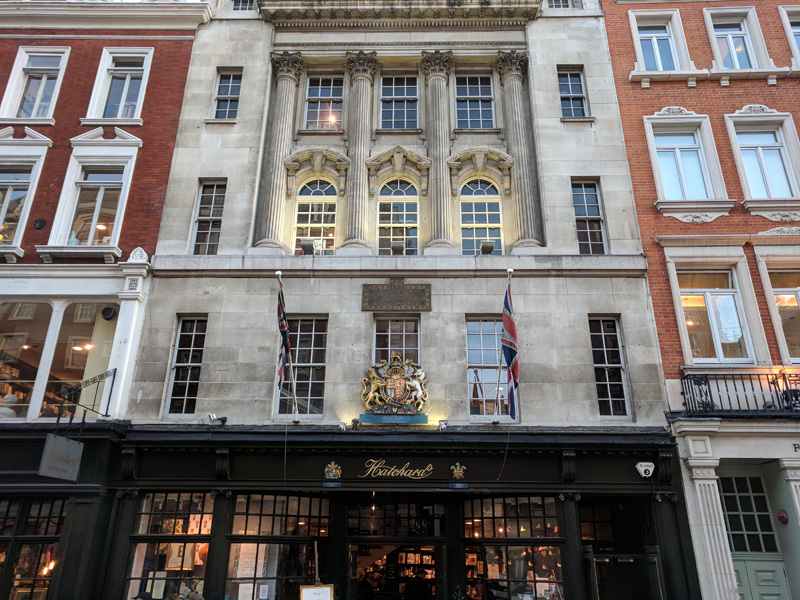
On reaching Piccadilly again we turn left to get to Hatchards the UK’s oldest bookshop. John Hatchard opened the store at 173 Piccadilly in 1797 and moved it to (what is now) 187 in 1801. The store has three Royal Warrants and is now owned by Waterstone’s.

IMG_20180126_154523

Since that move in 1801, Hatchards has been neighbour to Fortnum & Mason which preceded it in opening on Piccadilly by nearly a hundred years. It was 1707, to be exact, when Hugh Mason and William Fortnum set up shop at no.181 and it all began with them selling off Queen Anne’s half-used candle wax. In 1738, by which time it was established as one of the most prominent grocery stores on the capital, Fortnum and Mason’s invented the Scotch Egg while brainstorming ideas for food that travellers could eat on the go. In 1851 Fortnum’s won first prize as importers of dried fruits and dessert goods at London’s Great Exhibition and in 1886 became the first grocer’s in Britain to stock Heinz baked beans. In 1911 they sent hampers to the suffragettes who had been imprisoned for breaking their windows and they provided the 1922 Everest expedition with, amongst other things, 60 tins of quail in foie gras and four dozen bottles of champagne (amazing that they didn’t reach the summit with that to fortify them). The famous clock on the storefront was installed in 1964 and its bells come from the same foundry that produced Big Ben. The only record that F&M have ever sold is Band Aid’s “Do They Know It’s Christmas ?” These days Fortnum’s is more of a tourist destination than anything. There are no doubt still a few members of the landed gentry that pop up to town to stock up on comestibles and haberdashery but I didn’t see very many while doing the rounds. Since I mentioned it earlier I should also note that the selling of foie-gras was the subject of a PETA campaign in 2010 that was supported by a number of high-profile celebrities.

This slideshow requires JavaScript.

We exit the store (purchase-free) onto Duke Street and at the end of the block turn west for a final visit to Jermyn Street. Outside the Piccadilly Arcade is a statue to the Georgian “dandy” Beau Brummel (1778 – 1840). Poor old Beau’s not looking quite so dandy-ish at the moment having been boxed in by the workmen repairing the street.

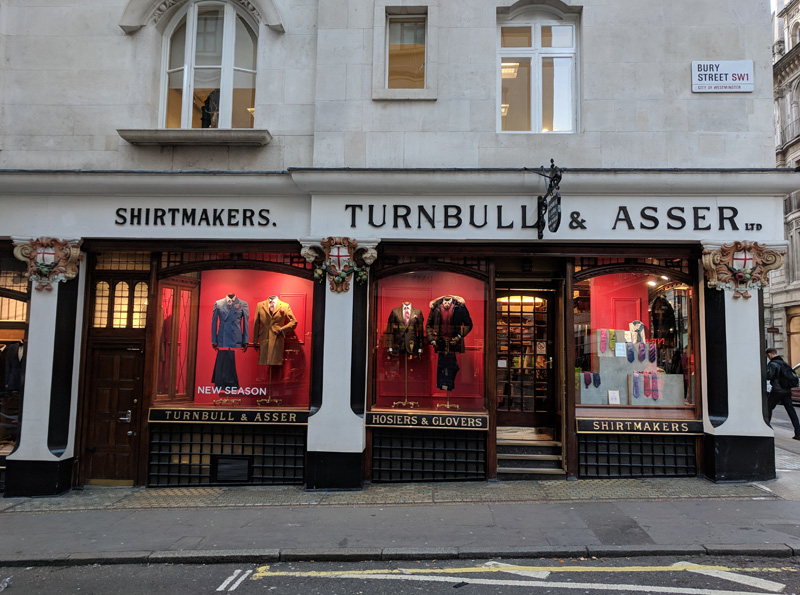
Jermyn Street has historically been second only to Savile Row in term of catering to the sartorial needs of the discerning London gentleman-about-town but these days it seems to consist mainly of branches of T.M Lewin. So I was pleased to finally encounter one of the few remaining proper old-style independent outfitters on the corner with the top of Bury Street.

IMG_20180126_155745

And that’s just about it. From Bury Street we turn right to make the western section of Ryder Street our last call of the day and I’ll leave you wondering, like me, what story lies behind this intriguing shot.

IMG_20180126_160411


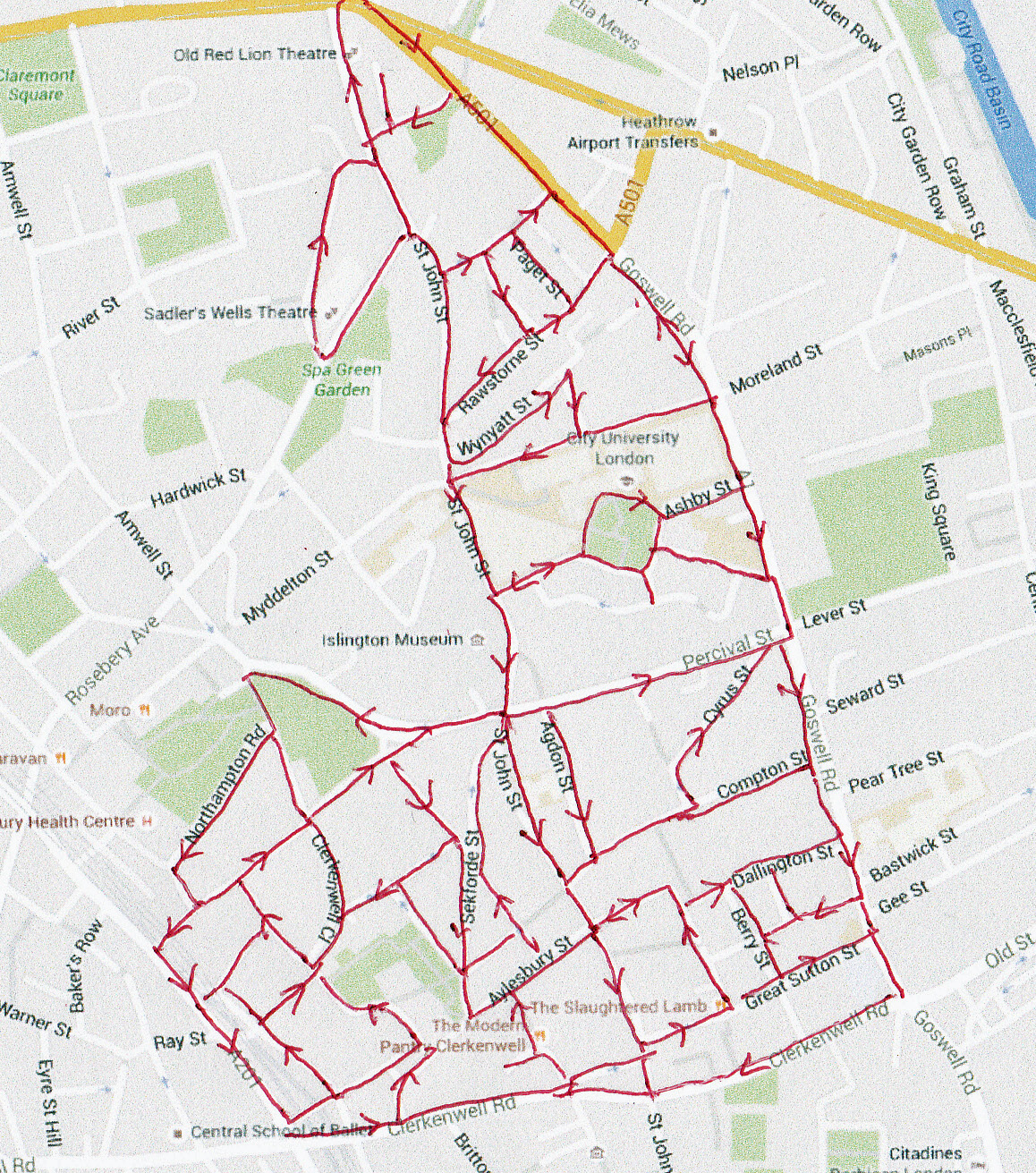
Day 14 – Clerkenwell – Finsbury – Farringdon Road

Pretty extensive route today; initially covering the eastern side of the Finsbury district between Goswell Road and St John Street then moving back into Clerkenwell and visiting the area east of Farringdon Road and north of Clerkenwell Road.

Day 14 Route

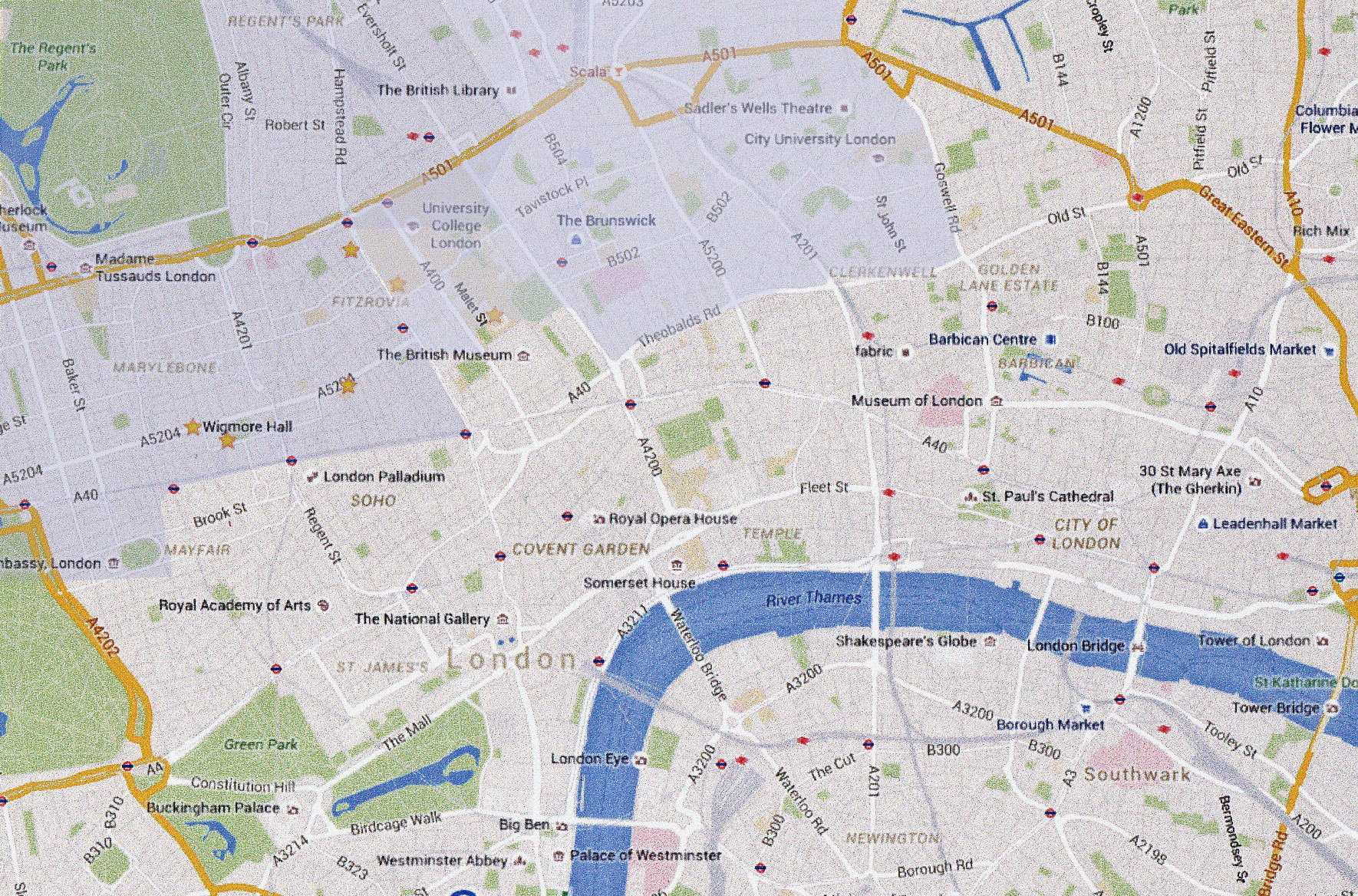
Before we get into that though here’s a quick update on overall progress so far (including today).

Covered So far copy

So today’s excursion takes Sadler’s Wells as its starting point and begins by heading north on Arlington Way and after a quick diversion along Chadwell Street merges into St John Street up to the apex with Goswell Road. On the way we pass the Old Red Lion Theatre (currently showing a world premiere of Arthur Miller’s first play “No Villain”). Criss-cross between Goswell Road and St John Street using Owen Street and Friend Street. The latter then links via Hermit Street and Paget Street to Rawstorne Street. This is occupied along its southern side by the Brewers Buildings, constructed in the 1870’s in an act of philanthropy by the Brewer’s Company, one of London’s historic livery companies.

Back on Goswell Road nos. 338-346 form the site of Angel House, a former tobacco warehouse with a set of distinctive travel-related plaques on its frontage.

Spencer Street, Earlstoke Street and Wynyatt Street take us back again to St John Street and turning south here takes us to the main building of City University. The University was originally founded in 1894 as the Northampton Institute with the objective of promoting ‘the industrial skill, general knowledge, health and wellbeing of young men and women belonging to the poorer classes’. It achieved university status in 1966 by Royal Charter. At the moment City University is not one of the federal colleges of the University of London but it was announced this year (2105) that it will become so as from August 2016. Alumni include  the likes of Tony Blair and Michael Fish amongst their number.

The University buildings cluster around Northampton Square from which radiate Wyclif Street, Ashby Street and Sebastian Street.

P1040766

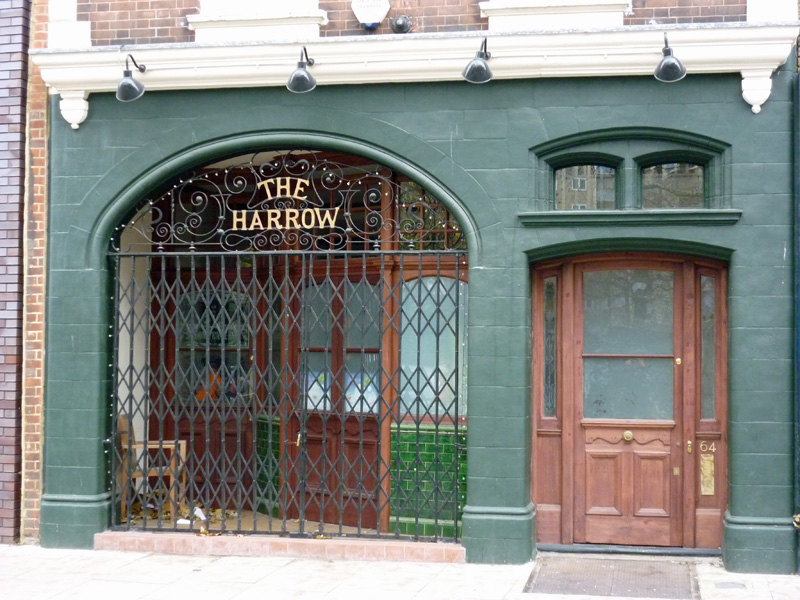
Next rung down is Percival Street which links, via Agdon Street and Cyrus Street, to Compton Street. This was the site of the Harrow public house from as far back as the 1760’s up to the late 1980’s. The building below dates from 1904-05, part of the Watney Combe Reid estate.

P1040767

Back on Goswell Road we encounter the design studio of the internationally-renowned architect Zaha Hadid (best known here for the Aquatics Centre for the 2012 Olympics). It’s not one of those places you can just pop into for a browse.

These days Clerkenwell is the main hub for London’s architecture and design studios and this is in full evidence in the cluster of streets around Brewery Square; Brewhouse Yard, Dallington Street, Pardon Street, Northburgh Street, Great Sutton Street and Berry Street.

Once these are out of the way we hit Clerkenwell Road itself

Head west until we reach St John’s Square, home to the Priory of the Order of St John. The origins of the Order and its mission to administer to the sick and injured lie as far back as 11th century Jerusalem. The Priory Church Clerkenwell was occupied by the Order from around 1140 to 1540 when, because of its association with the Catholic Church, the English branch was disbanded during the reign of Elizabeth I. Subsequently the building was put to a number of different uses, coffee house, pub, offices of the Master of the Revels, until the Order of St John in England was resurrected in 1888 by Royal Charter. Although it has other activities it is most prominent today in the guise of the St John’s Ambulance. Unfortunately, today both the museum and garden were closed (despite what is says on the sign).


This slideshow requires JavaScript.

St John’s Square is also home to the rather twee Zetter TownHouse Hotel and this gravity-defying paean to petty crime.

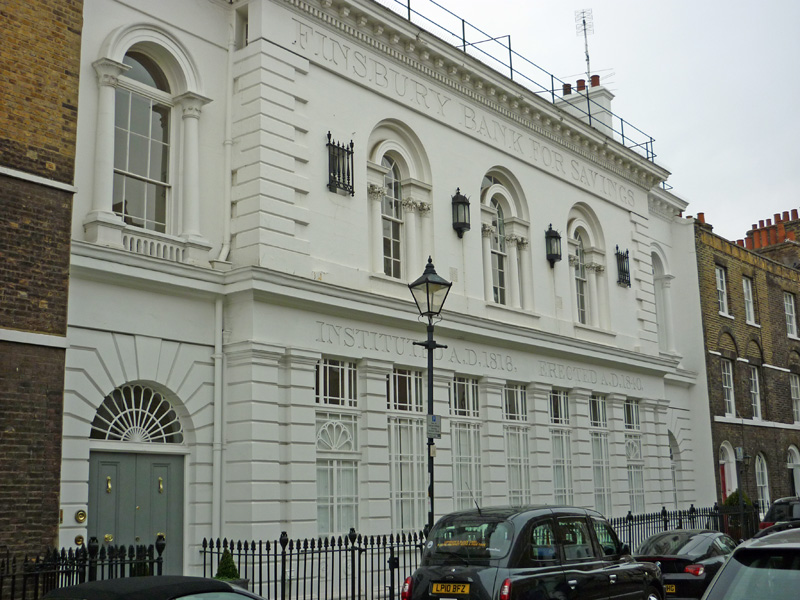
Leave the square via Jerusalem Passage which leads into Aylesbury Street and from here go north along Woodbridge Street as far as Sekforde Street. Here we find the site of the one-time Finsbury Savings Bank and another Dickens connection; apparently he deposited some trust funds here in 1845. The bank was absorbed into the London Trustee Savings Bank around 1928 and this branch closed in 1960.

P1040781

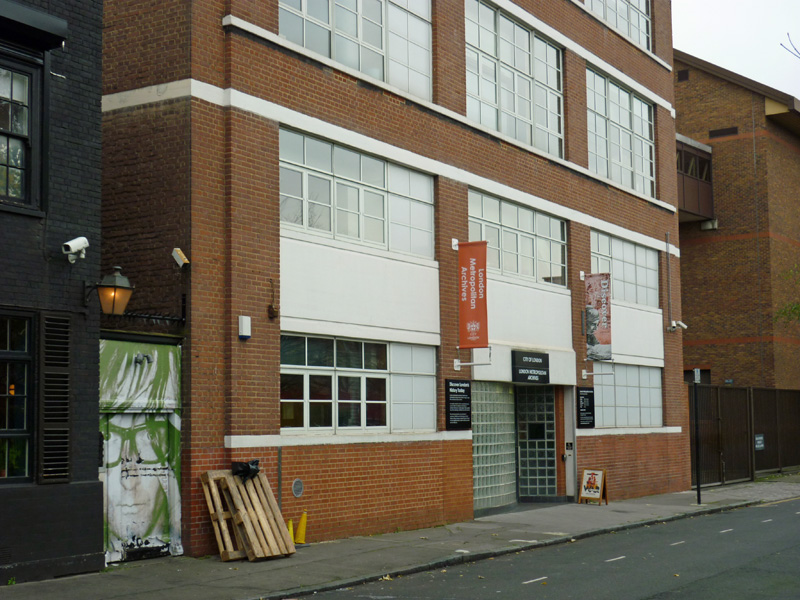
Continue back to St John Street and then sharp right into Skinner Street which skirts Spa Fields Park. At the top end we cut back through the park to reach the apex of the dog-legged Northampton Row which is the location of the London Metropolitan Archives.

P1040782

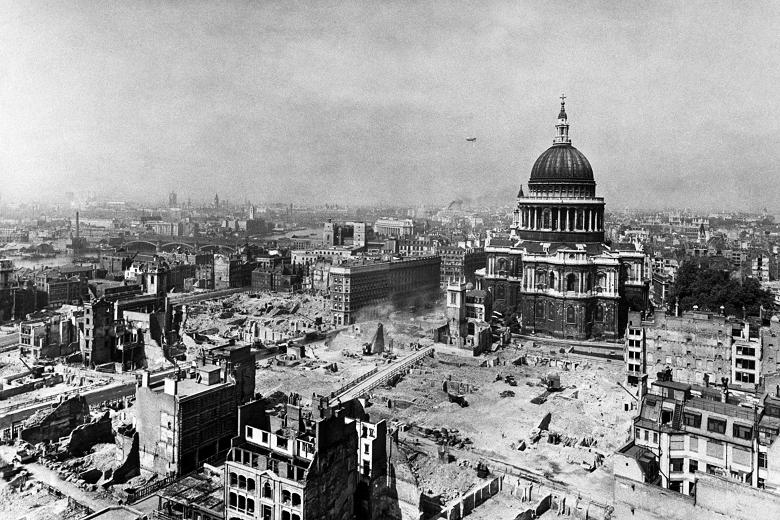
This free resource is home to an extensive collection of documents, images, maps, books and films covering around 900 years of London’s history. Took the opportunity to apply for a History card and also look around the current (to 27 April 2016) exhibition on War in London. This includes some very sobering photographic archives showing the destruction caused by the bombing raids of both World Wars. As the image below dramatically reminds, St Pauls only survived WWII against some pretty considerable odds.

Blitz_2_53923b

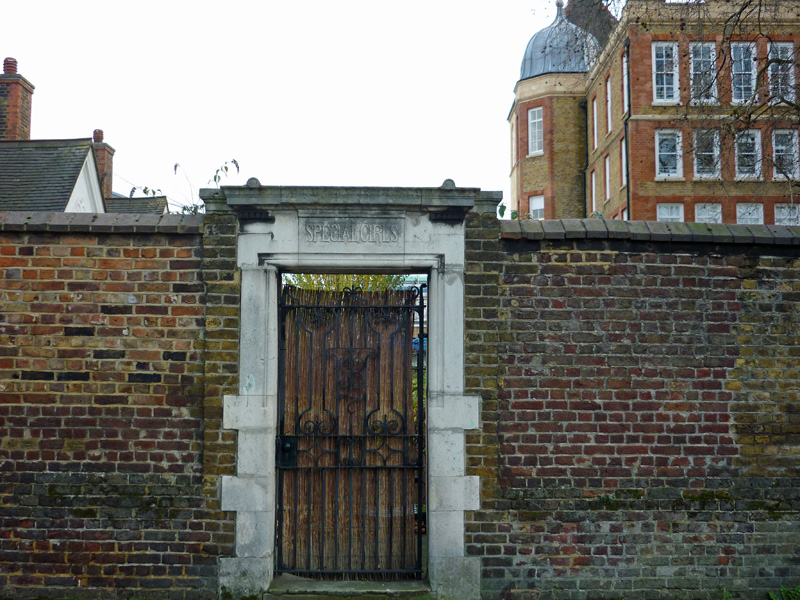
At either end of Northampton Road lies Bowling Green Lane which segues into Corporation Row which runs along the back of the former Hugh Myddleton (that man again) School. There were separate entrance gates here for Boys, Girls and so-called Special Girls. This was not intended in the Jose Mourinho sense of the word I believe but probably alludes to the fact that there was a separate school of deaf and dumb children on the premises at one time.

P1040783

Turning right back into Woodbridge Street and again into Sans Walk brings us round to the front side of the building, now offices and flats (of course).

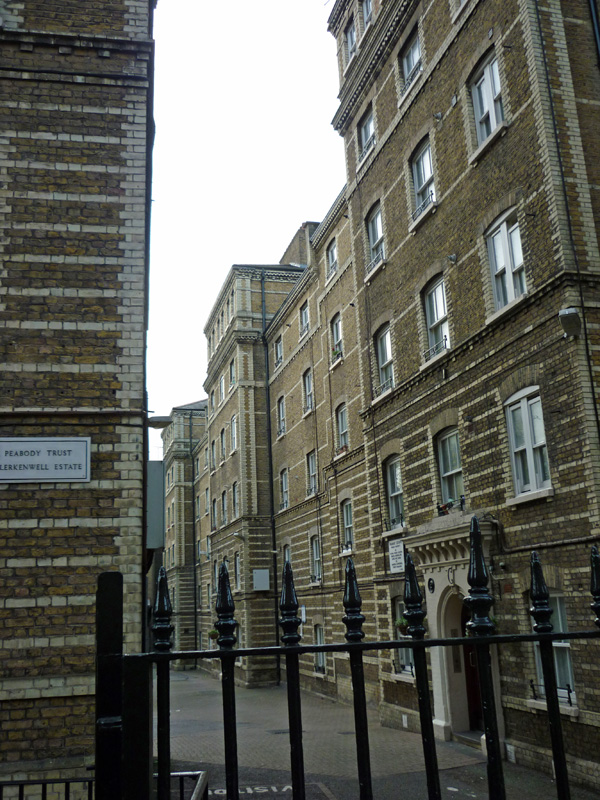
Head down St James Walk next and cut through St James’s Church Gardens to reach the two limbs of Clerkenwell Close on the eastern side of which sits the Peabody Estate, Pear Tree Court. This was one of six such estates built by the Peabody Trust in the late 1870s and 80s on sites cleared by the Metropolitan Board of Works. The Peabody Trust was one of the original London Housing Associations established in 1862 by the American Banker, George Peabody. It continues to fulfil that charitable mission to the present day.

P1040787

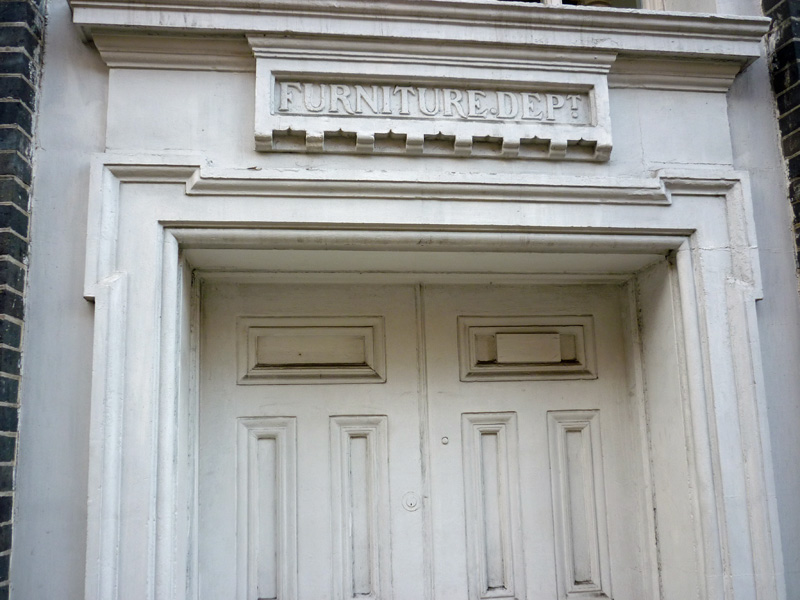
Also on Clerkenwell Close are former warehouses which were built in 1895–7 as the central stores of the London School Board. This is one of the several original entrances still visible today.

P1040786

Pear Tree Court leads out onto Farringdon Lane where we head south alongside the railway and past Vine Street Bridge. The sign in the picture below helpfully provides a number call if your vehicle should crash into the bridge.

P1040788P1040789

P1040790

Ok so we’re on to the final lap of this one, left into Clerkenwell Road then up Clerkenwell Green and back onto Clerkenwell Close to take a closer look at St James’s Church. This has apparently been a religious site since the 12th century though the current church dates from 1792. Unfortunately it wasn’t possible to get a look at the interior of the church, or its much vaunted crypt, on this occasion.
By way of compensation today’s Pub of the Day, the splendid Three Kings, is just across the road. A public house has occupied this spot since at least the 18th century, when it was originally known as the Three Johns. The somewhat unprepossessing exterior (blame a re-tiling job in 1938) is more than made up for by the splendidly idiosyncratic interior styling.

Until next time…