Day 82 – Midland Road – York Way – Copenhagen Street – Caledonian Road

Following an extended summer break, today’s walk sees us return to the area around King’s Cross for the first time in ten years, during which, I think it’s fair to say, quite a bit has changed. We visit the area to the north of KX station which has undergone a massive make-over in the last couple of decades then venture eastward into Pentonville, bordered to the south by the eponymous Road and to the north by Copenhagen Street. All of which is intersected by the Regent’s Canal.
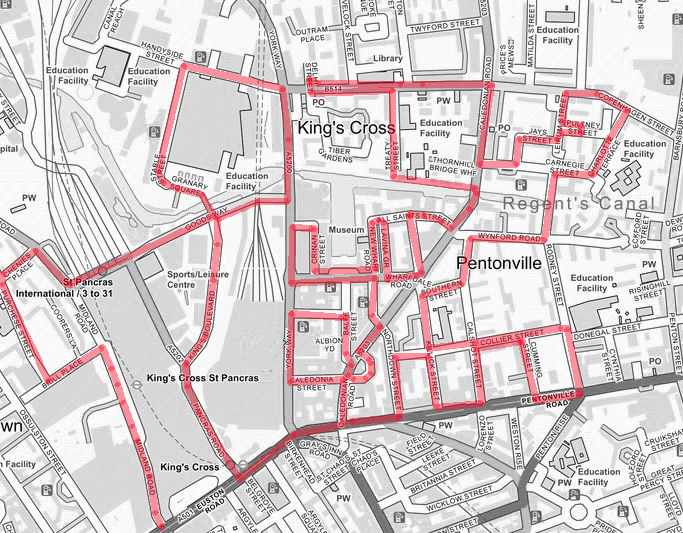
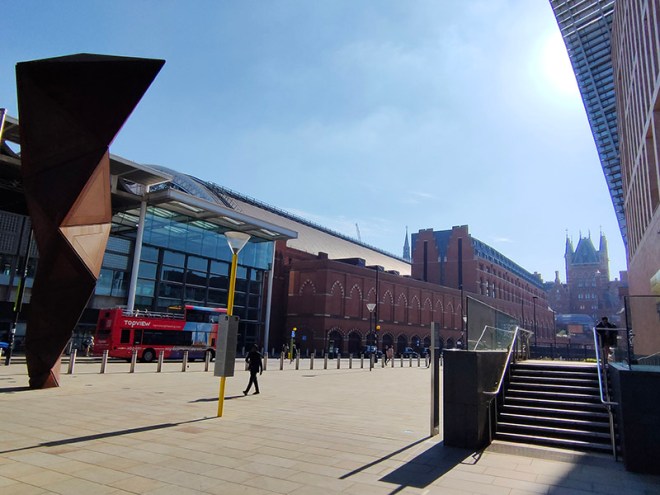
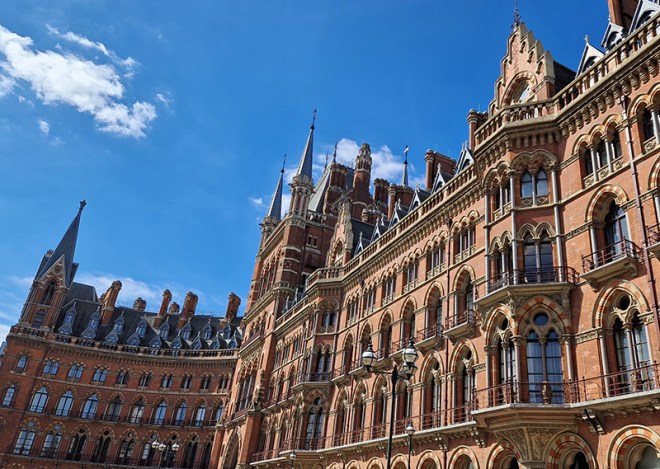
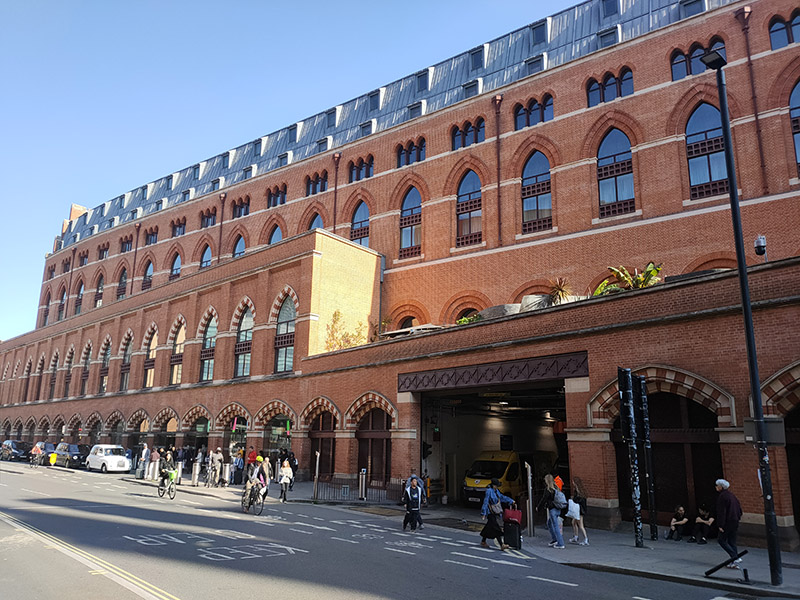
We kick off at the southern end of Midland Road which runs northward between the British Library and St Pancras International (both of which we dealt with back on Day 9). We also covered the always astonishing Renaissance Hotel (née Midland Grand Hotel) back then but as a bit of a bonus we’ll take another look at that at the end of this post.
Adjacent to the British Library, to the north, is the Francis Crick Institute, named after the British scientist who along with James Watson identified the structure of DNA in 1953, drawing on the work of Maurice Wilkins, Rosalind Franklin and others. The Crick, as it is generally known, is home to a partnership between six of the world’s leading biomedical research organisations: the Medical Research Council, Cancer Research UK, Wellcome, UCL (University College London), Imperial College London and King’s College London. The genesis of this partnership was the 2007 Cooksey report which looked at ways to consolidate and enhance medical research in the UK. The institute was officially opened by Queen Elizabeth in November 2016 and was fully operational by the spring of 2017. It now houses over 2000 people and more than 100 research groups.
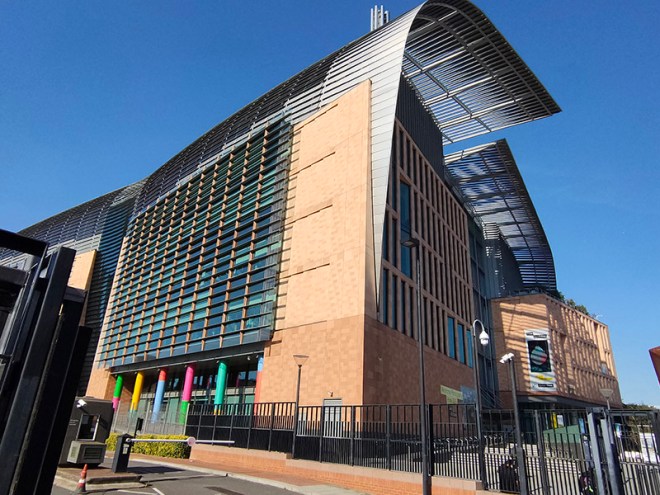
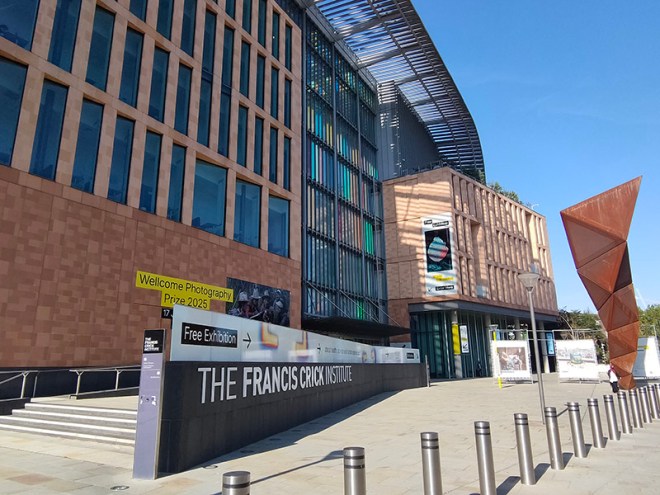
Beyond the Crick we turn left into Brill Place then follow Purchese Street and Chenies Place back round to Pancras Road which takes over from Midland Road.
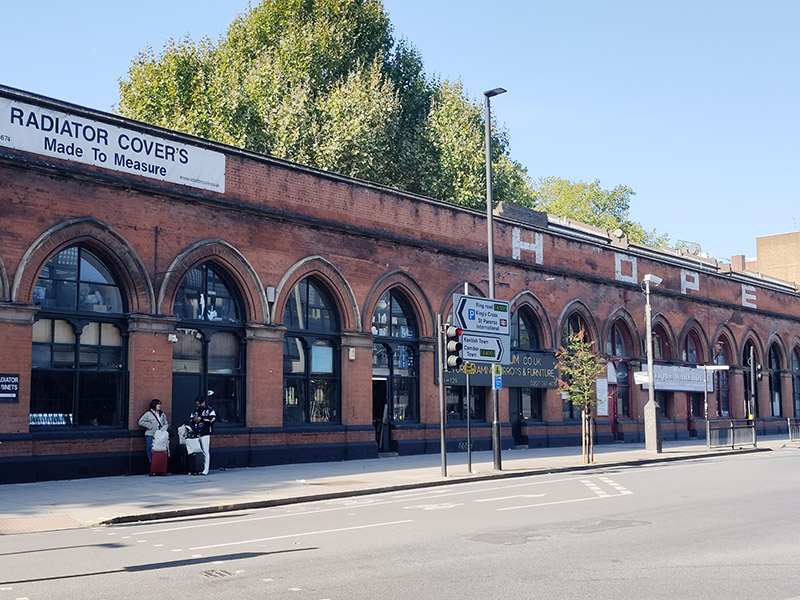
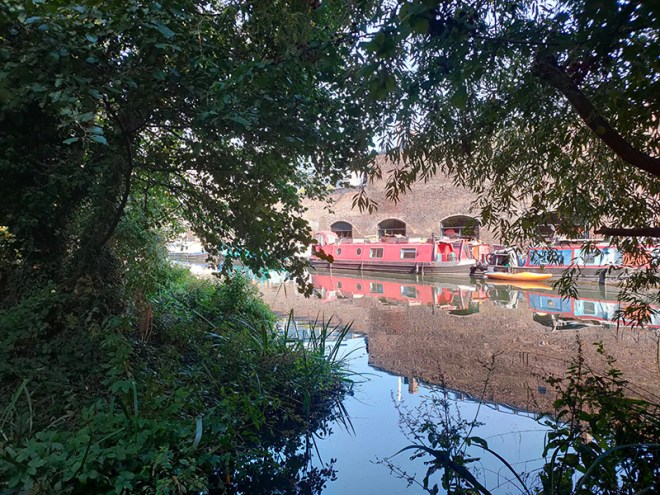
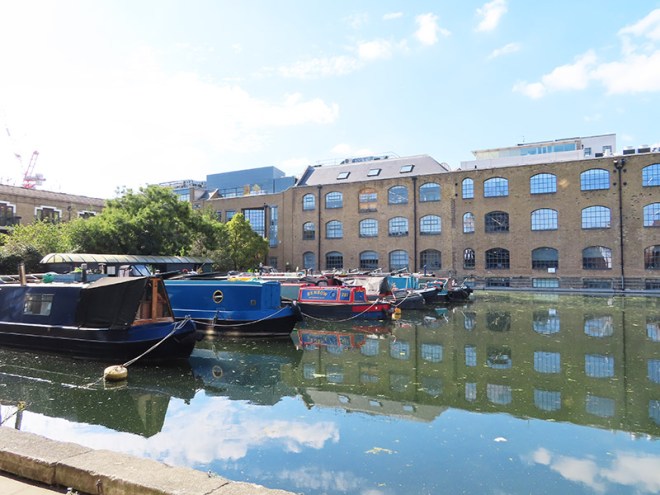
Pancras Road partially veers east in the form of a tunnel under the rail lines out of St Pancras then morphs into Goods Way. To the north of Goods Way, sandwiched in between Camley Street and the Regent’s Canal is the Camley Street Natural Park, a little patch of wilderness in the city. The site was once a coal drop for the railways into King’s Cross Station, which was demolished in the 1960s. As it was subsequently colonised by nature the London Wildlife Trust ran a campaign in the 1980’s to save the site from development and create a nature reserve which opened in 1985. Nice café if you’re in the vicinity. They’ll even do you an Aperol Spritz (which I think demonstrates that we’ve now reached peak Aperol Spritz).
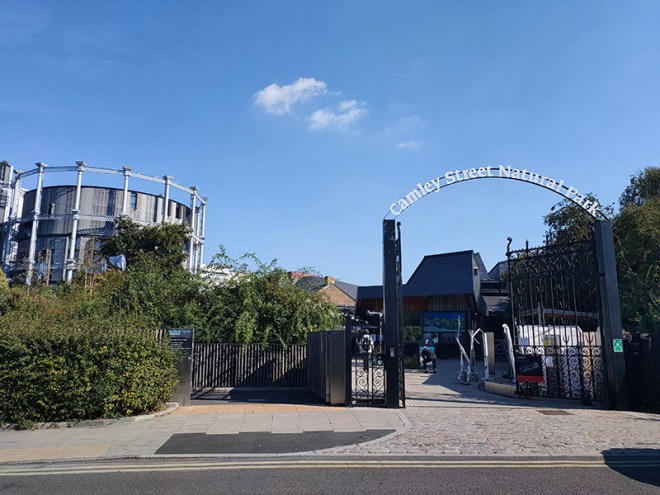
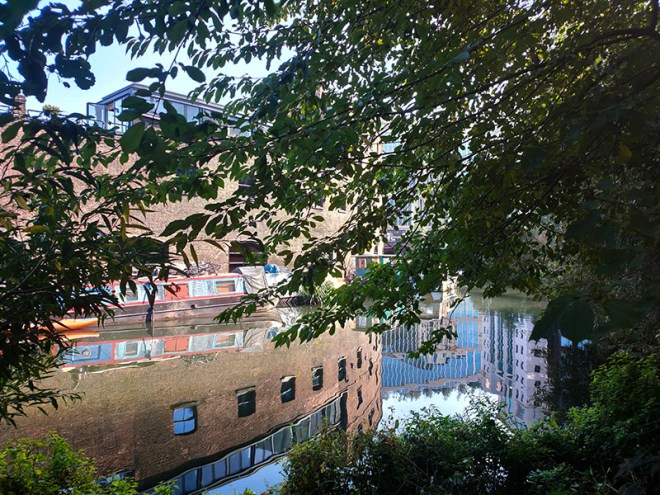
After polishing off an Earl Grey tea and ham and cheese croissant at the café we cross the canal via the Somerstown Bridge and enter the heart of the King’s Cross regeneration.
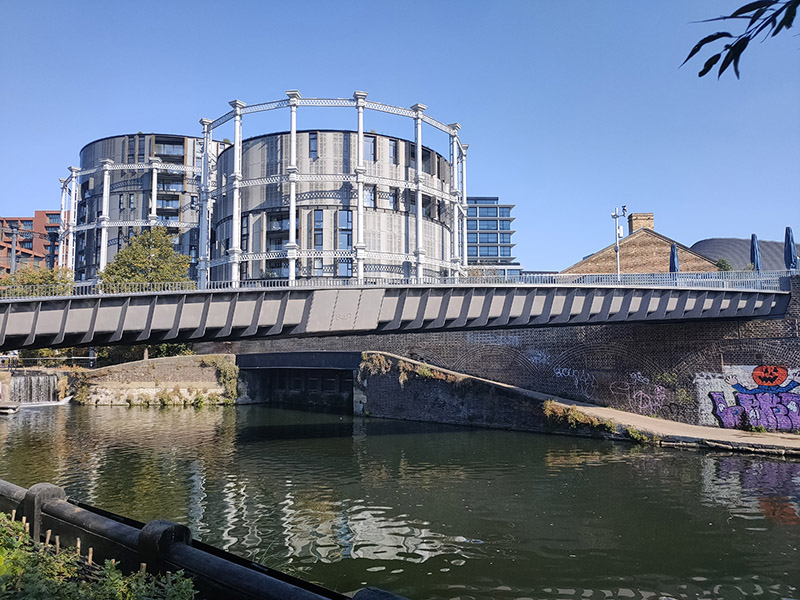
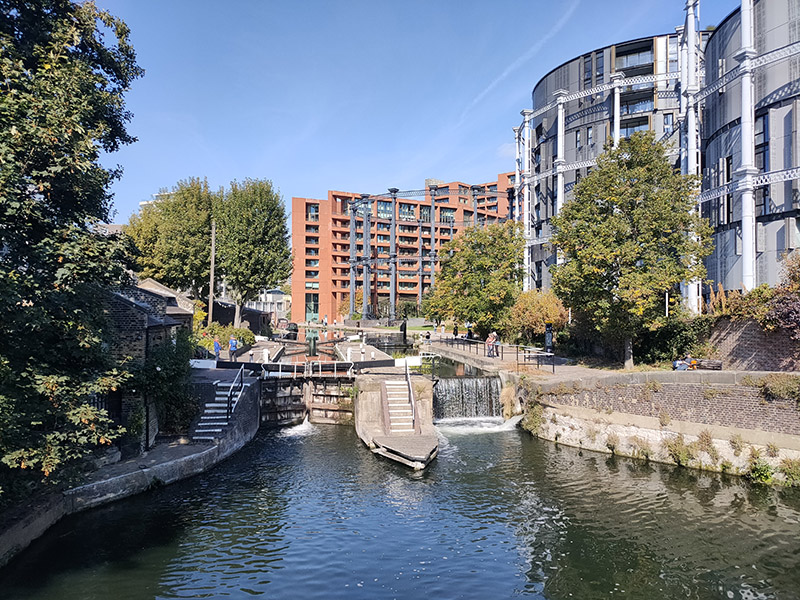
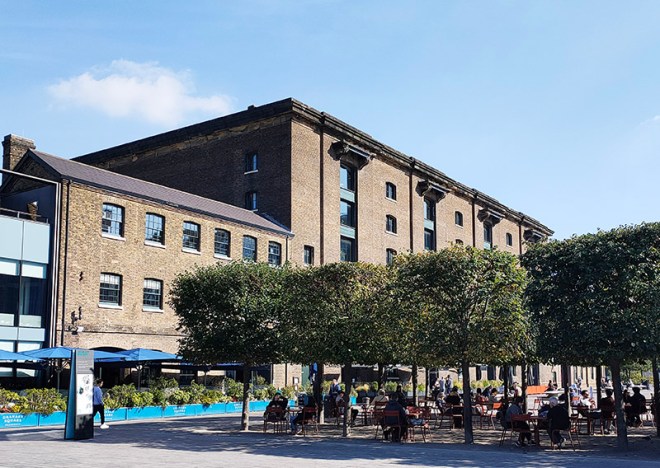
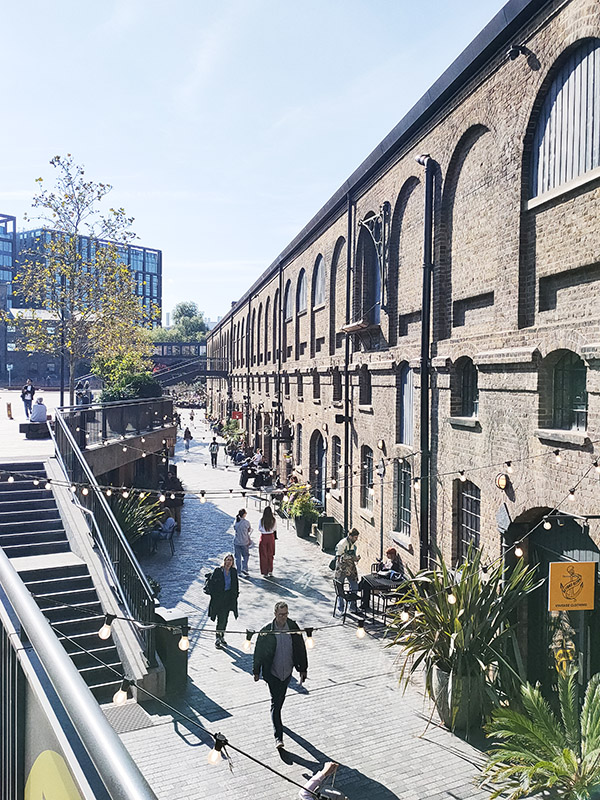
A potted history : In the early 19th century, prior to the arrival of the railways, this area had already developed into an industrial hub with the opening of the canal in 1820 and the Pancras Gasworks in 1824. A number of other “polluting” businesses such as paint manufacture and refuse sorting were also established in the area giving it a somewhat tarnished reputation. In an attempt to offset this, a huge memorial to, the recently deceased, King George IV was erected at a major crossroads in 1836. The memorial attracted ridicule and was demolished in 1845 to ease the flow of traffic, but the new name for the area – ‘King’s Cross’ – stuck. King’s Cross station opened in 1852 and St Pancras station followed around 15 years later. In the latter years of the 19th century both the railways and the gasworks were expanded leading to the demolition of much of the surrounding housing. After WWII and nationalisation of the railways in 1948, the transport of freight by rail suffered a rapid decline and in the southern part of the Goods Yard, most of the rail lines were lifted in the 1980s. Although six gasholders remained in service until 2000, the area went from being a busy industrial and distribution district to a place that was synonymous with urban sleaze and decay, consisting mainly of derelict and disused buildings, railway sidings, warehouses and contaminated land. At the same time it became something of a hub for artists and creative organisations and was closely associated with the illegal rave scene in the 1990’s.
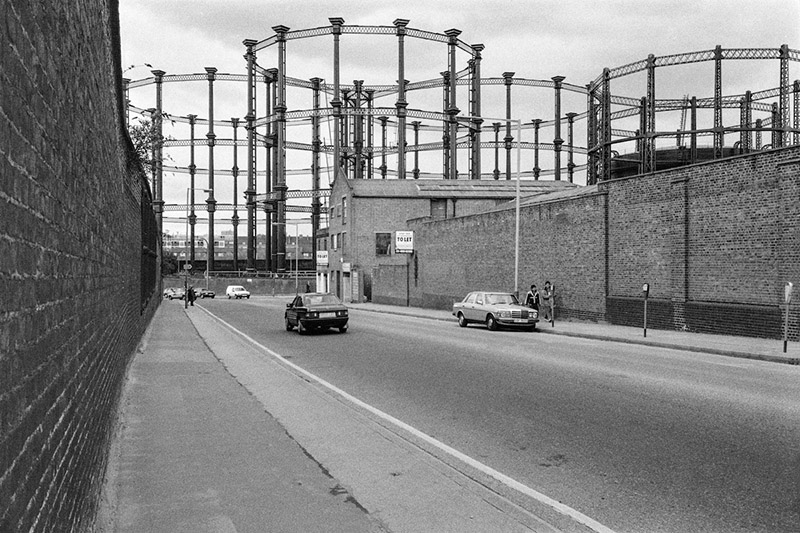
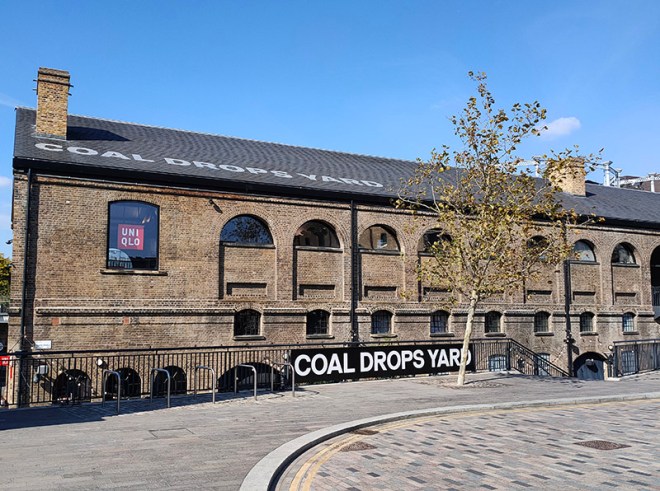
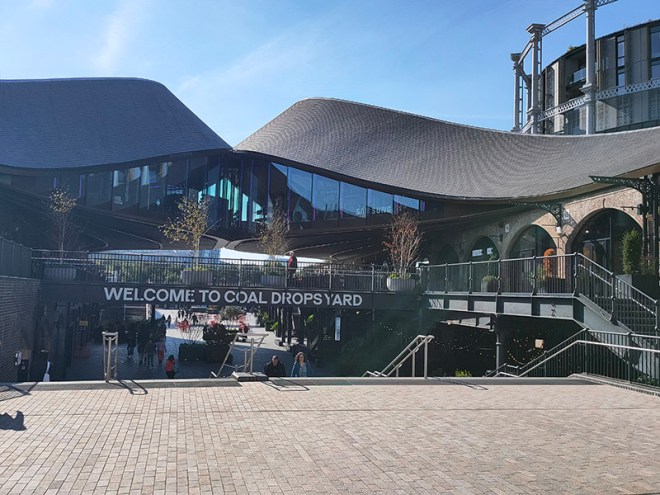
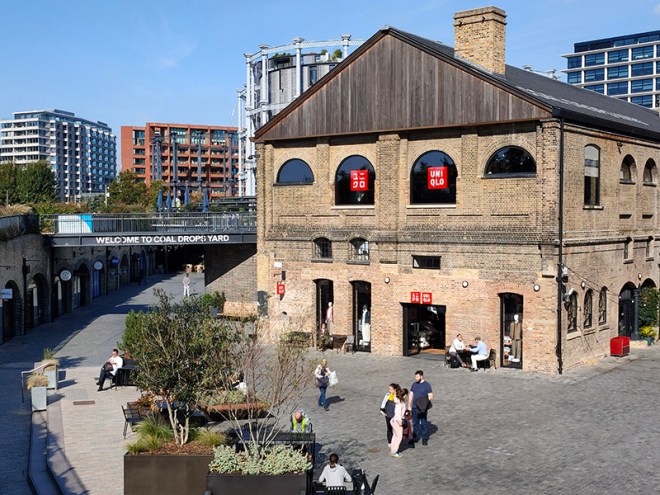
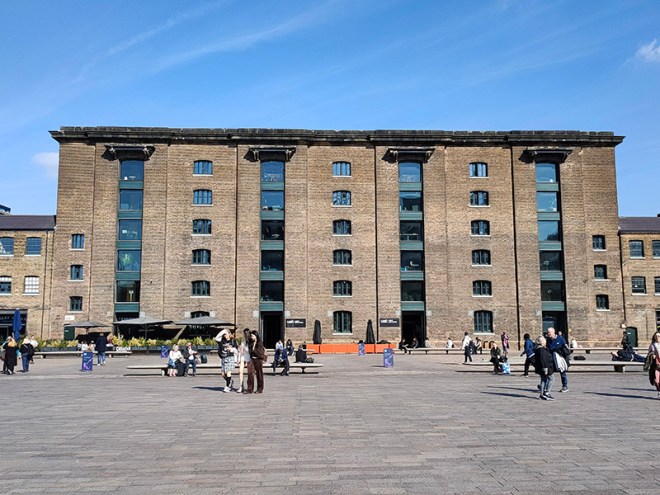
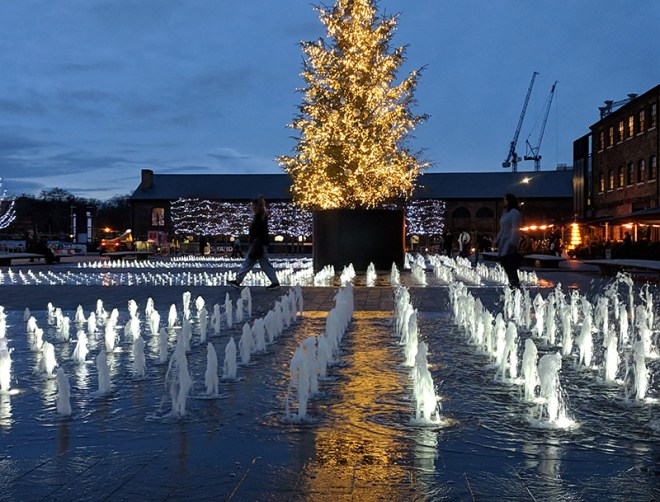
The 1996 decision to move the Channel Tunnel Rail Link from Waterloo to St Pancras became the catalyst for redevelopment by landowners, London & Continental Railways Limited and Excel (now DHL). It took another ten years though before outline planning permission was granted for 50 new buildings, 20 new streets, 10 new major public spaces, the restoration and refurbishment of 20 historic buildings and structures, and up to 2,000 homes. Early infrastructure works began in 2007, with development starting in earnest in late 2008. Much of the early investment was focused in and around the Victorian buildings that once formed the Goods Yard. In September 2011, the University of the Arts London moved to the Granary Complex, and parts of the development opened to the public for the first time. Since then the historic Coal Drops have been redeveloped as a shopping destination, and companies such as Google, Meta, Universal Music and Havas have chosen to locate here. New public streets, squares and gardens have opened, among them Granary Square with its spectacular fountains and Gasholder Park. In January 2015, the UK government and DHL announced the sale of their investment in the King’s Cross redevelopment to Australian Super, Australia’s biggest superannuation/pension fund. I must confess here that there is a part of me which wishes I had thought to undertake this project before all of the above happened.
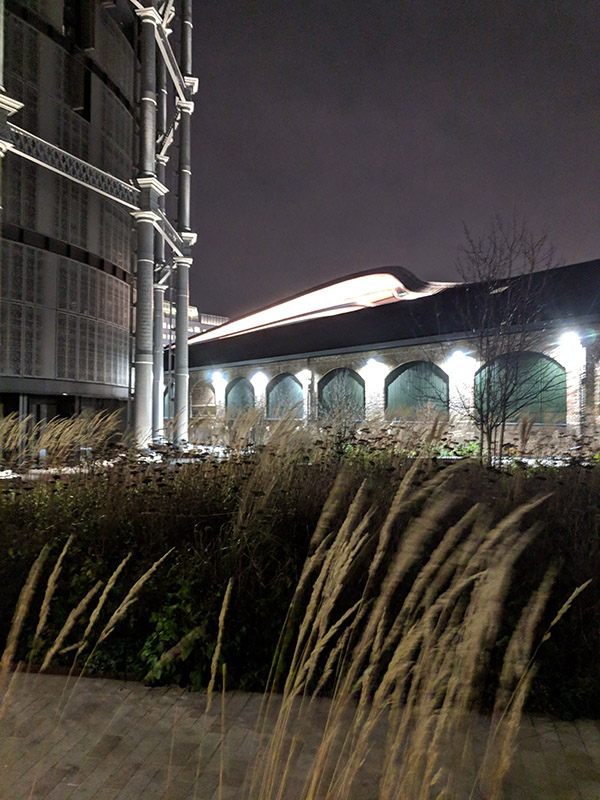
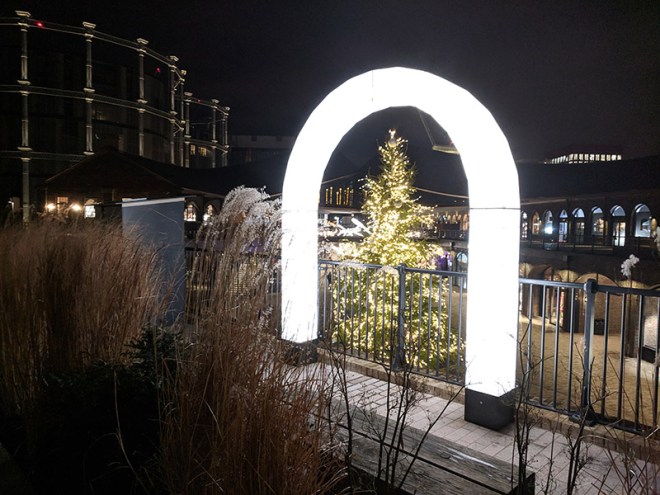
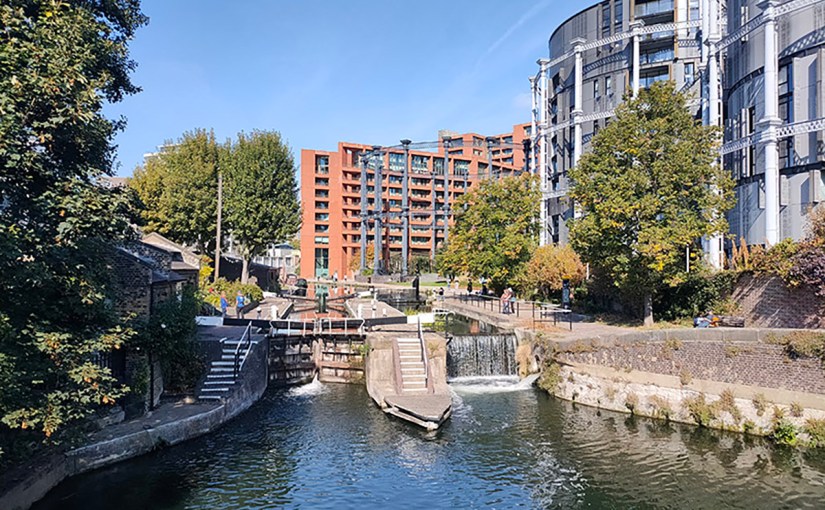
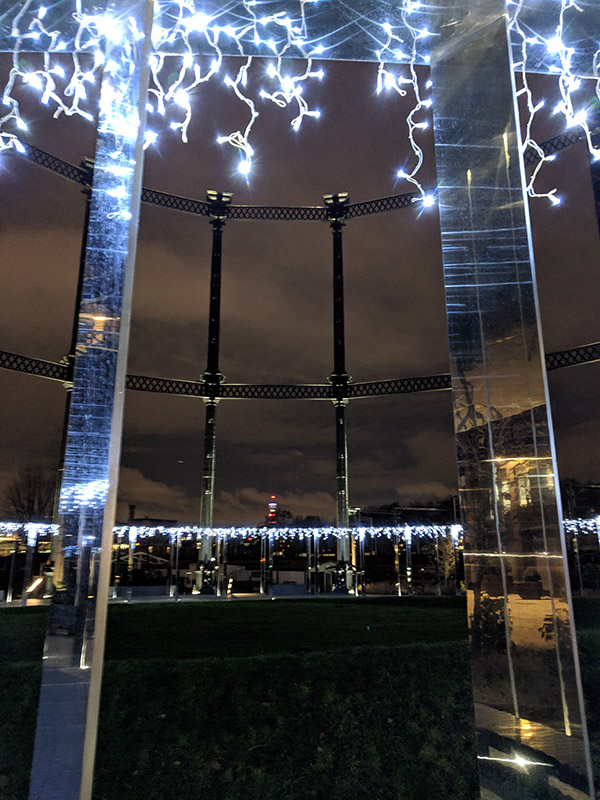
Three of the Gasholders built for the Pancras Gasworks in 1860-67, known as the ‘Siamese Triplet’, because their frames are joined by a common spine, escaped demolition and were awarded Grade II listed status. As part of the renewal programme these were painstakingly restored over a five year period by a specialist engineering firm in Yorkshire and upon their return to King’s Cross, erected on the northern bank of Regent’s Canal and developed into 145 apartments, designed by Wilkinson Eyre Architects, and completed in 2018. (The photos below are from a previous visit in December 2020).
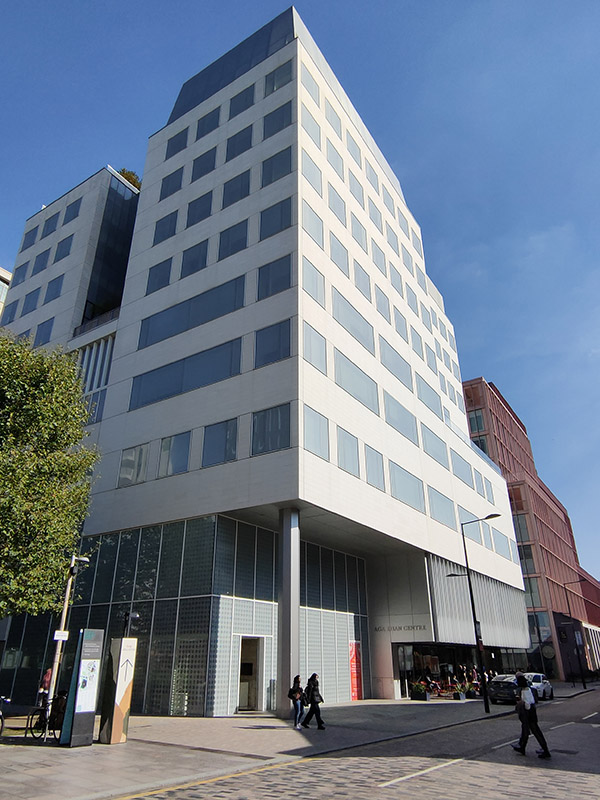
Stable Street runs through the middle of the development area as far as Handyside Street. At their intersection stands the Aga Khan Centre, the UK home for three organisations founded by His Late Highness Aga Khan IV, the hereditary spiritual leader of the Shi‘a Ismaili Muslims. The building was designed by the Japanese architect, Fumihiko Maki, who unfortunately passed away in 2024. The building is influenced by Islamic architectural history and is clad in detailed pale limestone, referencing the grand Portland stone buildings across London.
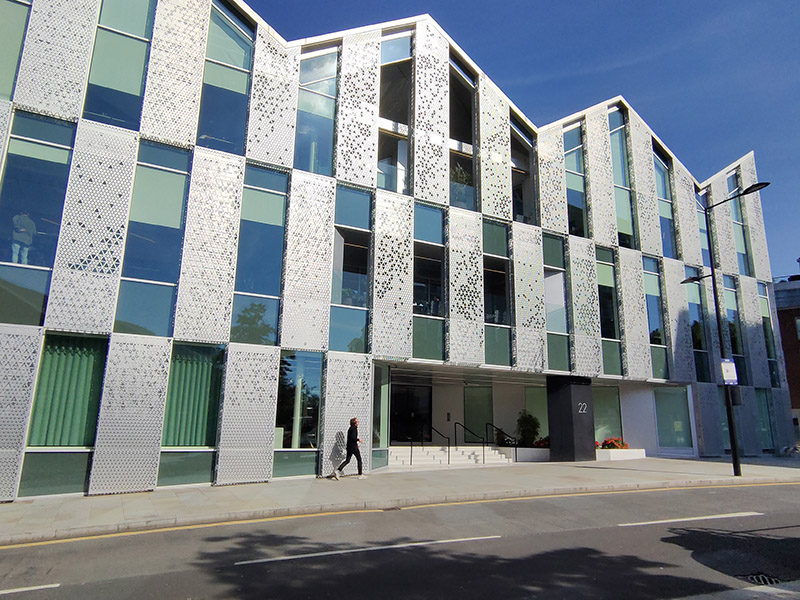
The striking Q1 office building at 22 Handyside was built over three listed railway tunnels so the design involved a lightweight structure with a diagonal orientation clad in perforated panels of anodized aluminium.
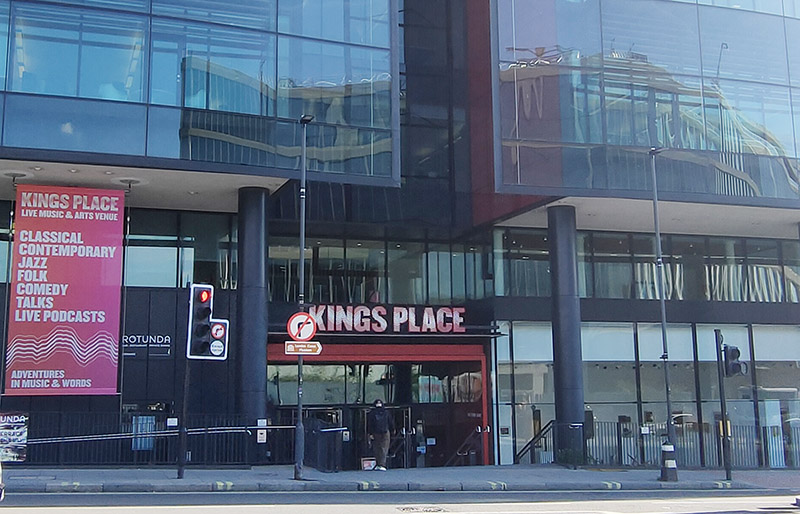
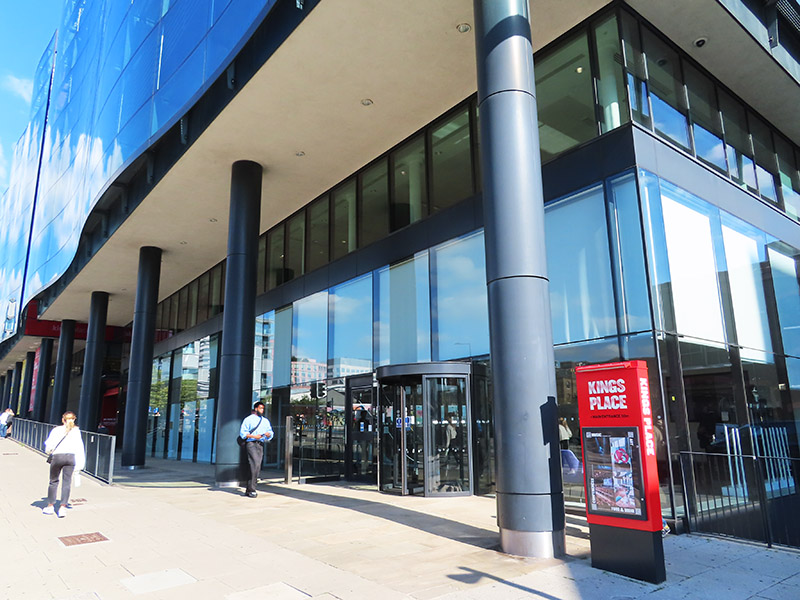
We head back south on York Way. Prominent on the east side is King’s Place music and arts venue which has been hosting an excellent programme of classical, contemporary and jazz concerts since 2008 and is also home to the London Podcast Festival. Dixon Jones were the architects for the building, which contains the first new public concert hall to be built in Central London since the completion of the Barbican Concert Hall in 1982.
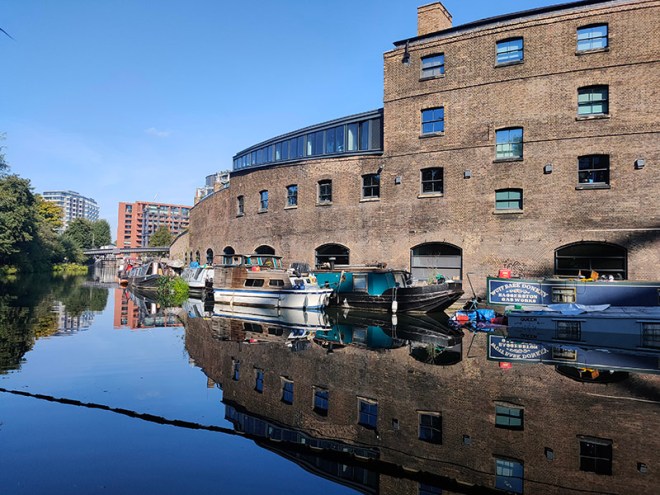
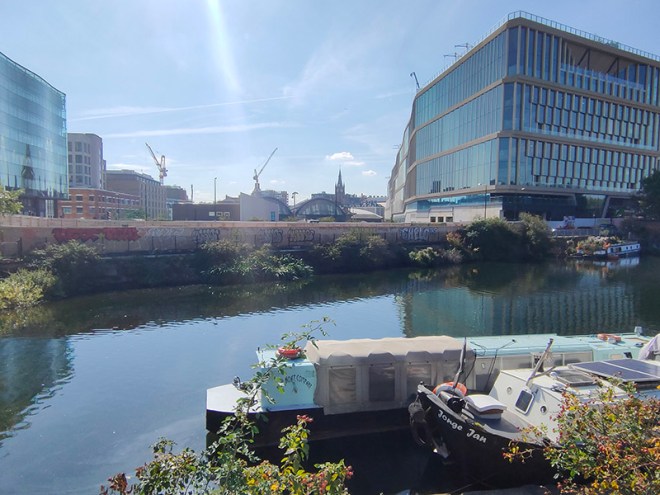
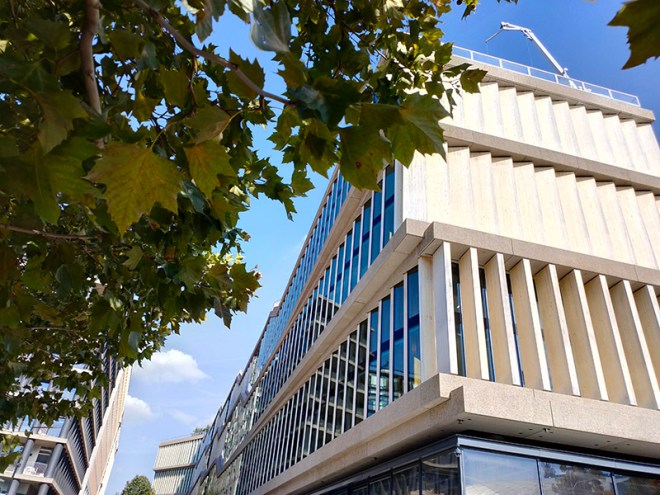
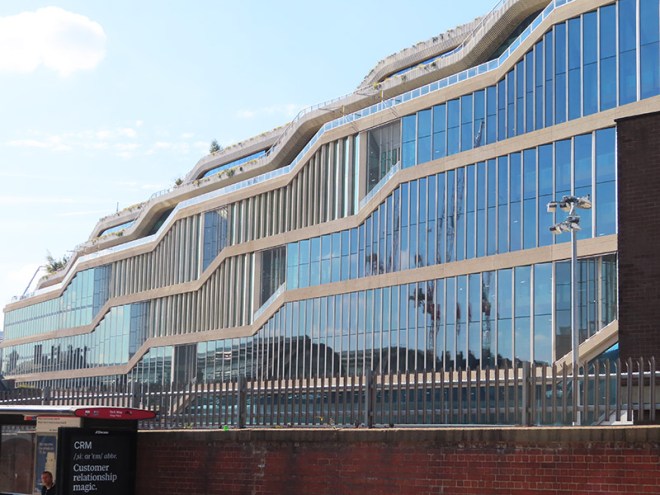
Returning to Goods Way we follow the canal along to Granary Square then turn down onto Kings Boulevard, almost the whole length of which, as far as the north end of King’s Cross Station, is flanked by Google’s new UK HQ. Construction on this, the first wholly owned and designed Google building outside the US, began way back in 2018. Designed by Heatherwick Studio and Bjarke Ingels Group (BIG), the purpose-built 11-storey building, which is 72 metres tall at its highest point and 330 metres long has been dubbed a “landscraper”. The 861,100sq ft of office space will, upon completion, make it the 8th largest building in Europe by office space and provide the potential to house 7,000 Google employees. Those employees are expected to start moving in later in 2025.
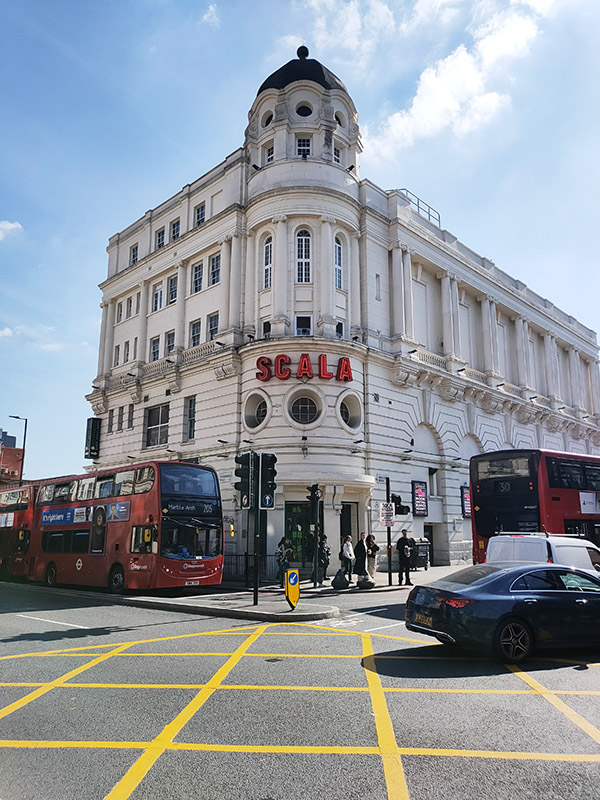
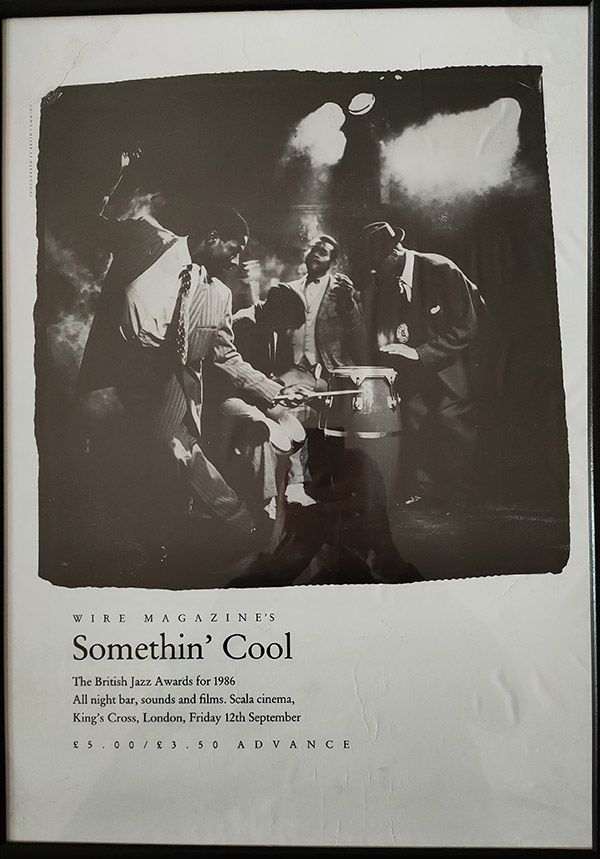
We round Kings Cross Station via Pancras Road and the fag end of Euston Road and find ourselves at the start of Pentonville Road opposite the Scala. I wrote about this back in Day 12 but at that time (towards the end of 2015) the building was swathed in scaffolding so there were no photographs included. I can now belatedly rectify that and also mention (which I didn’t before) that my one visit to the Scala was to attend the 1986 British Jazz Awards all-nighter (an event about which the internet is entirely ignorant it seems – this framed poster still hangs on my bedroom wall).
Across the road from the Scala we enter the Caledonian Road at its southern end then complete a circuit of Caledonia Street, York Way, Railway Street and Balfe Street. Nos. 17 and 17a on the latter are Grade II listed. These mid-19th century terraces must have had some remarkable changes of fortune during their lifetime and I doubt they have ever been more desirable than they are now.
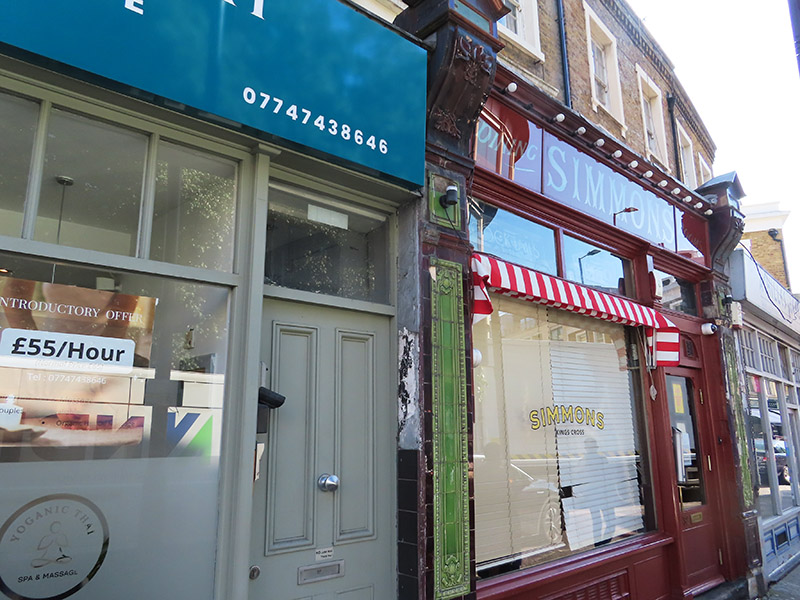
Back on Caledonian Road, the first of the Simmons chain of bars (opened in 2012) has cutely retained the façade of the old style tearoom that preceded it.
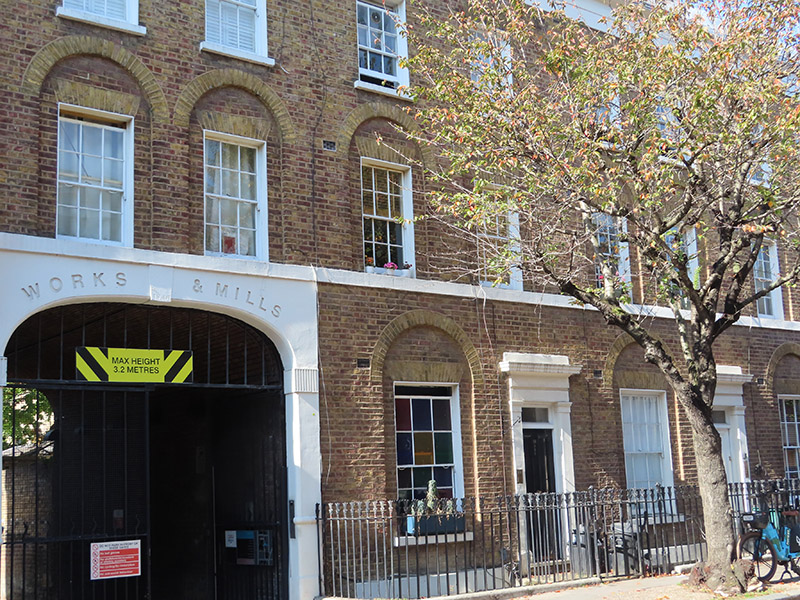
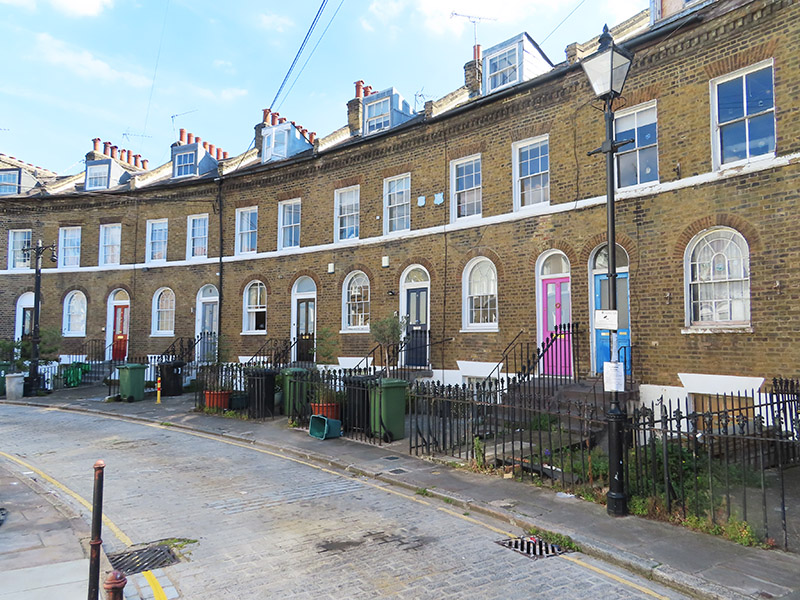
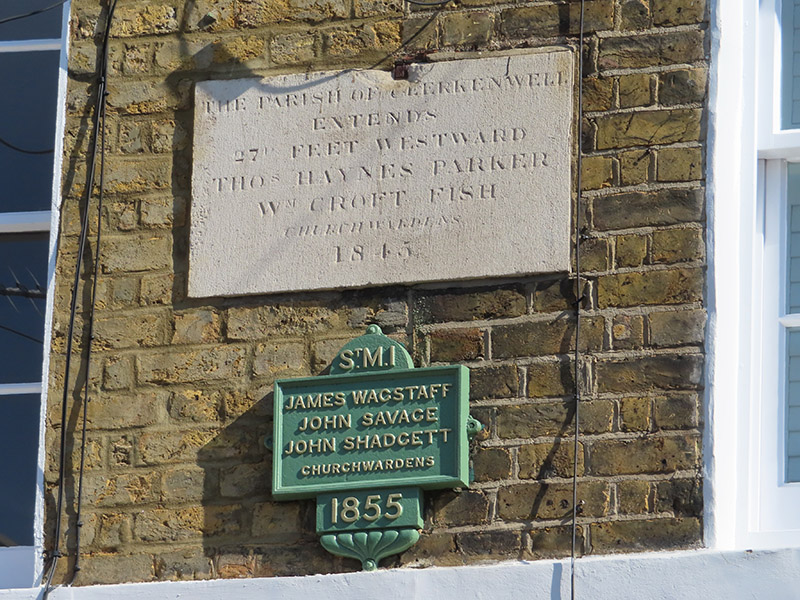
From here we swing left round Keystone Crescent (formerly Caledonian Crescent). Built by the son of a Shoreditch bricklayer, Robert James Stuckey, in 1846 this has the smallest radius of any crescent in Europe and is unique in having a matching inner and outer circle. The change of name was effected in 1917 by Robert’s grandson, Algernon, for reasons undocumented. The 24 houses in the Crescent are all Grade II listed; one of them has parish marker plaques that include the names of the local church wardens in 1845 and 1855 and another (no.28) operates as a Private Members’ Speakeasy.
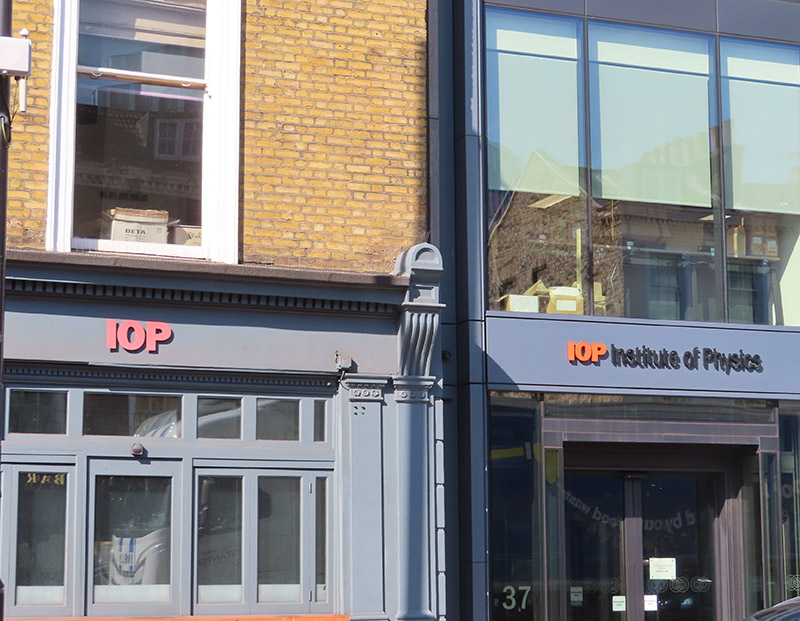
At the other end of the Crescent we’re back on Caledonian Road, naturally enough, and on the opposite side of the road to the Institute Of Physics which I wasn’t able to get a proper shot of due to the ridiculous volume of traffic. Just as well it’s not much to look at then. The IOP as it exists today was formed through the merger of the The Physical Society of London and the Institute of Physics in 1960. The former had been established in 1874, after Professor Frederick Guthrie, of the Royal College of Science, wrote to physicists to suggest a “society for physical research”. The latter was incorporated by the Board of Trade in 1920 with The Royal Microscopical Society and the Roentgen Society as its associate societies. To be honest, it’s not at all clear why two bodies were needed or what the difference between them was. But that’s Physicists for you.
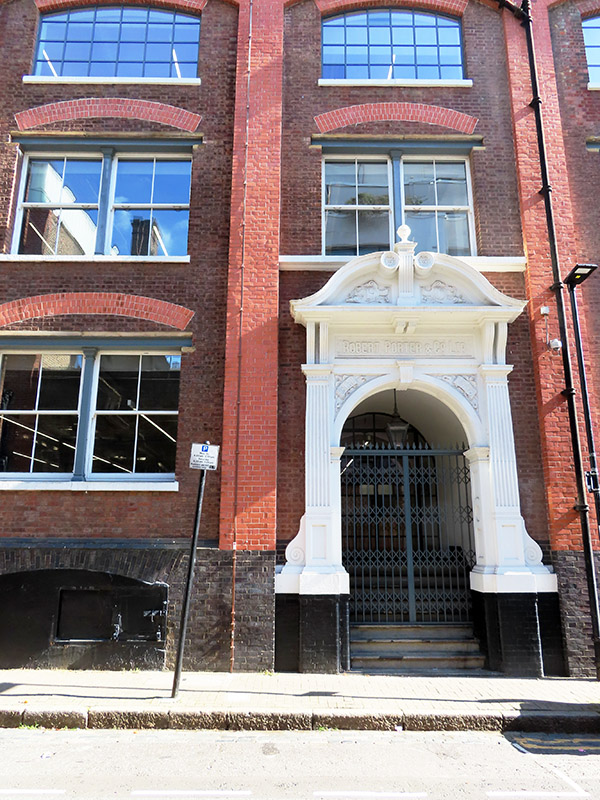
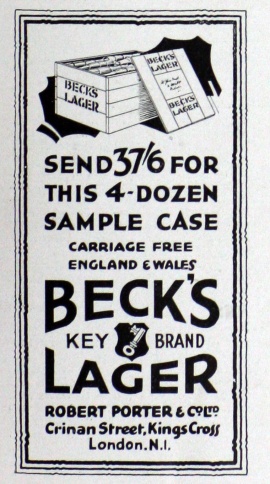
We make our way back to York Way via Northdown Street and Wharfdale Road then just before we reach King’s Place again we turn east onto Crinan Street which loops back to Wharfdale Road. Crinan Street is home the former Robert Porter & Co. Beer Bottling Plant. For some reason I always think of lager as being quite a recent arrival to these shores but (the aptly named) Mr Porter was bottling a Beck’s lager at least as far back as 1927.
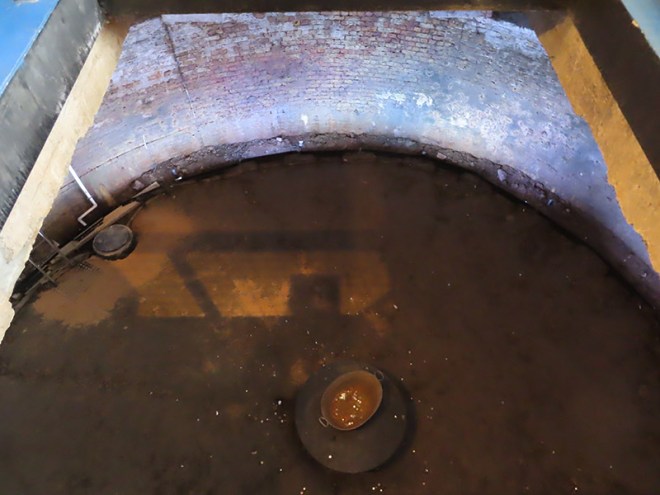
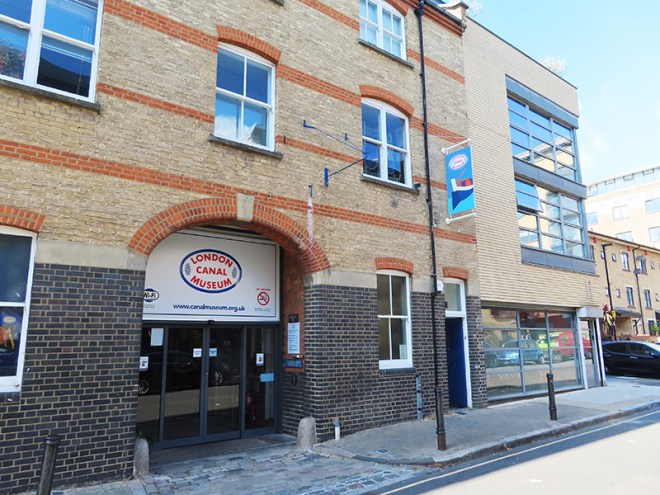
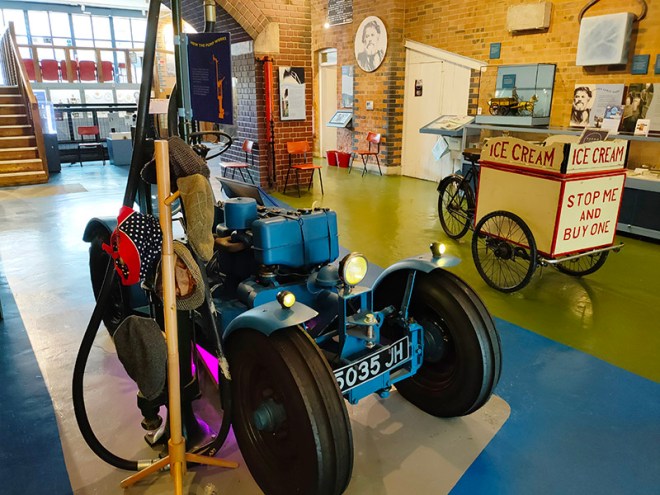
Next up is New Wharf Road where you will find the London Canal Museum. Naturally enough, the museum deals with the story of London’s canals but as it is housed in a former ice warehouse built in about 1862-3 for Carlo Gatti (1817 – 1878), the famous ice cream maker, it also, perhaps more interestingly, features the history of the ice and ice cream trade in this country. Gatti came to London from the Italian speaking part of Switzerland in 1847 and began his business life selling refreshments from a stall, a kind of waffle sprinkled with sugar, and chestnuts in winter. Within a couple of years he had opened his own café and restaurant which included a chocolate-making machine that he later exhibited at the Great Exhibition of 1851. Gatti was one of the first people to offer ice cream for sale to the public and, initially, he made this using cut ice from the Regent’s Canal. Subsequently though, as he concentrated on the ice trade business, he began importing ice that originated in the Norwegian Fjords. The ice well he had built at 12-13 New Wharf Road to cater for his first import of Norwegian ice, a consignment of 400 tons, is still on view at the museum. The museum is small but well worth the relatively modest admission charge. The staff are particularly knowledgeable and communicative.
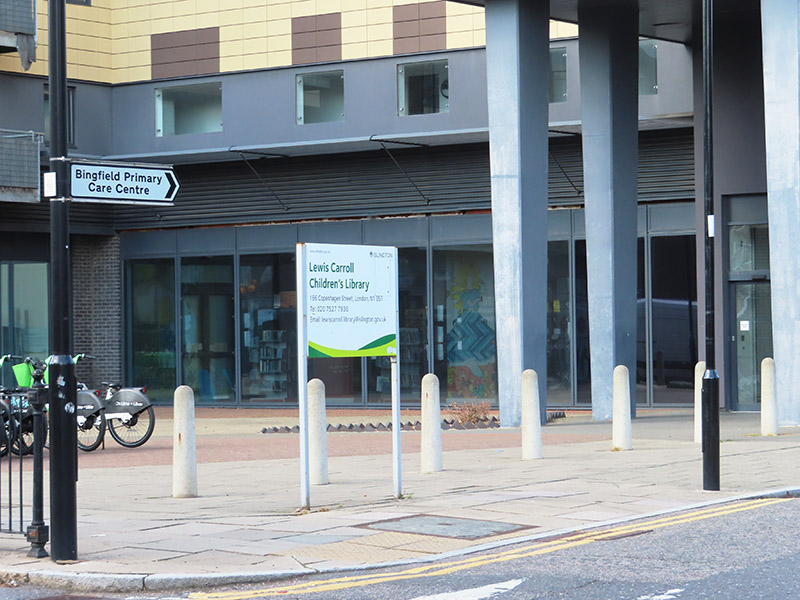
Beyond the museum, New Wharf Street forms a junction with All Saints Street from where we go down Lavina Grove and up Killick Street before re-joining the Caledonian Road. Crossing over the Regent’s Canal again we follow the north bank towpath as far as Treaty Street then continue north onto Copenhagen Street. Here we go west as far as (the miniscule) Delhi Street, York Way Court and Tiber Gardens before doubling back eastward past the Lewis Carroll Children’s Library. The Library opened originally in 1952 and was renovated in 2008 at which time it acquired murals inspired by Carroll’s Alice In Wonderland. Unlike traditional public libraries, the library maintains a unique access policy requiring adults to be accompanied by a child to enter, ensuring the space remains dedicated to its young users. Big up to Islington Council for keeping it going.
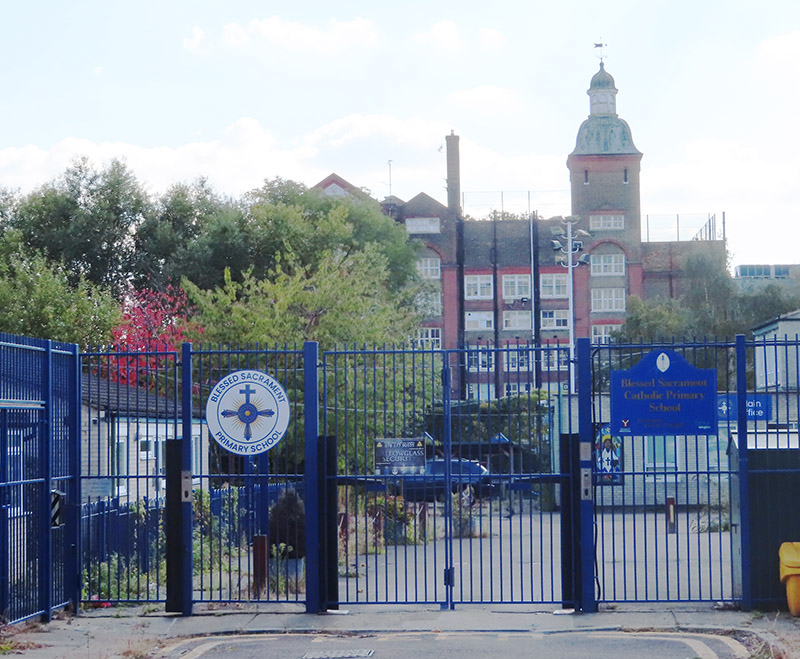
On the other side of Copenhagen Street is a stark illustration of the falling school pupil numbers in certain Inner London boroughs. Islington Council decided to discontinue Blessed Sacrament Roman Catholic Primary School, Boadicea Street with effect from 31 July 2024. The school had 210 places but only 76 pupils as at the October 2023 School Census. The School Roll Projections forecast roll numbers for this area to continue to fall across the next five years by a further three to six per cent a year.
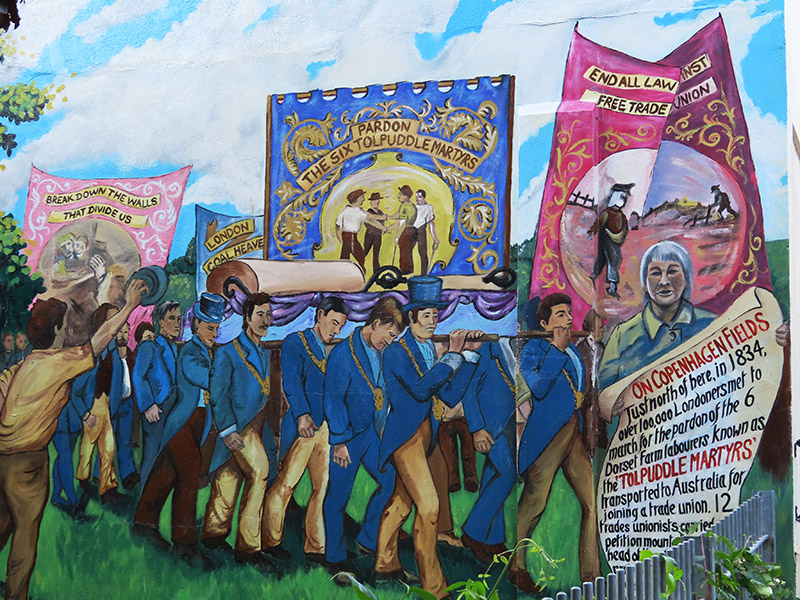
A short way further east at Edward Square there is a mural commemorating the 1834 protest at Copenhagen Fields (which was a bit further north of here) by up to 100,000 people in support of the Tolpuddle Martyrs. The mural was painted by Dave Bangs in 1984 to celebrate the 150th anniversary of the demonstration and used local people as models.
Continuing east past Julius Nyere Close, named after the first President of post-colonial Tanzania, we turn south onto another section of the Caledonian Road. You’d probably need to go quite a bit further east to come across another St George’s flag. I guess the owner of this one is either ignorant of or unfazed by the irony of its positioning.
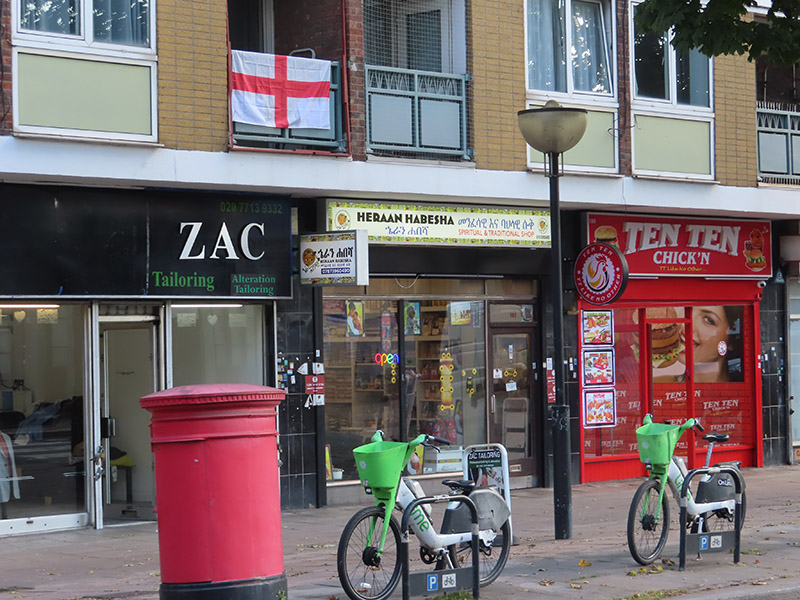
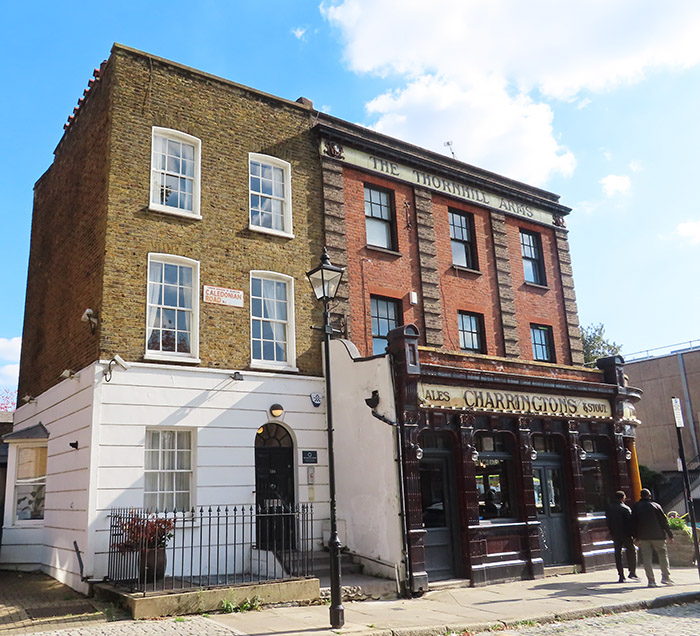
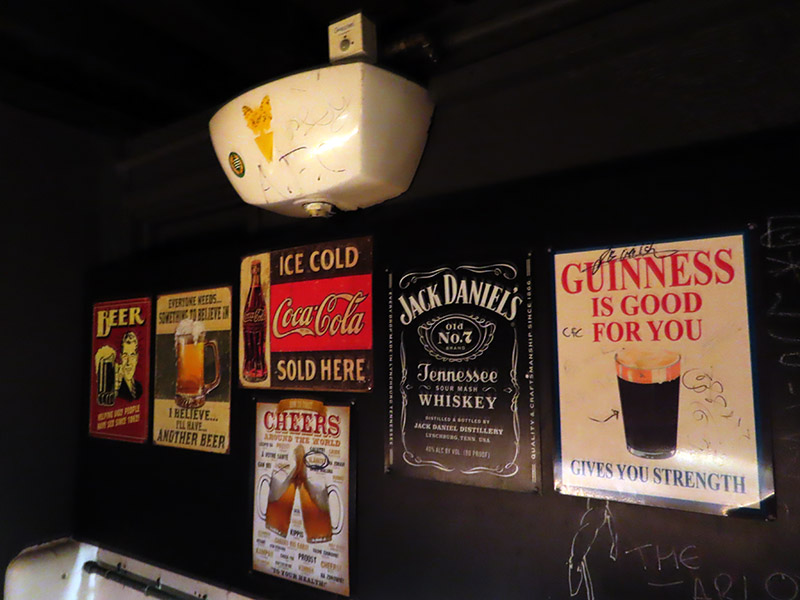
Turning off the east side of Caledonian Road we’re into public housing territory and work our way via Carnegie Street, Bayan Street, Jay Street, and Leirum Street back to Copenhagen Street. From here we take a route back south encompassing Charlotte Terrace, Pulteney Street, Muriel Street. This brings us onto Wynford Road where, just past Fife Terrace, we reach today’s pub of the day, The Thornhill Arms. This is one of those classic Charrington pubs, dating from the mid-nineteenth century with the iconic crimson glazed tiling on the lower floor and red brick with rusticated red/grey brick pilasters forming the exterior of the upper floors. Inside, the building contains many period features including what appears to be part of the original bar. There are tragically few of these pubs remaining in their original incarnation so I was relieved to find that this one wasn’t abandoned as I thought when I passed it heading up the Caledonian Road earlier in the walk.
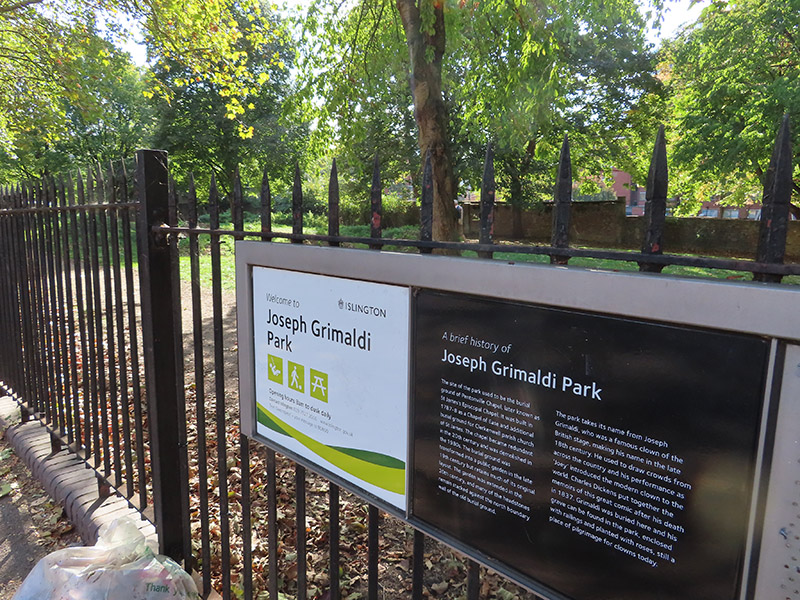
After a swift half we plough on back south on Calshot Street, Southern Street and Killick Street before switching east again along Collier Street. In between Cumming Street and Rodney Street is a contender for one of the most unkempt bits of green space in the capital. In fairness, I didn’t walk around all of Joseph Grimaldi Park, named after the most popular actor and entertainer of the Regency Era, but the part I did see just comprised a series of weed-covered mounds. Grimaldi died in 1837 and was buried here in what was then St. James’s Churchyard. Unfortunately, I was put off venturing into the park so I didn’t come across Grimaldi’s grave or the musical artwork that was installed in his honour as part of a 2010 re-landscaping. Tears of a Clown indeed.
In between the park and the Pentonville Road is the headquarters of the Royal National Institute of Blind People (RNIB). The RNIB moved into the Grimaldi Building, an office building designed by Allies and Morrison Architects to reflect the shape of the church that once graced the site, in 2023. Prior to that their HQ was in Judd Street, south of King’s Cross.
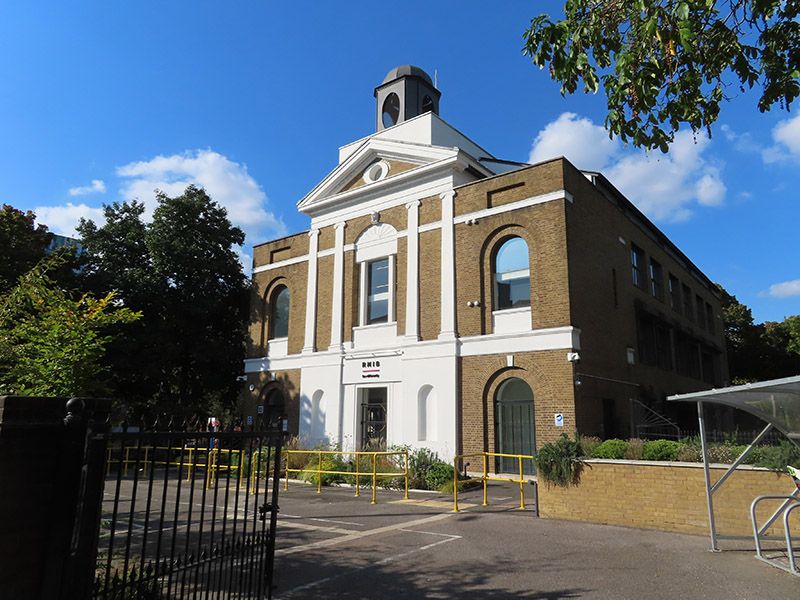
For the final part of today’s excursion it’s just a case of winding our way back to King’s Cross station utilising the streets in between Collier Street and Pentonville Road that we’ve already visited other sections of, namely Calshot Street, Killick Street and Northdown Street. For the sake of completeness we’ll also give the 40 metre long Afflect Street a mention.

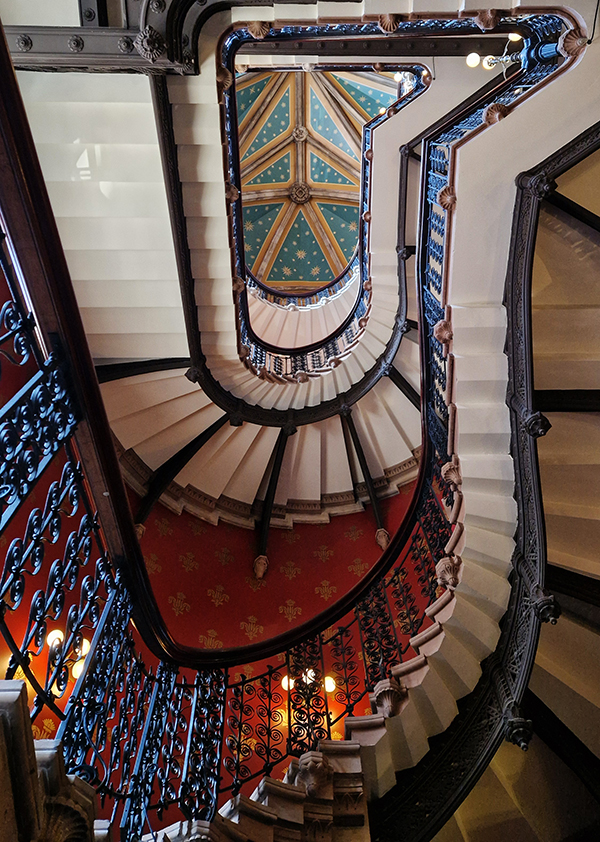
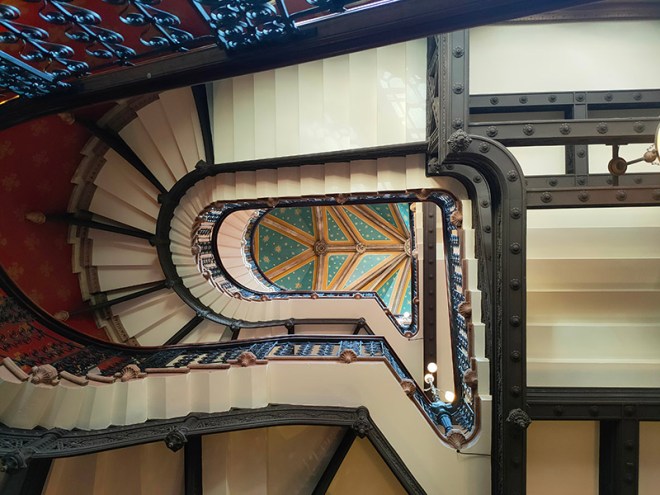
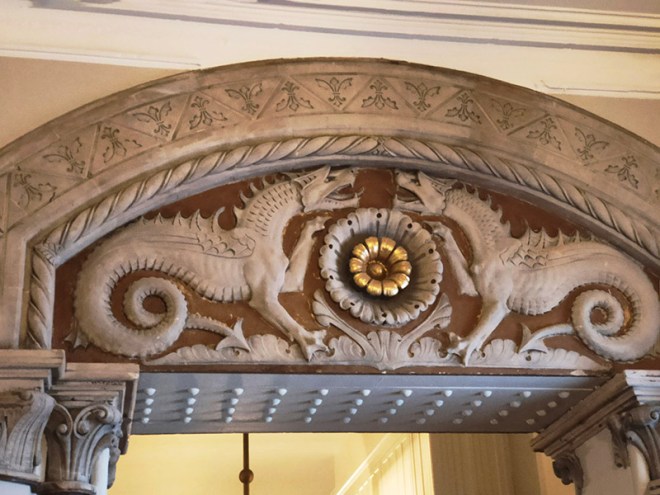
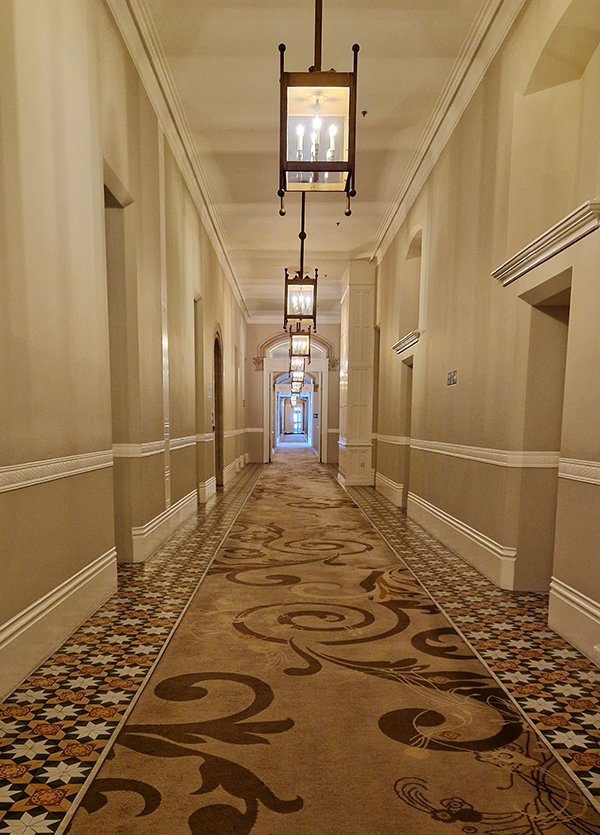
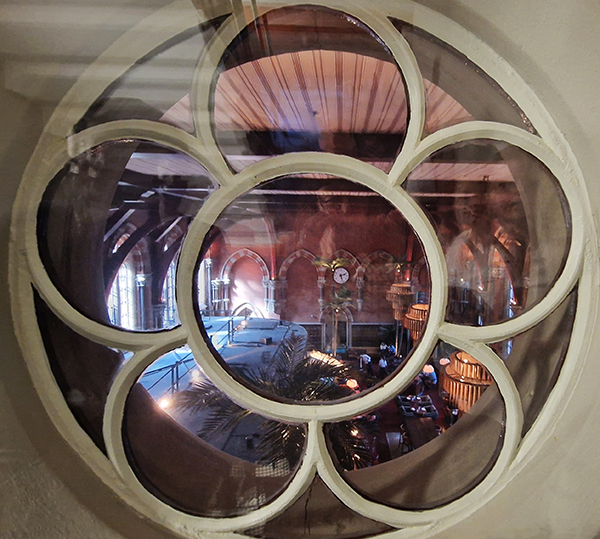
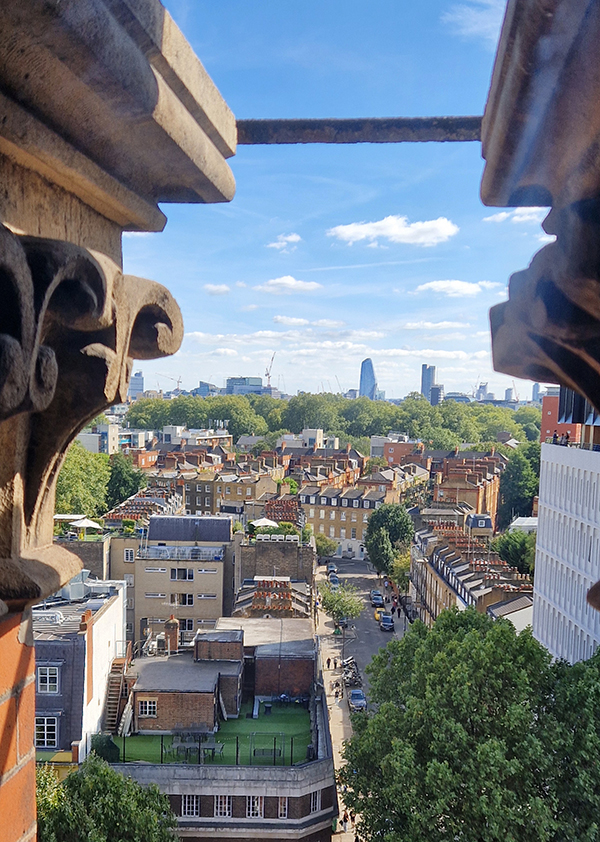
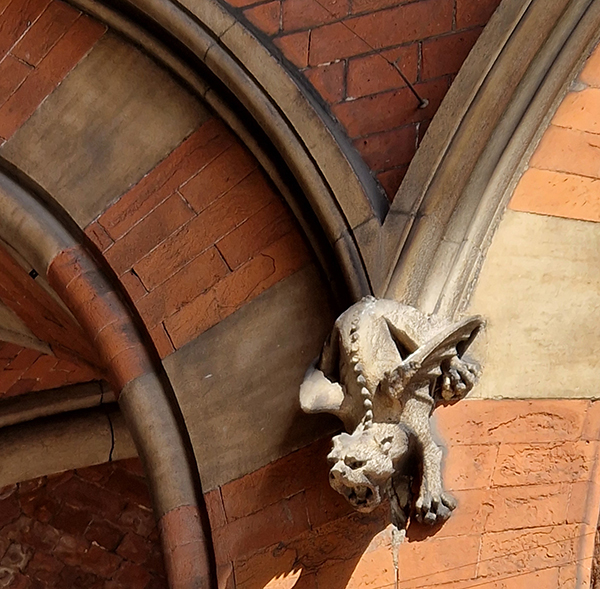
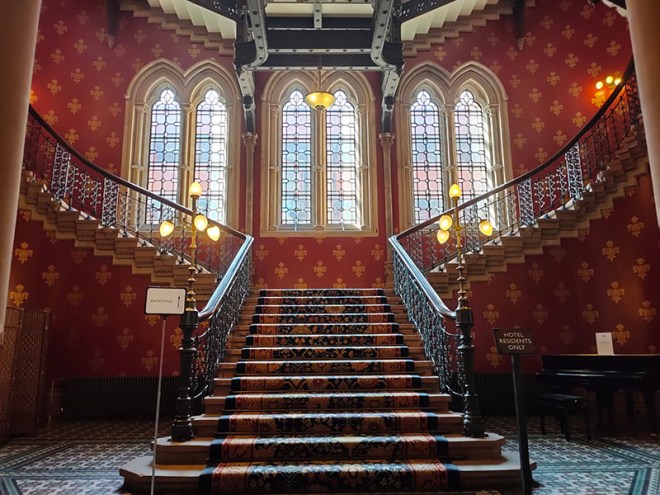
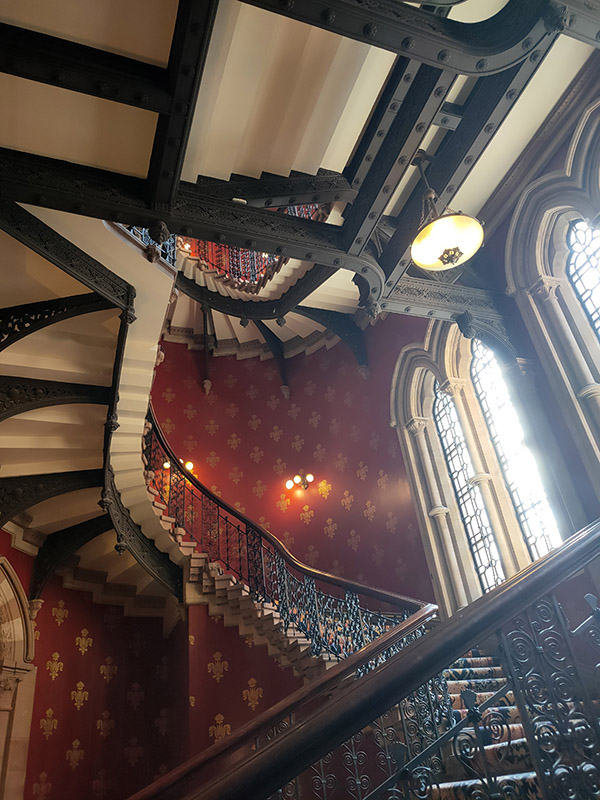
As noted at the start of the post, we’ll finish today with George Gilbert Scott’s 1873 masterpiece, The Midland Grand Hotel, now brought back to life (fittingly) as The Renaissance Hotel, St Pancras. So here are a few highlights of a tour of the inside of the hotel I took during Open House weekend 2024.
Day 50 – The Mall – Waterloo Place – St James’s Park

The weather has put paid to any excursion attempts for the last couple of weeks but normal service is belatedly resumed with a meandering route taking in the western end of the St James’s district between Piccadilly and Pall Mall, then moving east around the area between Pall Mall and The Mall and finishing off with a circuit of St James’s Park. On the way we pay a visit to Waterloo Place which has the largest outdoor collection of statues to dead national heroes to be found in the capital. So if you’re a fan of the odd bronze memorial or ten stay tuned. And if you’re not stay tuned anyway for some nice photos of the wildfowl in the park at the end.

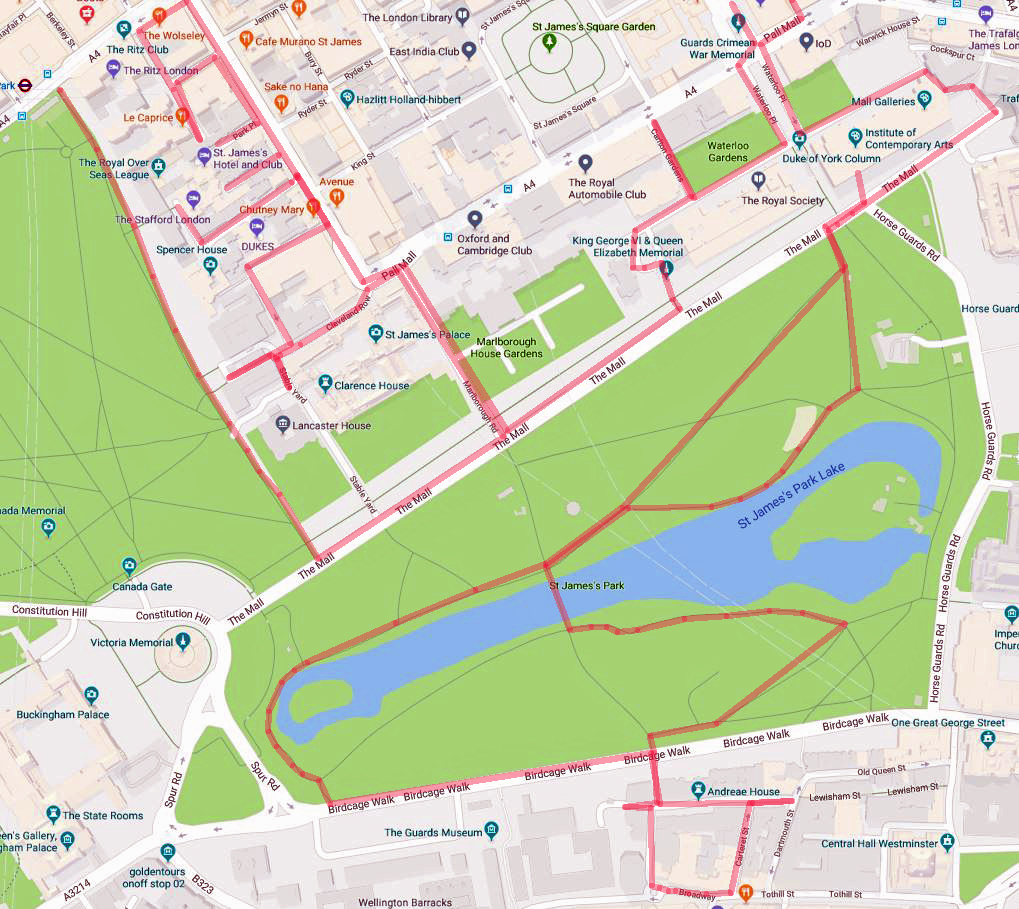
Day 50 Route

Starting point for today is once again Green Park tube but this time we’re heading south along the eastern edge of the park down Queen’s Walk. First of many historical buildings of note on today’s journey is Spencer House, built between 1756-1766 for John, first Earl Spencer, an ancestor of Diana, Princess of Wales. Designed by architect John Vardy it is proclaimed as London’s finest surviving eighteenth-century town house and was one of the very earliest examples of the ne-classical style. It’s open to the public but only on Sundays.

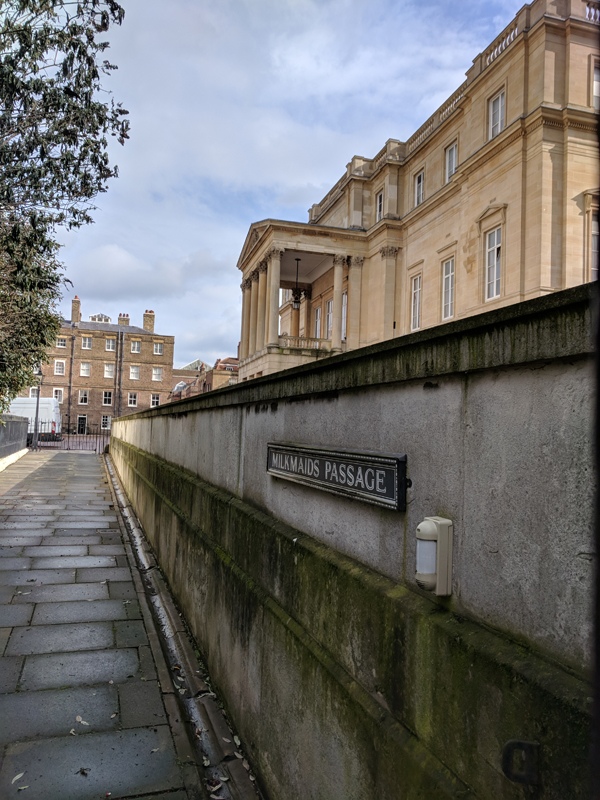
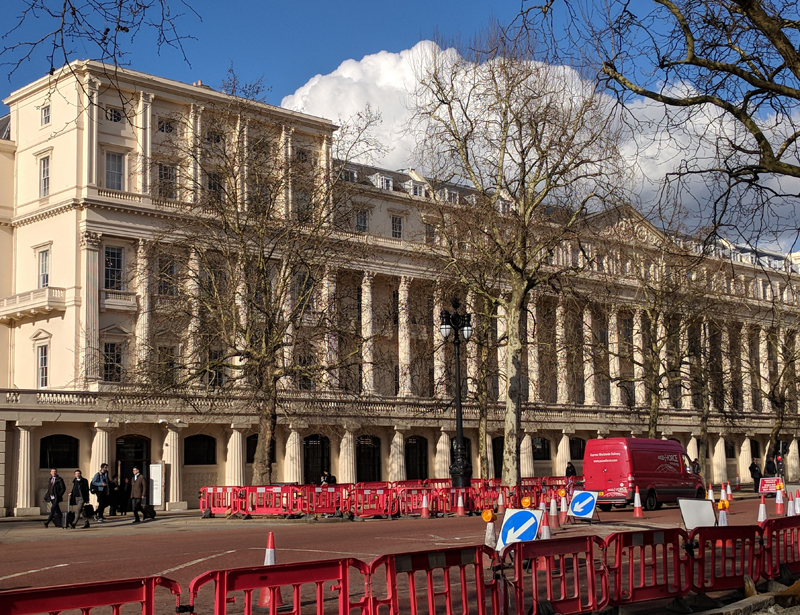
Occupying the corner position with the Mall, and largely obscured by trees, is Lancaster House. This was commissioned in 1825 by Frederick Hanover (a.k.a the Grand Old Duke of York), the favourite son of King George III – more of him later – so it was originally known as York House. Unfortunately for Freddie the paint was barely dry before he died. The house was acquired by the then Marquess of Stafford and renamed Stafford House. His family held on until 1913 when one Lord Leverhulme bought the lease for the nation and, perhaps, in a cheeky nod to the Wars of the Roses, changed the name again to Lancaster, after his home county. Today the building is run by The Foreign & Commonwealth Office and is regularly hired out as a film location for productions such as the King’s Speech and The Crown. Just ahead of Lancaster House is an alleyway by the name of Milkmaids Passage which is now closed off at both ends, presumably because there are no longer any milkmaids to pass through it.

IMG_20180307_113918

My arrival on the Mall happens to coincide with end of Buckingham Palace’s Changing of the Guard routine so I am able to follow the St James’s Palace detachment of the Old Guard as they return to their quarters accompanied by the 1st Battalion Irish Guards Corps of Drums & Pipes. This isn’t exactly a long march, just first left off the Mall up Marlborough Road and then left again into Friary Court (at the eastern end of St James’s Palace) for a final presentation of arms and dismissal.

This slideshow requires JavaScript.

En route along the Mall we pass in front of Clarence House which is now the official residence of the Prince of Wales and the Duchess of Cornwall (so near yet so far from Buckingham Palace). Like the next door Lancaster House this was built in 1825-27 only the architect this time was John Nash and the prospective resident was Prince William Henry, Duke of Clarence, 3rd son of George III and later to be King William IV. Like its neighbour and St James’s Palace, Clarence House is covered by Section 128 of the Serious Organised Crime and Police Act (SOCPA) of 2005 which deals with Trespass on Protected Sites.

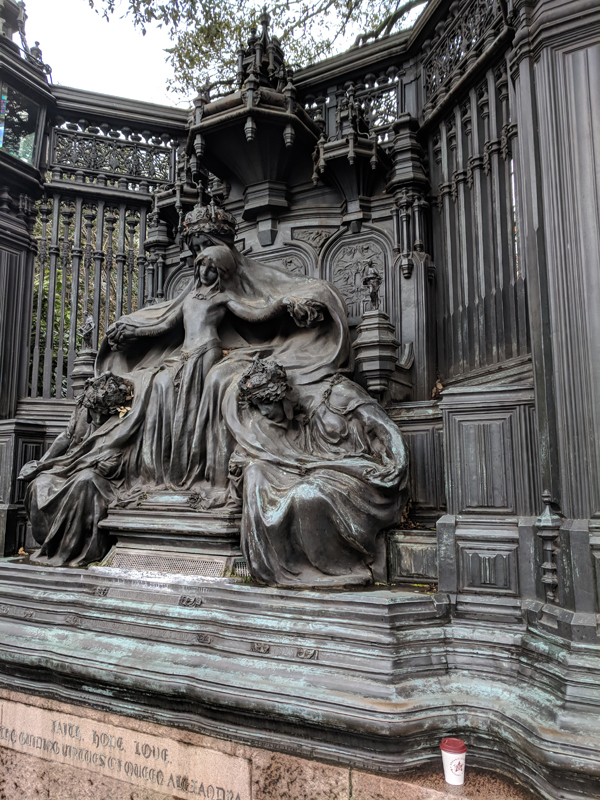
Opposite Friary Court on Marlborough Road, set into the garden wall of Marlborough House, is the Queen Alexandra Memorial, installed in 1932 in commemoration of the wife of King Edward VII. It was the last major work of Sir Alfred Gilbert (1854 – 1934), the man also responsible for the statue of Eros at Piccadilly Circus.

IMG_20180307_114826

As Marlborough Road joins with Pall Mall we head left along Cleveland Row which runs parallel with the north side of another Royal residence, St James’s Palace. SJP was largely built between 1531 and 1536 in the reign of Henry VIII. Much of the original red-brick building still survives today, including the Chapel Royal, the gatehouse, some turrets and two surviving Tudor rooms in the State apartments. It was here in 1558 that Mary Tudor signed the treaty surrendering Calais to the French and Elizabeth I was resident during the threat posed by the Spanish Armada and set out from St James’s to address her troops assembled at Tilbury. The last monarch to use this as a residence was the aforementioned William IV (whose successor Queen Victoria was the first to take occupancy of Buckingham Palace as we learned previously).

IMG_20180307_115300

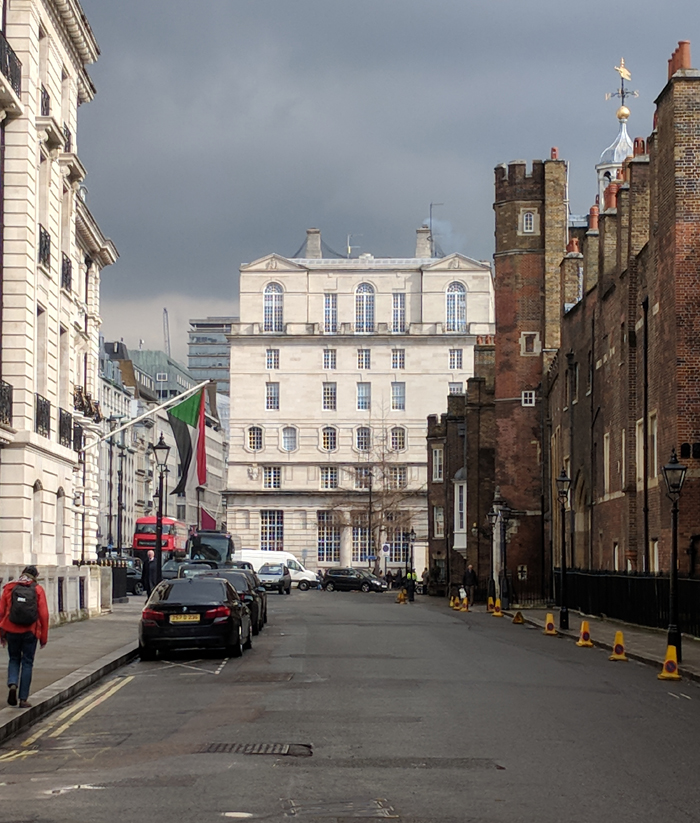
Perhaps a little surprisingly, the building opposite, adjacent to Russell Court, is the Embassy of Sudan.

IMG_20180307_115755

From Cleveland Row we turn north then east along Little St James’s Street bypassing Catherine Wheel Yard and the back of Dukes Hotel.

IMG_20180307_120136

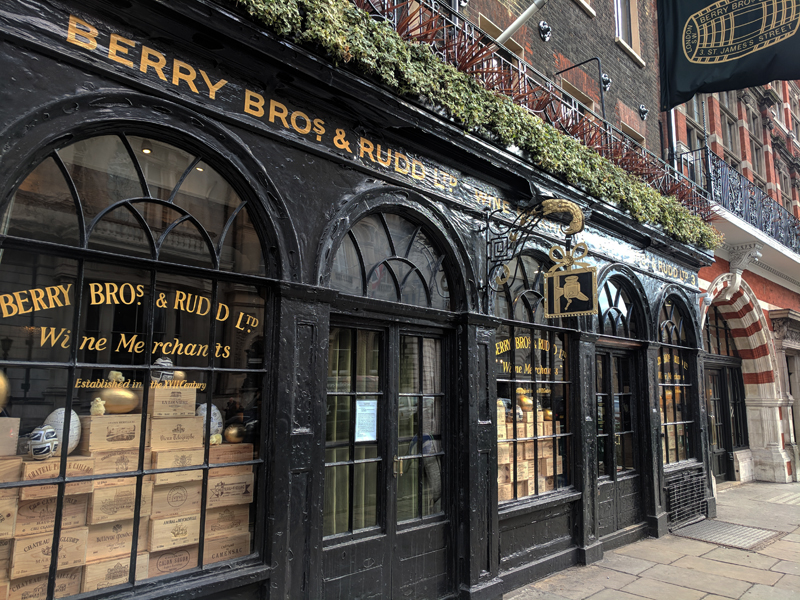
This takes us into St James’s Street, which like many of its neighbours as we reported last time out, is a bastion of niche, (let’s say) traditional emporia aimed at the refined gentleman (or possibly lady) about town. At no.3 is Berry Brothers & Rudd, Wine & Spirit Merchants and holders of two Royal Warrants courtesy of HM and Prince Charles. The shop was opened in 1698 by a lady known as the Widow Bourne, originally selling Coffee and exotic spices. During the 19th century, by which time the Berry family had taken over, the focus became more and more on wines and spirits eventually to the exclusion of all else though the “Sign of the Coffee Mill” remains outside to this day. While in exile in London during the 1830’s the future Napoleon III held secret meetings in no.3’s cellars and the Titanic sank in 1912 69 cases of the firm’s wines and spirits went with it.

IMG_20180307_120448

Just past Pickering Place on the same side of the street is another holder of two Royal Warrants (Phil & Charles this time), John Lobb Ltd., bootmakers, described by Esquire magazine as “the most beautiful shop in the world”.  Their premises at no.9 once housed the bachelor pad of Lord Byron. The original John Lobb started life as a Cornish farmboy but acquired shoemaking skills that eventually led to international recognition and Royal approval.

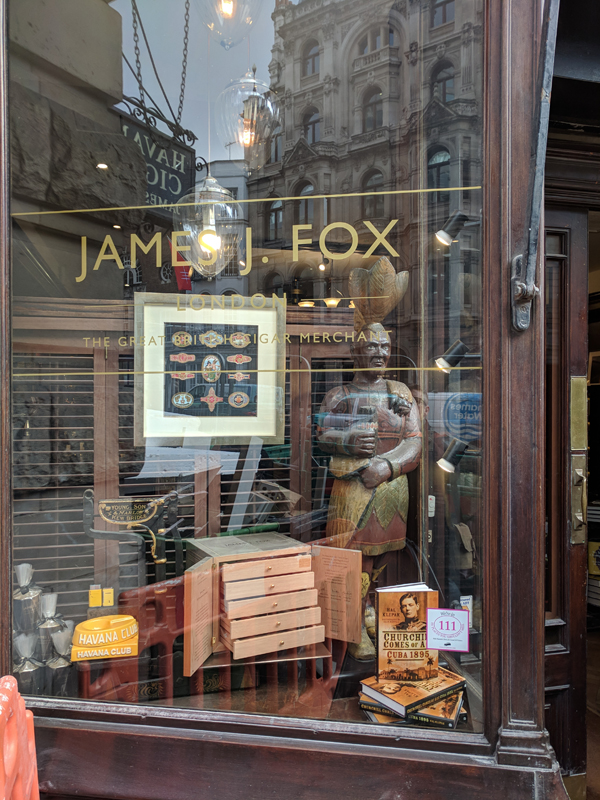
Further up still at no.19 is one of a number of cigar merchants on the street.  James J Fox was formed in Dublin in 1881 and opened its first tobacco shop in London in 1947. In 1992 it acquired the business of Robert Lewis whose family concern had begun trading fine tobacco in St James’s Street in 1787.

IMG_20180307_120915

At the top of St James’s Street we turn left on Piccadilly for just a block before heading south again down Arlington Street by the side of the Ritz Hotel. The Ritz opened in May 1906 having been conceived by the renowned hotelier Cesar Ritz whose aim was create the most luxurious hotel in England. After an indifferent start, the hotel eventually began to flourish thanks in good measure to the patronage of The Prince of Wales (the future King Edward VII) who was a loyal client of César Ritz and is reputed to have said; “Where Ritz goes, I go”.  The Aga Khan and Paul Getty had suites at the hotel, and Winston Churchill, Dwight Eisenhower and Charles de Gaulle met in the Marie Antoinette Suite to discuss operations during the Second World War. It was reputed that The Ritz was the first hotel to allow young unmarried women to visit unchaperoned. Since 1995 the hotel has been owned by the controversial Barclay Twins who from their fiefdom on the Channel Island of Sark also run the Telegraph newspapers and, unlike the EU nationals that their papers vilify, allegedly pay just about sod all in tax to the British exchequer.

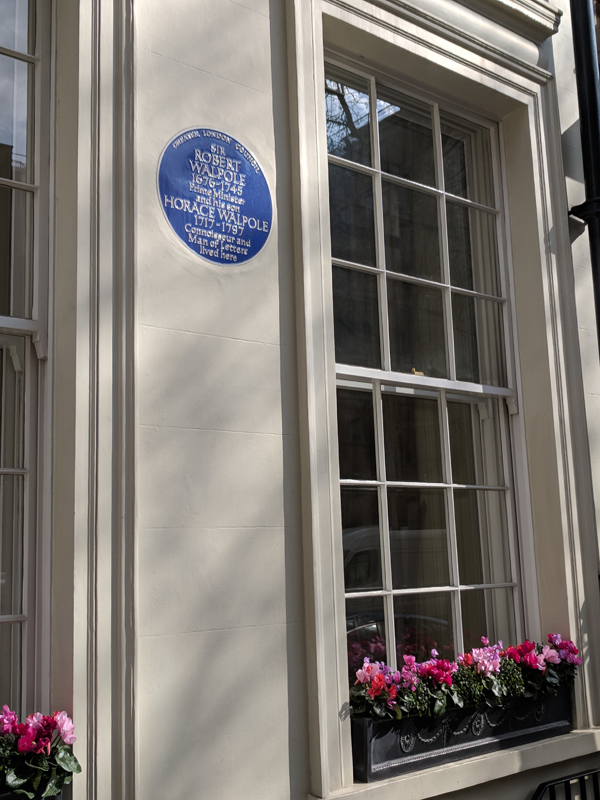
Across the road at no.5 is the one-time home of Sir Robert Walpole (1676 – 1745) generally regarded as de facto the first Prime Minister of this country and also the longest serving incumbent of that position (20 years during the reigns of George I and George II). His youngest son, Horace Walpole (1717 – 1797) took over the lease on the house upon his death. By comparison with his father, Horace had a less than glittering parliamentarian career hence the plaque’s rather nebulous description of him as a connoisseur and man of letters.

IMG_20180307_121512

From Arlington Street we return to St James’s Street via Benet Street then turn south down the west side of the former. At the end of Park Place sits the London clubhouse of the Royal Overseas League which refers to itself as a non-profit private members’ club dedicated to championing international friendship and understanding. Despite its Imperial inspirations when Sir Evelyn Wrench launched the Overseas Club, as it was initially called, in 1910 he drew up a ‘creed for membership’ which refreshingly for the time emphasised that the club was non-sectarian, non-party, open to women and non-jingoist. (The ROSL is the building in the background in the photograph below).

IMG_20180307_122059

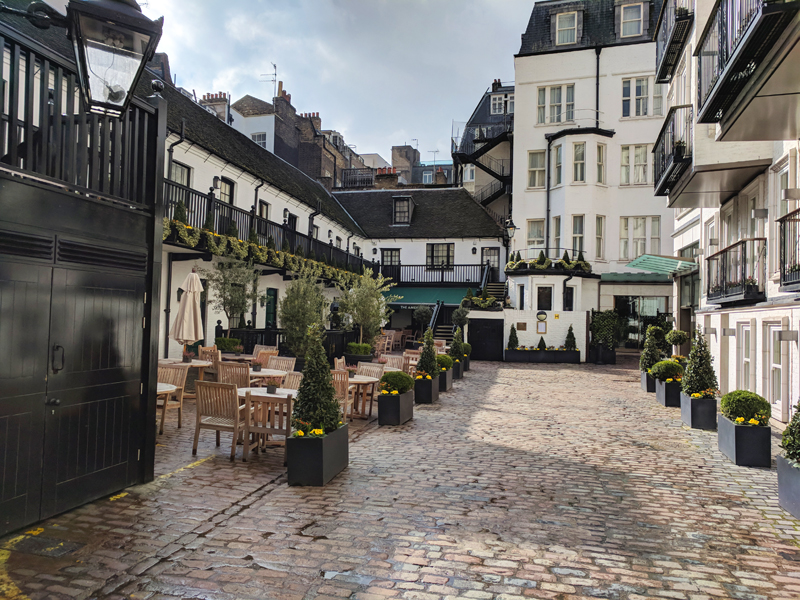
Next cul-de-sac down is Blue Ball Yard which leads to the rear of the Stafford Hotel another grand 5-star establishment which celebrated its centenary in 2012. During World War II, The Stafford London served as a club for American and Canadian officers stationed overseas who sought refuge in the Wine Cellars. This transatlantic connection is reflected in the institution that is the American Bar and the flying of the Stars and Stripes alongside the Union Jack over the front entrance. The Carriage House in Blue Ball Yard was originally built as stables and was converted into luxury accommodation in the 1990’s.

IMG_20180307_122405

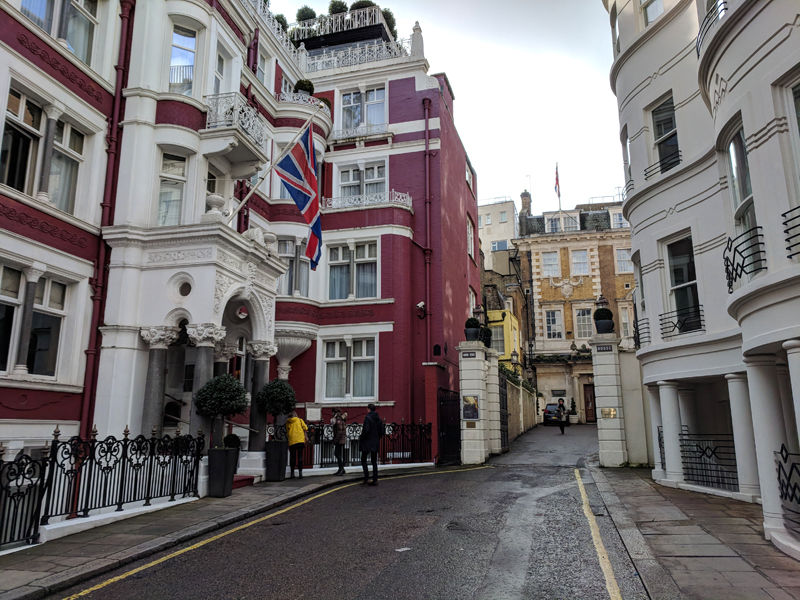
The front of the hotel is reached by swinging round St James’s Place which is the next turning off St James’s Street on the right. En route we pass three more plaques, two blue and one green. The former two are at no. 4 and no. 28 commemorating respectively, the house from which Frederic Chopin left to give his final public performance in 1848 and the residence of the statesman William Huskisson (1770 – 1830). Huskisson served during several parliamentary terms, including as Leader of the House of Commons and Secretary of State for War but, sadly for him, is best known for being the world’s first casualty of a train accident, having been run over and fatally wounded by Stephenson’s Rocket. The green plaque is at no.29 where Winston Churchill lived from 1880-1883.

We carry on down to the end of St James’s Street then retrace our steps down Marlborough Road to the Mall where we continue eastward past Marlborough House which is the headquarters of the Commonwealth of Nations and the seat of the Commonwealth Secretariat. The house was built in 1711 for Sarah Churchill, Duchess of Marlborough and a close friend of Queen Anne. It was yet another piece of work by Sir Christopher Wren, this time aided by his son. The Crown took it over for use as another Royal residence in 1817 and from 1853 to 1861 it housed the Royal College of Art, courtesy of Prince Albert’s patronage.

IMG_20180307_123535

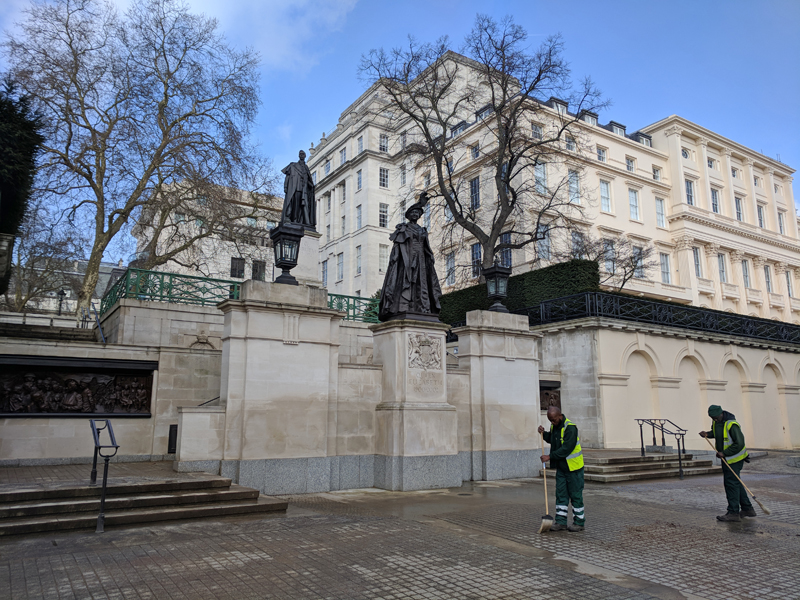
Beyond Marlborough House we ascend the steps by the memorials to Queen Elizabeth II and her father King George VI.

IMG_20180307_123906

This takes us up to Carlton Gardens where we find the former home of Lord Horatio Kitchener (1850 – 1916). Kitchener is best known for winning the 1898 Battle of Omdurman which facilitated the reconquest of the Sudan after the ignominy of the siege of Khartoum and the annihilation of General Gordon’s forces in 1885. He also played a key role during the Boer Wars and was Secretary of State for War at the outset of WWI. He died in 1916 when HMS Hampshire, on which he was travelling to attend negotiations in Russia, struck a German mine.

No.4 Carlton Gardens was where General Charles de Gaulle (1890 – 1970) set up the headquarters of the Free French Forces in 1940. In a previous incarnation it was also another of the houses where Lord Palmerston lived. There’s a statue to De Gaulle on the other side of the street and given his staunch opposition to the UK joining the EU I couldn’t help but imagine I detected a bit of a smirk on those bronze lips.

Carlton Gardens meets Carlton House Terrace at the corner of Waterloo Gardens. The statue here is of George Nathaniel Curzon (1859 – 1925), Viceroy of India from 1899 to 1905 and failed Prime Ministerial candidate in 1923 (he was passed over in favour of Stanley Baldwin). His three daughters by his first wife were prominent and controversial figures during the 20’s and 30’s as documented in the book The Viceroy’s Daughters  which I can recommend.

The terraces of white stucco-faced houses that give Carlton House Terrace its name were built between 1827 and 1832 to designs by John Nash with input from other architects such as our old friend Decimus Burton. Current occupants of the terrace to the west of Waterloo Place include the Royal Academy of Engineering at no2. 3-4, the Turf Club at no.5 and the Royal Society at nos. 6-9 (this was once the German Embassy). The Royal Society is yet something else we have that man Christopher Wren at least partly to thank for. It was after a 1660 lecture given by Wren at Gresham College that a so-called ‘invisible college’ of natural philosophers and physicians first got together. Almost immediately this society received the approval of Charles II and his Royal Charter and by 1663 the name ‘The Royal Society of London for Improving Natural Knowledge’ was established. To date there have been around 8,000 Fellows from Newton to Darwin to Einstein and beyond. Current Fellows include Jocelyn Bell Burnell, Richard Dawkins and Tim Berners-Lee. Up until this week that second list would have included the now sadly departed Stephen Hawking. If you get a chance to visit their Summer Exhibition which usually takes place at the start of July I can thoroughly recommend that as well. (The pictures of the interior below were taken during the 2106 exhibition).

This slideshow requires JavaScript.

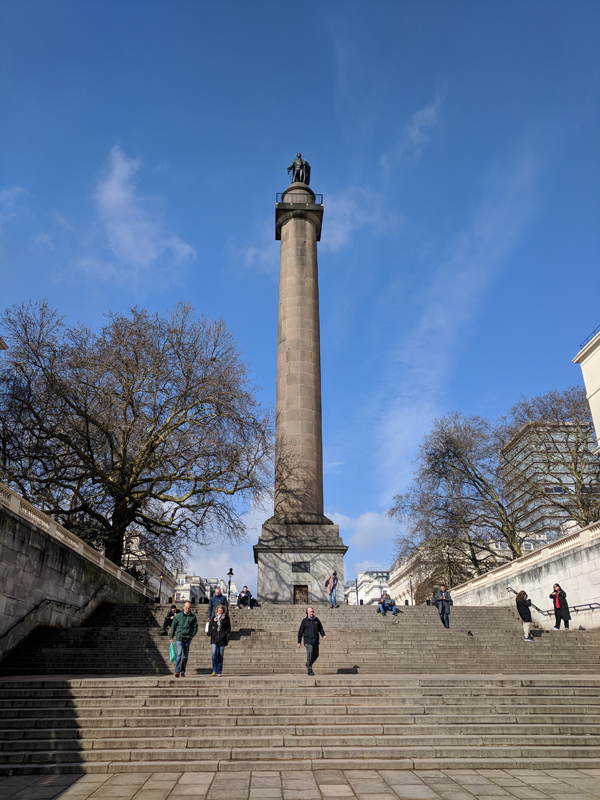
And so on to Waterloo Place, the southern end of which is dominated by the Duke of York column. As alluded to much earlier in this post, the column was erected as a memorial to the favourite son of King George III, Prince Frederick (the Grand Old Duke of York remember). The column is made from Aberdeenshire granite and was designed by Benjamin Dean Wyatt. It’s one centimetre shy of 42m in height and there is a spiral staircase of 168 steps inside that leads to a viewing platform that has been closed to the public for several decades. It would be something of an understatement to say that Frederick was a controversial figure – not many people have inspired a nursery rhyme commemorating their disastrous record on the battlefield. A womaniser and gambler, Frederick once drank and gambled his way through £40,000 in one year. He also found himself in serious trouble when one of his mistresses, Mary Clarke, admitted to having sold commissions to would-be army officers. Fortunately for him the House of Commons accepted his plea of ignorance and he was cleared of corruption charges.

IMG_20180307_124814

As I already noted, Waterloo Place, is a must-see destination for anyone who’s a fan of statues and monuments but I suspect that’s a rather small subset of the population so, for the sake of the rest of you, I’m not going to linger over any of them. Starting on the west side for now and moving south to north we have Field Marshal Sir John Fox Burgoyne (1782-1781) followed by Rear Admiral Sir John Franklin (1786 – 1847) and then Air Chief Marshal Sir Keith Rodney Park (1892 – 1975). One from each of the armed services basically. And across the road in the middle of the place is the equestrian statue of Edward VII.

This slideshow requires JavaScript.

Just north of Waterloo Gardens is the very grandiose-looking Athenaeum Club. It perhaps comes as no surprise that the architect of this extravagant piece of neo-classicism was once again the young Decimus Burton. Construction began in 1824, the year the Club was founded by John Wilson Croker as a meeting place for men who ‘enjoy the life if the mind’ (women were finally admitted in 2002). The frieze around the outside is a copy of the then recently rescued/stolen (depending on your point of view) Elgin Marbles from the Parthenon. It was executed by John Henning, a leading sculptor of the day, at a cost of over £2,000 which was about 5% of the entire budget for the building. Today the majority of the members of the Athenaeum are professionals concerned with science, engineering or medicine but the clergy, lawyers, writers and artists are also represented. A total of 52 past and present members have been the recipient of a Nobel Prize.

IMG_20180307_125739

At the north end of Waterloo Place we turn east along Charles II Street and then north up St Alban’s Street which leads past Carlton Street into St James’s Market. The St James’s Market Pavilion is currently showcasing an audio/visual exhibit (narrated by Stephen Fry) which tells the story of The Handsome Butcher of St James’s Market, a ballad written around 1790.

IMG_20180307_143751

Norris Street takes us into Haymarket where we drop south back to Charles II Street and then stroll through the Royal Opera Arcade to Pall Mall.

IMG_20180307_144043

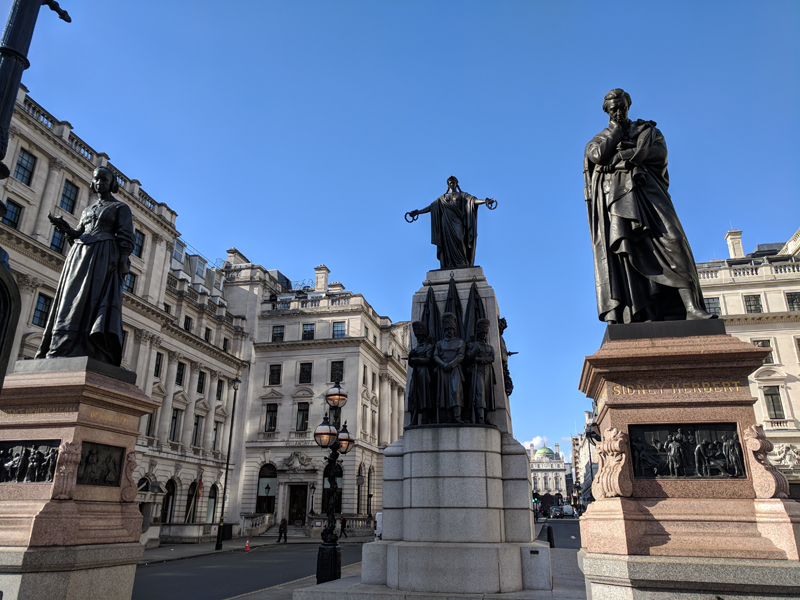
A westward turn then brings us back to Waterloo Place and those remaining statues and memorials. In the square to the north of Pall Mall we have the Guards Crimean War Memorial  created by sculptor John Bell. Immediately in front of that on the left is Florence Nightingale (1820 -1910), nursing heroine of the Crimean War of course, and on the right a pensive-looking Sidney Herbert (1810 – 1961) who was her friend and confidant and Secretary of State for War during the Crimean conflict.

IMG_20180307_144458

Crossing over Pall Mall we pass, on the corner, the home of those cheerleaders for free market capitalism, the Institute of Directors. The IOD was founded in 1903 and moved into the Grade I Listed, John Nash designed, 116 Pall Mall in 1978.

IMG_20180307_144532

We now pass down the eastern side of Waterloo Place where the three honoured heroes of the nation are : Captain Robert Falcon Scott (1868 – 1912) the ill-fated “Scott of the Antarctic” who reached the South Pole five weeks after the Norwegian, Roald Amundsen, got there first and, unlike Amundsen, failed to survive the return journey; Field Marshal Colin Campbell, 1st Baron Clyde (1792 – 1863), who managed to make it unscathed through the Napoleonic Wars, the Crimean War, the Indian Mutiny and the two Opium Wars; and John Laird Mair Lawrence (1811 – 1879) who was Viceroy of India in the             1860’s.

Turning left after the  last of these we enter the eastern section of Carlton House Terrace. Nos, 10-11 house the British Academy. Not to be confused with BAFTA this is the national academy for the humanities and social sciences – if you follow the link you can see which fields that encompasses but it definitely doesn’t include those upstarts Film and Television. No. 11 was also one of the many places where William Gladstone resided.

IMG_20180307_144904

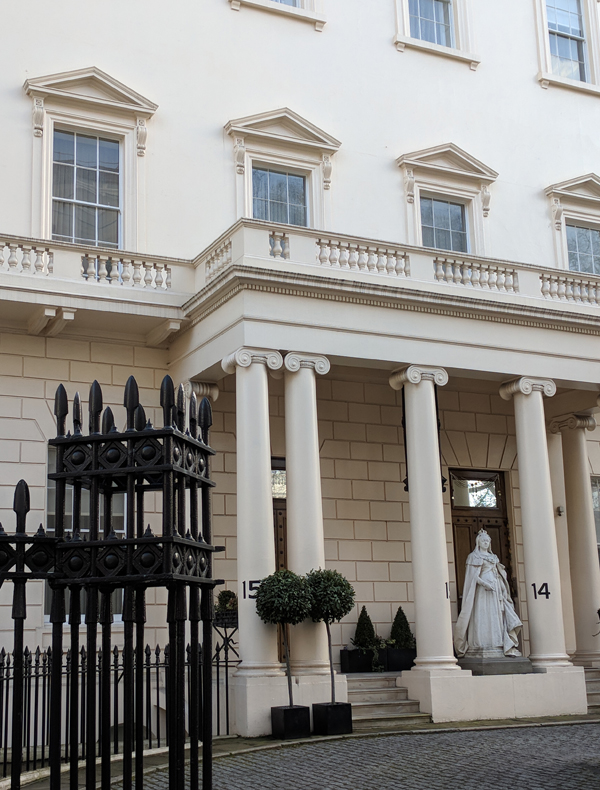
No.12 is The Institute of Contemporary Arts (better known as just the ICA) though the public entrance for exhibitions, cinema, bookshop etc. is on the Mall which also holds true for the Mall Galleries which occupies no.17 (and pretty much the opposite end of the artistic spectrum). Nos. 13-15 are owned by the Hinduja Brothers, Indian industrial magnates the eldest two of whom are reputed to be the wealthiest men in Britain, £16.2bn between them if you really want to know,

IMG_20180307_144956

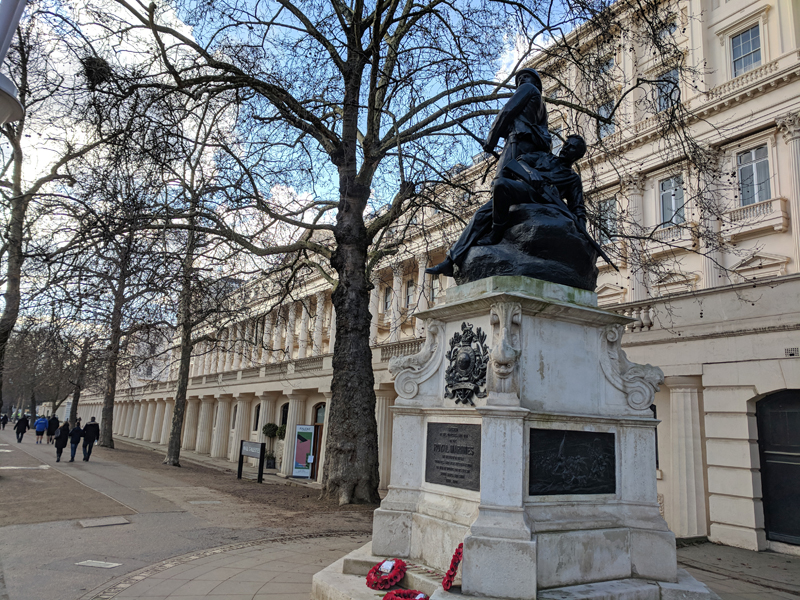
At the end of this stretch of Carlton House Terrace we descend the steps leading off to the south which take us down onto the Mall again. Turning right we pass the Graspan Royal Marines Memorial which commemorates the Royal Marines who died in the Boxer Rebellion and the Second Boer War.

IMG_20180307_145151

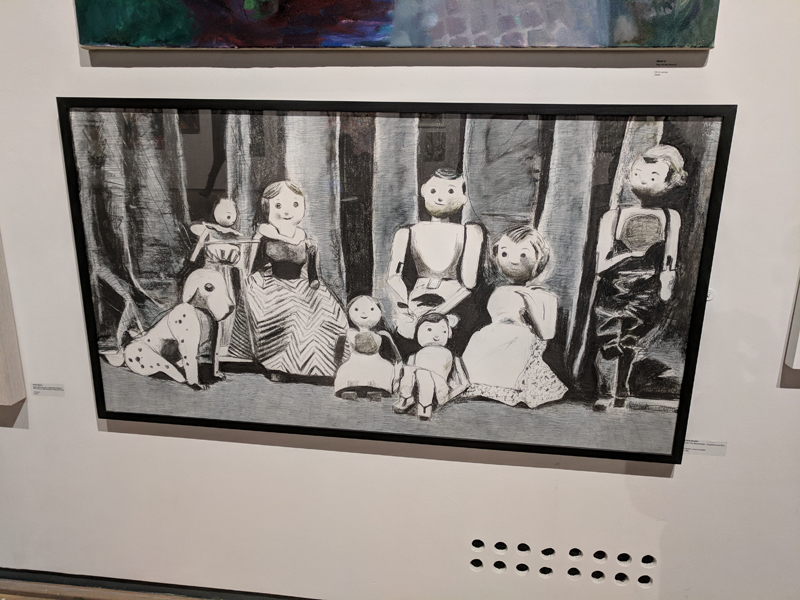
Since I’d never been in the Mall Galleries before I thought I’d better take a look. As I already knew, this celebrates those artists whose practice focuses on traditional media and technical proficiency rather than innovation and conceptual ideas. Nothing wrong with that but it’s not really for me. One of the current exhibitions did however include a painting of the Woodentops so brownie points for that.

IMG_20180307_145436

The ICA, on the other hand, I’ve visited countless times. You can always get a decent cocktail in the bar even if you don’t like the exhibition. On this occasion I popped in to buy a cinema ticket for the late afternoon screening of Ladybird – a bargain at £6. The ICA was founded in 1947 by Roland Penrose, Peter Watson, Herbert Read, Peter Gregory, Geoffrey Grigson and E. L. T. Mesens in 1947 who wanted to establish a space where artists, writers and scientists could debate ideas outside the traditional confines of the Royal Academy. It has occupied this site on the Mall, Nash House, since 1968. The ICA has always tried to push the envelope where artistic expression is concerned – in 1986   Helen Chadwick’s artwork, Carcass, consisting of a stinking pile of rotting vegetables, had to be removed after complaints from neighbours and a visit by health inspectors and in 1994 artist Rosa Sanchez installed a video camera in the men’s toilets to relay live images of urinating visitors.

IMG_20180307_150551

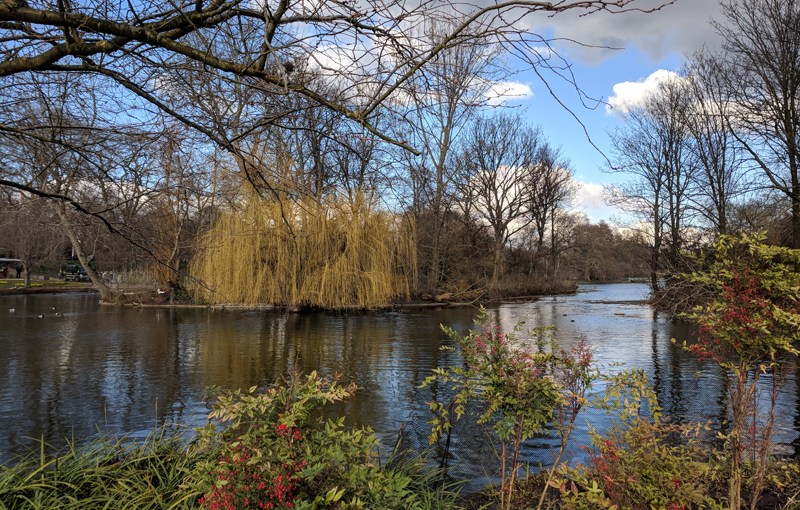
And so finally we cross over the Mall into St James’s Park. This is the oldest of London’s Royal Parks and takes its name from a thirteenth century leper hospital which was the first human intervention into the space. In 1532 Henry VIII acquired the site as yet another deer park and it continued as a private royal playground until Charles II had it made over with lawns and tree lined avenues and opened it to the public. It was later redesigned again by John Nash with the canal being transformed into the lake we see today. In 1837 the ancestors ( I like to think) of the wildfowl that inhabit the lake were introduced by the Ornithological Society of London who also had a birdkeeper’s cottage built. I’ve got into a bit of the old twitching (or birding) of late so I was pleased to be able to identify most of the feathered residents.

This slideshow requires JavaScript.

I realise that we’re already getting into War and Peace territory in terms of word count but we’ve just got a small section south of the park to tidy up then we’re done. Birdcage Walk (named after the Royal Menagerie & Aviary from the time of Charles I) runs from Buckingham Palace along the south side of the park. The Wellington Barracks front onto a good part of its length. The Barracks is home to the Foot Guards battalion which shares  guard duty for Buckingham Palace with the regiment stationed at St James’s Palace.

Beyond the Barracks we turn right into Queen Anne’s Gate. After an initial pedestrian-only section this splits three ways and we take the eastward option. No.26 was once home to the politician, lawyer and philosopher, Lord Richard Burdon Haldane (1856 – 1928) and no.20 is the house where Lord Palmerston was born in 1784. There are blue plaques at 14 and 16 as well but I won’t detain you with those since far more exciting is the fact that no.15 stood in as the home of Lord Brett Sinclair the character played by (the sadly missed) Roger Moore in The Persuaders (still the greatest theme tune in the history of television). No.15 also stands on one side of the statue of Queen Anne herself which has been in situ here since at least 1708. At the end of the street we double back and then head south down Carteret Street which takes us to the familiar territory of Tothill Street and Broadway which on a westerly trajectory link up with the north-south section of Queen Annes’s Gate. Returning to where we came from we make our final stop of the day outside no.40 which between 1814 and 1831 was the home of father and son philosophers James Mill (1773 – 1836) and (the more well known) John Stuart Mill (1806 – 1873). The latter, in particular, had an enormous influence on the development of social and political theory in the 19th century. He was an advocate of Jeremy Bentham’s theory of utilitarianism, in crude terms, “the greatest good of the greatest number” and a strong defender of the principle of free speech. He was also the first Member of parliament to publicly call for Women’s Suffrage – an appropriate note to end on in this anniversary year.

This slideshow requires JavaScript.