Day 27 (part 2) – Leicester Square – National Portrait Gallery

So this is the second leg of the jaunt round the epicentre of West End Theatreland; picking up where we left off in Leicester Square then heading round its southern end for a visit to the National Portrait Gallery.

Day 27 Route pt2

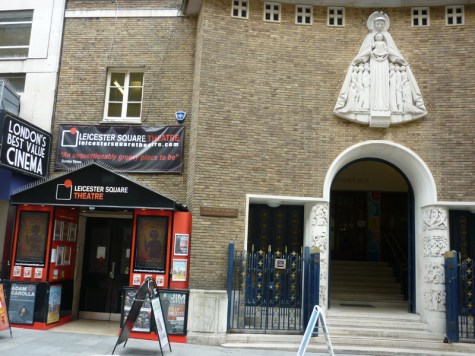
We finished the last post at the Queen’s House and turning the corner there we enter into Leicester Place which definitely punches above its weight in terms of points of interest. First up is the church of Notre Dame de France which serves the French-speaking Catholic communities of London. The parish has been in existence since the 1860’s but the original church building was severely damaged during the WW2 bombings of 1940. Although it reopened a year later after extensive repairs a full reconstruction was ultimately required and in 1953 Maurice Schumann, French Foreign Secretary, laid the foundation stone of the new building, which was brought from the Cathedral of Chartres. The architect was Hector Corfiato of Beaux Arts de Paris.

P1050642

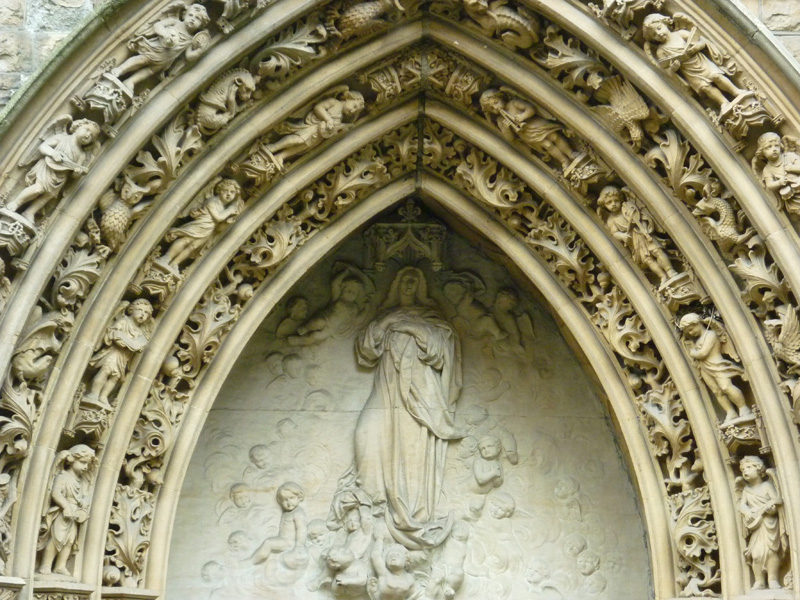
The most famous aspect of the church are the murals created by the artist, filmmaker and all-round renaissance man Jean Cocteau (1889 – 1963) during a week’s visit to London in November 1959. The murals depict scenes from the life of the Virgin Mary and are divided into three panels portraying the Annunciation, the Crucifixion and the Assumption. In front of the murals is an altar decorated with a mosaic of the nativity by the Russian artist Boris Anrep (1863-1969), best known for his giant works in the National Gallery, Westminster Cathedral and the Bank of England. This mosaic was created in 1955 but was then covered over in 1960 by a painted wooden panel of Cocteau’s a decision which unsurprisingly outraged Anrep. When the mosaic was rediscovered in 2003 in was decided to move the Cocteau panel to elsewhere in the church. The tapestry which hangs above the main altar is the work of the Benedictine Monk (and friend of Cocteau’s) Dom Robert (Guy de Chaunac-Lanzac 1907-1997). The theme of the tapestry is Paradise on earth with a reference to the Creation and to Wisdom. The New Eve, title given to Mary by the Church, is walking towards us as pure as a new bride.
This slideshow requires JavaScript.

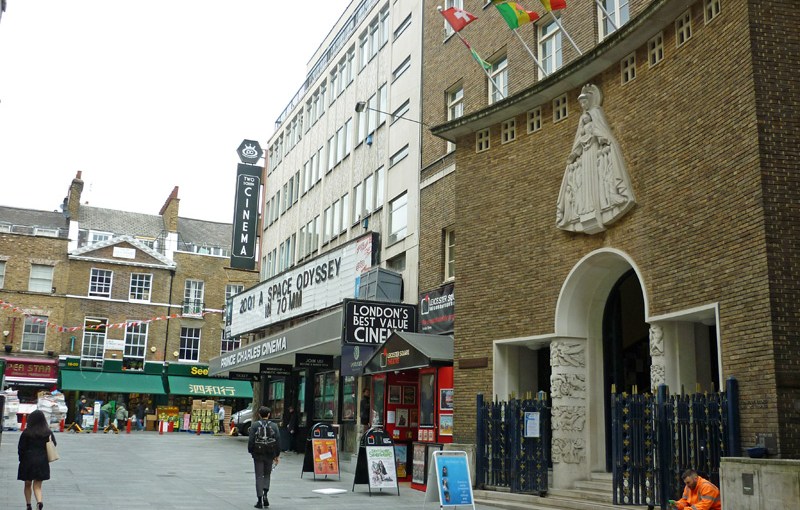
As you can see in the photograph above, part of the building which houses the church is given over to the Leicester Square Theatre. The LST is one of the top comedy venues in the capital, specialising in one-man stand up shows (I’ve seen Stewart Lee here a couple of times) or sketch group performances.

Next building along is the Prince Charles Cinema which these days is the only remaining repertory cinema in central London. Just lately I’ve spent quite a few afternoons there watching just-off new releases for a measly £4 (for members). The cinema started life as a small basement theatre in the early sixties then after a few years had a brief and equally unsuccessful stint as a music hall. Following rebuilding it opened as a cinema in 1969 eventually falling prey to the winds of change in the seventies and resorting to playing porn flicks. Its current incarnation began in 1991 and has enjoyed great success with a repertory mix of cult classics, arthouse second runs and themed programming.

P1050643

Staying with cinemas, next up when we return to Leicester Square and turn left towards the north east corner is the Vue West End. Currently a nine-screen complex this started life as the Warner Theatre, built in 1938 to the design of architects Thomas Somerford and E.A Stone. First presentation on opening was Errol Flynn in “The Adventures of Robin Hood”. The frontage was faced with reconstructed marble with a large relief panel by sculptor Bainbridge Copnall in each corner depicting spirits of sight and sound. When the cinema was redeveloped in the 1990’s this frontage was just about all that was retained of the original building.

P1050640P1050655

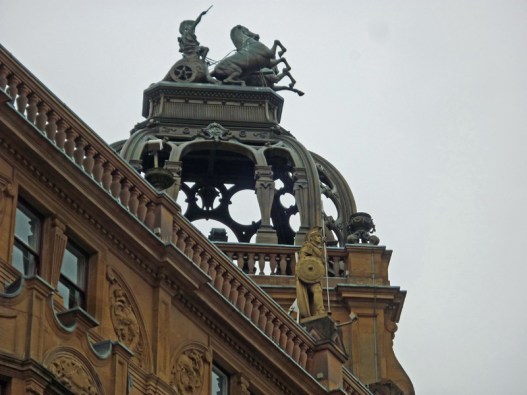
This brings us on to the Hippodrome which looms large over this corner of the square. The London Hippodrome was designed for the theatre impresario Edward Moss by architect Frank Matcham and opened its doors to the public 15 days into the start of the twentieth century. At the outset it specialised in a mixed programme of variety and circus performers including (as the name suggests) a number of equestrian acts. In 1958 the interior was completely remodelled and the venue was reborn as the Talk of the Town nightclub showcasing stars from Frank Sinatra and Judy Garland at one end of the spectrum to Val Doonican and The Seekers at the other. The T.o.t.T lasted until 1982 when after a brief closure and another renovation Peter Stringfellow opened a new nightclub and restaurant, reinstating the original name. He in turn sold out to a company called European Leisure who cashed in during the height of club culture in the late eighties and nineties by making the Hippodrome one of the highest profile (and also naffest) destinations in London. When that boom was over the Hippodrome had a few years in the noughties riding the burlesque wave before, following a £40m investment, it converted to a casino in 2012.

P1050656

Here’s a copy of a contemporary press report covering the impending opening night of the theatre in 1900 – Hippodrome2.

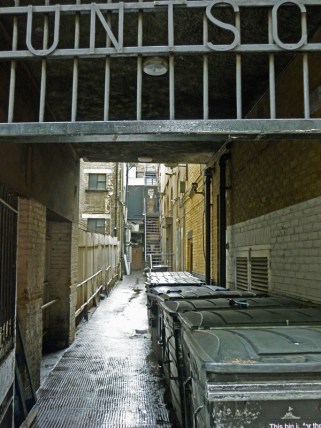
Head out of the square through Bear Street (which is really just a passage) and turn right on Charing Cross Road past Hunts Court which has a claim as one of the least inviting alleyways in London.

P1050658

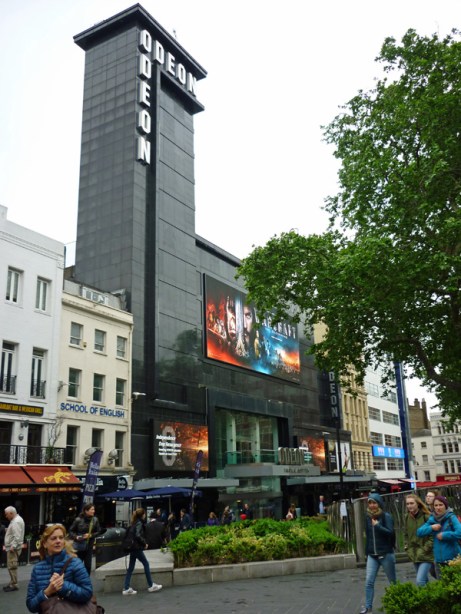
Turn right again up Irving Street, which is lined with tourist-trapping restaurants, and arrive back at the east side of the square which is home to the daddy of all West End cinemas, the Odeon Leicester Square. This iconic black monolith with its polished granite façade and 37m high tower was built in 1937 to the design of Harry Weedon and Andrew Mather. Weedon was the architect that Oscar Deutsch charged with overseeing the building programme for his  new chain of Art Deco Odeon Cinemas in the thirties. (Side note – it is apocryphally believed that the Odeon name is an acronym for Oscar Deutsch Entertains Our Nation but it almost certainly comes from the term Nickelodeon coined in the US in the early years of the century and itself derived from Ancient Greek). The cinema took seven months to build at a cost of £232,755 and had 2,116 seats and the film shown on the opening night was The Prisoner of Zenda. The grand interior was desecrated in a cack-handed 1967 modernisation but at least some of the original styling was restored in the Eighties.

P1050653

Leicester Square was originally laid out in 1670 and named after (the then) nearby Leicester House built in 1631-35 by Robert Sidney 2nd Earl of Leicester. Its renown as a hub of popular entertainment began in the 19th century and was enhanced by the building of the imposing Alhambra Theatre in 1854 (it was demolished in 1936 to make way for the Odeon). In the latter part of the 20th century the square came to be a byword for seediness and urban menace. During the 1979 winter of discontent it effectively became a temporary rubbish dump, earning the nickname Fester Square. Eventually Westminster Council woke up to the fact that having this running sore in the heart of tourist London was something of an embarrassment and in 2010 a major redevelopment was undertaken and completed 2 years later to coincide with the London Olympics. The improvements included 12,000 square metres (130,000 sq ft) of granite paving and a water feature surrounding the Shakespeare statue. The Shakespeare statue itself was erected during a previous renovation of the square in 1874.  It was sculpted by Giovanni Fontana after an 18thC. original by Peter Scheemakers which stands in Poets’ Corner in Westminster Abbey.

In the background of the bottom right photo above you can see the empty space where the Odeon West End cinema used to stand. This site is currently being developed as a new cinema and “guess what” complex.

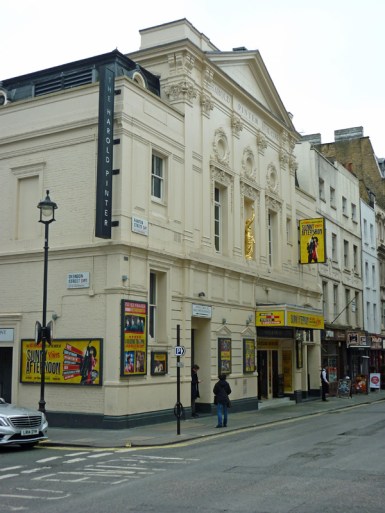
Exit the square’s south west corner via Panton Street where you will find the Harold Pinter Theatre (formerly The Comedy Theatre). This one opened in 1881, again designed by Thomas Verity, and atypically still has most of its auditorium in the original form. The change of name occurred in 2011 three years after the death of the playwright. Current production is the Kinks’ musical “Sunny Afternoon”.

P1050663

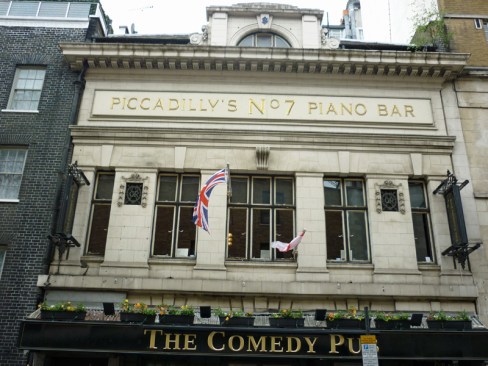
Comedy is still represented in the area in the form of The Comedy Pub and The Comedy Store which both inhabit Oxendon Street; the former was previously the rather classier Piccadilly’s No.7 Piano Bar (as the frontage still reflects).

P1050664

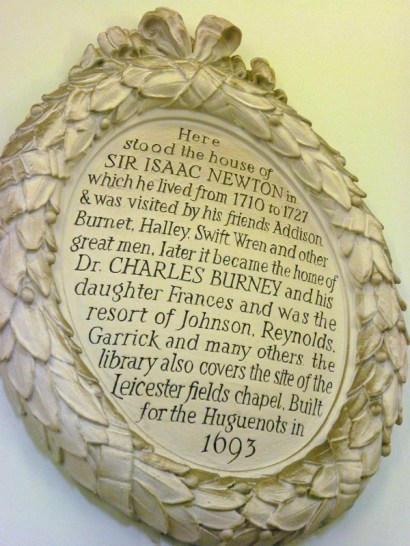
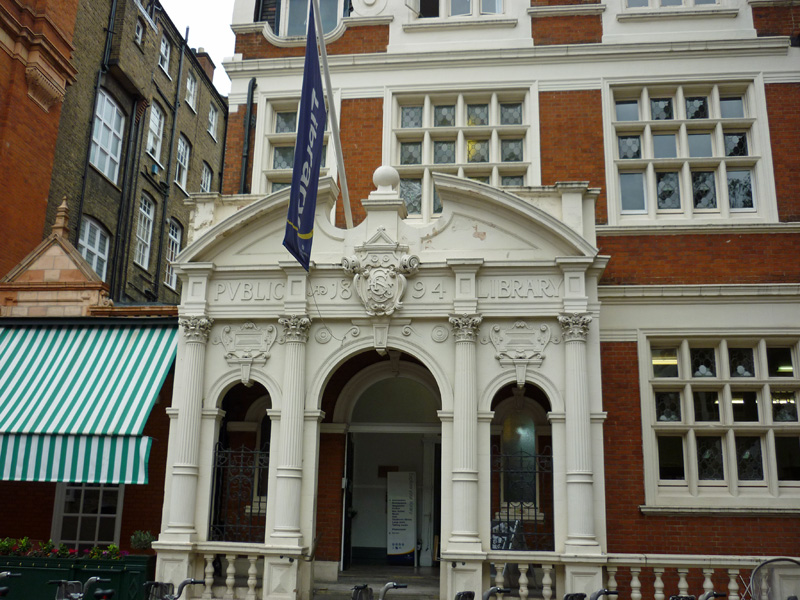
After a quick up and down of Oxendon Street we continue along Panton Street to Haymarket then turn south and head east again along Orange Street. The passageway that is the northern section of St Martins Street is closed off due to the new development so we have to skirt round Longs Court to get to no.35 which is now the Westminster Reference Library. However the building which formerly stood on this site was the home of Sir Isaac Newton from 1711 until his death in 1727. He had a small observatory built at the top of the house and a laboratory in the basement. Later residents of the house were the Burney family including Fanny Burney (later known as Madame D’Arblay) (1752 – 1840) the novelist and diarist. That building was demolished in 1913.

P1050671

The library holds over 15,000 books covering the performing arts and a wide range of film, theatre, dance, radio & TV publications, some (such as The Stage and Era) going back to the 19th century. It also houses The Sherlock Holmes Collection (which contains a far greater wealth of material than the tawdry museum on Baker Street which we ignored in our very first post). The library was also bequeathed the ballerina Anna Pavlova’s collection of books on dance which is kept in a separate section that was opened by Dame Alicia Markova in 1957.

This slideshow requires JavaScript.

Back on Orange Street is the Orange Street Congregational Church founded in 1693 by Huguenot refugees who fled France following the Revocation of the Edict of Nantes. Given the current furore concerning migrants from Syria and North Africa I thought the passage (included in the slideshow above)  which I discovered in one of the books on Isaac Newton’s house that I looked at in the library had a timely poignancy.

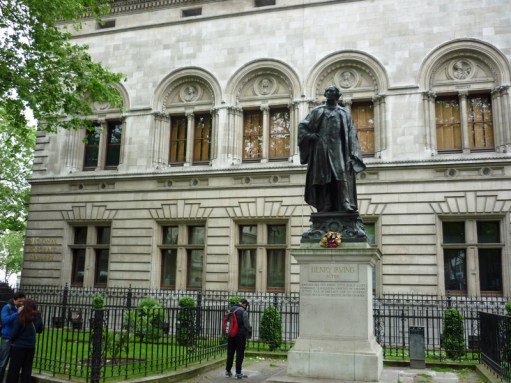
Reaching the end of Orange Street we turn right on Charing Cross Road past the statue of the stage actor Henry Irving (1838 – 1905) (who gives his name to the aforementioned street of course) to get to the National Portrait Gallery.

P1050674

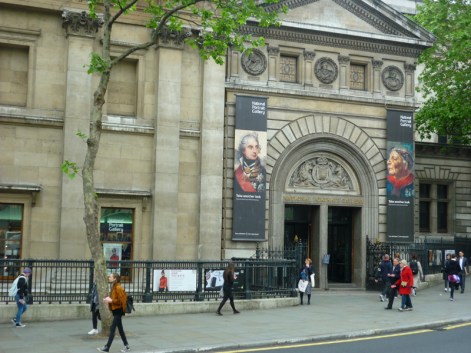
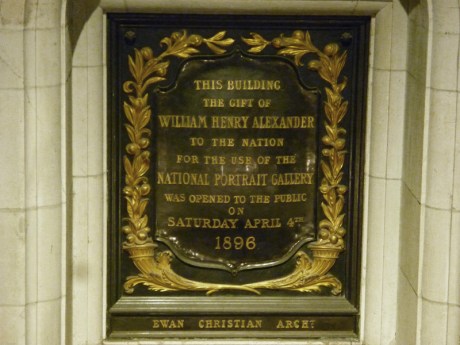
The NPG was the brainchild of three men, Philip Henry Stanhope, Thomas Babington Macauley and Thomas Carlyle, whose efforts are commemorated in three busts above the main entrance to the gallery. Although the idea for a national gallery dedicated to portraits of famous Britons was first mooted in 1846 it was another ten years before it was actually founded. And then it wasn’t until 1896 that it established a permanent residence on the current site, funded by a donation from the philanthropist, William Henry Alexander. Both the architect, Ewan Christian, and the gallery’s first director, George Scharf, died shortly before the building was completed.

P1050694

P1050678

There are over 200,000 works in all in the NPG’s collection though only a fraction of these are on display at any one time. On the second and first floors the portraits of the great and famous are displayed more or less chronologically from the Tudor period up to the 20th century. The ground floor is devoted to special exhibitions and contemporary works.

The following slideshow presents the individual portraits of all the British monarchs from Henry VIII through to William IV (excluding a couple of Georges) but starts with a compendium set of portraits depicting all the rulers from William the Conqueror to Mary Tudor which was probably created between 1590 and 1620 (after the last of them had died).

This slideshow requires JavaScript.

And since we were just looking round where his old gaff used to be here’s Sir Isaac Newton (bottom) with his contemporary, the philosopher John Locke.

P1050688

Finally, for this time, here are the so-called Medieval Stairs with their busts on the main protagonists in the Wars of the Roses, for the Houses of York and Lancaster respectively.


Day 27 (part 1) – Leicester Square – Chinatown – Shaftesbury Avenue

Back again and into the heart of tourist London; running the gauntlet of the yellow properties on the Monopoly board – Leicester Square, Coventry Street and Piccadilly – along with the streets that make up the capital’s Chinatown.

Day 27 Route pt1_a

P1050607

Starting point for today is Piccadilly Circus and as we head east along Coventry Street the first thing we pass is the massive London Trocadero complex, a site with a long and chequered history. In the 1820’s and 30’s there were various attempts to establish a theatre here but by the mid century it was being mainly used as an exhibition space. It was then leased to a wine merchant by the name of Robert Bignell, who reconstructed the existing buildings into Assembly Rooms called the Argyll Subscription Rooms. Thirty years later the place had degenerated into a haunt of prostitutes and their clients and in 1878 was raided and then closed down by the police. Despite losing his license, Bignell was not one to let go lightly and four years later he managed to re-open the building as the Trocadero Palace music hall. Bignell died in 1888, the music hall failed to flourish in his wake and seven years later his daughter sold the building on a 99-year lease to J. Lyons & Co. who converted it into the Trocadero Restaurant. This was decorated in an opulent baroque style with murals on Arthurian themes alongside the grand staircase and a Long Bar which catered to gentlemen only. During World War I, the Trocadero initiated the first “concert tea” served in the Empire Hall and accompanied by a full concert programme. The restaurant lasted right up until 1965 and after its demise the building played host variously to a dance hall, bowling alley and casino. Then in 1984, the Trocadero was redeveloped as a tourist-oriented entertainment, cinema and shopping complex; the largest in the UK at the time. Sadly for the owners, visitor numbers for attractions such as the Guinness World Records Exhibition and later the Segaworld arcade failed to match the scale of the ambition. By the mid-noughties the place was in a sorry state and, as you can see in the pictures below, most of it is now boarded up. In 2015 however the opening of a new Picturehouse cinema on the Shaftesbury Avenue side of the building at least provided signs of rejuvenation.

P1050608

P1050609

Turn north up Rupert Street passing this elaborate roof-top embellishment about which I can find no information on whatsoever.


P1050610

Emerge on to Shaftesbury Avenue opposite the run of three theatres that we covered briefly in one of the Soho posts. First of these, moving west to east, is the Lyric which opened in 1888 but retained the façade of the house built in 1766 by  Dr William Hunter, an anatomist, partly as a home and partly as an anatomical theatre and museum. Amazingly, “Thriller Live”, the current production has been running since 2009 which means it could soon become the most successful show this theatre has ever hosted (takes all sorts I guess).

Bang next door is the Apollo which opened three years later with an exterior designed in the Renaissance style. The four figures on the top of the facade were created by Frederick Thomas, of Gloucester and Cheltenham, for the Theatre’s opening and represent Poetry, Music, Comedy and Dance.

P1050611

In 2013 part of the auditorium ceiling collapsed during a performance of ‘The Curious Incident of the Dog in the Night-time’ and nearly 80 people were injured. The Theatre was subsequently closed for investigation and repairs for over 3 months and by the time it reopened the National Theatre-spawned smash had moved to the Gielgud just a block down.

P1050613

The Gielgud started life as the Hicks Theatre in 1906 but within three years had been renamed the Globe. It was renamed again in 1994 after the eponymous theatrical knight; partly in celebration of the renowned thespian (who still had six years to live at the time) but also to avoid any confusion with the newly opened Shakespearean Globe Theatre on the south bank. (For this information and most of the rest on the history of London theatres I am greatly indebted to www.arthurlloyd.co.uk).

Next we cut through Rupert Court to the lower end Wardour Street which marks the western boundary of Chinatown,

P1050616

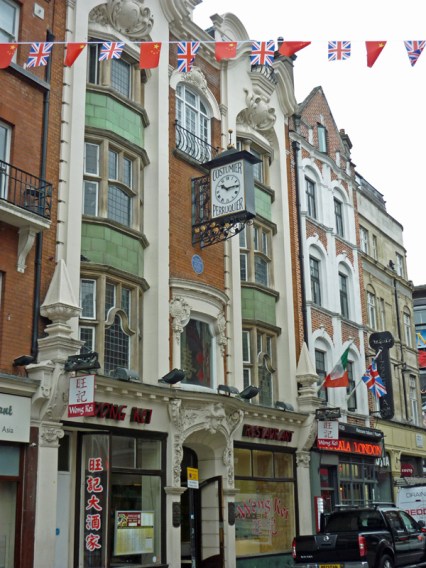
No 41-43 is the home of the Wong Kei restaurant, renowned back in the day for the “alleged” rudeness of its waiting staff. This was said to only increase the popularity of the restaurant which is generally full but that probably has more to do with the reasonableness of their prices. You can’t expect both value for money and over-politeness.

The building is another designed in the baroque style (with added touches of Art Nouveau) and as the blue plaque attests was once owned by Willy Clarkson (1861 – 1934), theatrical costumier and perruquier (that’s wigmaker to you).

P1050614

Dansey Place is basically just a back alley that runs behind the restaurants on the north side of Gerrard Street and emerges into Macclesfield Street. Despite all the visits I’ve made to this area I’d never even noticed it before but it has a distinct dingy, unchanged for decades charm to it.

P1050618

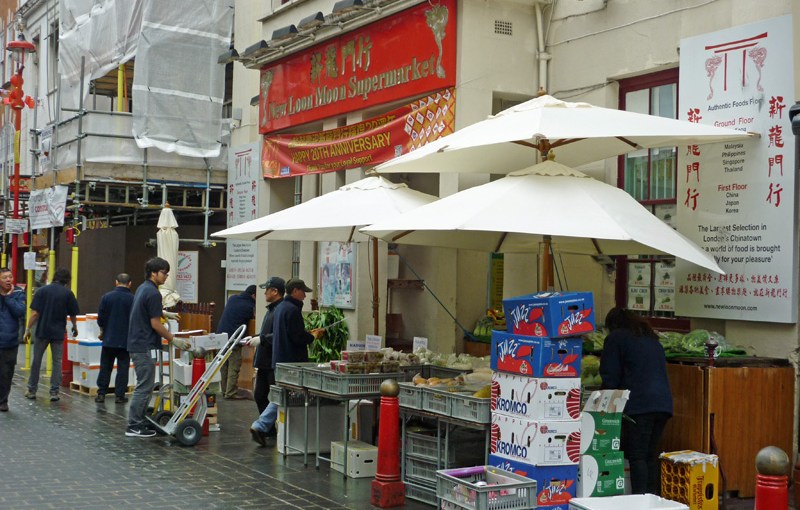
Next we’re on to Gerrard Street itself which at mid-morning with a parade of white vans lined up making deliveries manages, if anything, to look slightly tackier than normal. Though I have to confess to a bit of a soft spot for its gaudy accoutrements.

The part of London originally known as Chinatown was down in Limehouse in the East End and consisted of businesses that catered to Chinese sailors visiting the docks. It wasn’t until the Seventies following an influx of immigrants from Hong Kong and a growing taste for oriental cuisine that Gerrard Street and the surrounding area began to assume the name.

This slideshow requires JavaScript.

Those two carved Chinese lions in the one of the slides above were donated by the People’s Republic of China and were unveiled by the Duke of Gloucester in 1985 at a formal naming ceremony (which coincided with the quatercentenary of the City of Westminster). Appropriately, given the Chinese fondness for gambling, they are now backdroppped by a  Betfred bookmakers.

There are a couple of atypical commemorative plaques on Gerrard Street. At no.37 is one to John Dryden (1631 – 1700), England’s first Poet Laureate. The phrase “blaze of glory” is believed to have originated in Dryden’s 1686 poem The Hind and the Panther (which celebrated his conversion to Catholicism), in that it refers to the throne of God as a “blaze of glory that forbids the sight.”

(The portrait of Dryden above was taken in the National Portrait Gallery which will feature in the next post.)

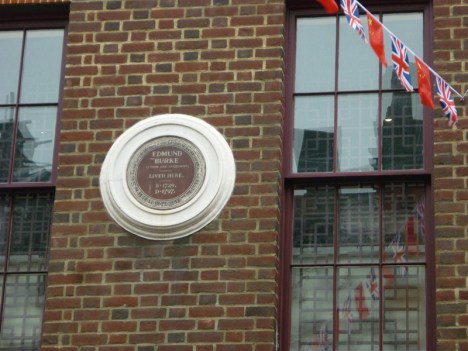
The second plaque is at no.37 in honour of the Anglo-Irish statesman Edmund Burke (1729 – 1979). Burke, who was both a philosopher and politician, was supportive of American independence and Catholic emancipation but vehemently antipathetic to the French Revolution. Although a member of the Whigs he is widely touted as the “father of modern conservatism”.

P1050622

As noted in an earlier post, the original Ronnie Scott’s Jazz Club was at no. 39.

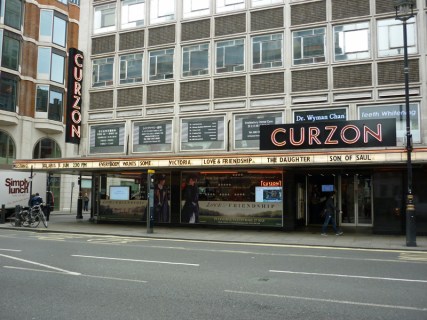
If you nip up Gerrard Place, at the western end of the street, you hit Shaftesbury Avenue opposite the Curzon Cinema which, to my mind, is one of the best in London. Its existence is under threat from the proposed Crossrail 2 (Gawd help us) and though the building it occupies the basement of is nothing to write home about, the cinema would be sorely missed. (So go on – sign the petition).

P1050626

Next we go south down Newport Place and veer left down the alleyway that is Newport Court. This brings us out onto Charing Cross Road where we turn right almost immediately back up Little Newport Street. The building on the corner that is now a branch of Pizza Express is Grade II listed and was once an outlet of the costumiers, Morris Angel & Son.

P1050627

Pass round the back of the Hippodrome (more of that next time) and continue along Lisle Street which probably has a better selection of Chinese restaurants than its parallel neighbour.

At the end we’re back out on Wardour Street opposite what used to be the Chuen Cheng Ku restaurant which served the best Dim Sum in Chinatown in bamboo baskets wheeled round on trolleys. Not sure what it is now and the splendid Dragon Pole is gone, in its place a plaque commemorating the building as the site where the Magic Circle was founded in 1905. Bizarrely a website for the restaurant still lives on as a ghostly reminder so you can see what’s been lost here.

P1050631

A couple of doors down no. 9 was once the residence of Benjamin Smart, a goldsmith and dealer in bullion, who wasn’t shy of advertising the fact as you can see.

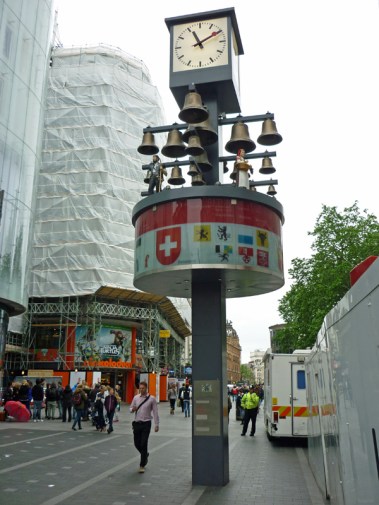
A left turn at the southern end of Wardour Street and Swiss Court takes you into Leicester Square and face-to-face with the Swiss Glockenspiel, a 10m high structure, with 27 bells, an automated musical clock with a procession of herdsmen and their animals ascending an alpine meadow. This rather charmless confection was only erected here in 2011 in an attempt to replace the far more impressive glockenspiel and clock which in 1985 was installed on the front of the Swiss Centre that occupied the north-west corner of the square, from 1966 until its demolition in 2008.

P1050634

I don’t think I ever really understood the purpose of the Swiss Centre but its demise seems to be lamented by quite a few online commentators. In any event it was preferable to the building which has replaced it and incorporates yet another luxury hotel and M&M’s World which stretches to a mind-boggling four floors. About as necessary as another Teenage Mutant Ninja Turtles movie.(For people of a certain age – M&Ms are like an American version of Smarties).

P1050635

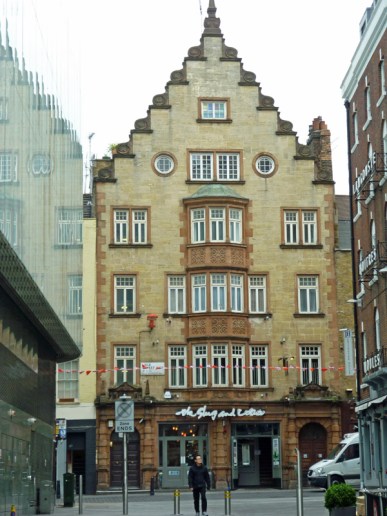
Leicester Street runs north from the square to Lisle Street emerging opposite no.5 which was designed by Frank T. Verity in 1897 in the early Renaissance style of northern Europe. The building was first occupied in 1900 by the French Club and subsequently by Pathé of France and Pathéscope Limited, film-makers. From 1935 to 1989 it was the home of St. John’s Hospital for Diseases of the Skin. After that it became the aptly-named Crooked Surgeon pub until in 2007 it was (sigh) taken over by the owners of the ubiquitous Slug and Lettuce Chain.

P1050636

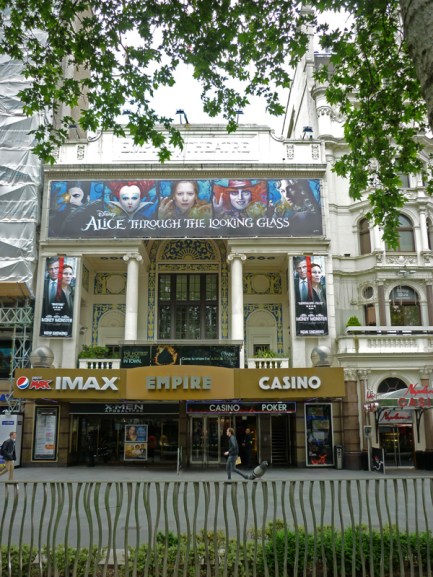
In the next block down on the square itself is the Empire Cinema and Casino. The current building is the third incarnation of the Empire Theatre to occupy this site. The first version opened in 1884 as a high-end variety theatre but within three years had repositioned itself as a popular music hall. That building was demolished in 1927 and the second Empire Theatre which opened a year later operated primarily as a cinema. After WW2 the theatre became known for its Cine-Variety programmes – a combination of film showings and live performances – and example of which you can see here. In 1959, the Empire installed 70mm projectors and a new screen in front of the proscenium to show Ben-Hur, which ran for 76 weeks. Following this, in 1961, the Empire was closed for extensive internal reconstruction to a design by Architect George Coles. It reopened in 1962 with a new 1,330 seat auditorium in place of the circle and a Mecca Ballroom where the stalls used to be. The latter is now the Casino. The cinema today comprises 9 screens, one of which is an IMAX.

P1050638

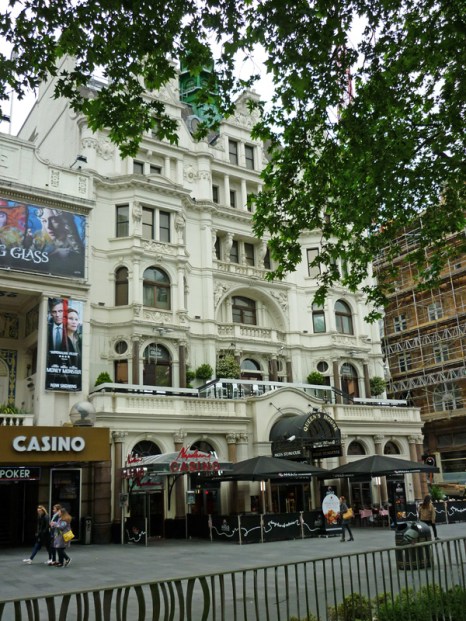
Next door to the Empire is Queen’s House which was built in 1897 and opened as the Queen’s Hotel in 1899. In 1920 the socialist MP Victor Grayson vanished mysteriously after telling friends that he had to pay a quick visit to hotel. It was rumoured that the MP, who had made a number of enemies in high places, was killed to stop him revealing details of government corruption.

In 1936 the building was remodelled to accommodate office space on the upper floors but today it is once again a hotel (wait for it) as part of the Premier Inn stable. It also plays host to yet another casino (Napoleon’s).

P1050639

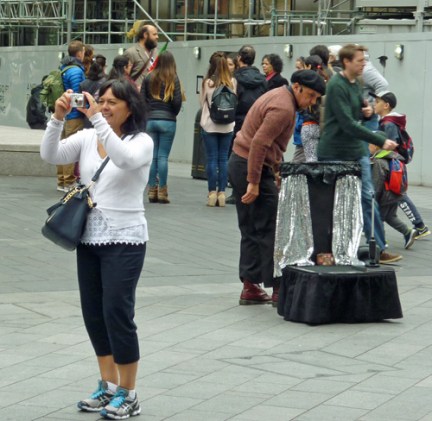
On that note it’s time to bring things to a conclusion but we’ll be back with more of Leicester Square in the next post. Until then here’s a reminder of what it’s really all about – foreign tourists and half-baked street performers.

P1050637


Day 25 -Shoreditch High Street – Arnold Circus

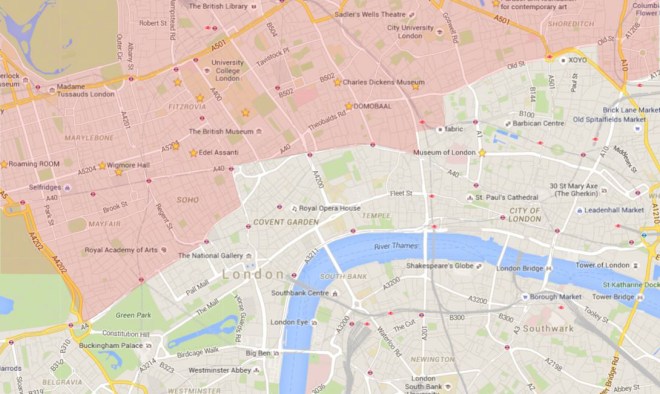
More than a touch of serendipity about this excursion as a couple of days after the last walk, on Bank Holiday Monday to be precise, I went along to the Secret 7″ sale at Sonos Studios in Shoreditch and therefore found myself only a couple of hundred yards away from the previous finishing point. Before we get into that though here’s another of the periodic updates on overall progress so far.

Covered so far May 2016 copy

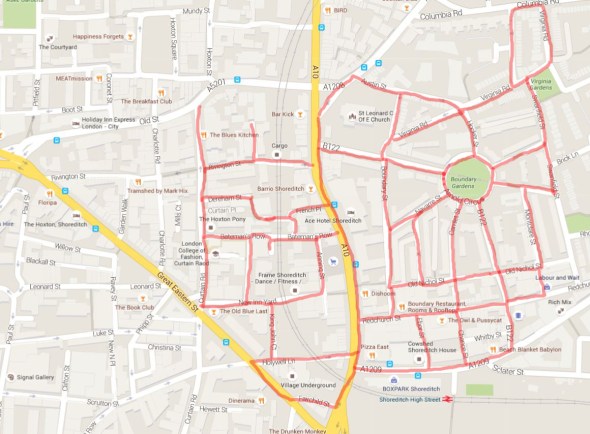
Back to today’s trip which takes in the western side of the area wedged between Columbia Road and Bethnal Green Road and the streets enclosed within the quadrilateral of Old Street, Shoreditch High Street, Curtain Street and Great Eastern Street.

Day 25 Route

First up, from Bethnal Green Road we head north up Club Row which is where the Sonos Studios live. Secret 7″ has been running for a few years now but this is the first time at this location. Principle is similar to the RCA’s Secret Postcard fundraiser but this involves record covers designed for one of seven specially chosen tracks and is in aid of Amnesty International. You can get the full lowdown here. Didn’t get there until an hour after the start by which time I would say around 65% of the covers had already been snapped up. Happy enough though with my two acquisitions, which you can see in the selection below. Actual singles were the offerings by The Jam and Tame Impala.

This slideshow requires JavaScript.

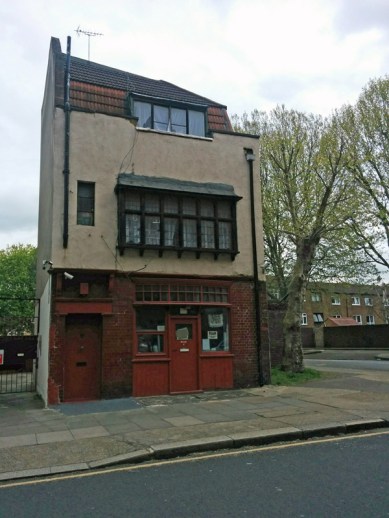
Having bagged my two 45’s continue north up Club Row to Arnold Circus, of which more later. Circle anti-clockwise and exit along Pallissy Street. This leads into Swanfield Street where at no.74 stands an isolated remnant of the past in the last remaining weaver’s house in the area (the East End being a hub of the weaving industry in the 18th and early 19th centuries). These days it’s a foam shop.

IMG_20160502_123808

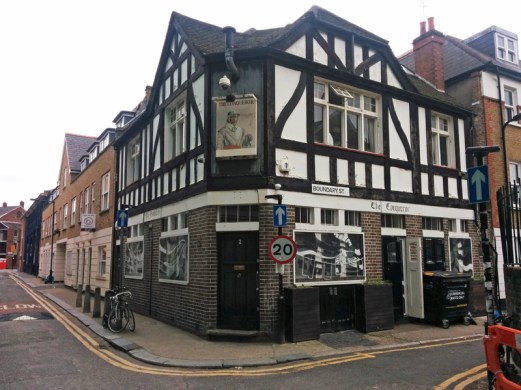
At top of Swanfield Street turn right along Virginia Road which emerges onto Columbia Road and then almost immediately double-back down Gascoigne Place. Going westward Virginia Road forks off into Austin Street and at the junction of Boundary Street, which rejoins the two, there is, seemingly, another member of the Dead Pubs’ Society. Some commentators have suggested that the Conqueror is named after William I of that soubriquet but judging from the sign I would be more inclined towards Oliver Cromwell.

IMG_20160502_124438

Continuing along Austin Street brings us out onto the bottom end of Hackney Road again and a left turn takes us round the corner to the entrance to St Leonards Church. This will of course be familiar to all fans of one of the best sitcoms of recent years, Rev (starring Tom Hollander and Olivia Colman). St Leonard is the patron saint of prisoners and the mentally ill and there is evidence of a church on this site since Anglo-Saxon times though that was demolished by the Normans who built their own replacement. It was the Norman church which became known as the actors’ church. Many of the Elizabethan theatrical fraternity are buried in the remains under the current crypt. This includes three Burbages, James who built the first English theatre (again more of that later), his son Cuthbert who built the Globe theatre and his other son Richard who was the first to play Macbeth, Hamlet, Richard 3rd, Othello and especially Romeo. These associations are commemorated in a stone memorial on a wall inside the present-day church which dates from around 1740. The splendid organ was built by Richard Bridge in 1756 and is one of the few surviving examples of a tracker organ without pedals.
This slideshow requires JavaScript.

The somewhat macabre monument in white marble with two grinning skeletons tearing into the “tree of life” is in memoriam of one Elizabeth Benson, died 1710, and is the work of Wren’s favourite sculptor, Francis Bird. The final part of the Latin inscription roughly translates as “hale and hearty and regardless of old age she accidentally tripped and fell, alas, at the age of 90 ; and the stem of life was not gently withdrawn but torn asunder.”

There is a very timely exhibition on inside the church at the moment which runs until June 2016. Entitled Development Hell this shines a light on the on-going planning battles concerning a number of areas adjacent to the City of London and Boris Johnson’s role in greenlighting a number of controversial schemes.

Across the road on Shoreditch High Street are a number of fine Victorian buildings including Wells & Company Commercial Ironworks built in 1877 but only retaining its industrial function until 1895.

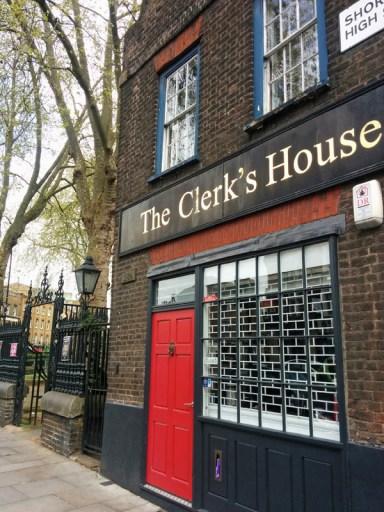
Back on the east side adjacent to the church (at no 118 and 1/2) is the Clerk’s House. This dates from 1735 and so is a couple of years older than the church itself. Current occupancy is by a fashion boutique.

IMG_20160502_130559

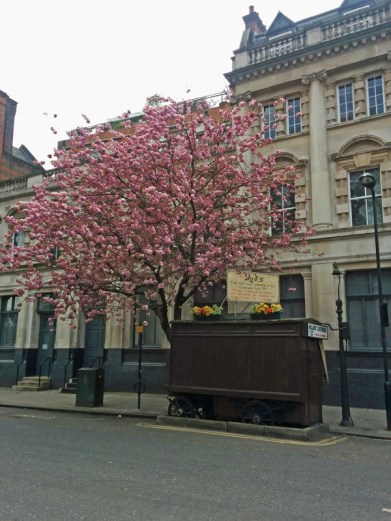
On the corner with Calvert Avenue you’ll find Syd’s Coffee Stall. Named after its first proprietor, Sydney Edward Tothill, who set up the business just after the First World War financed with his invalidity pension. The stall’s not open today as it’s a Bank Holiday but this is more than compensated by the resplendent blossom on the tree behind.

IMG_20160502_130640

Calvert Avenue links back with Virginia Road and then Hocker Street returns us to Arnold Circus with its bandstand and gardens which sits as the hub in the wheel of the Boundary Estate. Cited as the world’s oldest social housing project, Boundary Estate was developed between 1890 and 1900 on the site of the Old Nichol Rookery slum. The redbrick tenements are all now Grade II listed and although around of the 500-odd flats are now in private hands the rest are still under the control of Tower Hamlets council. The separate tenement buildings are all named after towns or villages on the River Thames such as Sunbury, Chertsey & Hurley.

This slideshow requires JavaScript.

Leave the circus this time via the 4 o’clock spoke which is Rochelle Street and then head south back toward the Bethnal Green Road down Montclair Street. This bit of Shoreditch is the home of (mostly) officially sanctioned graffiti art and, regardless of whether or not you consider these to be sanitised hipster versions of the original ‘street’ art form, they undoubtedly make for an arresting sight.

This slideshow requires JavaScript.

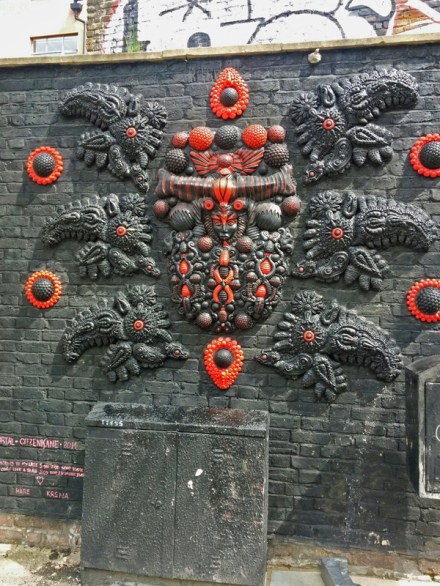
So the above examples can all be found on the route back up to Arnold Circus that takes in Turville Street, Redchurch Street, Whitby Street, Chance Street and Camlet Street. This route also includes another turn down Club Row where we pass this singular three-dimensional piece by the artist, Cityzen Kane, which takes inspiration from African art and the late eighties rave scene.

IMG_20160502_131757

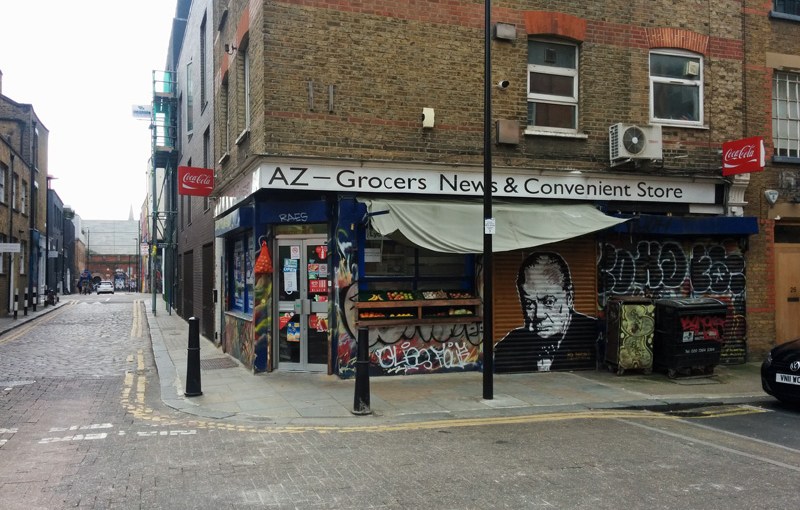
Finishing off this section to the east of Shoreditch High Street we visit Navarre Street, Ligonier Street, Old Nichol Street, another stretch of Boundary Street, Redchurch Street again and finally Ebor Street. And here’s another selection of graffiti art encountered along the way – taking us from Marvel’s Avengers to Winston Churchill via the Cycle of Futility.

This slideshow requires JavaScript.

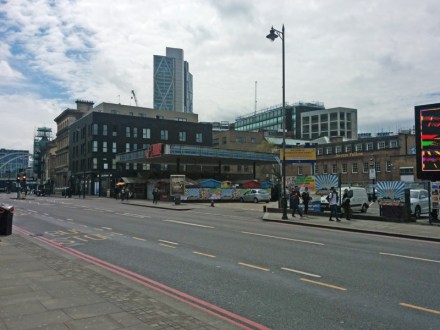
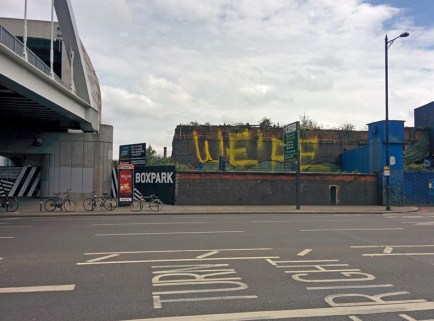
Back on Shoreditch High Street we cross over by the old garage which is now home to a pop-up food festival (says it all really) and head south to the junction with Great Eastern Street.

IMG_20160502_133244IMG_20160502_133930

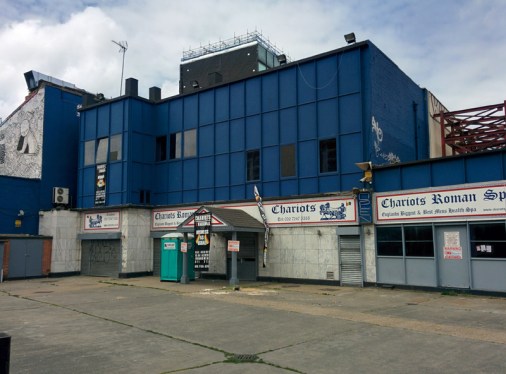
Right on that junction (and purportedly still open for business appearances to the contrary) is Chariots Roman Spa – self proclaimed as England’s biggest at best men’s health spa. Which  makes you hope that you never find yourself in the worst.

IMG_20160502_134015

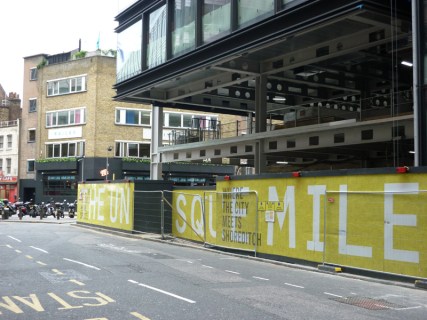
The graffiti is a little bit more anarchic in the enclave between Curtain Road and Shoreditch High Street which is crossed initially by Fairchild Street and Holywell Lane. The latter is also home to music venue, Village Underground, which sits beneath the railway arches. Have only been here once and wouldn’t rate it as one of my favourite concert venues mainly because the auditorium is far too narrow.

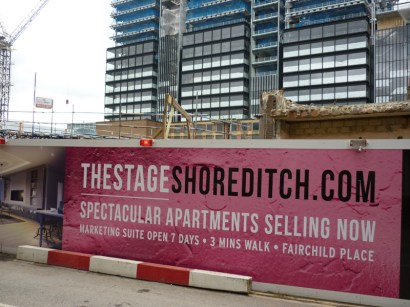
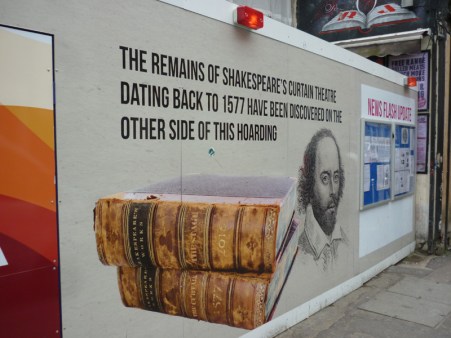
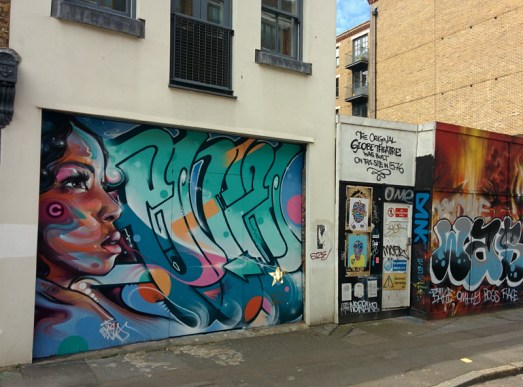
Next up is King John Court which adjoins with New Inn Yard at its north end. This is reliably believed to be the site of the first permanent theatre built in England (as mentioned earlier) courtesy of James Burbage. Known simply as The Theatre it opened in 1576. Some of Shakespeare’s early works were performed here as well as plays by Marlowe and Thomas Kyd.  From 1594 it was home to the famous players known as the Lord Chamberlain’s Men (after their patron Henry Carey who fulfilled that office at the time). However the theatre only lasted for four further years until after a series of disputes between the Burbages, Shakespeare and the Lord Chamberlain’s Men the former had the playhouse taken down and rebuilt as the first Globe Theatre across the river. All of this is, I think it is fair to say, commemorated in a somewhat low-key style.

IMG_20160502_134618

Northward on New Inn Street takes us past the back entrance to the old Curtain Road primary school.

IMG_20160502_134710

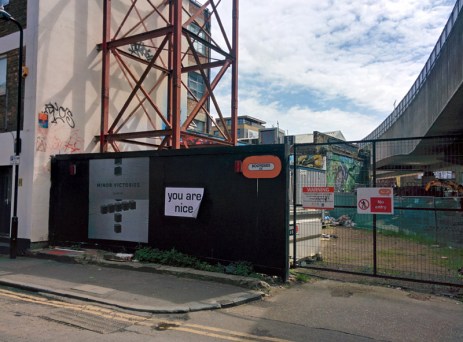
Then it’s on to Bateman’s Row where there is a sign of encouragement (but not perhaps genuine insight).

IMG_20160502_135225

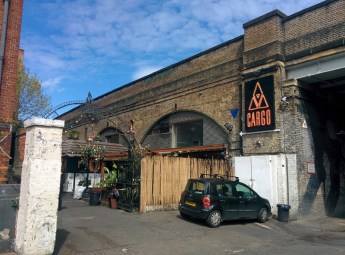
South on Anning Street then back up along Shoreditch High Street past French Place to get to Rivington Street, which is the final call for today. This is the location for a couple of Shoreditch institutions; after-hours club Cargo and the Rivington Place Gallery. The former no longer at the cutting edge of club culture by all accounts. The latter we shall return to on another visit.

IMG_20160502_135621

And once again that’s all folks !


Day 12 – Gray’s Inn Road -Pentonville Road – New River Head – Charles Dickens Museum

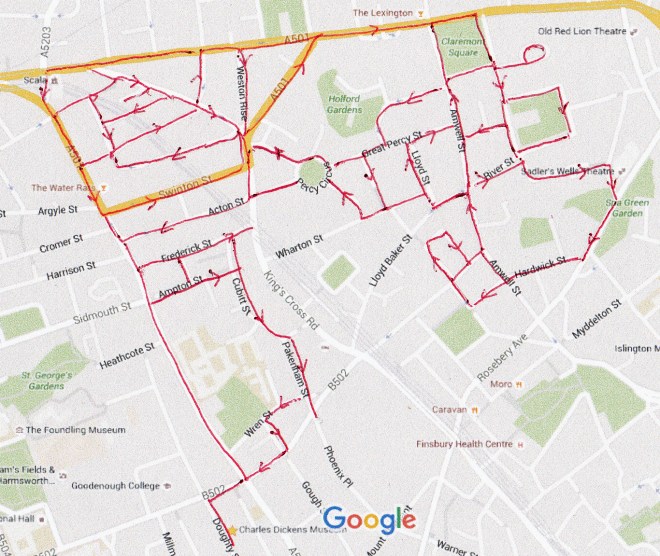
Bit of a meandering one today, largely covering the triangular area bounded by King’s Cross Road, Pentonville Road and Roseberry Avenue then returning to Gray’s Inn Road and ending up at the Charles Dickens Museum. Much of this area is comprised of the site known as New River Head which is integral to the story of London’s water supplies. This trip also takes us for the first time into the London Borough of Islington.

Day 12 Route

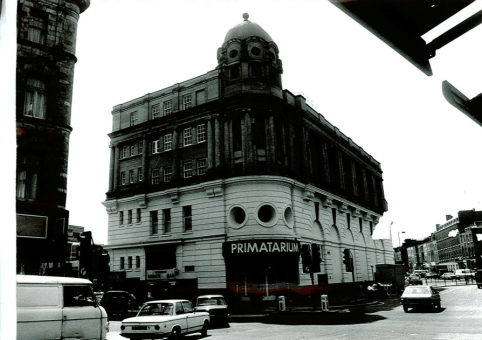
Begin within a return visit to Kings Cross and take the Scala on the corner of Pentonville Road and King’s Cross Bridge Road as the starting point. Originally opening as a cinema in 1920, the Scala has had many incarnations including a brief ill-fated stint in the late seventies as a Primatarium (a specially made-up word I suspect). This monkeying around lasted all of 18 months before the venue reverted to being a cinema and also hosting live music performances. That continued until 1993 when the Scala Cinema Club went into receivership after losing a court case over an illegal screening of Stanley Kubrick’s A Clockwork Orange. After a radical make-over it was resurrected in 1999 as a concert and club venue. Unfortunately the building is completely swathed in scaffolding for repainting at present.

primatarium

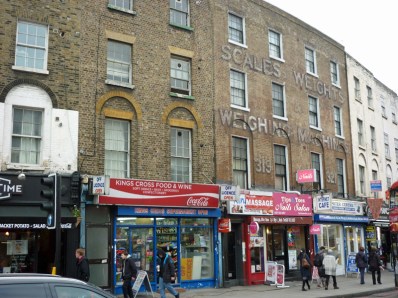
Cut through onto the top end of Gray’s Inn Road where the familiar un-tarted up Kings Cross lives on.

P1040704

On the opposite side of the road is Willing House, now a Travelodge but originally built around 1910 in a ‘Free Baroque’ style for the Willing family, whose fortune was founded on billboard sites.

P1040705

The streets which intersect between Gray’s Inn and King’s Cross Road have little of real interest but the photos below give some flavour of St Chad’s Place, Field Street, Leeke Street, Swinton Street, Wicklow Street and Britannia Street.

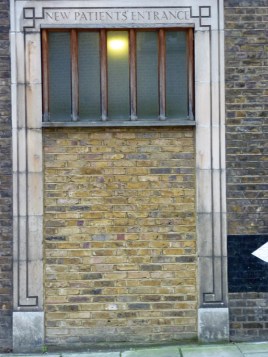
One thing of note on Wicklow Street is this indication that the Royal National Throat, Nose and Ear Hospital isn’t that keen on taking on any additional patients.

P1040712

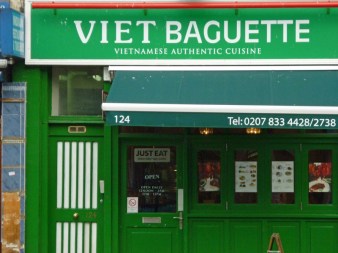
After that lot it’s back out onto King’s Cross Road and a break for lunch; finally catching up with the vogue for Vietnamese Banh Mi rolls (after everyone else has moved on no doubt).

P1040713

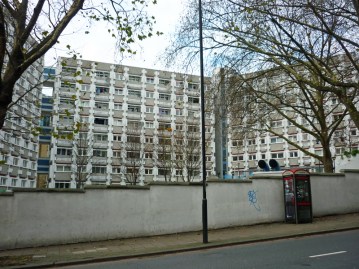
Cut up onto Pentonville Road again via Lorenz Street then back down Weston Rise and up Penton Rise. Somehow it’s never really registered with me before that a Rise is so-called because it does just that. On the west side of this incline is the 1960’s GLC built Weston Rise Estate which is garnished at its southern end by a somewhat incongruous tropical garden.

P1040715

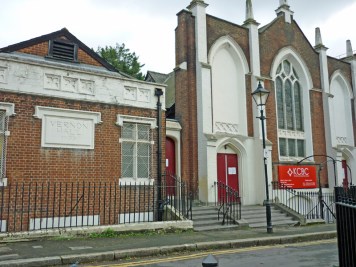
On the other side is Vernon Square, home to Kings Cross Baptist Church and behind which is another SOAS campus.

P1040714

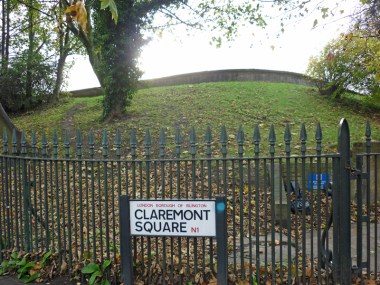
Heading further east along the Pentonville Road brings us to Claremont Square in the middle of which is the eponymous reservoir originally dug at the start of the 18th century then covered in 1855 following The Metropolis Water Act of three years earlier, prompted by the cholera epidemic of 1846, which required this of all reservoirs within London. The reservoir fell into disuse in the 1990s, but came back into service in 2003 to provide a kind of header tank or balancing reservoir for the London Ring Main

P1040717

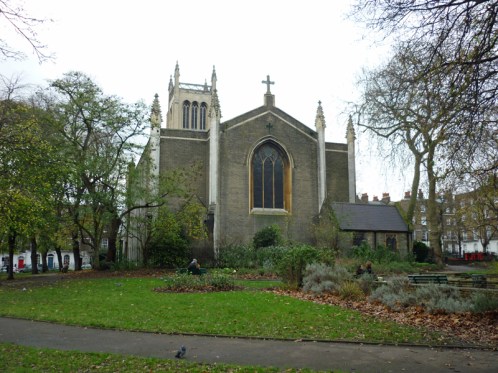
Claremont Close loops off the square and then Mylne Street leads off the south-east corner down to Myddleton Square. This, the largest square in this part of London, is named after Sir Hugh Myddleton  one of the main architects of the New River project – of which more in a minute. In its centre sits St Mark’s Church, Clerkenwell, consecrated on 1st January 1828. The church is unusual in that there is no graveyard in its grounds. The congregation have also shared the church with the World Community for Christian Meditation since 2002.

P1040718

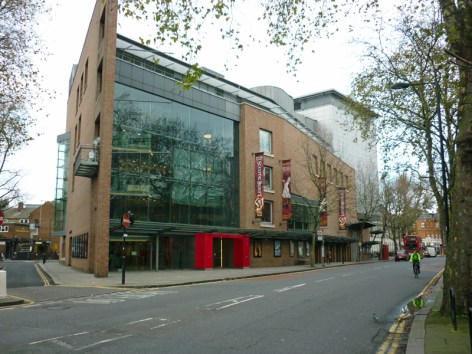
Having circumvented the square, Ingelbert Street takes us into Amwell Street and then River Street returns us to the square from where Myddleton Passage cuts through to Arlington Way. Here we emerge opposite the west side of Sadler’s Wells Theatre on Roseberry Avenue, London’s premier contemporary dance venue. The current building which opened in 1998 is the sixth theatre on this site; the first erected in 1683. Current offering is Matthew Bourne’s “Sleeping Beauty” which I can thoroughly recommend.

P1040720

Immediately to the west of Sadler’s Wells is the area known as New River Head which derives its name from being the site of the mouth of the New River, the channel cut at the start of the 17th century to supply London with water from springs out in Hertfordshire. This was all carried out under the auspices of the New River Company which became a very substantial property owner over the next couple of centuries before being taken over by the Metropolitan Water Board in 1904. It was the latter which constructed the Laboratory Building (below) in 1938 as a home for the testing of water quality. This archetypal 1930’s creation was converted to residential use in the 1990’s.

P1040722P1040721

On the apex of Roseberry Avenue and Hardwick Street sits the equally impressive New River Head Building which was opened in 1920 as the headquarters of the MWB. This also succumbed to conversion into luxury private residences in the nineties.


Hardwick Street leads into Amwell Street again and crossing over into Merlin Street we find Charles Rowan House  with its distinctive turrets and atypically Expressionist feel. This was originally built in the 1920’s as married quarters for Met policemen and was converted into council housing in 1974.

P1040727

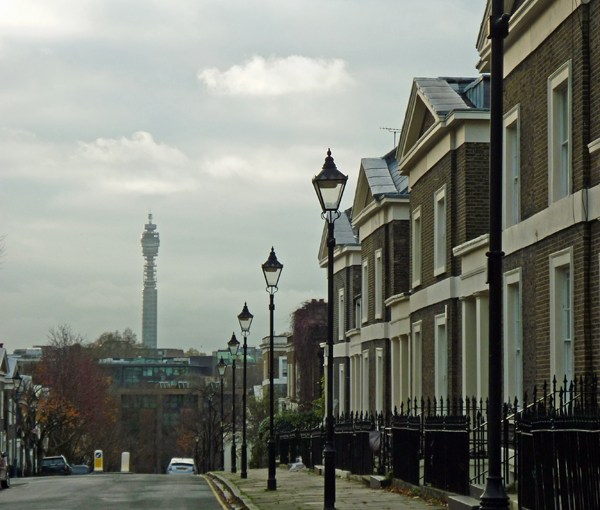
Next up is Wilmington Street, then Fernbury Street and Naoroji Street (named after Dadabhai Naoroji (1825 – 1917) the so-called “Grand Old Man of India” and the first Asian to sit as a British MP). A bit more of Amwell Street then left into Lloyd Baker Street and right into Lloyds Street. The elevation comes into its own here with this view across to the BT Tower in the west.

P1040729

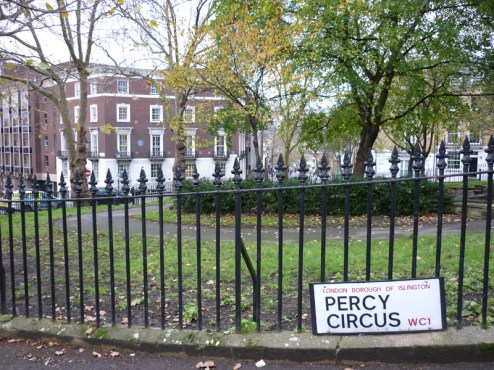
From Great Percy Street we dip back into Amwell Street then loop back via Cruikshank Street and Holford Street. Cumberland Gardens and Prideaux Place are the next stops before arriving at Percy Circus. Like Great Percy Street, this takes its name from Robert Percy Smith, Governor of the New River Company from 1827 to his death in 1845. It is also the least central of the London Circuses. At No. 16 is yet another blue plaque commemorating a brief residency of Lenin.

P1040730

Next down Vernon Rise back to King’s Cross Road and again zig-zag between this and Gray’s Inn Road taking in Acton Street, Frederick Street, Ampton Place, Ampton Street, Cubitt Street, Pakenham Street and Wren Street. This brings us to St Andrews Gardens opposite which on GIR is the London Welsh Centre – a hub for Welsh cultural activities in the capital not a rugby player.

Just a bit further up the road is the old Kings Cross telephone exchange with its distinctive blue façade.

P1040731

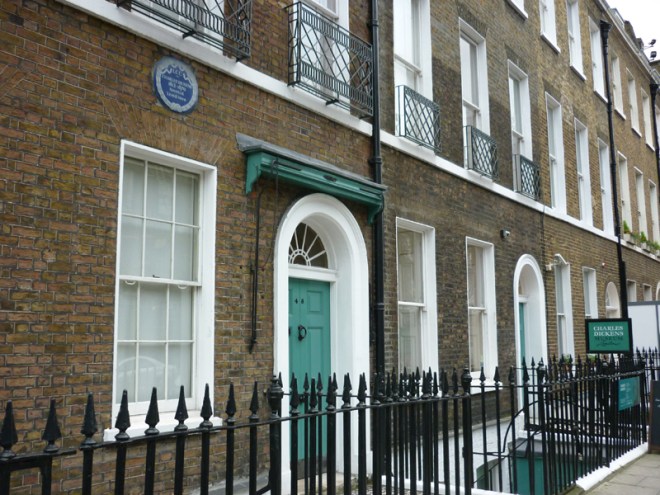
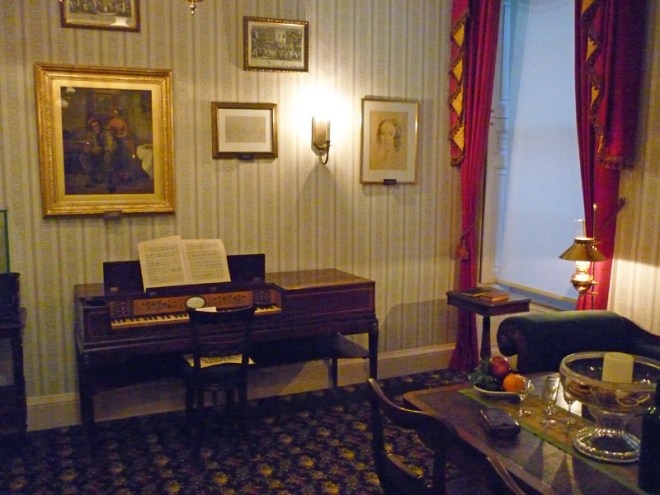
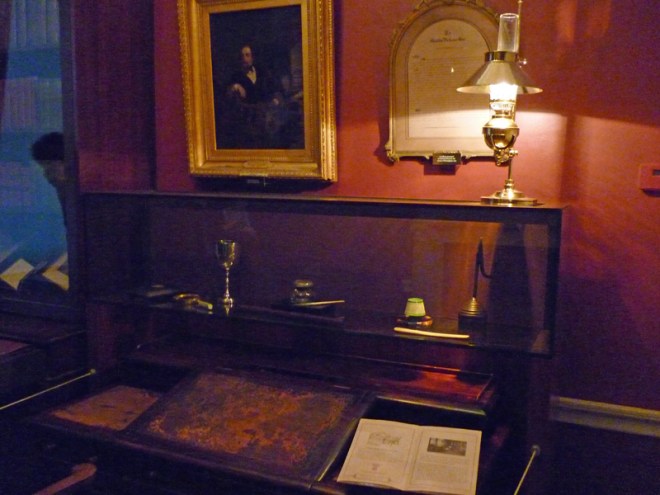
Wander down to Doughty Street to  rendezvous with final stop of the day, the Charles Dickens Museum at no.48. Dickens only lived in this Georgian terraced house from 1837 to 1839 but two of his daughters were born here. it was where he wrote Oliver Twist and it also sadly witnessed to the death of his 17 year old sister-in-law. The museum first opened in 1925 and, as you would expect, is home to the world’s most important collection of Dickens memorabilia, including the writing desk you see below. To be honest I can’t say it was the most scintillating museum experience I’ve ever had – perhaps I should have waited a week for the Christmas decorations to go up.

P1040734
48 Doughty Street
P1040736
Drawing Room
P1040735
Study


Day 11 (part 2) – Tottenham Court Road – University College London – Bloomsbury

Second leg of today’s walk resumes at the north side of Russell Square then concentrates on the constellation of buildings and institutions that constitute the “Bloomsbury Site” of the University of London, principally UCL.  This was originally an area of eleven acres stretching from Woburn Square to the British Museum and its acquisition, from the Duke of Bedford (see last post) in 1927, was partially funded by the Rockefeller Foundation. It ends with visits to the two wonderful in-house museums belonging to UCL, the Grant Museum of Zoology and the Petrie Museum of Egyptian Archaeology.

Day 11 Route pt2

We begin by heading north up Bedford Way then after turning left into Gordon Square venture south again via Woburn Square and Thornhaugh Street before returning to Russell Square and exiting that by the south-west corner. This takes us into Montague Place which runs along the back of the British Museum (more of which in a later post).

P1040656

As mentioned above the creation of this new hub for the University of London in the thirties was facilitated by an endowment from the Rockefeller Foundation – £400,000 which was a pretty immodest sum back then. The centrepiece of the development was the (still) imposing Senate House on Malet Street. Construction of this iconic Art Deco edifice (often claimed as London’s first skyscraper) began in 1932 and although some staff moved in during 1936 it wasn’t fully completed until 1937 by which time it had been scaled back from the original designs due to a shortfall in funds.

The building was used by the Ministry of Information during WWII and this, combined with its monolithic appearance no doubt, inspired both Graham Greene’s “Ministry of Fear” (adapted for the cinema by Fritz Lang) and George Orwell’s Ministry of Truth as featured in “1984”.

There is even an actual Room 101 inside on the first floor though there is not thought to be any direct correlation between this and Orwell’s home of nightmares made flesh (despite the fact that his wife worked for the MoI during the war).

The right-hand image below is of a map in The Chancellor’s Hall showing the location of all the constituent colleges of the University of London in 1939. The actual painting, by MacDonald Gill, is 4m across.

The building mainly functions as the administrative centre for the University of London but also houses its main library. On the left below is the Senate Room itself; these days used only a handful of times a year for meetings of the actual Senate (which is largely ceremonial) though it is available for hire.

To the north of the Senate House is Torrington Square where reside  Birkbeck College and The School of Oriental and African Studies (SOAS). Opposite the latter is the Brunei Gallery (no prizes for guessing where the funding for that came from) which is well worth a visit, not only for its exhibitions but also its Japanese roof garden.

Across the road at the top end of the square is the southern end of  Church of Christ the King, Bloomsbury

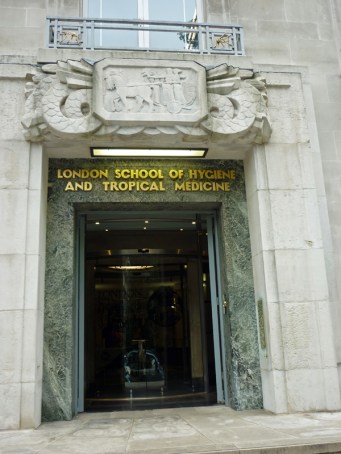
Here we turn left along Byng Place then head back down Malet Street until we get to Keppel Street which is where London School of Hygiene & Tropical Medicine lives.

130922 Open House (4)

The creation of this new building for the school, following the granting of its Royal Charter in 1924, was another result of the munificence of the Rockefeller Foundation. The building, which was opened in July 1929, was one of the first constructed around a steel frame. The facade of Portland stone incorporates above the main entrance a carving of Apollo and Artemis riding a chariot. As you can also see above, the first floor balconies are  decorated with a selection of gilded bronze studies of insects and animals infamous for their roles in the transmission of disease.

The sculpted panel above is by Eric Kennington (1888 – 1960) who is mainly known for his work as an official artist in both World Wars. The bust in the library is of Sir Richard Doll (1912 – 2005) considered to be the foremost epidemiologist of the 20th century.

Cross over to Store Street with its uniformly fronted independent shops, galleries and coffee shops and on the corner with Ridgmont Street come across the site of the old Bloomsbury Service Station which was redeveloped in 2012 incorporating the style and some of the features of the original 1926 building into what is now offices and a Byron hamburger joint.

Next up Chenies Street, North Crescent and Alfred Place. The middle one of those is largely comprised of Minerva House, a grade II listed former car showroom and workshop.

P1040664

Back on Store Street, South Crescent to be precise, is the Building Centre. Established in 1931, this is now not-for-profit organisation is dedicated to providing education, information and support in relation to all aspects of the built environment. Worth a visit just to see the 3D map which highlights all the current new-build projects in London.

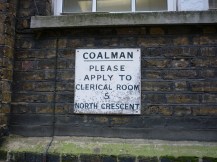
We now take a first dip into Tottenham Court Road and the next turning on the right is Alfred Mews where we come across this somewhat redundant instruction.

P1040668

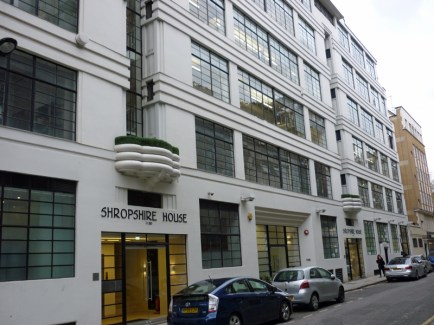
Criss-cross between Tottenham Court Road and Gower Street via Torrington Place, Huntley Street, Chenies Mews and Capper Street. Last of these features another great surviving example of the Art Deco form in Shropshire House which dates from 1932.

P1040671

Another cul-de-sac off of TCR is Queen’s Yard where behind this unprepossessing entrance can be found the Government Art Collection. One of the small selection, of the over 100,000 works in the collection, on display is the splendid 4’33” (Prepared Pianola for Roger Bannister) by Mel Brimfield


On University Street, where we turn next, there is, appropriately, a pub named after the philosopher, Jeremy Bentham (1748 – 1832),  who left his body to be publicly dissected by his friend, Dr Thomas Southwood Smith, and preserved as an ‘auto-icon’. Jeremy the auto-icon was bequeathed to UCL in 1850 and has remained there ever since.


The Grant Museum of Zoology sits on the corner of University Street and Gower Street and houses around 68,000 remarkable zoological specimens.


Founded in 1828 as a teaching collection, the Museum is packed full of skeletons, mounted animals and specimens preserved in fluid. Many of the species concerned are now endangered or extinct. Below are a selection of my personal favourites.

This slideshow requires JavaScript.


After leaving the museum we head down Gower Street, stopping briefly for a look at the UCL Main Building also known as the Octagon Building.

To get to the final stop for today, the Petrie Museum of Egyptian Archaeology we veer off to the left and left again into Malet Place. The museum was set up as a teaching resource for the Department of Egyptian Archaeology and Philology at UCL. Both the department and the museum were created in 1892 through the bequest of the writer Amelia Edwards (1831-1892). The collection, of over 80,000 Egyptian and Sudanese artefacts dating from prehistory through the time of the pharaohs to the Islamic era, was considerable extended due to the extraordinary excavating career of the first Edwards Professor, William Flinders Petrie (1853-1942) after whom the museum is named. Of course the export of such antiquities from their place of discovery has long been illegal so the collection is a static one. It is also quite astonishing.

This slideshow requires JavaScript.

2015 is actually the centenary of the museum opening to the public and in recognition of that here is one final exhibit to hopefully whet your appetite for a visit.

P1040695

This is a fragment from the “Book of the Dead” papyrus belonging to a man named Khnumemheb. It shows the ‘weighing of the heart’ scene in which the deceased’s heart is weighed against the feather of truth while Ammut, the monstrous devourer of the dead, sits beneath the balance awaiting the judgement.


And on that cheery note…until next time.


Day 11 (part 1) – Russell Square – Queen Square – Great Ormond Street – Lambs Conduit Street

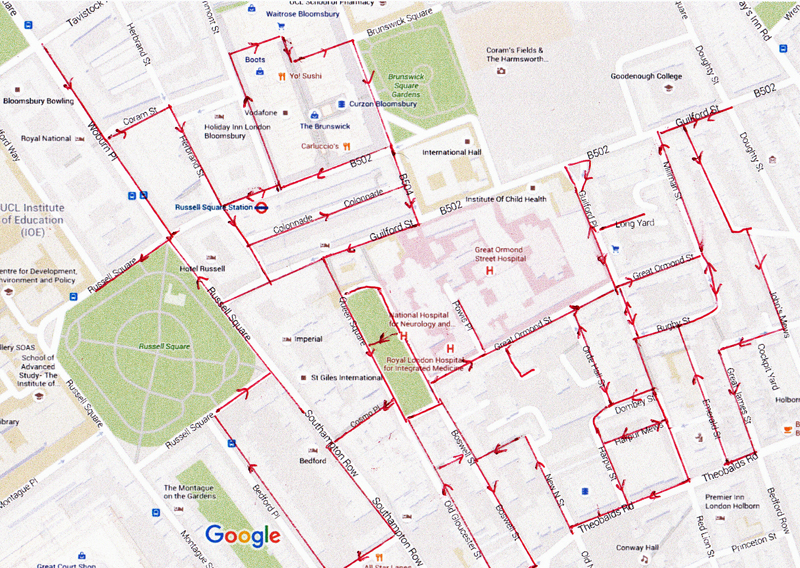
Covered a lot of territory today so I’m going to split this up into two separate posts. This first one starts near Russell Square tube station then takes in the Brunswick Centre before moving south through Queen Square, east along Great Ormond Street and back west via Theobalds Road to Russell Square itself. As you might imagine this part of town is largely known for the hospitals which cluster together here. When we move west of Russell Square on the second leg of this walk it’s all about the University of London.

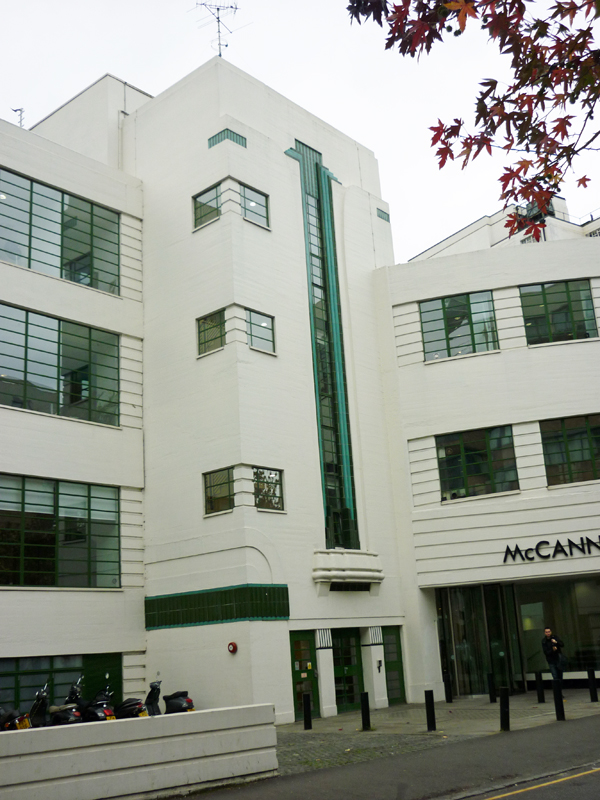
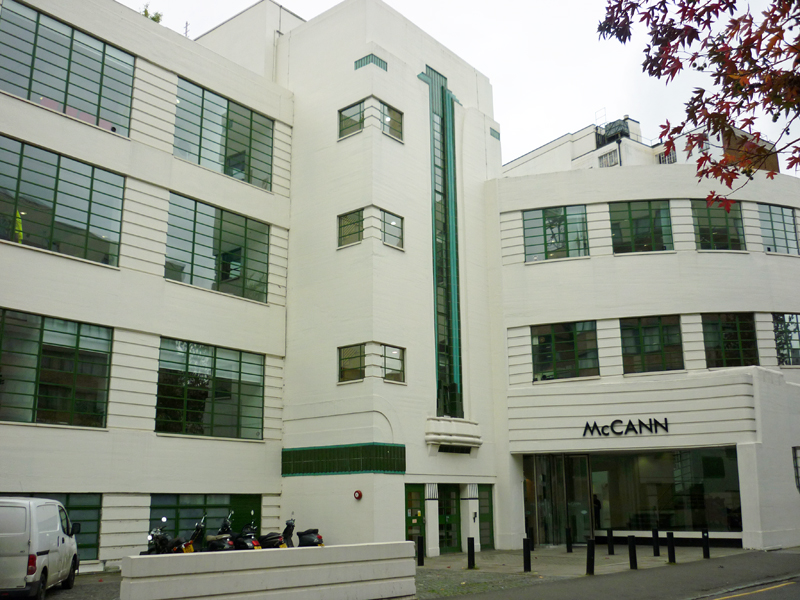
Day 11 Route pt1 Starting point for today is Woburn Place from where we turn left into Coram Street and then turn south down Herbrand Street.  Here on the right, opposite a particularly unlovely Hilton hotel, is the McCann building, a superb example of 1930’s Art Deco created in 1931 by Wallis Gilbert & Partners who were also responsible for the much loved Hoover factory. The building was originally a Daimler car hire garage.

P1040625 P1040624

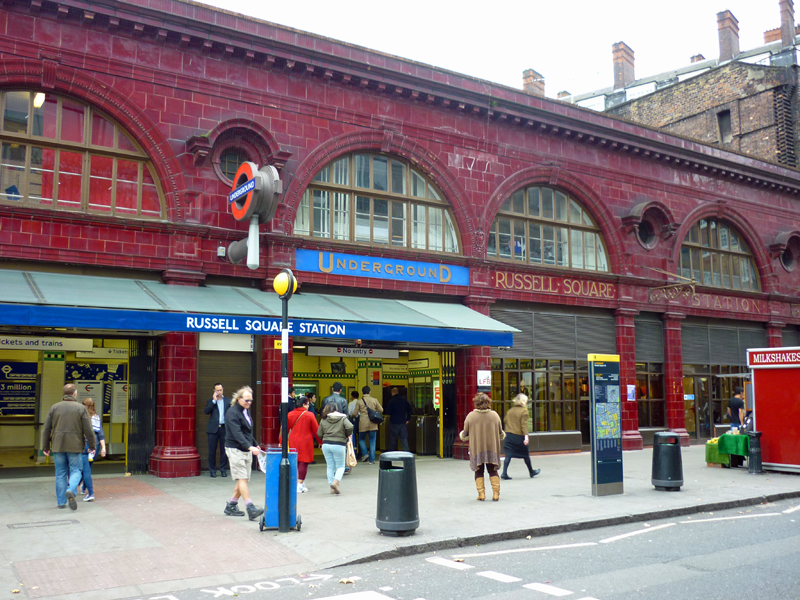
Turning left at the next junction along Bertrand Street takes us past Russell Square station, one of the best examples of the classic Leslie Green-designed underground stations with their iconic claret tiling.

P1040626

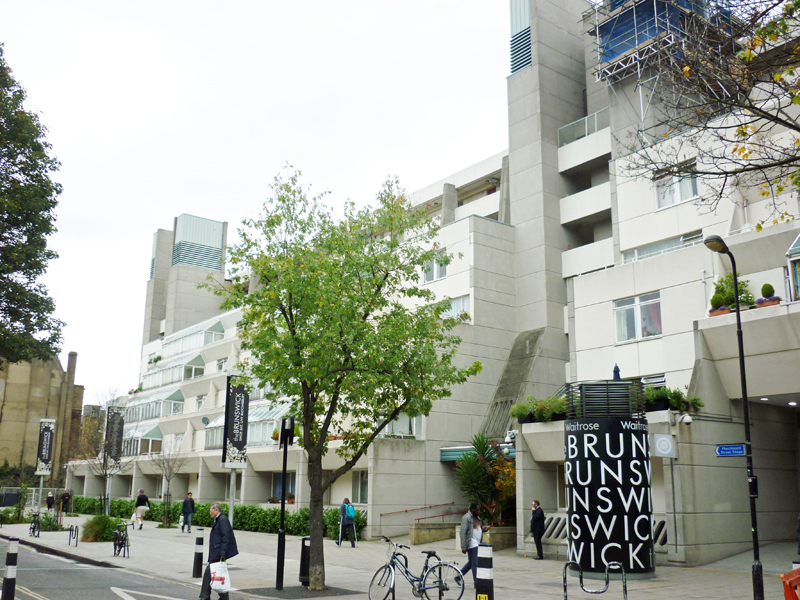
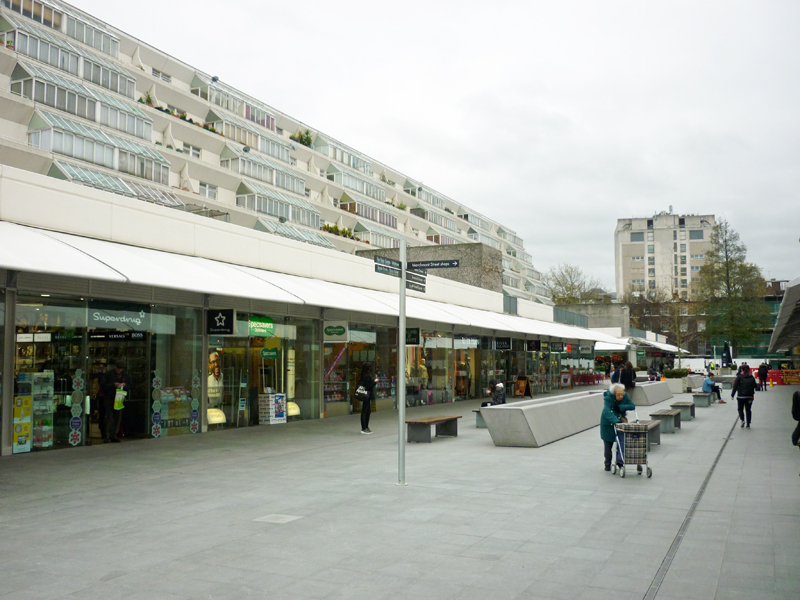
Heading north again, this time on another stretch of Marchmont Street, and from there turn right into the Brunswick Centre, a residential and retail development designed in the 1960’s and finally completed in 1972. It’s one of the few constructions of that era to have achieved Grade II-listed status and still divides opinion. I’m quite fond of it as it reminds me of my first halls of residence at UEA, though by the time I was working near here in the mid-eighties it was already quite tired; with the flavour of a down-at-heel provincial high street. In recent times it’s been spruced up of course and now looks like any generic semi-prosperous high street.

P1040627 P1040628

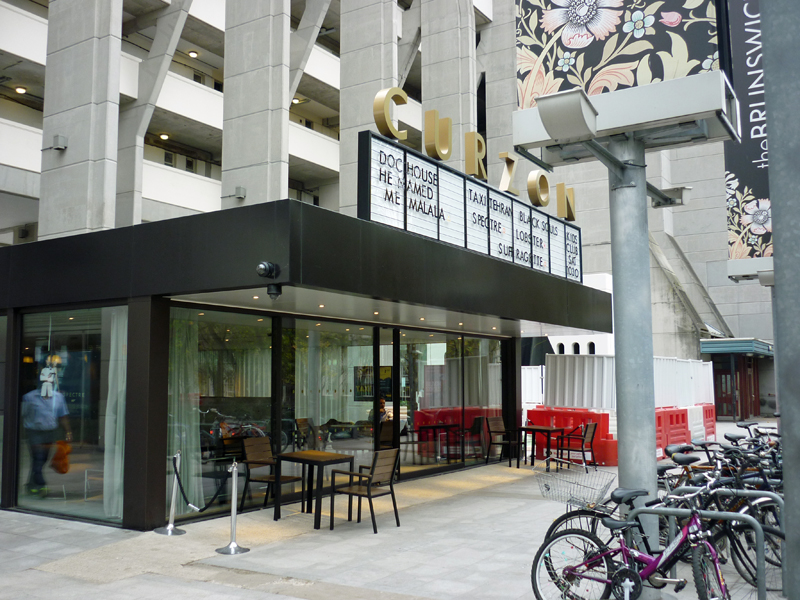
I used to frequent the bunker-like cinema on the east side of the square back in the day when it was still the Renoir (fell asleep in Screen 2 during a showing of Tarkovsky’s “Stalker” in 1986). It’s recently been done-up and re-branded as the Curzon Bloomsbury (progress eh ?).

P1040629

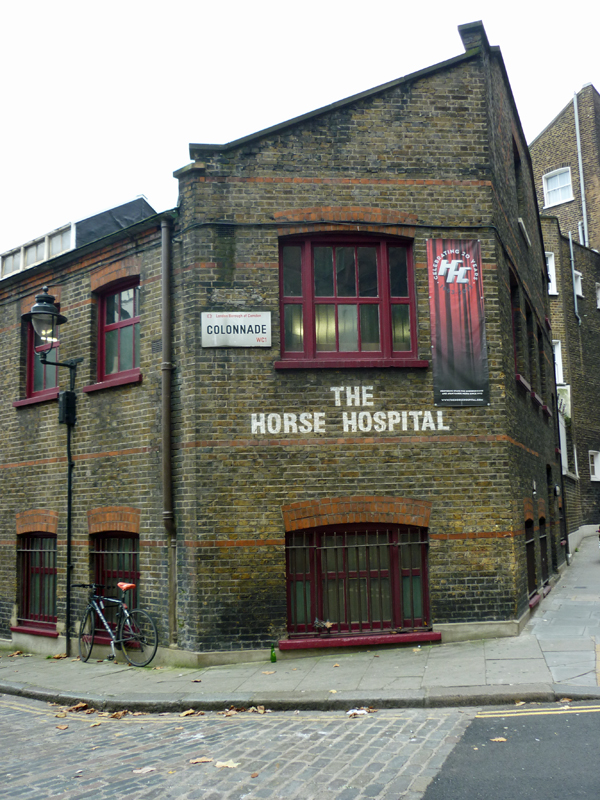
Back past the tube station and hang a left into the final bit of Herbrand Street before reaching Colonnade (our first and for all I know the only example of a one-word named London thoroughfare) on the corner of which sits the Horse Hospital. Originally built at the end of the 18th century as a functioning two-storey horse stable it has housed one of London’s most alternative arts venues since 1993. Unfortunately this bastion of the avant-garde and the underground is currently under threat of closure following the decision in 2014 of the building’s owners to put it up for sale (for a cool £2.5 million). In order to try and safeguard its future the HH has set up a fighting fund and crowdfunding support campaign and is running a number of fundraising events involving artists who have been associated with the venue.

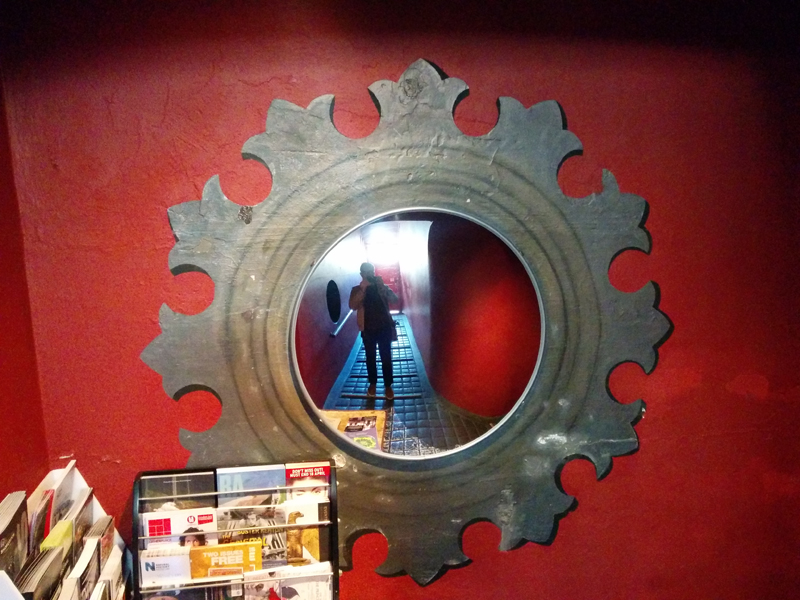
P1040630 Horse Hospital

Unfortunately the right-hand picture above can’t really count as the selfie-of-the-day as it was taken on a visit earlier this year during Horse Hospital opening hours.

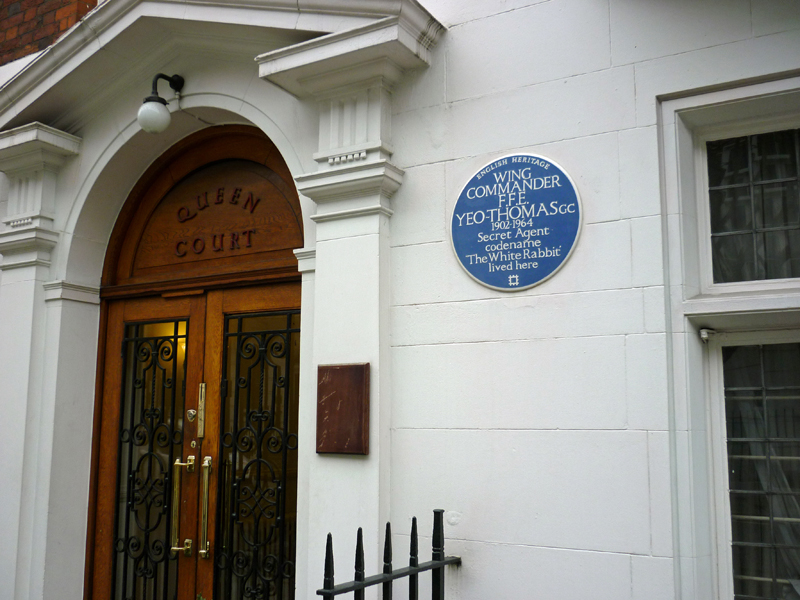
After the Colonnade it’s right into Grenville Street and right again back on to Guilford Street. A short way along at Queen’s Court there is a blue plaque commemorating Wing Commander Forest Frederick Edward Yeo-Thomas (1902 – 1964), the British secret agent known as “The White Rabbit“. Recruited by the British SOE during WWII to act as liaison with the French Free Resistance he was instrumental in securing vital support for the latter by appealing directly to Churchill. Check out the link  and I think you’ll agree that they don’t really make ’em like that anymore (eat your heart out Mr Bond).

P1040631

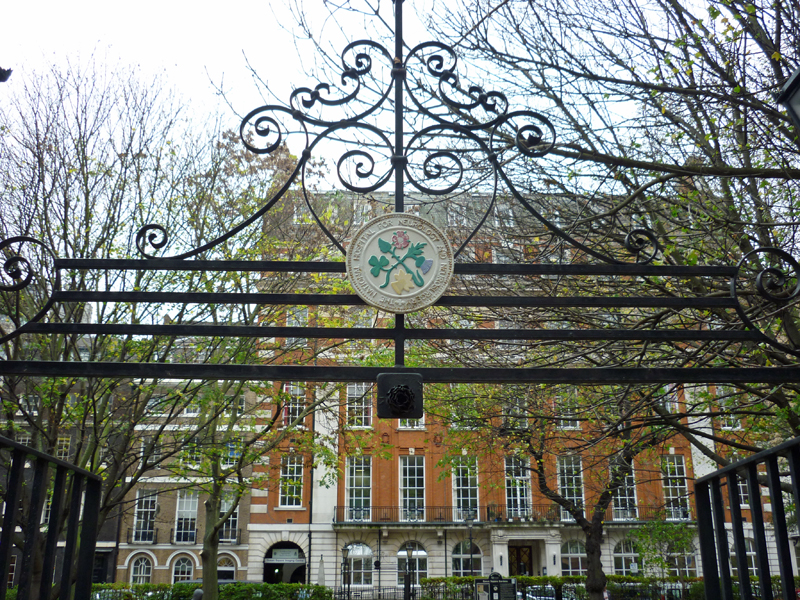
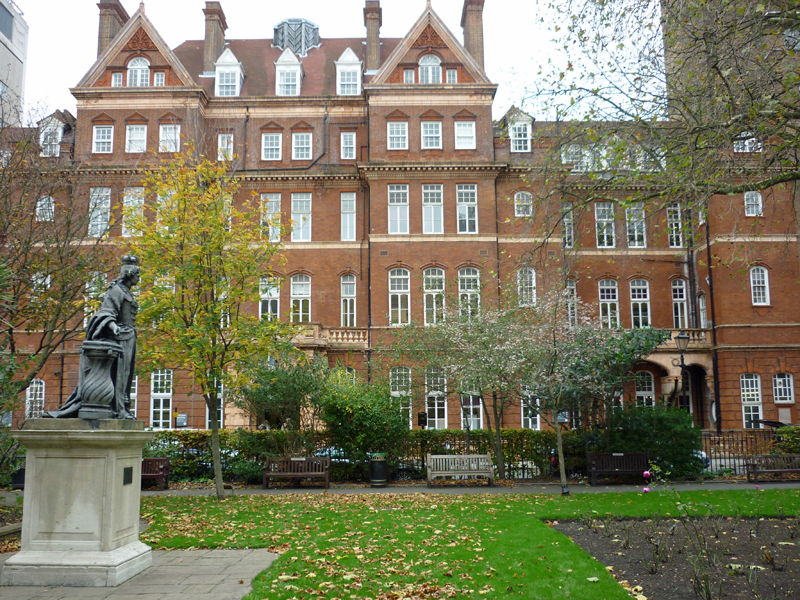
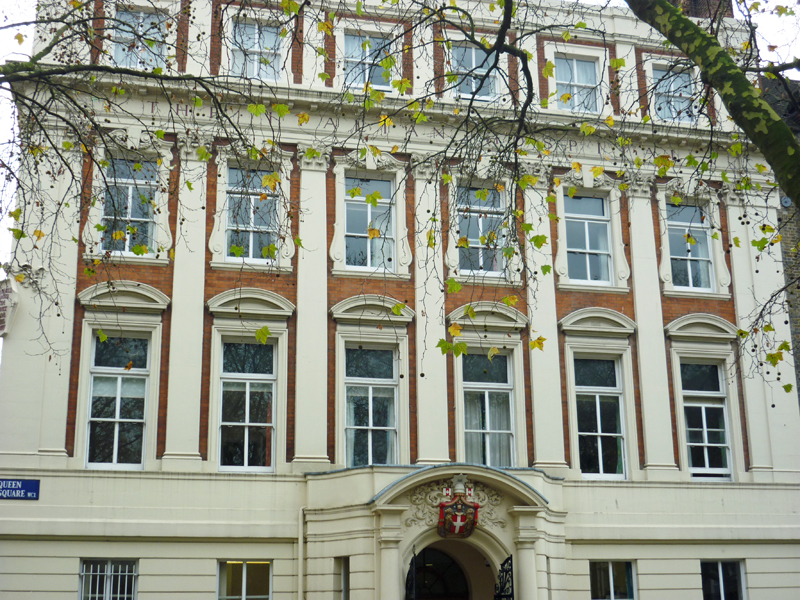
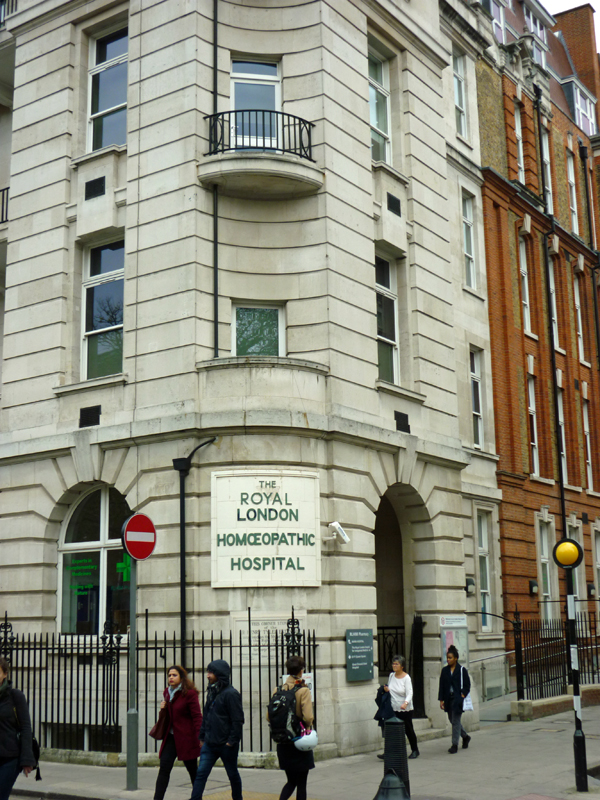
South into Queen Square which is flanked on its east side by the National Hospital for Neurology and Neurosurgery. At its bottom end sits the former Italian Hospital which is now part of Great Ormond Street. Between the two is the Royal London Hospital for Integrated Medicine which (as you can see from the picture below) was formerly the Royal London Homeopathic Hospital. In light of recent announcements about NHS blacklisted treatments it might need to get on with completing the airbrushing. The statue in the gardens is believed to be of Queen Charlotte wife of George III.

P1040632 P1040633

P1040636 P1040638

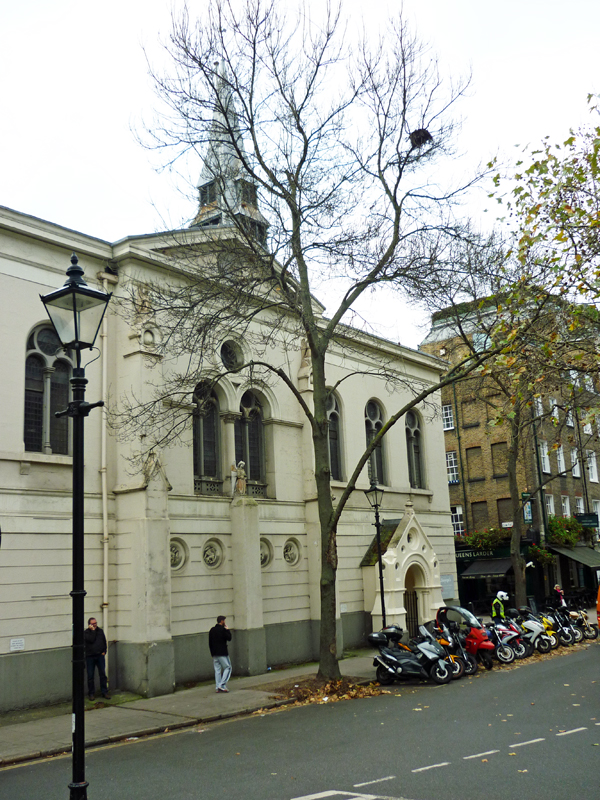
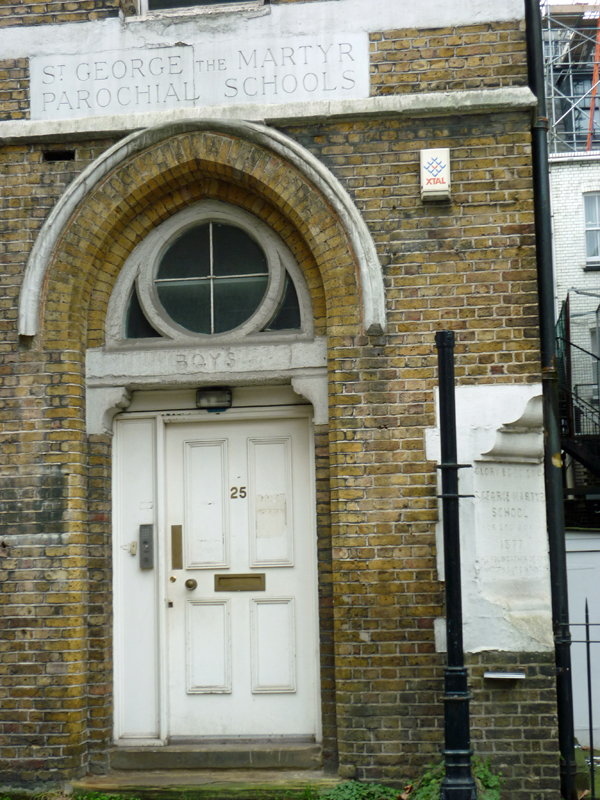
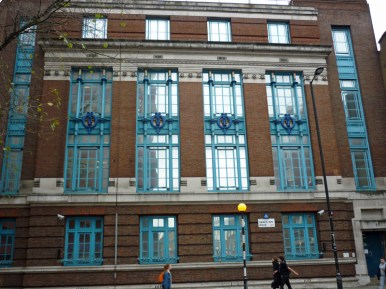
At the South-West corner of the square we find the Church of St George the Martyr, dating back to 1706 (though it has been seriously remodelled at least twice since then). Its major claim to fame is that it played host to the wedding of Ted Hughes and Sylvia Plath in 1956. Adjacent to the church is the derelict site of an eponymous charity school opened just four years after the church. A St George the Martyr C of E primary school still exists nearby having moved to a new-built site in 1976.
P1040635 P1040634

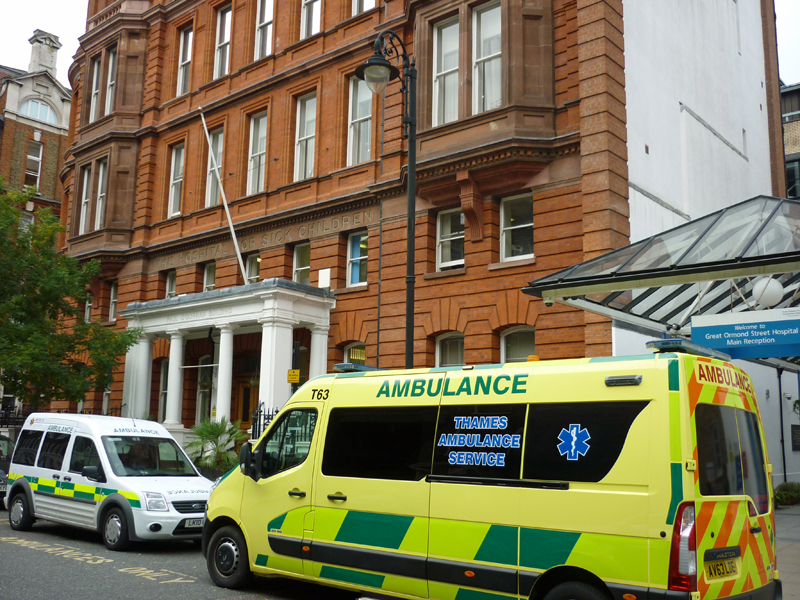
We leave the square via Great Ormond Street itself and pass the main entrance to the world-famous children’s hospital. The hospital first opened in 1852 and, as is well known, has benefitted from ownership of the universal rights to Peter Pan since being given them by J.M Barrie in 1929. This has contributed no-doubt to the many breakthroughs in paediatric medicine that have occurred here – including the first successful bone marrow transplant in 1979.

P1040640 P1040639

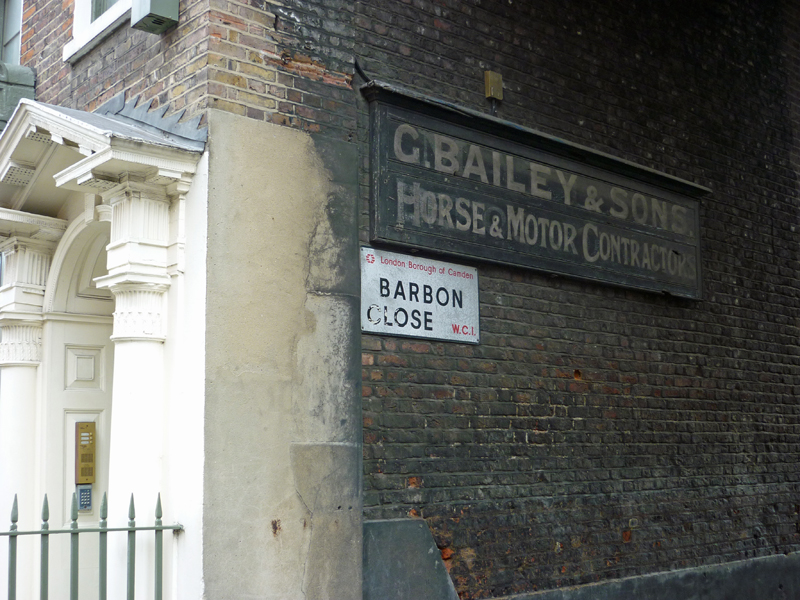
Opposite the hospital at the entrance to Barbon Close is a vestigial sign advertising the presence of G. Bailey & Sons Horse & Motor Contractors a business which sadly closed its doors in 1951. Oddly though a company of the same name was founded just two years ago in 2013 and has its registered office nearby in Theobalds Road.

Next up is Lambs Conduit Street with its boutique designer shops and high-end coffee houses. Sadly the public conveniences at its north end where it morphs into Guilford Place rather let the side down. In the background you might just be able to make out the Young’s pub, the Lamb, which has been around in one form or another for the best part of 300 years.

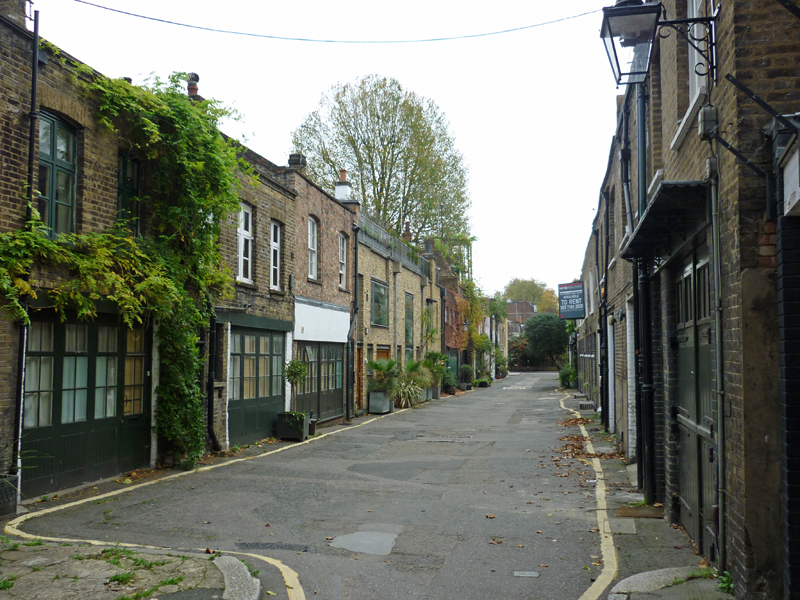
P1040641So, doubling back, we check out Long Yard then turn left into the final part of Great Ormond St before going north on Millman Street and then south again down Doughty Mews.

P1040642

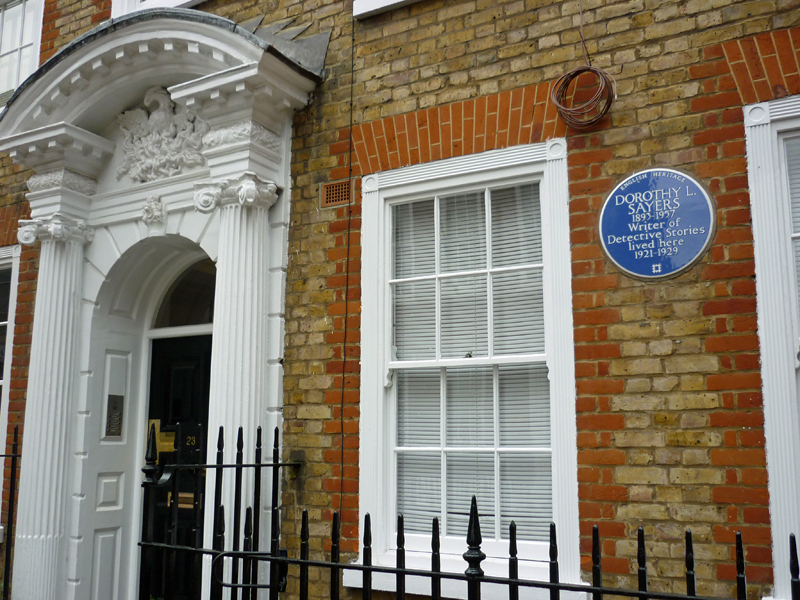
On mews leads to another, John Mews this time, from where we turn right into Northington Street. This runs into Great James Street where No.23 was home in the 1920’s to Dorothy L. Sayers (1893 – 1957) one of the queens of detective fiction and the creator of Lord Peter Wimsey, perhaps most famously portrayed by Ian Carmichael on British TV in the early seventies.

P1040643 carmichael

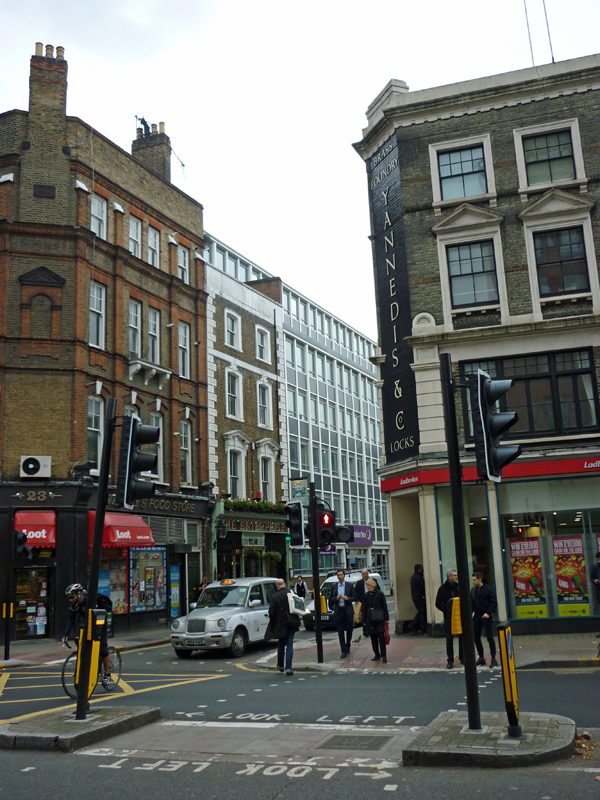
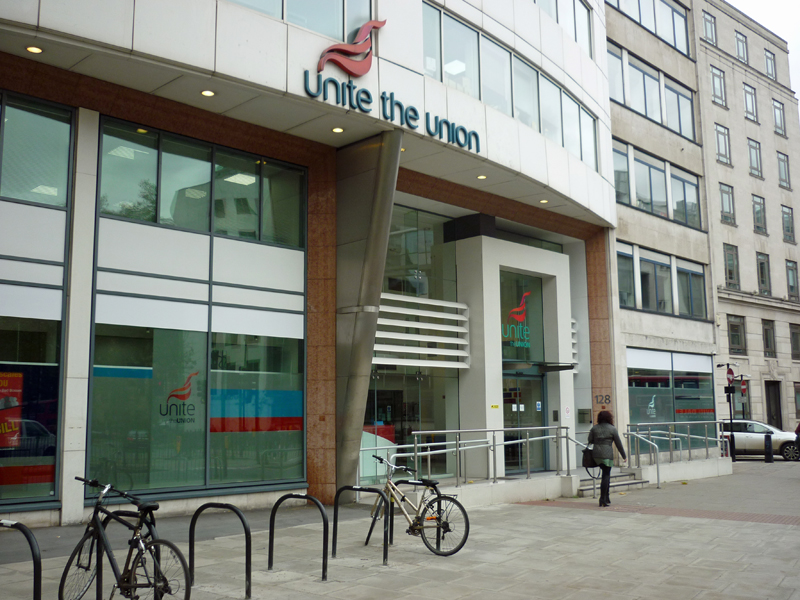
This takes us down onto a stretch of Theobalds Road from where we head north again up Emerald Street and then visit Rugby Street, Dombey Street , Orde Hall Street and Harpur Street before returning to Theobalds Road and passing the London HQ of mega-union, Unite.

P1040644 P1040649

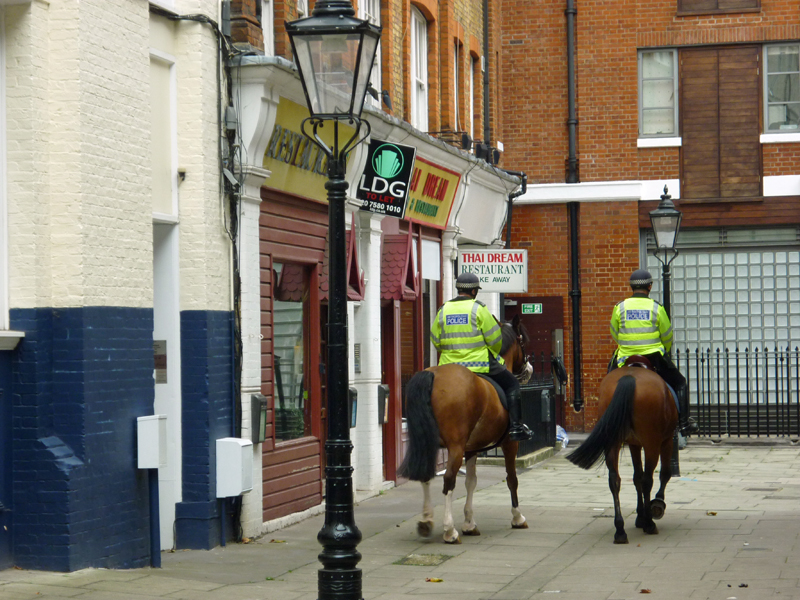
Next up is New North Street at the top of which we turn left into an alley which cuts through to Boswell Street and encounter a couple of mounted policemen on patrol.

P1040648

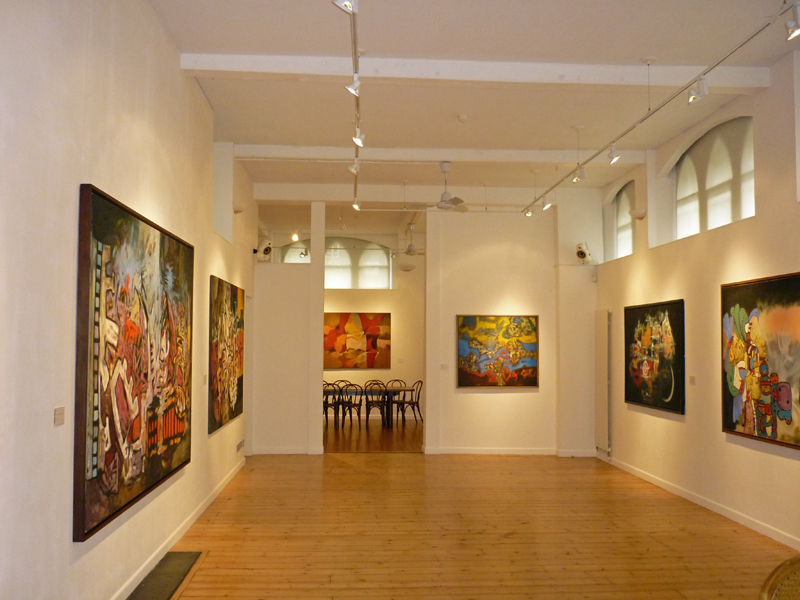
Gage Street then takes us through to Old Gloucester Street, home to the October Gallery which is not only a commendably internationally-flavoured art space but also has exceedingly nice washroom facilities.

P1040651 P1040652

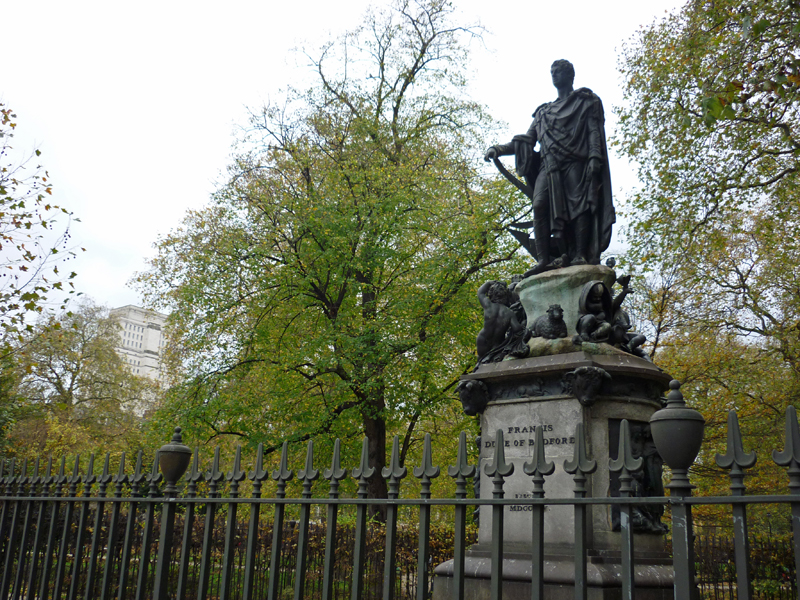
We emerge again into Queen Square and quick left into Cosmo Place brings us out onto Southampton Row. Head south until we reach Bloomsbury Place which links up with Bedford Place. This is one of those streets full of white-fronted, black-railinged townhouses that Hollywood thinks everyone in London lives in. In reality they’re mostly hotels or offices. The top end of Bedford Place comes out opposite Russell Square gardens and the statue of the man who commissioned their creation, the fifth Duke of Bedford. And that completes the first half of today’s circuit.

P1040653 P1040654

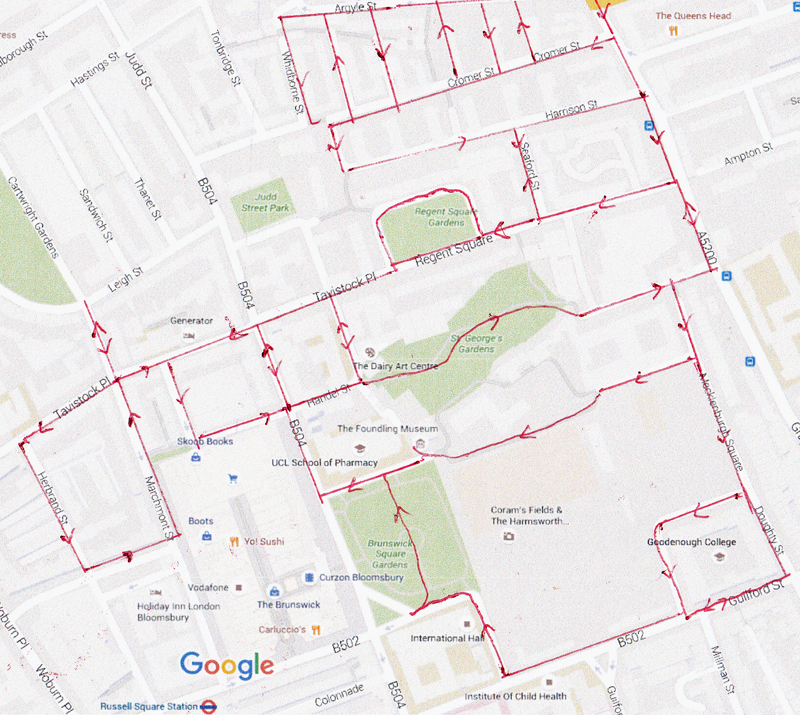
Day 10 – St Pancras – Foundling Museum – Coram’s Fields

Pretty grim autumn day so another curtailed trek. Pick things up at Kings Cross again then cover the remaining streets in the St Pancras district before flirting with Bloomsbury once more and finishing off with a visit to the Foundling Museum.

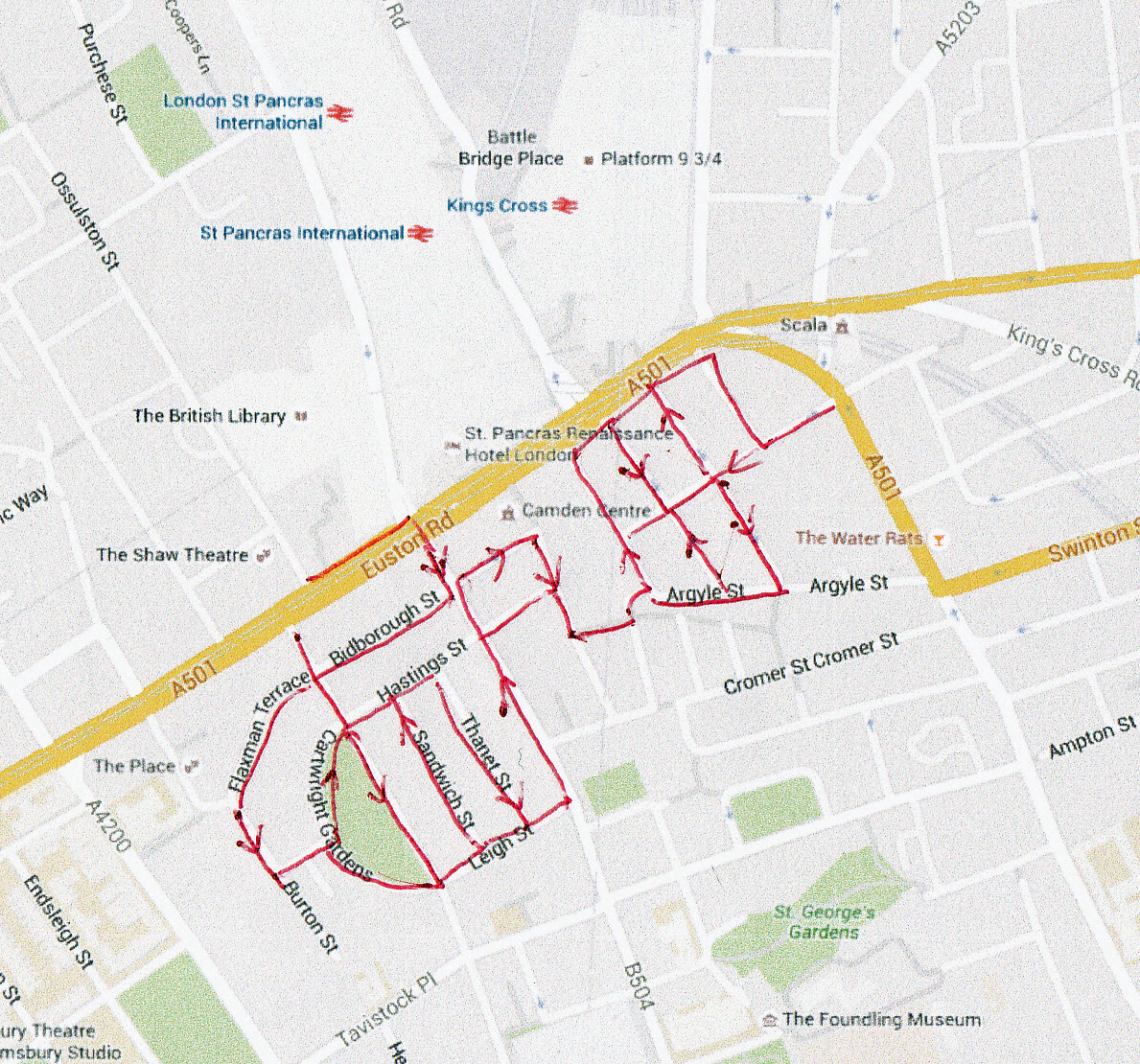
Day 10 Route

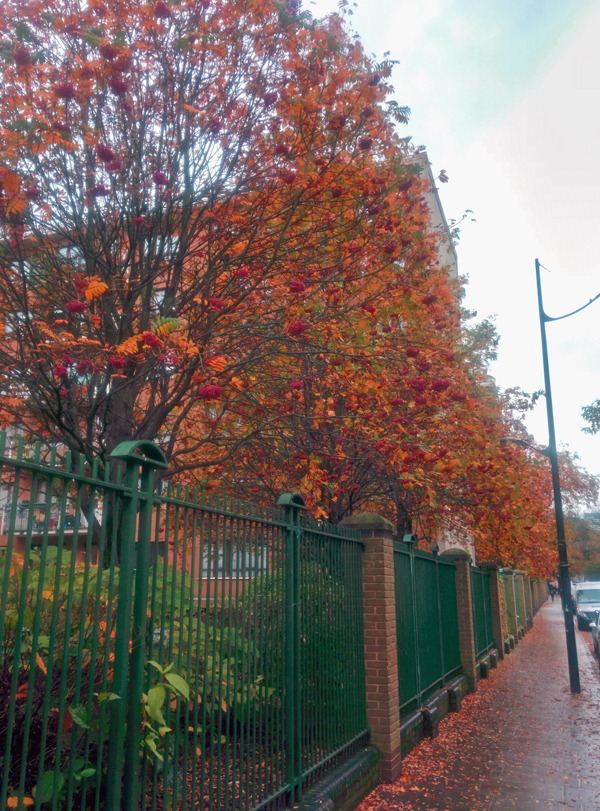
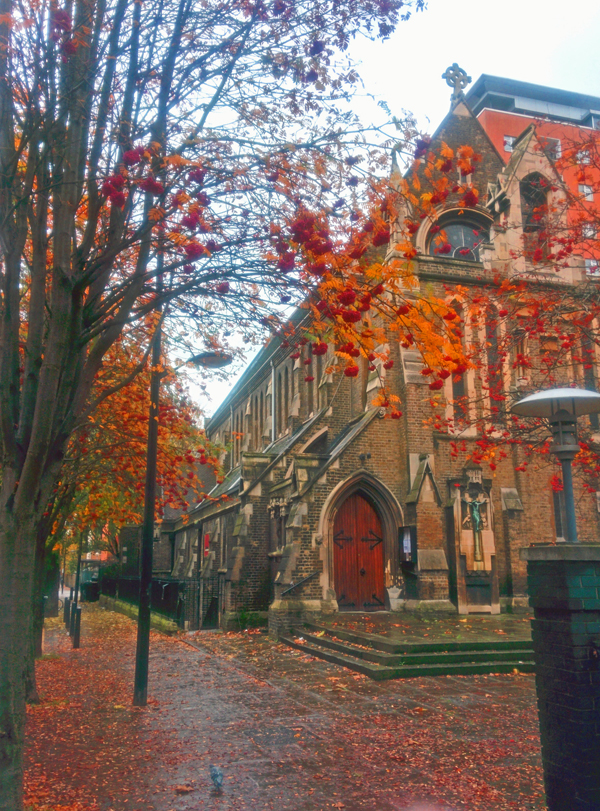
Quick stroll down Gray’s Inn Road then hook a right into Cromer Street where the Rowan trees are resplendent in their Autumn finery.

IMG_20151105_113447 IMG_20151105_114344

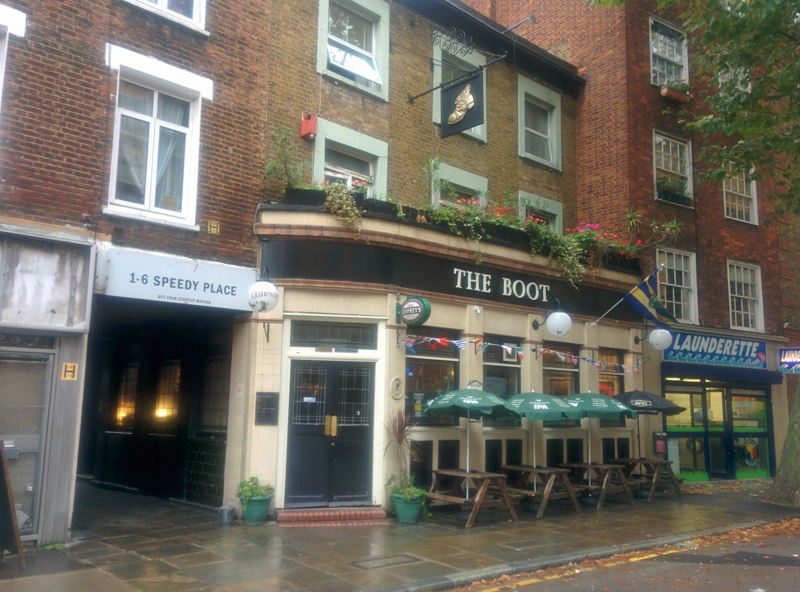
On the north side, Loxham Street, Tankerton Street and Midhope Street don’t detain us long and Speedy Place lives up to its name. The main purpose of the picture below is for Mr Pedant here to highlight the correct spelling of the word, launderette. Most of these establishments that remain use the deliberately misspelt form from the 1985 film “My Beautiful Laundrette”.

IMG_20151105_114249IMG_20151105_114934

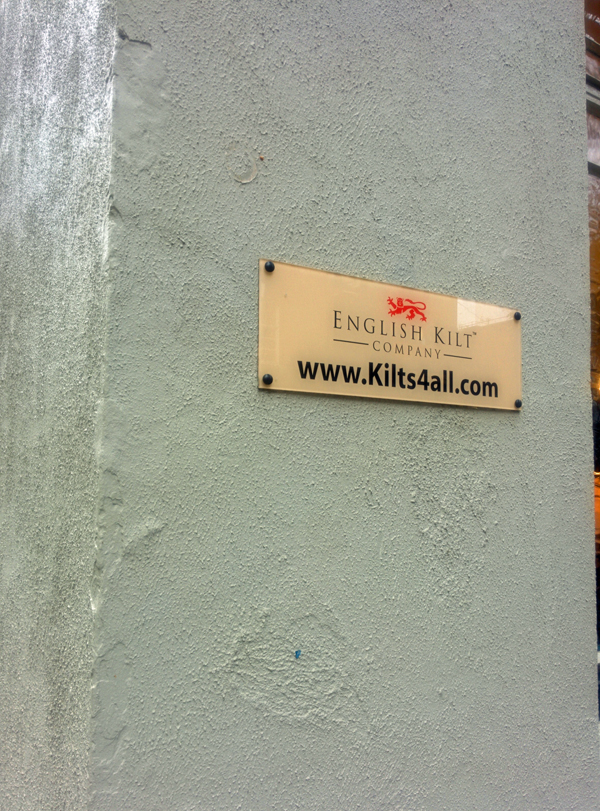
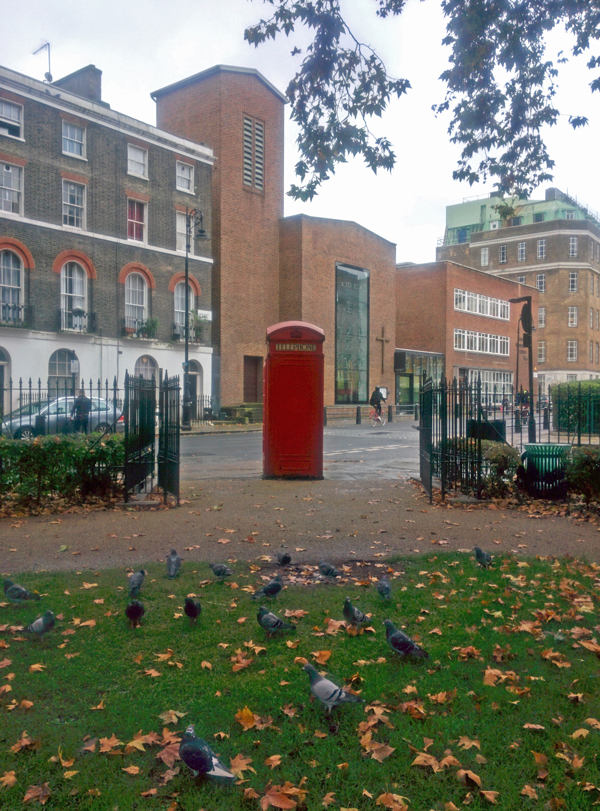
Turn east down Harrison Street, home to the unexpected English Kilt Company, back to Gray’s Inn Road then west again down Sidmouth Street. Brief detour down Seaford Street before arriving at Regent Square. Unfortunately only the southern terrace remains of the original 1829 construction. The other 19th century buildings failed to survive the WWII bombings and were replaced by flats in the 1950s. At the south-entrance to the gardens an oddly-situated red phonebox channels the spirit of the Tardis.

IMG_20151105_115720 IMG_20151105_120015

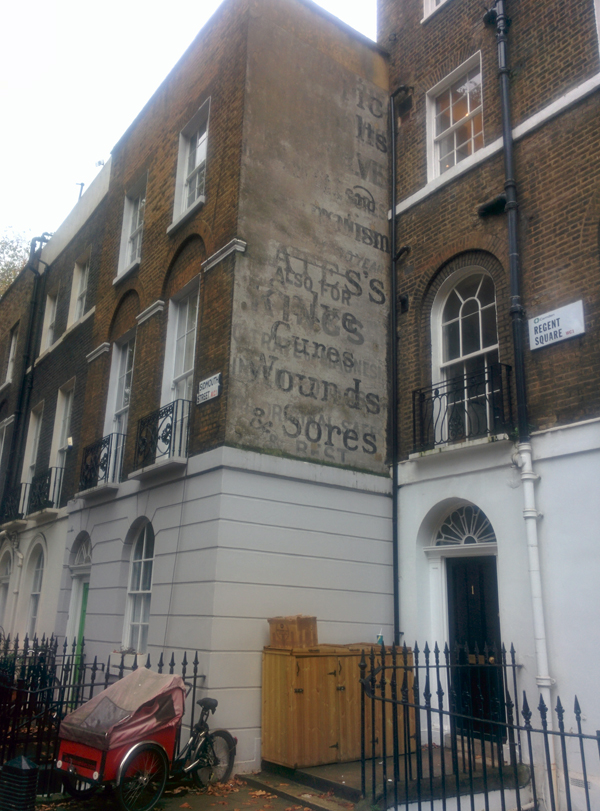
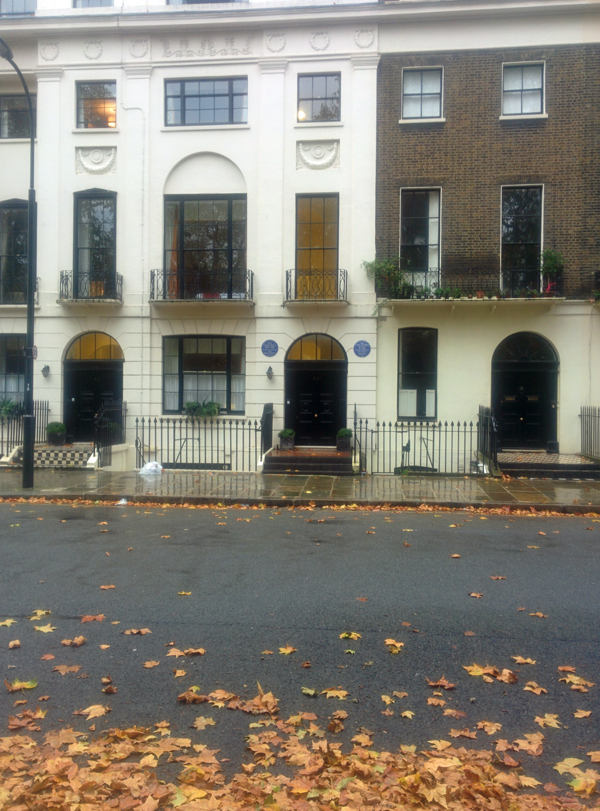
Tavistock Place leads off this south-west corner and here we encounter one of the more incongruous blue plaque proximities. No.36 and No.32 were home, respectively, to Vladimir Ilyich Lenin (1870-1924) in 1908 while he was reading at the British Museum and writing ‘Materialism and Empirio-criticism’ and Jerome K. Jerome (1859-1927), author of the quintessentially English “Three Men In A Boat”, during 1884-85. Both of these were only recently put up, courtesy of the local Marchmont Association – the former not without a touch of controversy.

lenin3men

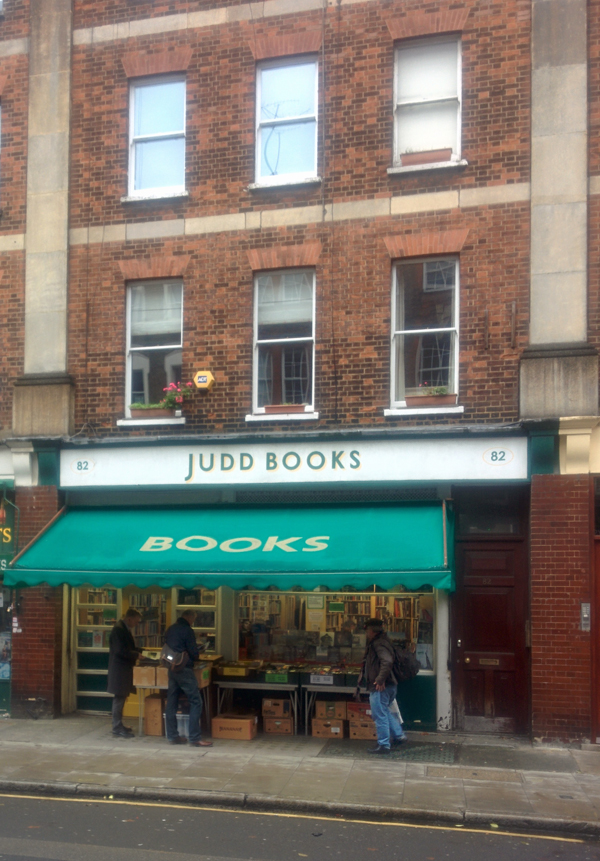
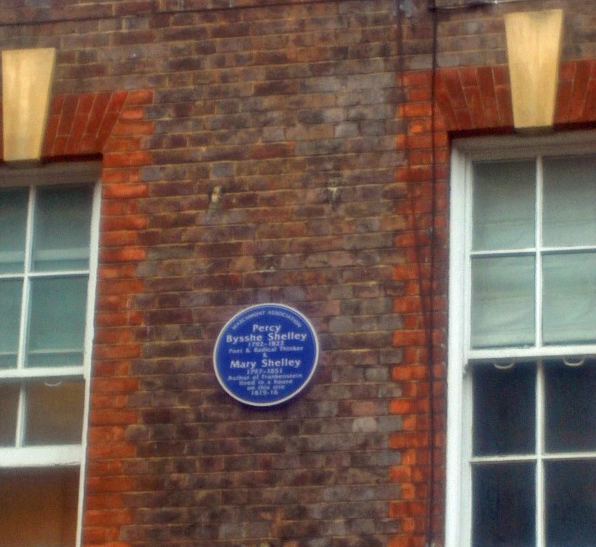
On the north stretch of Marchmont Street we take a break to browse through the extensive selection on display at the impressive Judd Books which is just opposite another plaque – this time commemorating the fact that Percy Bysse Shelley and Mary Shelley spent a couple of years (1815-16) in a house on the site.

IMG_20151105_122812 IMG_20151105_122739

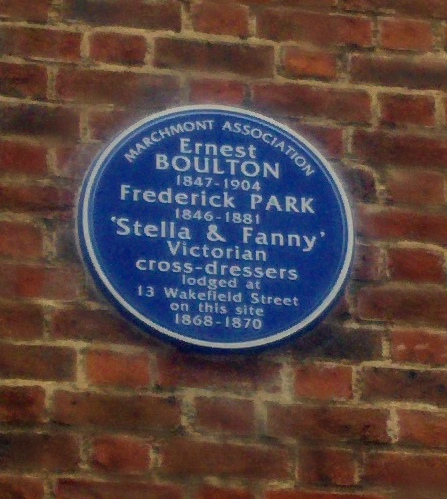
Herbrand Street, Kenton Street (not I guess named after the character in the Archers or vice versa) and Handel Street bring us to Wakefield Street site of another plaque courtesy of the (actually quite sinister-sounding) Marchmont Association. This one is in honour of the celebrated Victorian transvestites, Ernest Boulton and Frederick Park, also known respectively as Lady Stella Clinton and Miss Fanny Winifred Park or collectively as “Stella and Fanny”. The following is from the information board in Regent Square Gardens – “In April 1870 they were arrested as they left the Strand Theatre having been seen together in a box dressed as women and winking and smiling at gentlemen sitting in the stalls. During their trial it emerged that Boulton enjoyed a close friendship with Lord Arthur Pelham-Clinton, the third son of the Duke of Newcastle and MP for Newark. Boulton and Park appeared at trial wearing extravagant costumes, the former in a cherry coloured silk evening dress with white lace trim. They were acquitted to huge cheers from the public galleries”.

IMG_20151105_124743

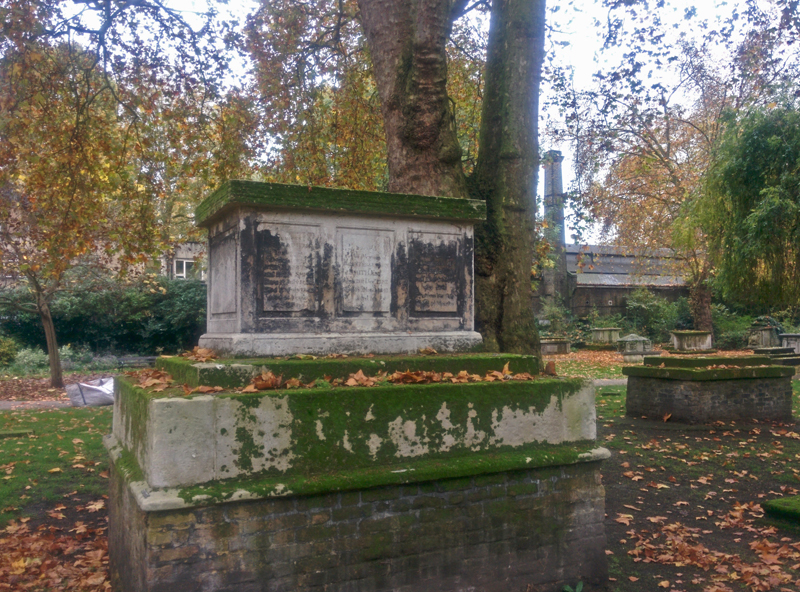
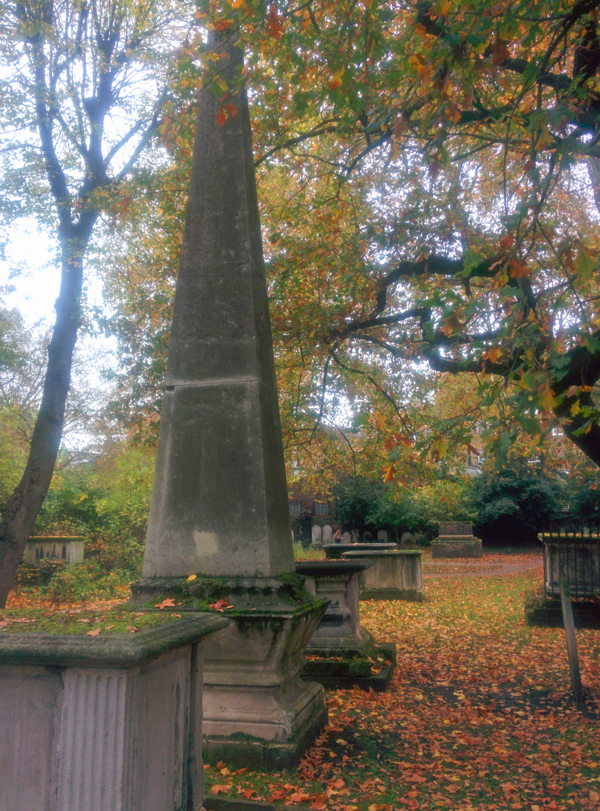
Wakefield Street is also the western entrance to St George’s Gardens, established in 1713 as a pair of burial grounds to serve the parishes of St. George the Martyr Queen Square and St. George’s Bloomsbury. They were the first Anglican burial grounds to be set away from the churches they served. The gardens contain the tomb of Oliver Cromwell’s grand daughter, Anna Gibson. They are also a reminder of the dark history of body-snatching – the first recorded case took place here. Having become very run-down by the late 1990’s the gardens were restored with help from a lottery grant and reopened in 2001.

IMG_20151105_125025

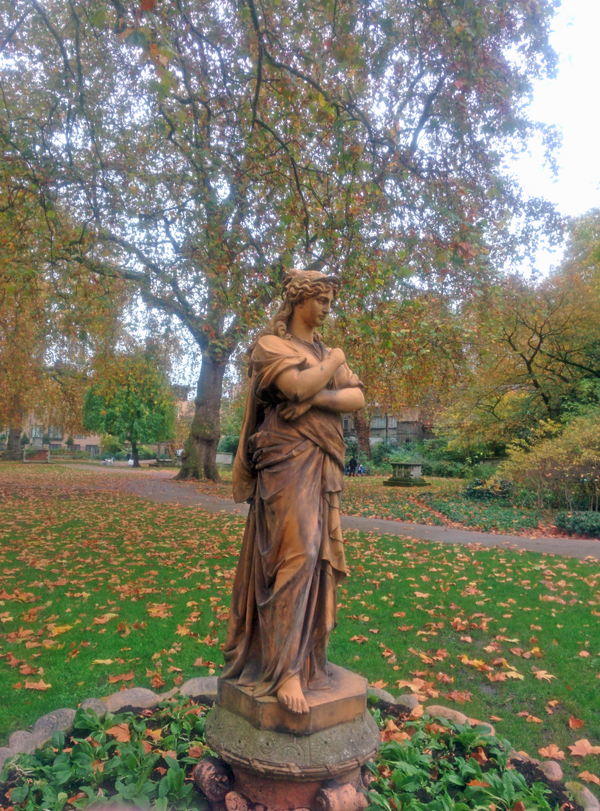
Euterpe, the Muse of Instrumental Music. Terracotta figure, one of nine muses which decorated the facade of the Apollo Inn (1898) on the corner of Tottenham Court Road and Torrington Place.

The obelisk below was reputedly built by a Thomas Falconer in 1729 but it is not known whose death it commemorates.

IMG_20151105_125436 IMG_20151105_125203

Exit the east side of the gardens into Heathcote Street then turn right into Mecklenburgh Street and again to follow the alley which runs along the north side of Coram’s Fields to reach the Foundling Museum.

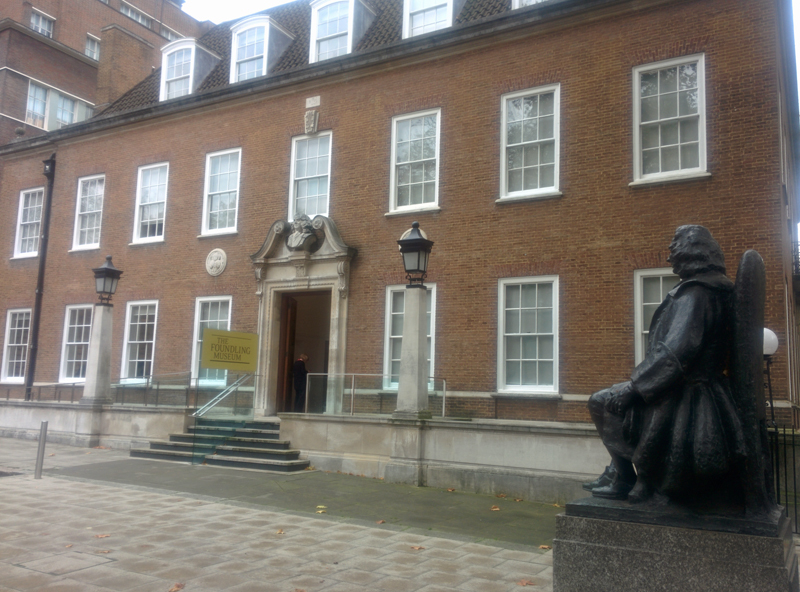
The museum, which opened in 2004, explores the history of the Foundling Hospital, the UK’s first children’s charity and first public art gallery. The Foundling Hospital, which continues today as the children’s charity Coram, was established in 1739 by the philanthropist Thomas Coram to care for babies at risk of abandonment.

IMG_20151105_130116IMG_20151105_133020

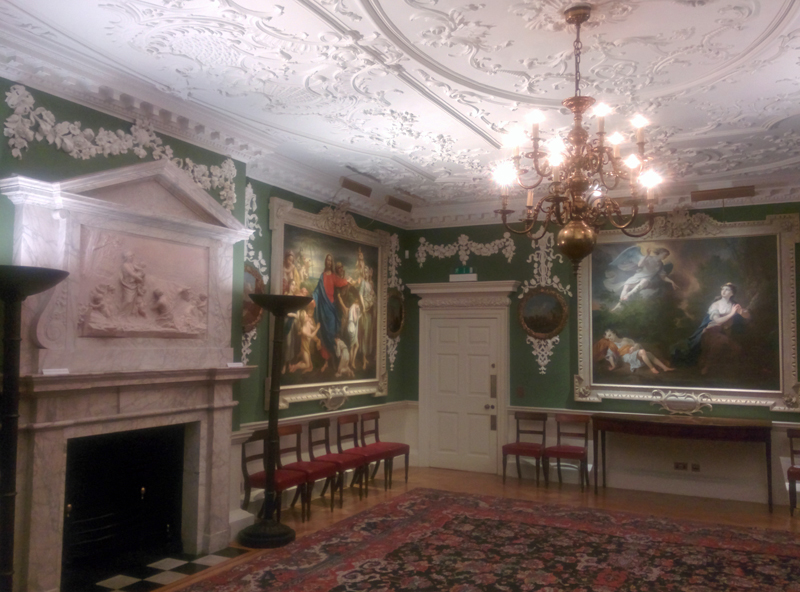
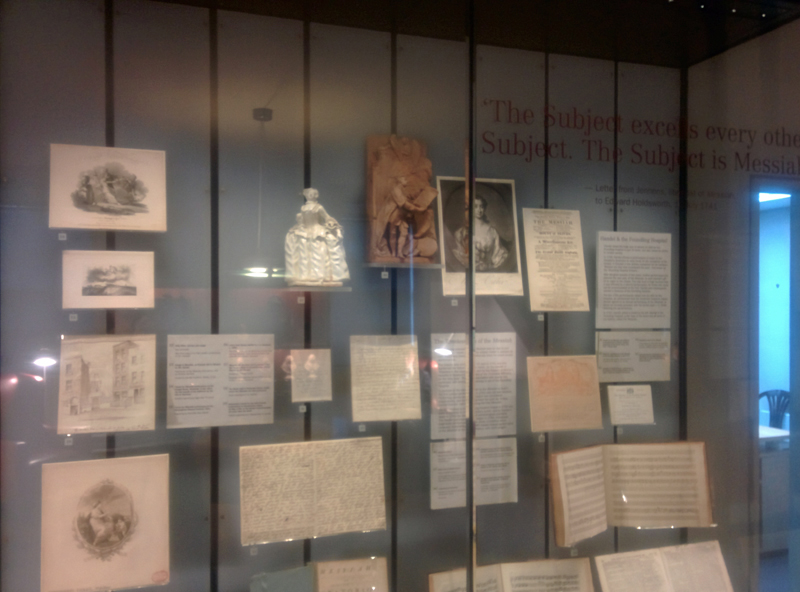
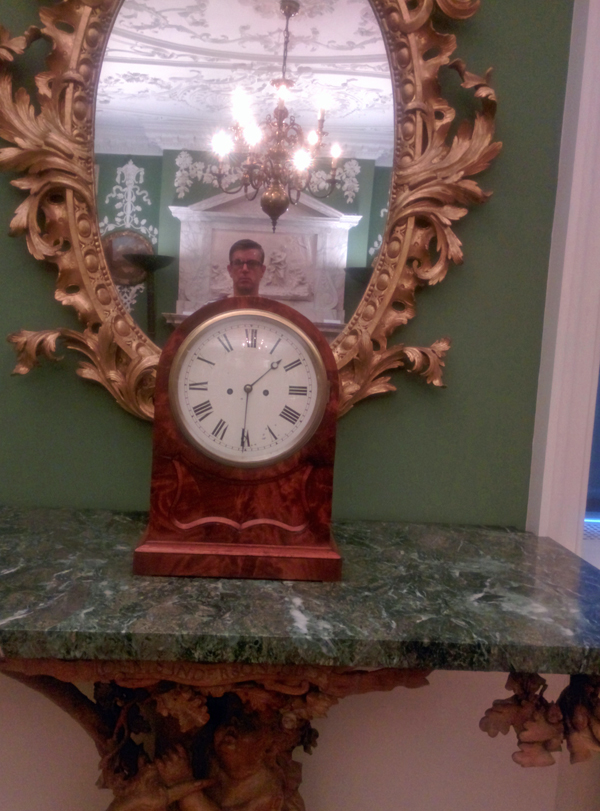
Among the prominent benefactors of the hospital were the artist William Hogarth and composer George Frederic Handel. The former encouraged the leading artists of the day to donate work in order to set up the inaugural public art gallery and the latter donated an organ (musical rather than biological) and conducted annual benefit performances of The Messiah. The second floor of the museum houses the largest collection of material and memorabilia relating to Handel (including the original manuscript score of The Messiah) which was put together by one Gerald Coke. The donated Victorian artworks are showcased in the second floor gallery. Not really my thing unfortunately – though the gallery did present the opportunity for the latest Selfie of the Day.

IMG_20151105_131520 IMG_20151105_133053

The permanent exhibition on the ground floor tells the moving story of the Foundling Hospital while the lower ground floor is running an exhibition on the phenomenon of the Victorian “Fallen Woman”. This includes a large collection of the written petitions submitted by women who had fallen pregnant out of wedlock and would be unable to take care of the baby once it was born. These petitions were reviewed by the Governors of the hospital and only in cases where the woman was perceived to have been respectable (i.e. not complicit in her own undoing) would the child be accepted.

IMG_20151105_135904

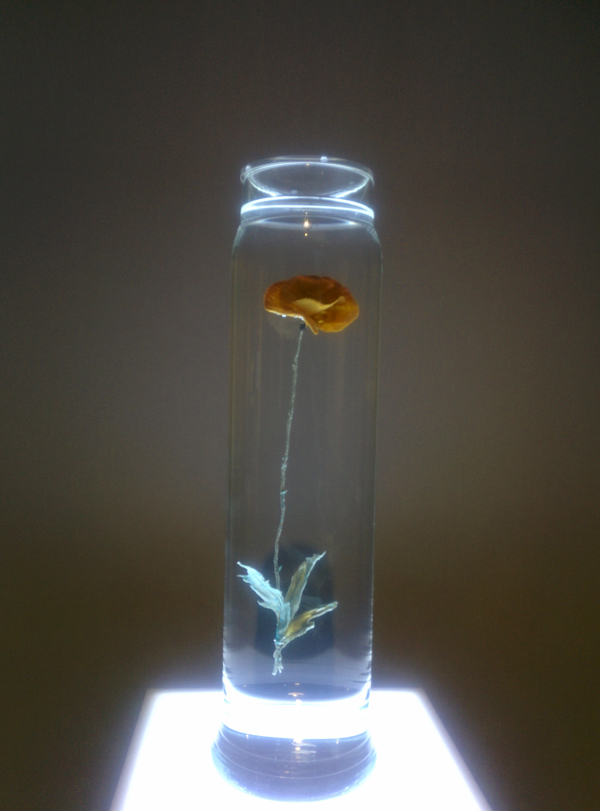
Until the end of November you can find the above artwork, Papever Rhoeas, created by artist Patrick Hartley in the ground floor gallery. This representation of a single poppy is composed of lamb’s heart muscle tissue, horsehair and vintage suture cotton and presented in a glass-blown jar designed in the form of a used World War One artillery shell.

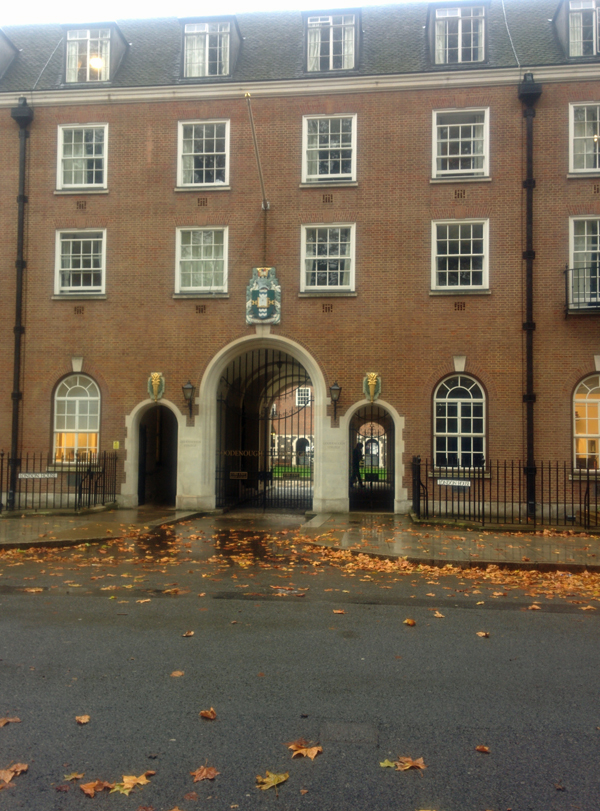
By the time I leave the museum, having stopped on for lunch in the café, the rain is tipping down. I retrace my steps back to Mecklenburgh Square , the Square (Grade II listed) and its garden were part of the Foundling Estate and named after the wife of King George III, Charlotte of Mecklenburgh- Strelitz. The south side of the square is occupied by Goodenough College, named not for the modest expectations placed upon would-be students  but after its founder, Frederick Craufurd Goodenough, a Chairman of Barclays Bank, who in 1930 formed a Trust to raise funds for a hall of residence for male students from the British ‘Dominions’.

IMG_20151105_144814 IMG_20151105_144942

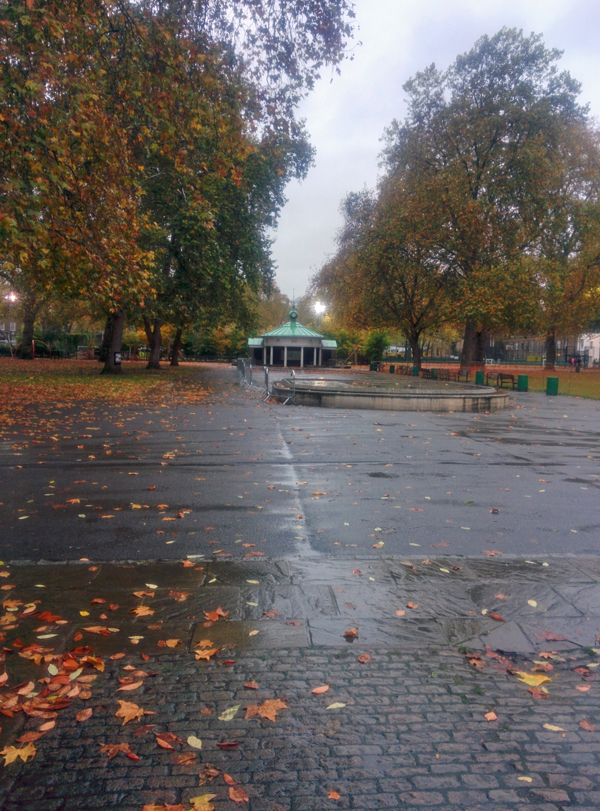
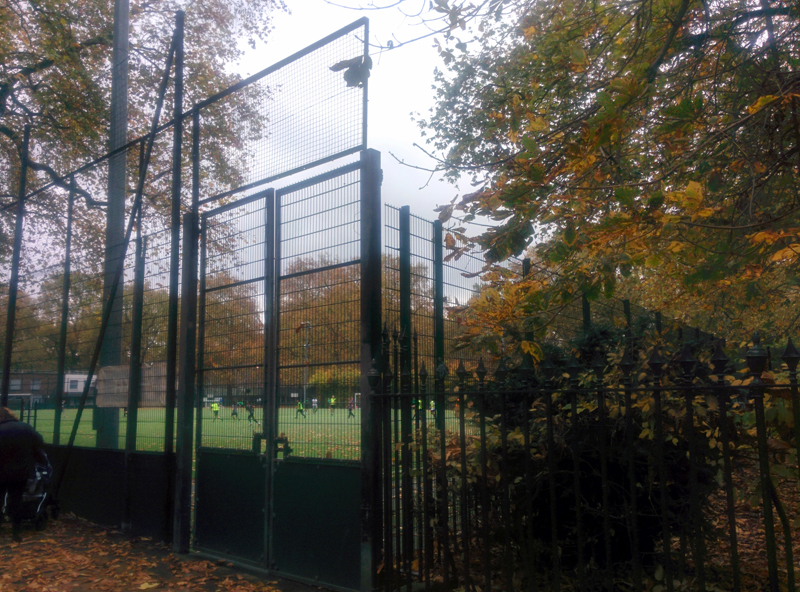
As the rain continues to lash down I hurry on down to Guilford Street and after a detour into Doughty Street head west past the southern entrance to Coram’s Fields. This seven-acre site which includes a Youth Centre, Children’s Centre, Community Nursery, Sports Programme and a city farm is run by its own charitable trust and is not connected with the charitable legacy of the aforementioned Thomas Coram. Adults not-accompanying children are not allowed in except to use the football pitches on the north side.

IMG_20151105_145512 IMG_20151105_130155

A right turn into Lansdowne Terrace brings us to Brunswick Square and the western exit from this out opposite the Brunswick Centre from where we shall resume things next time.

Day 9 – British Library – St Pancras – Kings Cross

A pretty short one today; partly due to the fact that I dropped my phone shortly after leaving the house, and then cut my thumb open on the smashed screen. I also lingered rather longer than anticipated in the British Library, from where this walk begins before crossing the Euston Road and making a brief foray into the St Pancras area south of the eponymous station.

Day 9 Route

Before we kick off though the shaded area in the map below shows what we’ve covered so far. As someone once said – this could take a while.

Covered So far copy

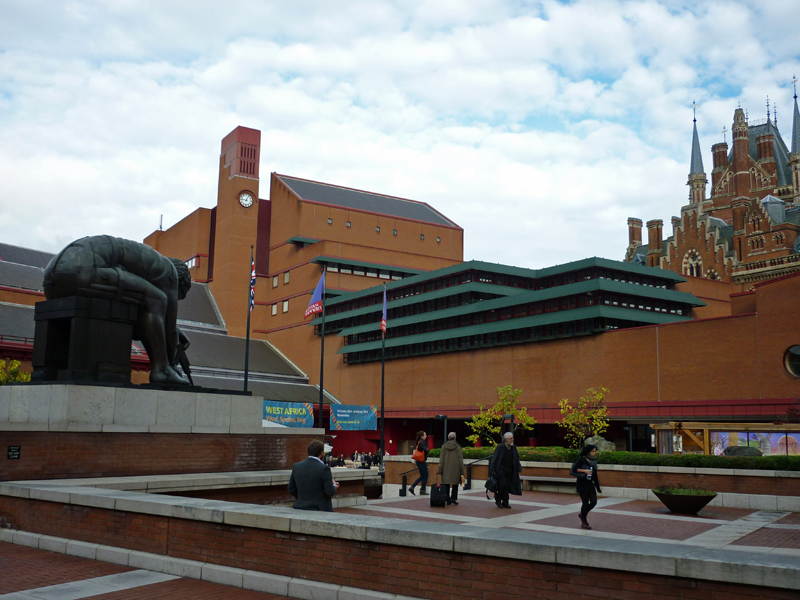
As already noted, the starting point today is the British Library which divorced itself from the British Museum and moved to this purpose-built site on the Euston Road in 1997 (the largest public building constructed in the UK in the 20th century). I don’t think it’s in any way controversial to describe the building itself as uninspiring – not helped by the unflattering comparison with its majestic neighbour, the Renaissance (formerly Midland Grand) Hotel of which more in a minute. Someone must like it though as it was granted Grade 1 listed status this year.

The BL collection comprises more than 150 million items adding around 3 million each year. This takes up 625km of shelf space and requires a further 12km every year.

P1040590 P1040592

The statue in the picture above on the left is a representation of Sir Isaac Newton by artist Eduardo Paolozzi “after the style of William Blake”. Funding for this was provided by a grant from pools companies, Littlewoods, Vernons and Zetters. This was  just one year after the start of the National Lottery which was ultimately responsible for forcing the three pools companies to merge into one and effectively disappear off the public radar.

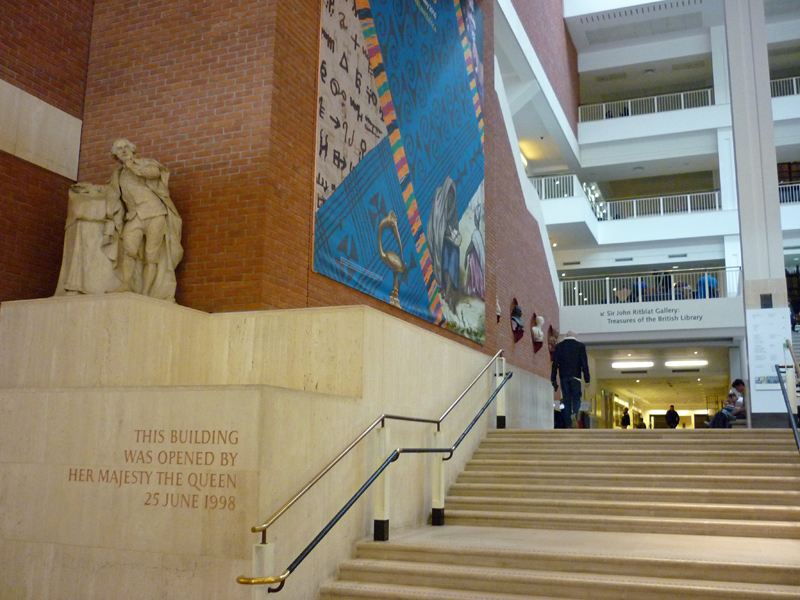
P1040595 P1040593

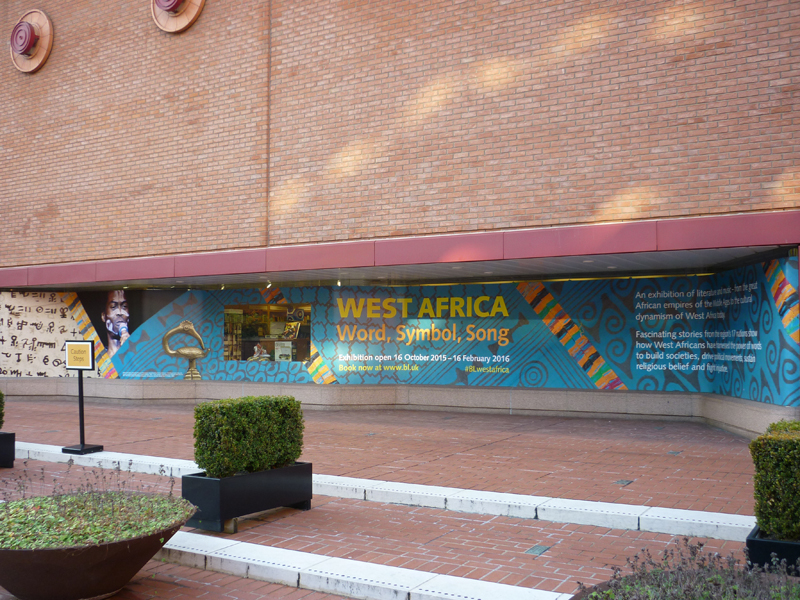
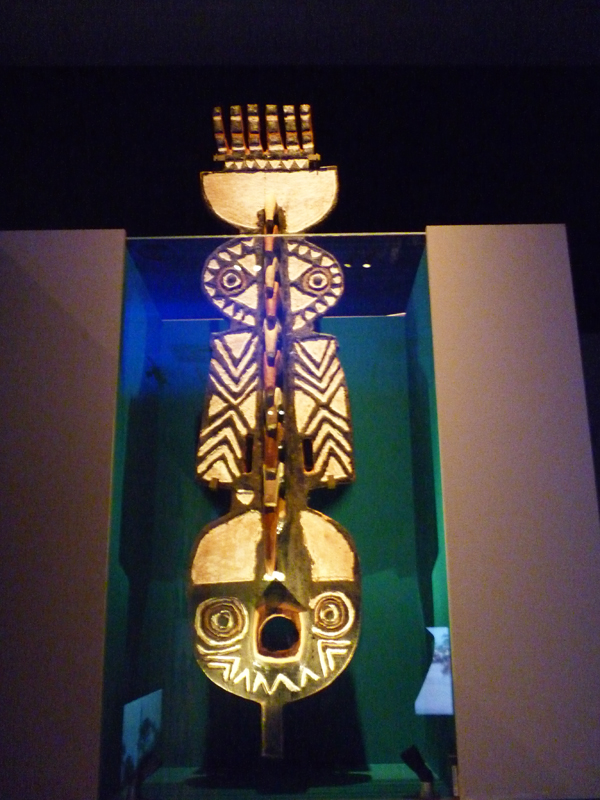
As I said I spent longer than intended at the BL. This was down to visiting the recently-opened “West Africa: Word, Symbol, Song” exhibition, which I can thoroughly recommend (it’s on until 16 February 2016).

The mask in the right-hand picture above is of a kind used in masquerade rituals in Burkina Faso and northern Mali. The black and white pattern represents the importance of learning – black signifying the deep knowledge of the elders and the white the lack of knowledge of the youth. ( I think we can all get with that particular message).

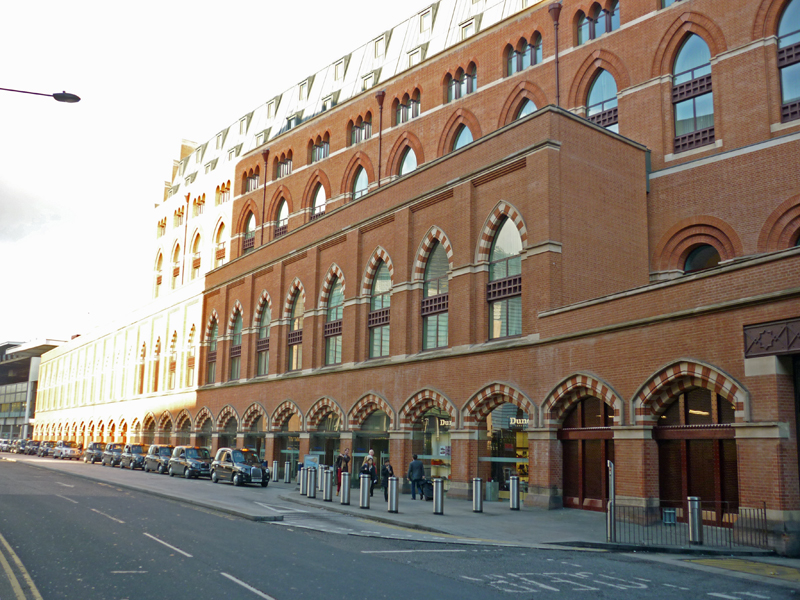
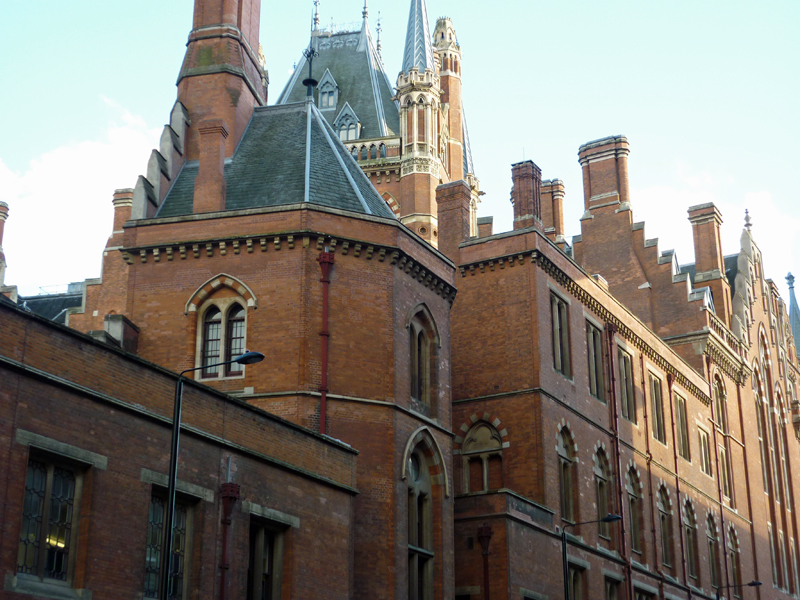
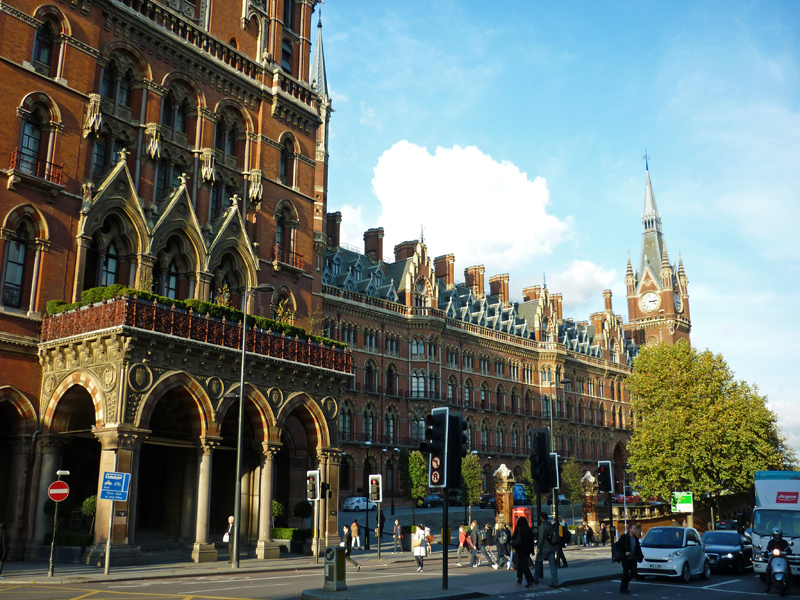
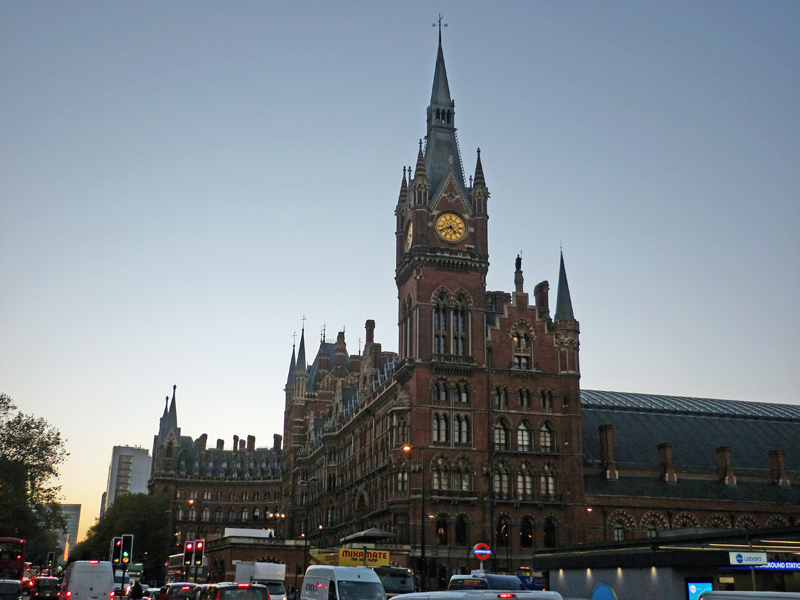
Anyway, I finally leave the library and make a quick up-and-down Midland Road which separates the library from St Pancras International Station and the aforementioned Renaissance Hotel. The original St Pancras Station opened in 1868 and the Midland Grand Hotel eight years later. The hotel was the “wonder of the age” when it opened but after the First World War, during which it was bombed, it gradually fell out of favour and closed in 1935. From then until 1985, when it was declared unsafe, it was used as railway company offices. In the 1960’s there was a proposal to demolish both the hotel and St Pancras station but a vociferous public campaign led instead to listed status in 1967.

P1040596 P1040597

Latterly, of course, the arrival of the Channel Tunnel and the decision to site the eventual London terminus for Eurostar services at St Pancras led to the redevelopment of the site between 2004 and 2007 and the rebirth of the station as St Pancras International and the hotel, which Betjeman had feared “too beautiful and too romantic to survive” as the Renaissance Hotel. The pictures above show how the architectural motifs of the original building were carried over into the new construction.

P1040601 P1040619

Further evidence for the case that it is nigh on impossible to take a photo of anything in London without a bloody white van getting into the frame.

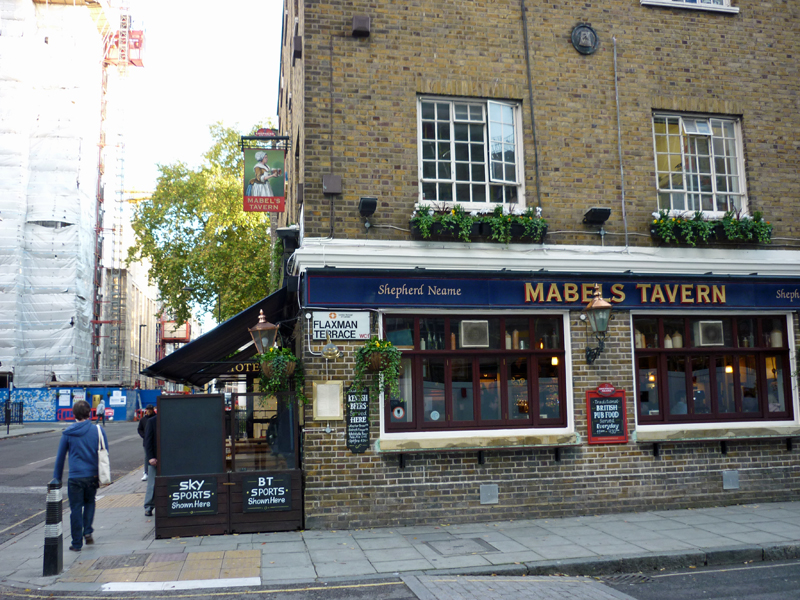
So crossing Euston Road we venture down Judd Street before taking a right into Bidborough Street which leads into Marbledon Place and today’s pub of the day, Mabel’s Tavern. Very nice pint of Shepherd Neame Bishop’s Finger and a sausage sandwich but how many screens blasting out Sky Sports News do you really need.

P1040602

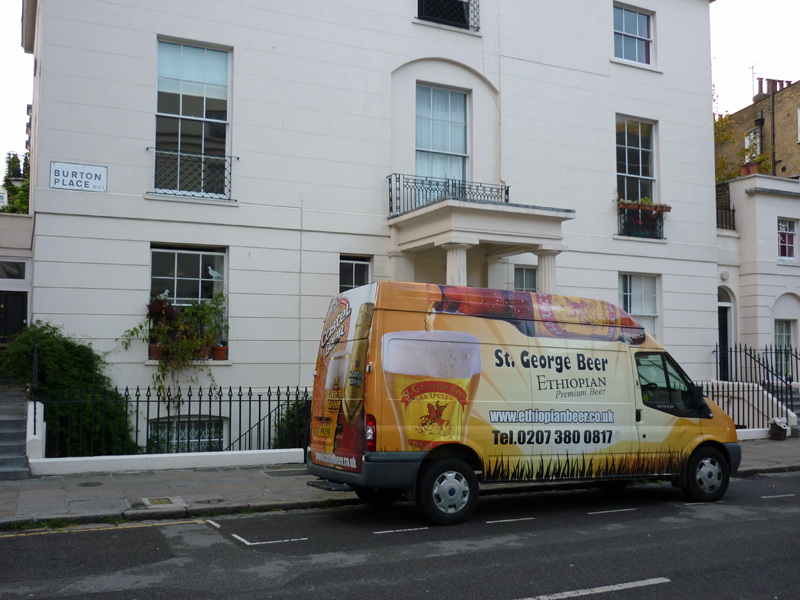
On leaving the pub it’s a revisit of Flaxman Terrace before turning left into Burton Street and then right into Burton Place where we come across this van promoting St George Ethiopian beer. Having never seen this stocked anywhere I was half-inclined to view this as some kind of elaborate art installation with the name being a stab at political comment on cultural misappropriation. However it transpires that St George is not thought to have ever been anywhere near Ethiopia and is merely a shared patron saint and that the brewery named after him has been going since 1922.

P1040603

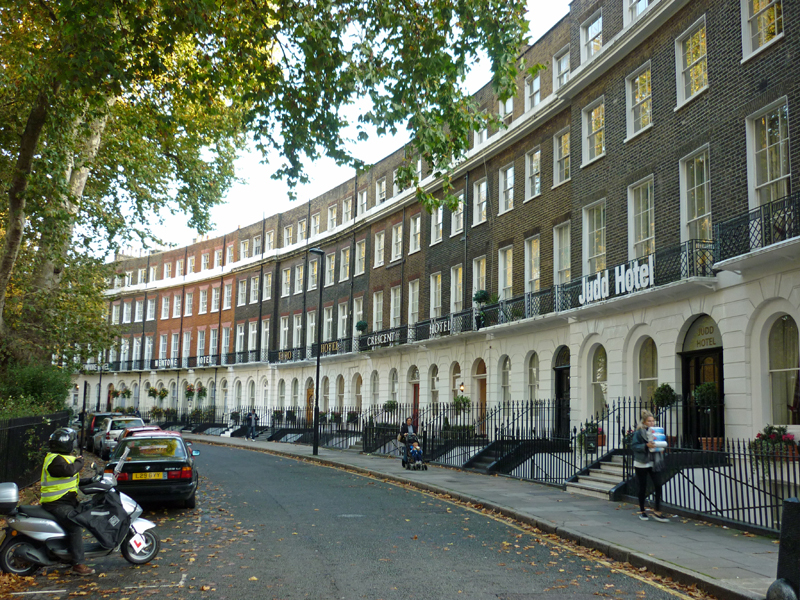
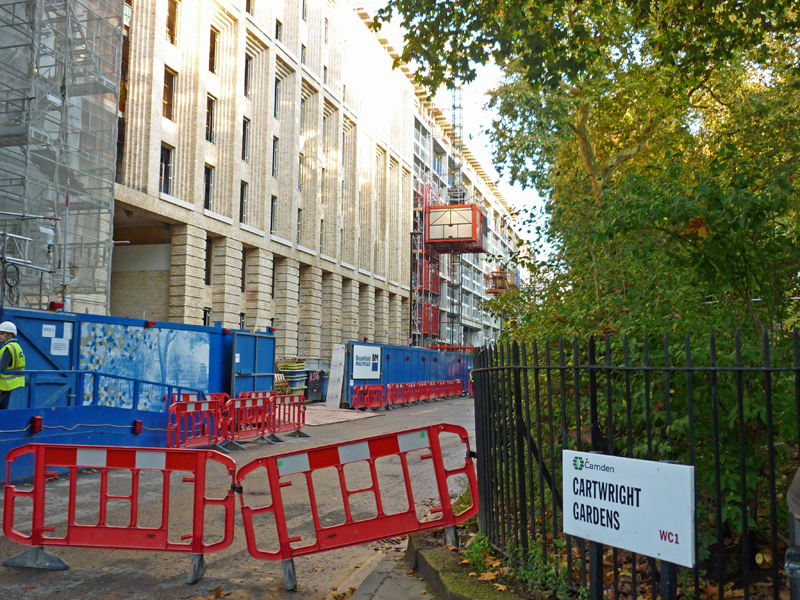
Burton Place leads into Cartwright Gardens. This whole area is awash with budget hotels (though in London the term is purely relative) but this particular crescent is wall-to-wall with them.

P1040604

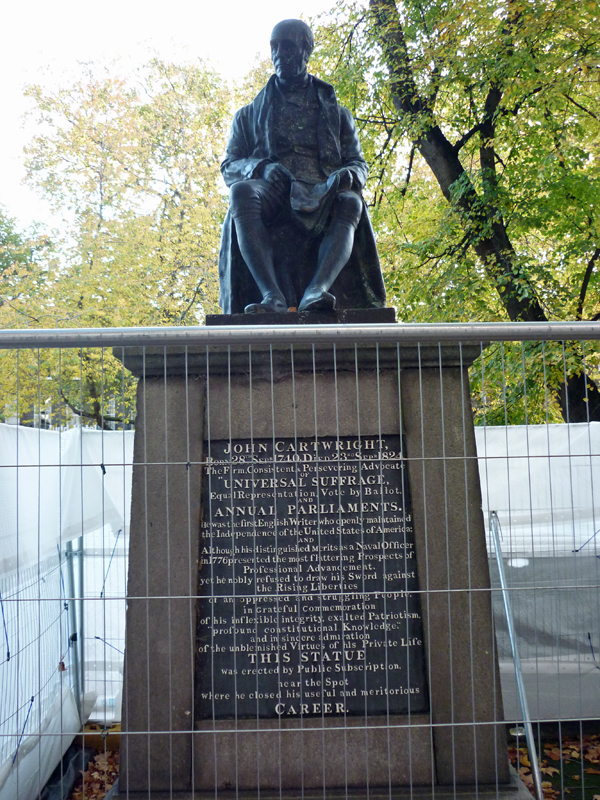
Cartwright Street is closed off due to a massive redevelopment of student halls so we have to traverse the actual gardens which are themselves undergoing a make-over. Hence the caging off of the statue of the man after whom the gardens were named. John Cartwright (1740 – 1824) was a political reformer who campaigned for universal suffrage well before the concept became reasonably acceptable. His status as all-round good bloke is evidenced by the fact that this statue was paid for by public donation.

P1040605 P1040606

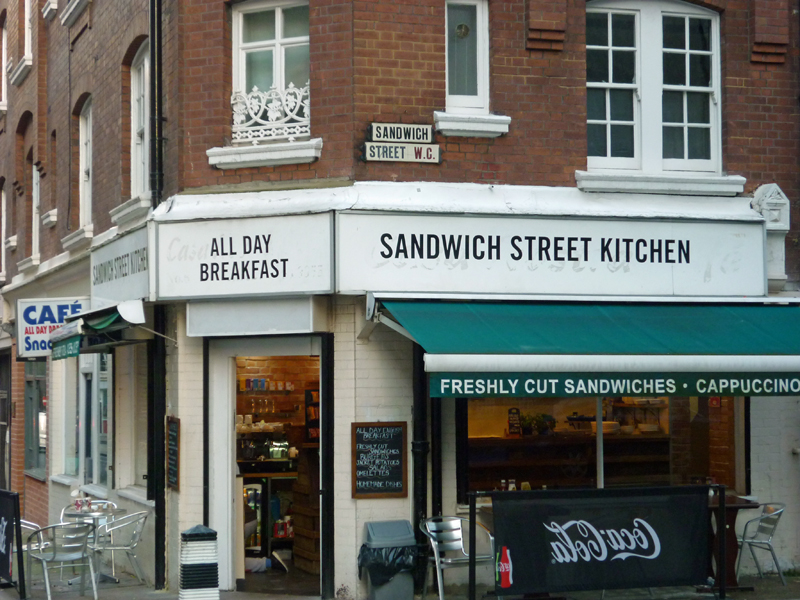
Next up is Sandwich Street which is obviously where I should have had lunch.

P1040607

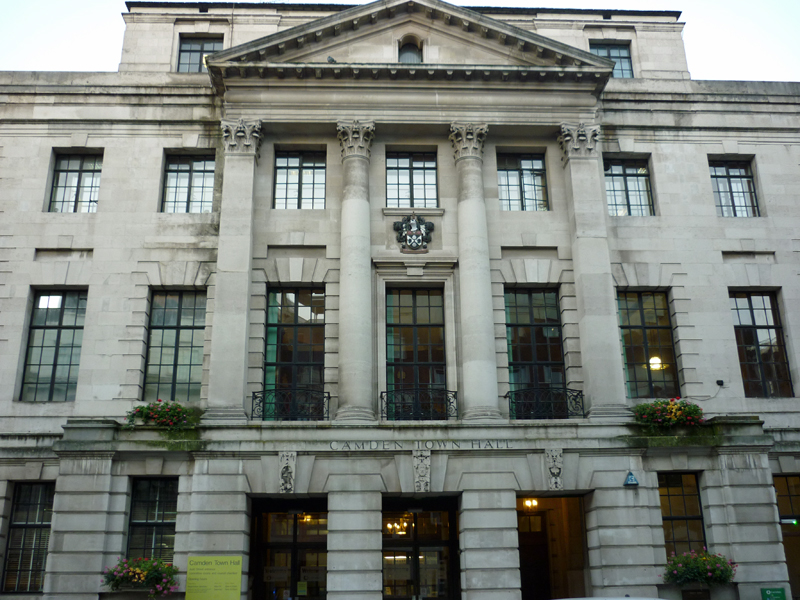
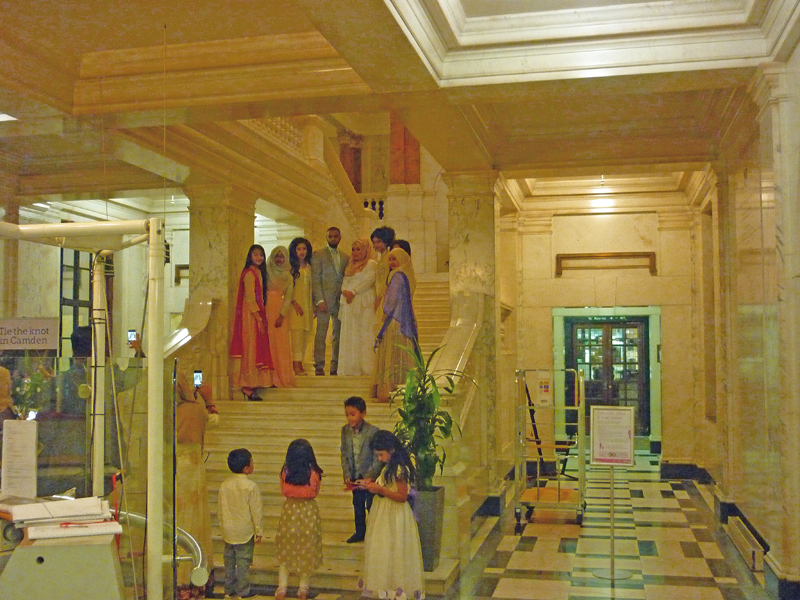
Then on to Thanet Street and via Leigh Street back to Judd Street where there’s just time to pay a visit to Camden Town Hall. As well as, naturally, being home to Camden Borough Council this Grade-II listed neo-classical thirties building is now a much-used venue for civil marriage and wedding ceremonies (as exampled below).

P1040613 P1040608

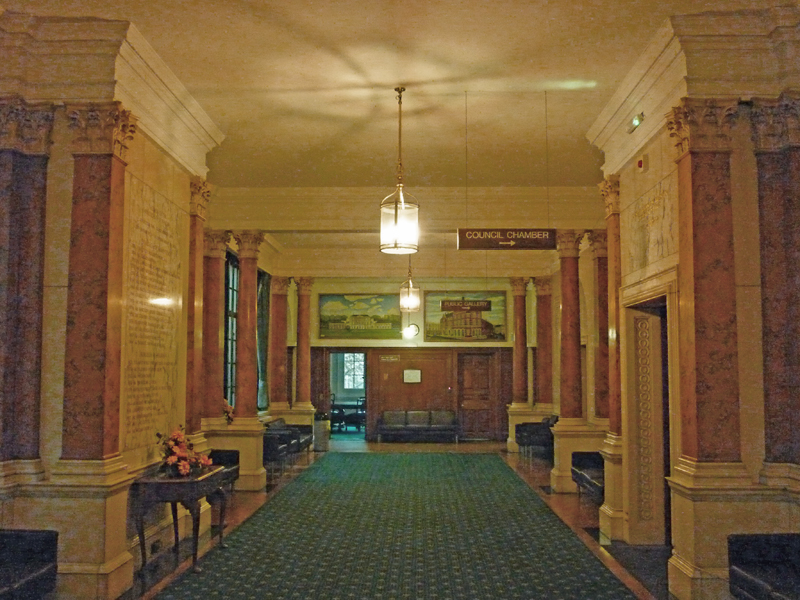
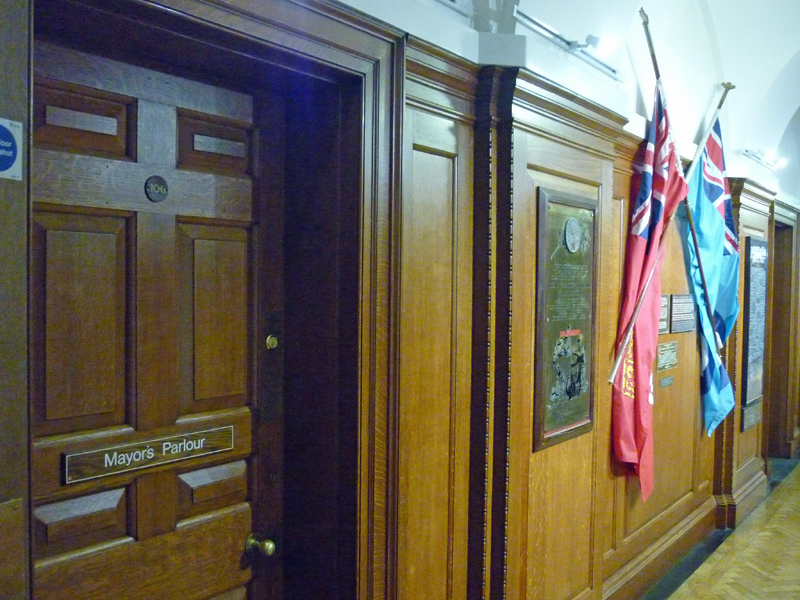
There is public access to the first floor where the council chambers are located and also the Mayor’s parlour (which his or her office is quaintly referred to). The plaque you can see in the picture below celebrates residents of the borough who fought on the right (i.e. the left) side in the Spanish Civil War. The flags commemorate the wartime contribution of Canadian airmen.

P1040610 P1040612

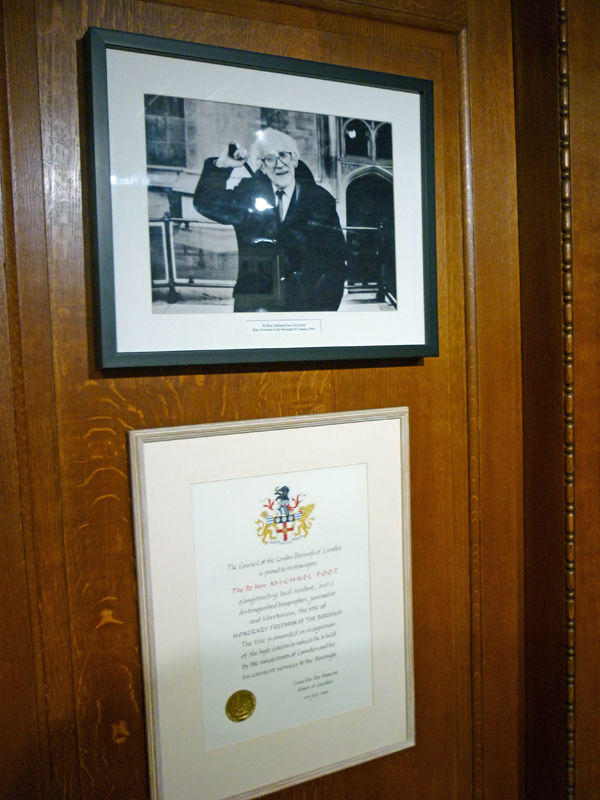
Fittingly, given the rise of Jeremy Corbyn, there is also a commemoration of the granting of the freedom of the borough to Michael Foot (the last genuinely socialist leader of the Labour party).

P1040611

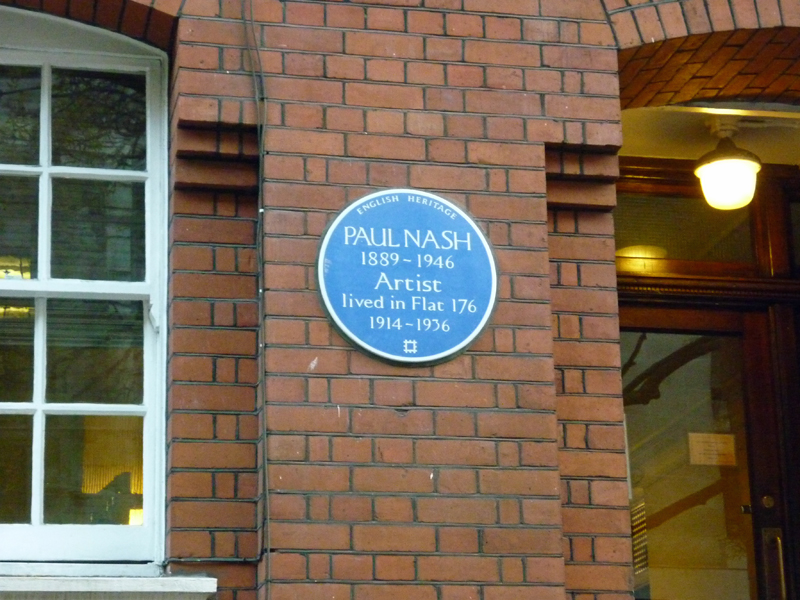
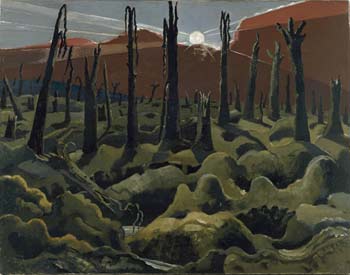
 Back on the eastern side of Bidborough Street are the Victoria mansions which were home for 22 years to the British surrealist painter and wartime artist, Paul Nash (1889 – 1946). Nash is best known for his haunting, proto-Modernist WW1 landscapes.

P1040614 Paul Nash WW1

The remainder of the streets bounded by Gray’s Inn Road to the east and Euston Road to the north are unremarkable save for the already-remarked upon proliferation of lower-end hotels. So via Tonbridge Street, Argyle Walk, Whidborne Street, Argyle Street, Belgrove Street, St Chad’s Street, Argyle Square, Crestfield Street and Birkenhead Street we end emerge again opposite Kings Cross Station just as the early evening gloom is setting in.

P1040617

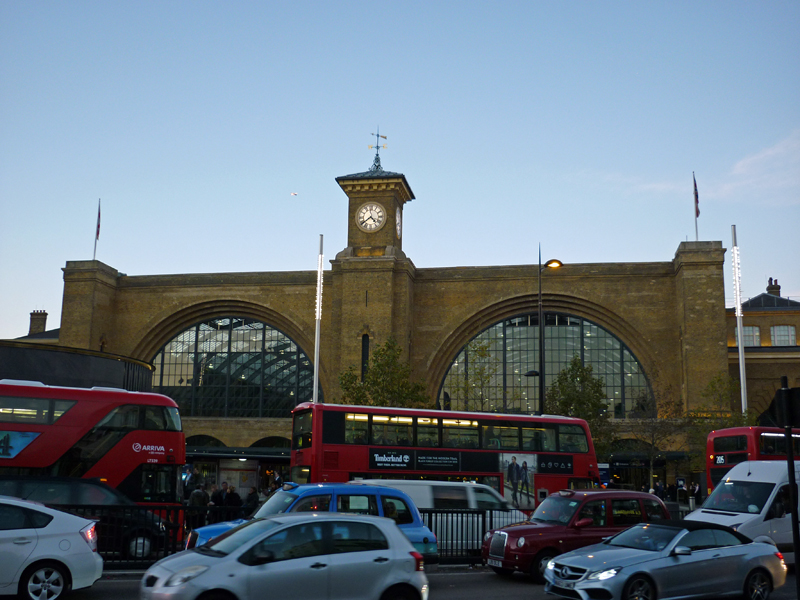
Gateway to the major cities of Yorkshire, North-East England and Scotland, Kings Cross (or King’s Cross – either is used) has a strong history in popular culture. In fact it’s probably better known today for being the home of Harry Potter’s fictional platform 9 and 3/4 than for the tragic fire of 1987 in which 31 people died. It also featured prominently in the great Ealing comedy of 1955, The Ladykillers.

According to folklore, King’s Cross was also the site of Queen Boudicca’s final battle and she is buried somewhere under one of the platforms.

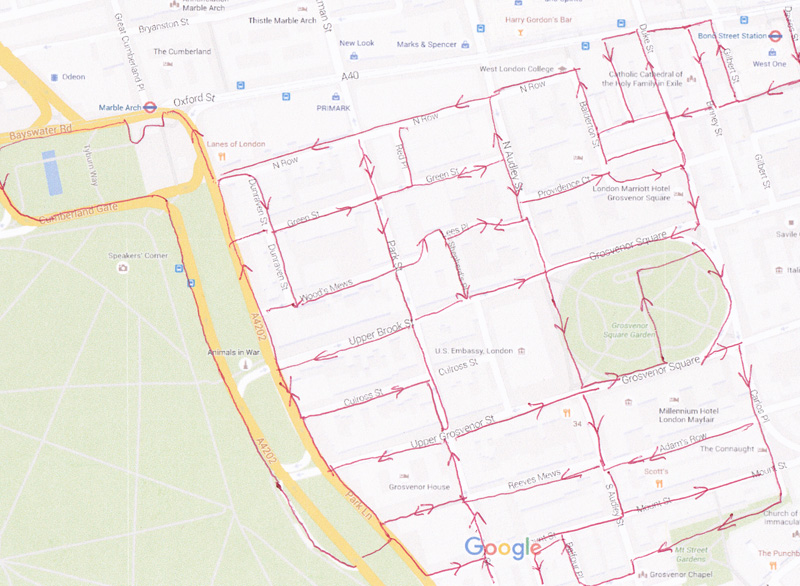
Day 8 – Marble Arch – Hyde Park – Park Lane – Mayfair – Grosvenor Square

Today’s route involves a first trip to the two most expensive properties on the Monopoly Board, Park Lane and Mayfair via the underside of Oxford Street, the Marble Arch gyratory system and the eastern edge of Hyde Park. It also takes in that little bit of central London which is all about the US of A, Grosvenor Square.

Day 8 Route

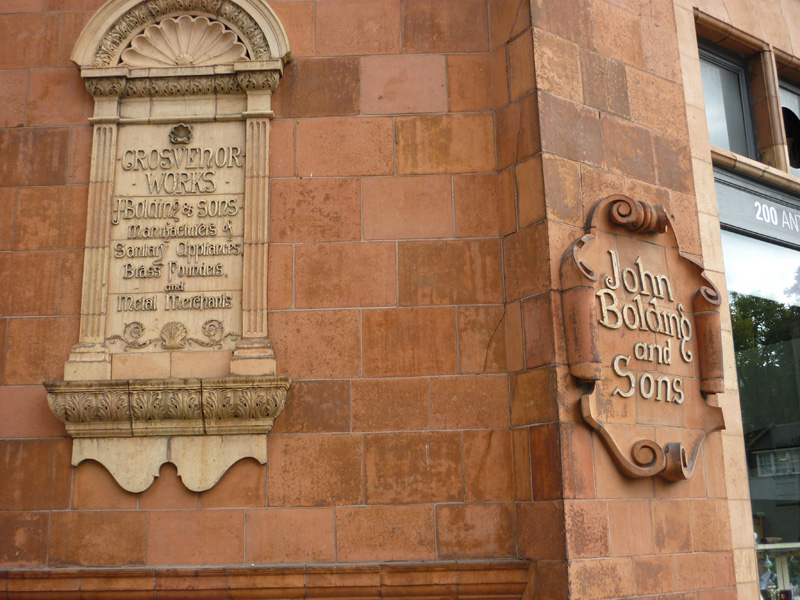
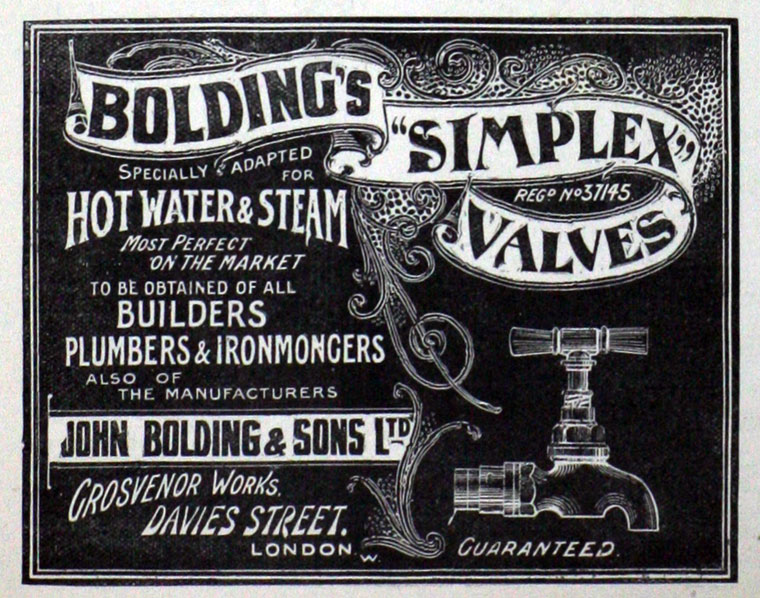
Start at Bond Street tube station and immediately venture south down Davies Street where on the intersection with South Molton Lane we find the Grosvenor Works, which is now occupied by Grays Antiques but was from the late 19th century home to John Bolding & Sons makers of sanitary appliances (bathroom fittings in other words).

P1040535 Im18980806ILN-Bolding

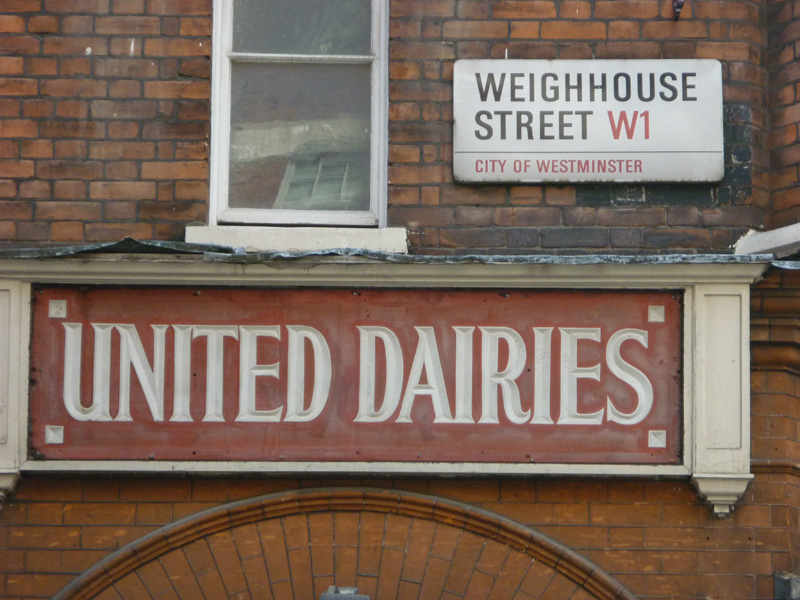
Turning right along Weighhouse Street there is another reminder of London’s industrial and commercial past – this United Dairies signage on a building currently undergoing redevelopment. United Dairies effectively ceased to exist in 1959 when it was merged into what became Unigate – so this must have at least been obsolete for longer than I’ve been around.

P1040537

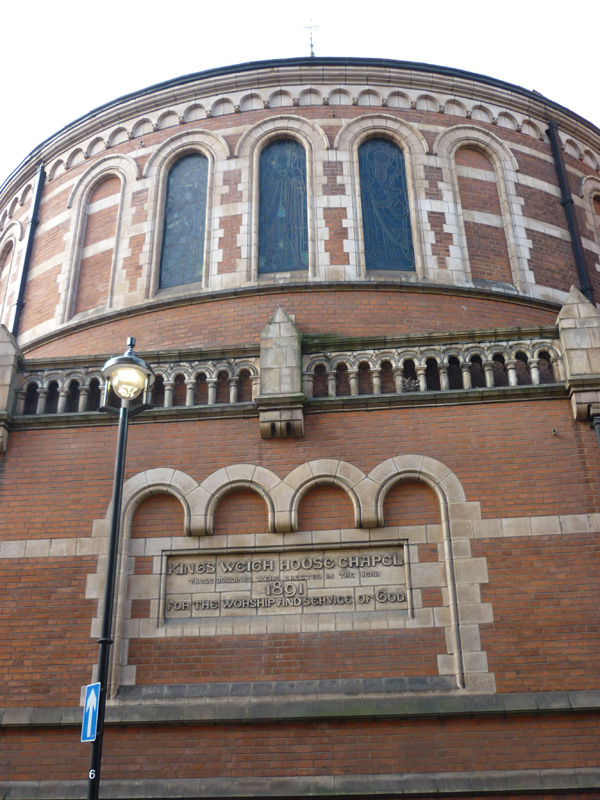
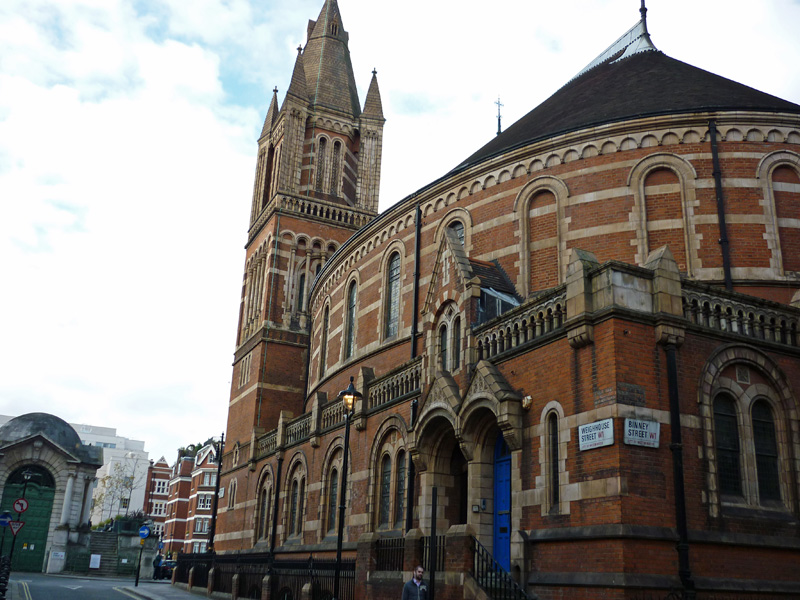
Up Gilbert Street and down Binney Street where, sandwiched between this and Duke Street, is the former King’s Weigh House Chapel which nowadays operates as the catchily-entitled Ukrainian Catholic Cathedral of the Holy Family in Exile. Designed by the eminent Victorian architect, Alfred Waterhouse, the chapel’s original name derives from the fact that its dissenter congregation’s original place of worship, in Eastcheap, was above the office for checking the weight of merchandise.

P1040536 P1040538

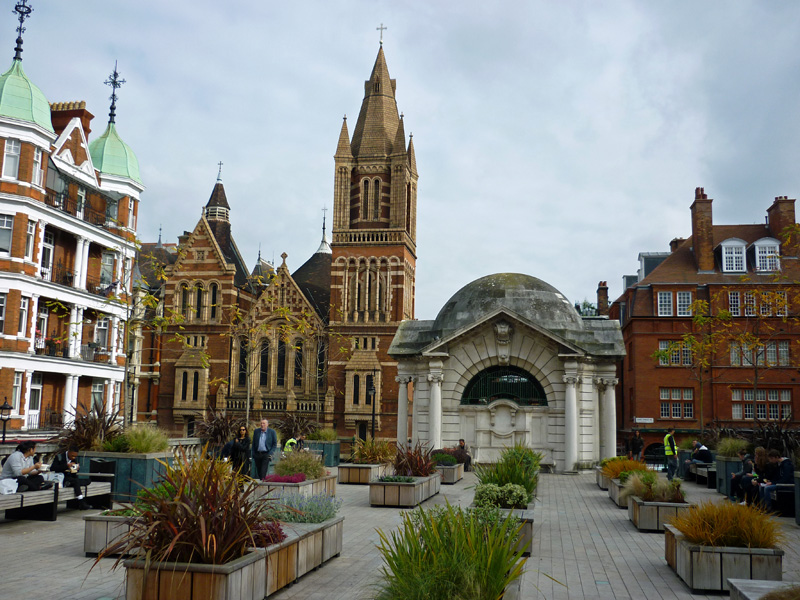
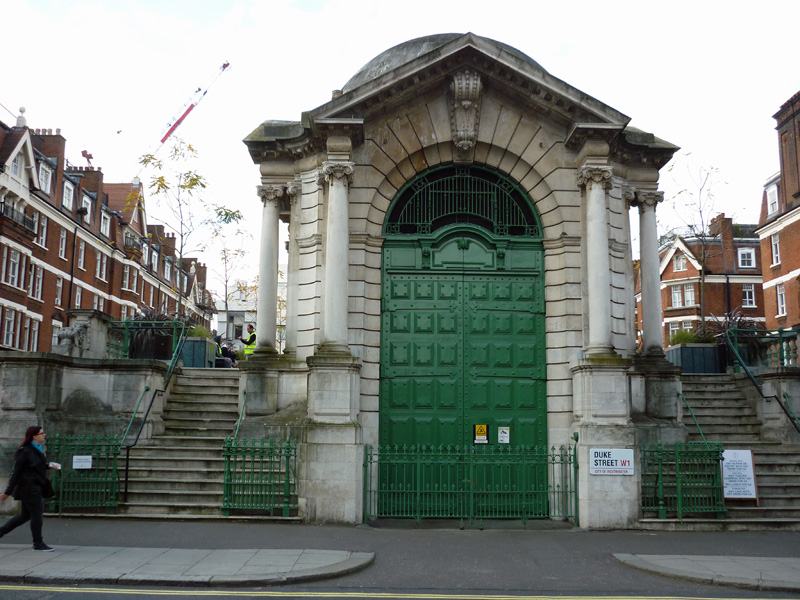
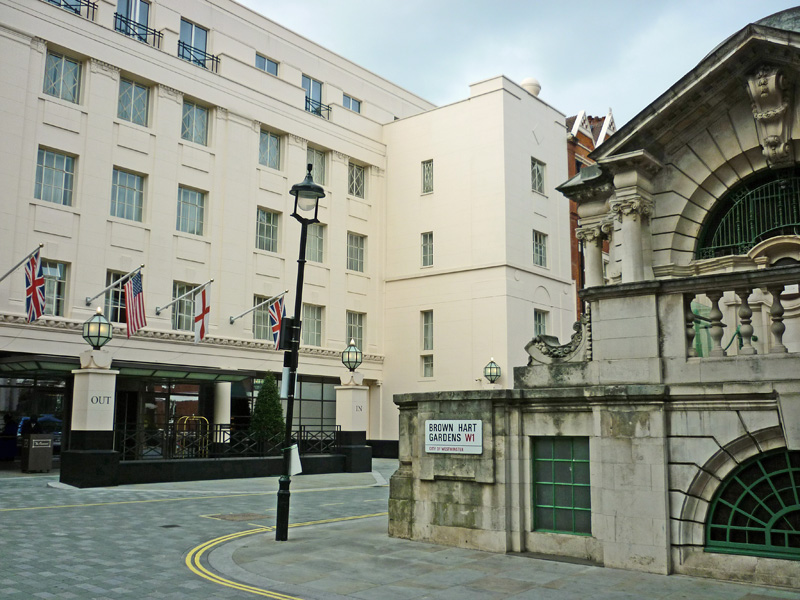
Head up Duke Street to Oxford Street again and then down Lumley Street (no sign of Joanna) to arrive back west of the church in Brown Hart Gardens. The eponymous gardens in the middle of this square are laid out on a raised terrace and replaced the original communal street level gardens which made way for the construction of what must be one of the world’s grandest electricity substations at the turn of the last century. The substation was completed in 1905 to the design of C. Stanley Peach in a Baroque style from Portland stone featuring a pavilion and steps at either end, a balustrade and Diocletian windows along the sides to light the galleries of the engine rooms. The overlaying of a paved Italian garden was carried out at the insistence of the then Duke of Westminster.

P1040541 P1040539

The gardens have very recently been renovated and the terrace is now, like every other tarted up bit of the capital, graced with a posh café. The western end of the square is occupied by another five-star hotel – the Beaumont.

P1040543

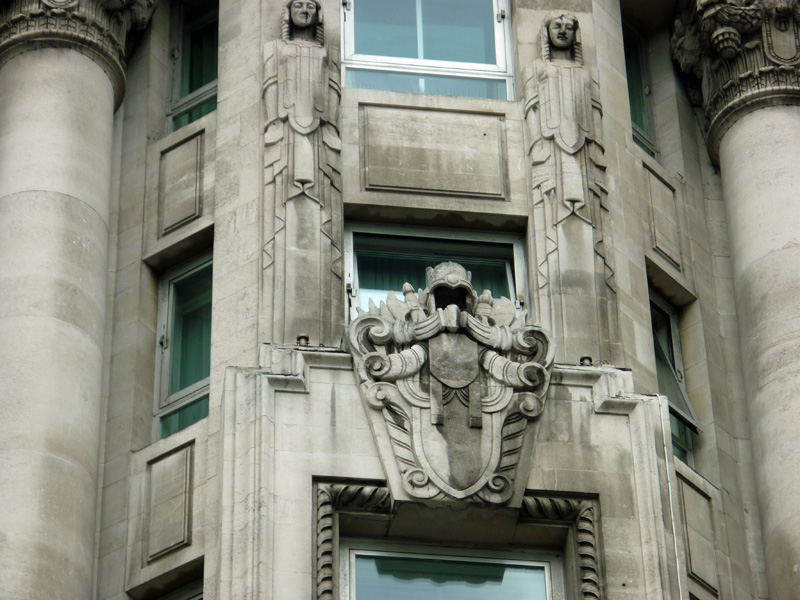
We now head north on Balderton Street and turn left into North Row, which runs parallel with Oxford Street and has nothing of interest to detain us until we reach Marble Arch. Pause at the corner of Park Lane to note the detailing on the southern exterior of the Cumberland Hotel where Jimi Hendrix kept a room in the late sixties and which now has a suite (though not the same one) named in his honour.

P1040544

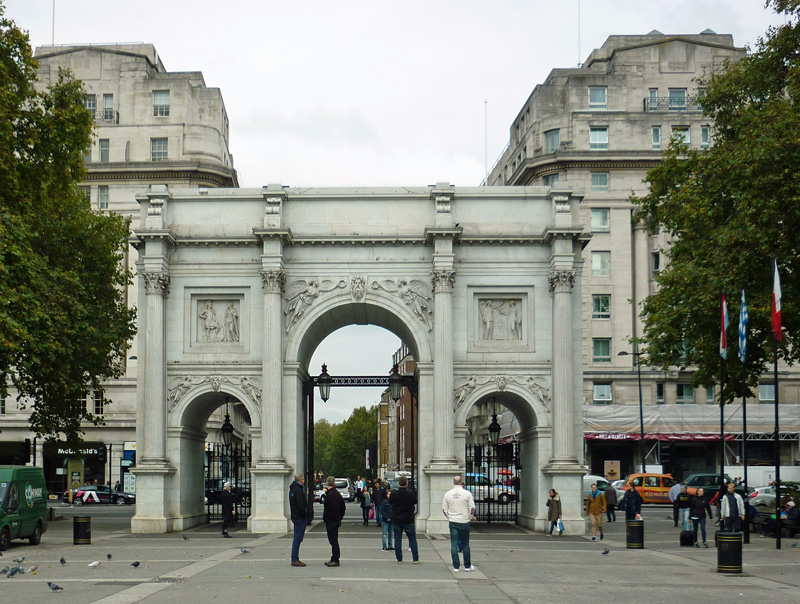
Cross the road to take a closer look at Marble Arch itself. This was originally designed by our old friend John Nash to be one of the state entrances to Buckingham Palace but was relocated in 1851 upon the widening of Park Lane and now sits isolated and underwhelming amid the traffic visited only by hordes of pigeons and a few less discerning tourists.

P1040545 P1040546

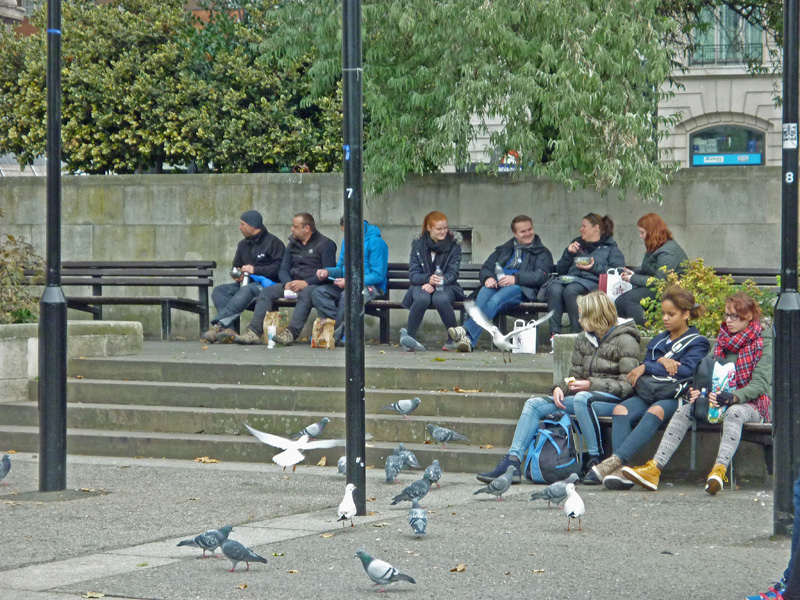
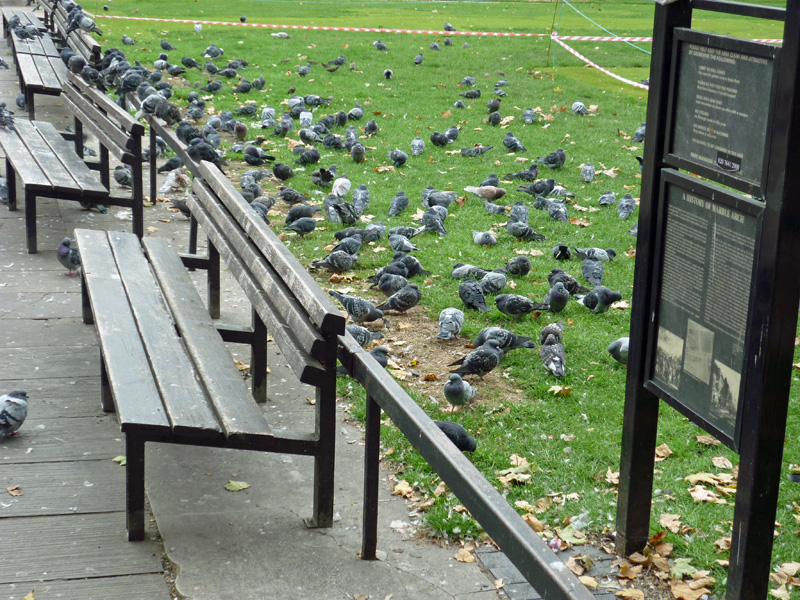
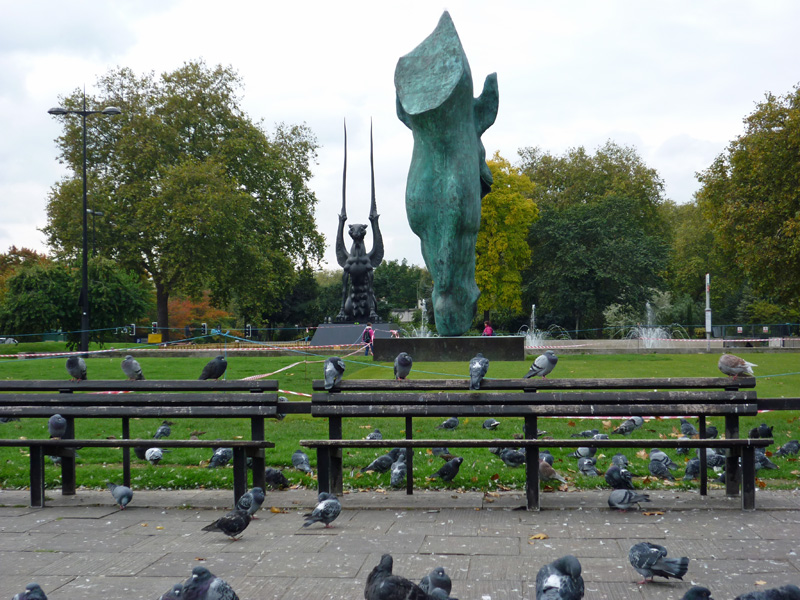
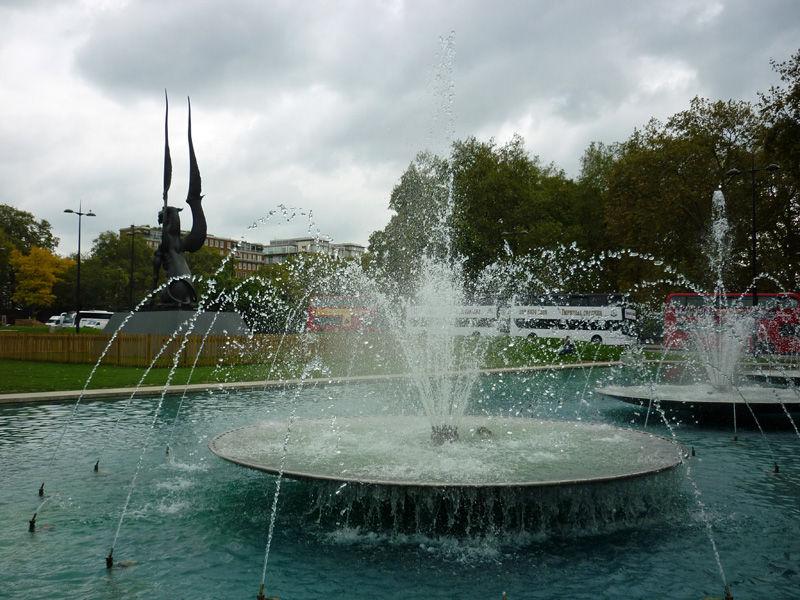
Yes, if you were wondering where all the pigeons went after being driven away from Trafalgar Square here’s your answer. As a consequence the sign in the photo below which exhorts members of the public to keep the area clean is a perfect exercise in futility. The statue you can see in the far distance is a very recent addition to the area. The work, called ‘She Guardian’, comprises four tonnes of bronze, sculpted over two years by Russian artist Dashi Namdakov. Unfortunately (or perhaps not) its positioning means only the hardiest tourist (or pigeon) will ever get close enough to experience its true majesty.

P1040549 P1040548

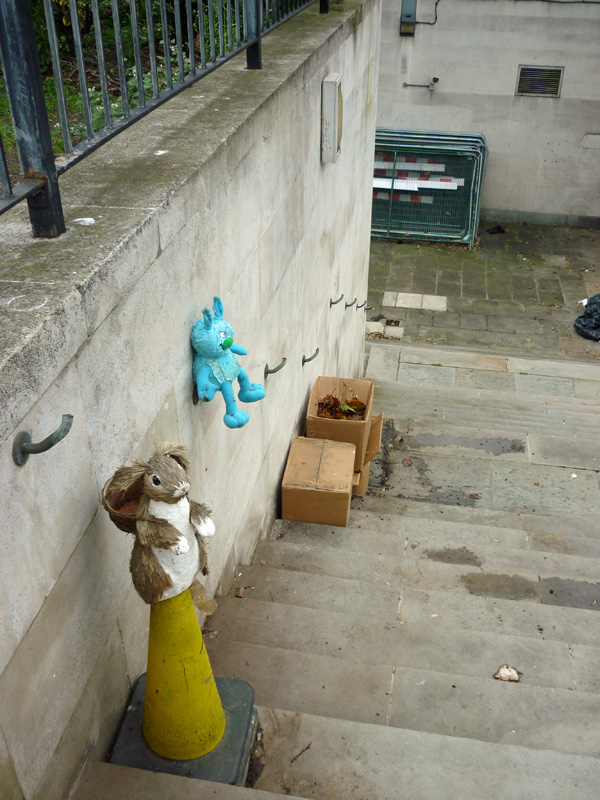
These little guys have even gone so far as to hide away down a disused subway entrance to escape its awesome majesty.

P1040550 P1040551

We make our escape too; skirting round Cumberland Gate to enter Hyde Park at Speakers’ Corner. In accordance with an 1872 act of parliament anyone can still turn up unannounced to speak on any subject, as long as the police consider their speeches lawful. Though on this particular day no-one had made the effort.

P1040552 P1040554

Dodge the joggers and cyclists en route through the park to exit by the Joy of Life fountain, a 1963 creation of T.B Huxley-Jones. Take the subway under Park Lane to emerge on the edge of Mayfair by Mount Street. On this stretch of Park Lane we have at no.93 the Grade I listed former London residence of Disraeli from 1839 to 1872. And at no. 100 the Grade II listed Dudley House, one of the few surviving aristocratic private palaces in London. It didn’t exactly come as shock to learn that this 17-room mansion is now owned by a member of the extended Qatari royal family.

P1040556 P1040561

For the next stretch of the walk we weave in and out of Park Lane and the parallel running Park Street which isn’t exactly short of high-end apartment blocks.

P1040557 P1040559

No. 16 on the interconnecting Upper Grosvenor Street was once the residence of Sir Robert Peel. Although he served twice as Conservative Prime Minister in the 1840’s Peel was one of the great political reformists, playing a key role in the repeal of the Corn Laws, Catholic emancipation and the 1832 Reform Act by supporting the Whig government from the opposition benches. Such Liberal tendencies have not exactly endeared him to certain elements of subsequent generations of Conservatives. His best-known legacy is probably the creation of the Metropolitan Police and the designation of its members as either “Peelers” or “Bobbies”.

P1040555 museum-peelers-480

Culross Street, Upper Brook Street, Woods Mews and Green Street are the other interlinking streets. The second of these is home to Michael Roux Jr.’s Michelin two-star, Le Gavroche at no. 43.

P1040560

Reaching the top of Park Lane again we cut back down Dunraven Street where no.17 announces itself as the former home of the immortal P.G Wodehouse. There are very few surer ways of fending off a bout of the glums than a good dose of Jeeves and Wooster. If you’re not familiar with the radio adaptations featuring the late greats Richard Briers and Michael Hordern I urge you to seek them out.

P1040562 p-g-wodehouse-4

Continue via Lees Place and Shepherds Place to North Audley Street where at no.13a we find the former St Mark’s Church. Dating from 1828 and designed in the (by now familiar) Greek revival style the building ceased to be a parish church over 30 years ago and after an long period of abandonment and aborted re-usage attempts is now re-branded as One Mayfair and owned by the same events company that previously brought you One Marylebone. The adjacent red-brick No. 13 was originally the vicarage and is still today used as a private home.

P1040563 P1040566

P1040567

Nearby Providence Court provides a prime example of the vogue for redevelopment that involves propping up historic frontages and completely rebuilding behind them.

P1040568George Yard takes us back to Duke Street from where it is a short hop to Grosvenor Square. As already noted this is dominated by the monstrous incongruity that is the American embassy. Chap with his hands on his hips is Dwight Eisenhower. He’s joined at the southern end of the building by Ronald Reagan whose statue was unveiled in 2011. I suppose the thinking was that the one was a hero of the Second World War and the other of the Cold War, though the equivalency escapes me.

P1040570 P1040572

Pride of place in the gardens in the centre of the square goes to a statue of Franklin D. Roosevelt and on the eastern side there is a pavilion and memorial garden created to honour the victims of September 11. The building in the background is the significantly more discrete Italian Embassy.

P1040575 P1040576

Leave the square via Carlos Place which is the location of the Connaught Hotel and also the Timothy Taylor gallery where one of the works in the current exhibition provides today’s selfie of the day.

P1040577 P1040588

Duck through Mount Street Gardens, created in 1889 out of a former burial ground, passing the rear of the Jesuit Church of the Immaculate Conception before entering onto South Audley Street. Here we find the 120-year old Mayfair Library which is still just that, a public library run by Westminster Council. It’s quite difficult to imagine any of the residents of this part of town popping in to borrow an actual book so perhaps it’s not surprising that the library has expanded its services to include offering itself as an approved venue for wedding ceremonies.

P1040579 P1040580

P1040581 P1040582

Opposite the library is the Grosvenor Chapel which was built in the 1730’s and whose Anglican congregation was swelled during the Second World War by the presence of American servicemen and women.

P1040583 P1040584

South Audley Street is also, at no. 57, home to James Purdey and Sons, Gun and Rifle makers by Royal appointment. Still no sign of Joanna (tenuous cultural cross-reference of the day).

P1040586Right, we’re nearly done now. Aldford Street and Rex Place bring us back to Mount Street and a stretch which is the location of the Brazilian Embassy proper and a swathe of high-end boutiques and restaurants (which in fairness the buildings do deserve).

P1040585 P1040587

Finish off with Adams Row, Reeves Mews and then Grosvenor Street where the final pause of the day is to clock the embassy of the Principality of Monaco at no.7. Not quite sure why they feel the need for an embassy as most of their residents will be too scared to visit London in case they get asked to pay some tax (God forbid!)

P1040589

Day 4 – North of Oxford Street West

Today’s route covers the area north of the Marble Arch to Bond Street stretch of Oxford Street. It’s a part of London dominated by soulless chain hotels and the knock-on effect of proximity to the mecca of consumerism but with some surprises.

Day 4 Route

First of those surprises is Stratford Place which almost has more of interest in its short span than the rest of this area put together. Immediately adjacent to Bond Street tube it’s only about 100 yards long but by the end of it you would never know that the inferno that is Oxford Street is within spitting distance. The Tanzanian and Botswanan high commissions are next door to each other at numbers 3 and 5 and at no. 7 is the one-time residence of Martin Van Buren, 8th President of the USA.

IMG_20150817_112254 Van Buren

Colloquially known as the “Little Magician” he was unfortunately unable to conjure up a solution to the financial crisis of 1837 (which if you read about it sounds rather familiar – plus ca change).

At no.10 is the Royal Society of Musicians and at no. 11 (though it doesn’t advertise itself) is the Oriental Club, originally established in 1824 by and for officials and officers who had served in India and elsewhere in the “East”. Nowadays you just need to have the right background and a £1,000 a year to spare.

IMG_20150817_112352

IMG_20150817_112644

Finally at no.12 is the Kabbalah Centre. “Kabbalah is an ancient wisdom that provides practical tools for creating joy and lasting fulfilment.” As you can see from these handy aphorisms (if you enlarge the picture).

IMG_20150817_112909

Next street down is James Street which has gone for al-fresco dining in a big way.

IMG_20150817_142836I notice that the branch of Nando’s here does a Quinoa salad. And thoughtfully displays a poster advising on the ridiculous pronunciation (Keen-wah). Can’t be long before people in Ireland start naming their children after it. Come back cous-cous all is forgiven.

IMG_20150817_114045Running parallel is St Christopher’s Place, home of high-end brunching and shops aimed at people who might get French puns, as in the name “Les 100cials”, and appreciate a bush shaped into a giant platform shoe.

IMG_20150817_113916Turn right into Wigmore Street and then north up Welbeck Street. IMG_20150817_115231This was home to the scientist Thomas Young (1773 -1829) at no.49 and the poet and sculptor Thomas Woolner (1825 – 1892) at No.29. Woolner was one of the founding members of the Pre-Raphaelite Brotherhood (though not quite colourful enough to make it into the TV series).

Left into Bulstrode Street and on to Marylebone Lane. Here you can find Paul Rothe & Sons delicatessen (est.1900). As you can see, actor Tim McInnerny (of Black Adder fame) worked behind the counter back in the day.

IMG_20150817_120832

paul_rothe2

Bentinck Street houses the former residences of historian Edward Gibbon (1737 – 1794) and chemist James Smithson (1765 – 1829) at nos. 7 & 9 respectively. The former is of course best known for the Decline and Fall of the Roman Emperor (the book not the actual event). The latter was the founding donor of the Smithsonian Institute in Washington, D.C. despite having never visited the United States.

North again on Mandeville Place. At no.11-13 is the School of Economic Science, a registered charity which has the somewhat esoteric mission of finding the common ground between Philosophy and Economics and the spiritual dimension to that link.

IMG_20150817_121334IMG_20150817_121407

Mandeville Place is bisected by Hinde Street, home to quite an imposing Methodist Church which dates from 1887, before turning into Thayer Street. A nod to the AtTheMovies film poster store at no. 18.

IMG_20150817_121443 IMG_20150817_121521

Right onto George Street where we find St James’ Spanish Place RC Church with a lunchtime service in full swing. Out of respect I decide I have no choice but to sit down and wait for this to finish before taking a look around. Quite a fan of the current Pope but judging by the literature on display some of his more liberal notions have yet to filter down to the grassroots.

IMG_20150817_123655 IMG_20150817_125622

On Spanish Place proper no.4 is the former of home of the novelist Captain Frederick Marryat (1792 – 1848) and actor-manager George Grossmith (1847 – 1912).

IMG_20150817_130356A quick tour round Manchester Square home of the Wallace Collection (see previous post). At no. 14 lived Lord Alfred Milner (1854 – 1925) the sort of chap who wouldn’t have had any trouble getting into the Oriental Club.

IMG_20150817_130743

The route then takes us along Robert Adam Street, Blandford Street, Portman Close and Upper Berkeley Street. The beginning of the last of these is sandwiched between the massive and unlovely Radisson and Hyatt Regency hotels.

Montagu Street then on to Great Cumberland Place which goes all the way back down to Marble Arch. Part way down is Wallenberg Place which features this memorial to the great Raoul Wallenberg (1912 – 1945?). The Swedish diplomat responsible for savings tens of thousands of Jews from the Nazi holocaust who was taken captive by the Red Army at the end of WW2 and never heard of again. If you’re not familiar with him this is one of the essential bios to look up.

IMG_20150817_132924

On Bryanston Street can be found the Church of the Annunciation Marble Arch then down to Marble Arch itself (which more another day). Don’t know when this ferris wheel was put up.

IMG_20150817_133252 IMG_20150817_133527

Finally brave the hell that is Oxford Street to briefly marvel at the hordes outside Primark. Since this is everywhere these days God alone knows why anyone would want to trek into town just to patronise a slightly larger branch. I will also note in passing the very sizeable presence of middle-easterners in this corner of the capital – the Marble Arch to Bond Street stretch of Oxford Street could just as well be part of downtown Riyadh.

IMG_20150817_133756

 Take in Old Quebec Street, Seymour Street and New Quebec Street before reaching Portman Square which has one of those private gardens that always strike a discordant note. Off the north-west corner of the square is Fitzhardinge Street which is only notable for being the former home of B.T Batsford the publisher for whose softball team, the Batsford Bats, I turned out as a regular ringer during the late eighties and early nineties.

Back to Oxford Street via Seymour Mews and Orchard Street. No pub of the day today as this part of town is something of desert as far as hostelries are concerned. Duke Street has both the Devonshire Arms and the Henry Holland but the former doesn’t do food and the latter is asking £8 for a baguette. It also boasts the fact that Simon Bolivar (1783 – 1830) the hero of South American liberation took lodgings at no.4 in 1810.

IMG_20150817_142156

Picton Place and Barrett Street then finish off at Selfridges the world-renowned emporium and TV series inspiration founded by Harry Gordon Selfridge in 1909.

IMG_20150817_140409 IMG_20150817_140538

Was going to have something to eat on the 4th floor but £11 for a Halloumi wrap (as an example) is taking the proverbial somewhat. Still, the toilets are splendid enough to make the trip worthwhile even if it does involve passing the jaw-dropping apparition that is the Christmas Shop. Now either they’re jumping the gun by several months or this is here all year round – and I don’t know which is worse. All the more surprising since quite a fair proportion of their clientele definitely doesn’t do Christmas.

IMG_20150817_141007