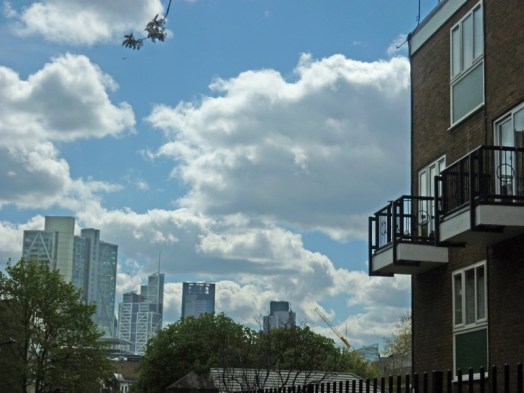
Day 29 – Bunhill Fields – Whitecross Street – Barbican

This walk begins opposite where the last one finished, on the western side of City Road at Bunhill Fields, the last remaining historic burial ground in central London. It then winds its way westwards and southwards, taking in Whitecross Street market before ending up at the behemoth of modernist architecture that is the Barbican Centre and estate.

Day 29 Route

Bunhill Fields is the final resting place for an estimated 120,000 souls, a large proportion of them interred at the time of the great plague of 1665 when the area first came into use as a burial ground. As the ground was never consecrated by the Church of England it became a popular burial site for Nonconformists and Radicals among whose number were  John Bunyan (1628 – 1688), the author of The Pilgrim’s Progress and a Baptist, Daniel Defoe (1660 -1731), writer of Gulliver’s Travels and Moll Flanders and a Presbyterian, and William Blake (1757 – 1827), poet, artist and religious iconoclast.

P1050759
Tomb of John Bunyan
P1050760
Memorials to Daniel Defoe and William Blake

The last burial here took place in 1854 and the site was configured into its current layout in the 1860’s with a public garden area created alongside a hundred years later. The burial ground now contains 2,333 monuments, mostly simple headstones (of which there are 1,920) arranged in a grid formation. Among the more extravagant memorials is that of Dame Mary Page, wife of Sir Gregory Page, first baronet, wealthy City merchant and East India Company director. As you can see below, the tomb is unusual in bearing an inscription setting out the graphic detail of the disease that brought about the lady’s demise – believed to be what is now known as Meigs’ Syndrome.

This slideshow requires JavaScript.

After a circuit of Bunhill Fields we head north up City Road a short distance before turning left into Featherstone Street and proceeding west to Bunhill Row with a brief deviation into Mallow Street. Cross over into Banner Street just off the south side of which sits the Bunhill Fields Quaker Friends House, originally the caretaker’s house of a set of Quaker mission buildings, the rest of which were destroyed in WWII. The surrounding gardens and playground occupy the site of the old ‘Quaker Burying Ground’ where the movement’s founder, George Fox, is buried along with many thousand early adherents.

P1050770

At the next intersection with we turn north for the first of several visits to Whitecross Street. This has been home to an eponymous market since the 17th century though by the late 19th century the area had become a by-word for poverty and alcohol, known colloquially as Squalors’ Market. When I used to visit it occasionally ten years or more ago it was very much in the “pile it cheap and high” tradition of street markets with just the odd food stall among the DVDs, kitchen implements and cut-price clothing. Nowadays the “street food” has effectively taken over completely and the market is more-or-less just a lunchtime affair. Naturally (in keeping with established tradition) I got here just as all the stalls were packing up.

We hit Old Street just opposite St Luke’s and resume west as far as Golden Lane where we turn south then east along Garrett Street back to Whitecross Street. The restaurants that line the street have gone pretty upmarket and edged out most of the old-school retailers. The second-hand record store run by a couple of aging Teddy Boys is long gone but one or two of the old guard cling on as you can see.

P1050774

Whitecross Street and its offshoots have also succumbed to the encroachment of “street art” (spreading west from its Shoreditch heartland). Topically and appositely, the latest manifestation is an image of someone very cross and very white.

This slideshow requires JavaScript.

Next up it’s the western stretch of Banner Street which returns us to Golden Lane where we look in on Nags Head Court before turning back east along Roscoe Street. Loop round Baird Street then continue east along Chequer Street (through another Peabody Trust estate). On the return to Bunhill Row we dip south briefly then make a right into Dufferin Street and complete a circuit of Dufferin Avenue and Cahill Street before crossing Whitecross again, this time into Fortune Street. Where this meets Golden Lane once more we encounter what can only be a sign of things to come.

P1050781

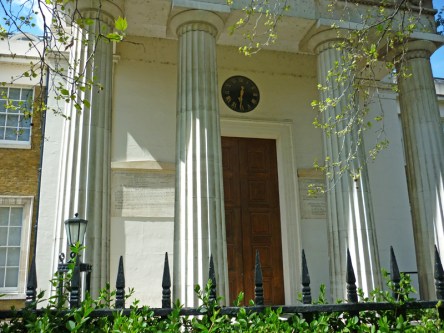
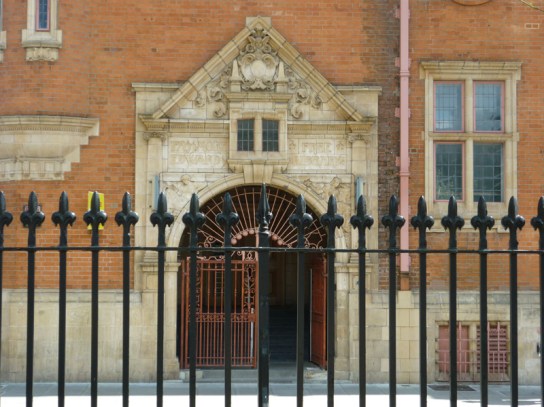
Turning south we arrive at no.1 Golden Lane which is now offices of UBS Bank but started life in 1896 as the home of the Cripplegate Institute; a charitable foundation set up by the City of London Parish of the same name. The building, designed by architect Sidney Smith, who was also responsible for what is now known as Tate Britain, incorporated a reference library, news and magazine rooms and classrooms for teaching such subjects as photography, dressmaking and first aid. In 1898 a theatre, staging mainly amateur productions, was opened in the building. The institute left the premises in 1987 and relocated to Chiswick, having sold the building for £4.5m.

P1050782

At its southern end Golden Lane emerges into Beech Street, a lengthy stretch of which forms the Barbican Tunnel. Heading east again we pass the Barbican Cinema which is now housed in a separate building from the rest of the arts complex.

P1050784

Passing this we turn back into Whitecross Street where the last vestiges of the old 3-for-a-fiver style street market are huddled in a concrete forecourt to a Waitrose supermarket. I once bought a checkered trilby hat here for £6 and still get occasional use out of it when the sun deigns to make a proper effort.

P1050786

Next right is Errol Street which forks right again into Lambs Buildings where you can find the home of the Royal Statistical Society in a converted Victorian Sunday School building. In 1833 the British Association for the Advancement of Science (BA) created a statistical section following a presentation by the Belgian statistician Adolphe Quetelet to its fellows. This proved so popular that, a year later, a Statistical Society was founded by Charles Babbage, Thomas Malthus and Richard Jones with the Marquis of Lansdowne as President. Florence Nightingale became the first female member in 1858. I failed miserably to come up with any interesting actual statistics about the RSS but a mildly interesting fact is that Harold Wilson was its President in 1972-73 whilst leader of the opposition to Ted Heath.

P1050787

Just around the corner is St Joseph’s Catholic Church featuring the memorial Cardinal Hume Quiet Garden.

Turning left we’re back on Bunhill Row which was originally called Artillery Walk (as it runs along the western side of the grounds of the Honourable Artillery Company – as featured in the last post). John Milton lived here for a time, during which he completed Paradise Regained.

P1050790

We go south from here onto Chiswell Street and then complete a circuit of Lamb’s Passage, Sutton’s Way and Whitecross Street (for one final time) before crossing into Silk Street and entering the Barbican Centre just as the rain starts to fall.

P1050803

The Grade II listed Barbican is Europe’s largest multi-arts and conference venue and one of London’s best examples of Brutalist architecture. It was developed from designs by architects Chamberlin, Powell and Bon as part of a utopian vision to transform an area of London left devastated by bombing during the Second World War. Although the first proposals were submitted in 1955 it wasn’t until 1971 that construction started and 1982 when the Queen formally opened the building. For a whistle-stop  history of the Barbican site from medieval times to the present day I would recommend this animated video inspired by an essay from the pen of Peter Ackroyd. The image below shows how things looked in 1955, with only the church of St Giles Cripplegate having miraculously survived the carnage wrought by the German air raids.

bombedchurch

The following selection of images feature :

  • a spatial installation in the foyer (until 10/09/2016), exploring the theme of collision, in which two revolving arms narrowly evade each other in a mobile of light and sound in constant motion.
  • the Barbican Muse – a sculpture, created by artist Matthew Spender, of a woman holding the separate masks of tragedy and comedy.
  • the Guildhall School of Music and Drama – founded in 1880 and taking up residence in the Barbican complex in 1977.
  • the “lakeside” terrace (thronged on this day with graduating students from King’s College)
  • the residential tower blocks (now some of last remaining from their era)

This slideshow requires JavaScript.

Nip in to see the latest exhibition in the art gallery which is a retrospective of work by the Icelandic performance artist, Ragnar Kjartansson which you can catch until the first week of September 2016. Centrepiece of the exhibition is a work entitled Take Me Here by the Dishwasher: Memorial for a Marriage (2011) a live performance featuring ten guitar-strumming troubadours singing for up to eight hours a day against a backdrop of a clip from an Icelandic softcore film of the Seventies starring the artist’s parents.

This slideshow requires JavaScript.

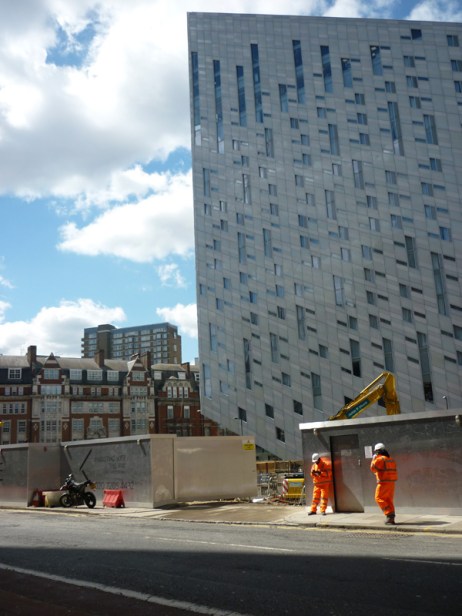
Leave the Barbican by the Silk Street entrance again, head east and loop round Milton Street and Moor Lane. This area is home to several of the monolithic glass skyscrapers that have come to dominate the City and these days there are as many residential as there are office blocks and I find myself asking if there isn’t perhaps a finite pool of people who can stump up £3.75m plus for an apartment, however stunning the view.

This slideshow requires JavaScript.

Moor Lane backs onto another massive instalment of the Crossrail redevelopment.

P1050810

Fore Street takes us round to the southern side of the Barbican complex where we find the aforementioned St Giles Cripplegate church.  It is believed that there has been a church on this site since Saxon times though it was during the Middle Ages that it was dedicated to St Giles. The name “Cripplegate” refers to one of the gates through the old City wall, which had its origins in Roman times as a fortification to protect the Roman city from attackers. There is no definitive explanation of the origin of the word ‘Cripplegate’ but it is thought unlikely that it relates to cripples despite the fact that St Giles is their patron saint (along with beggars and blacksmiths).  It is more likely that the word comes from the Anglo-Saxon “cruplegate” which means a covered way or tunnel, which would have run from the town gate of Cripplegate to the original Barbican, a fortified watchtower on the City wall. Sections of the old wall can still be seen near the church.

The church was designated a Grade I listed building on 4 January 1950 and it was extensively restored in 1966. Against the northern flank of the church is one of 14 artworks located around central London which were organised during Lent 2016 into a trail telling the story of the Passion of Christ under the umbrella title Stations of the Cross. Some of these (like the Jean Cocteau mural reported on a couple of posts back) are longstanding features of the city but the one you can see below, station no.9 by G.Roland Biermann, is one of four freshly commissioned pieces in 2016.

This slideshow requires JavaScript.

As you see, after an absence of several weeks, some more of my pigeon friends have managed to inveigle themselves into this final collection of images.

Leaving the many fascinations of the Barbican behind we finish for today by walking down Wood Street to London Wall (which we will return to on other occasion).


Day 28 – Where Shoreditch meets the City

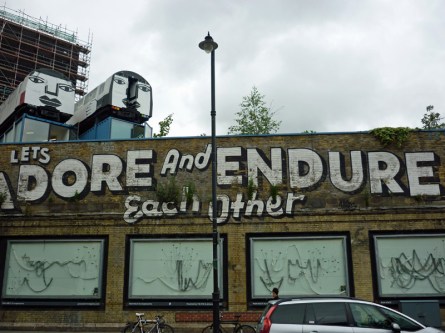
This walk took place on 22 June, the day before London pegged its colours to the masts of tolerance and enlightenment and practically the whole of the rest of England laughed in the face of this exhortation on the Great Eastern Road.

P1050738

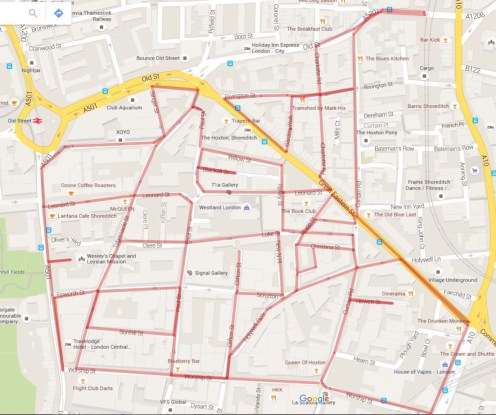
Which is where we begin this time; heading north west initially then veering due north up Curtain Road before covering the area west of there as far as City Road and south as far as Worship Road which is pretty much the northern boundary of the City now.

Day 28 Route copy

First though there’s a brief detour back on to Old Street to take a look at two Grade II listed buildings on opposite sides of the road. On the north side is the former Old Street Magistrates Court and Police Station, constructed in the Edwardian baroque style in 1906 to the design of architect John Dixon Butler. This has recently been converted into a 5-star 128-room hotel (opening just last month in May 2016 in fact). In somewhat dubious taste perhaps, five of the old 5ft by 15ft cells where East End felons including the Kray twins were banged up have been incorporated into the hotel bar as VIP booths which can be hired out for the night. The bar will also serve cocktails with a range of crime-oriented names including “slammer”, “clink” and “nick”.

Facing the hotel is Shoreditch Town Hall which was designed by Caesar Augustus Long opened in 1866 as the Vestry Hall for Shoreditch. Throughout the building the motto ‘More Light, More Power’ can be seen beneath the crest of Shoreditch. This motto, together with the statue of Progress on the front of the tower, commemorates the reputation that the Vestry, (later the Metropolitan Borough of Shoreditch), had as a progressive local government, particularly in its provision of electric power to the borough. Shoreditch Town Hall ceased to be a centre of municipal administration in 1965, when the boroughs of Shoreditch and Stoke Newington merged with Hackney to form the larger London Borough of Hackney.  For the next four years the Assembly Hall became one of the East End’s premier boxing venues until in 1969 when, after a hard-hitting fight against Joe Bugner, the tragic death of Trinidadian boxer Ulric Regis led to a ban on boxing throughout Hackney. After this the building’s future became increasingly uncertain as neglect and disrepair set in. In the early 1990’s there was colourful interlude in the shape of the Whirl-Y-Gig weekly trance nights before in 1997 a trust was formed with a mission to regenerate the building. This eventually led to a reopening in 2004, following major restoration work, as an independent arts and events venue.

This slideshow requires JavaScript.

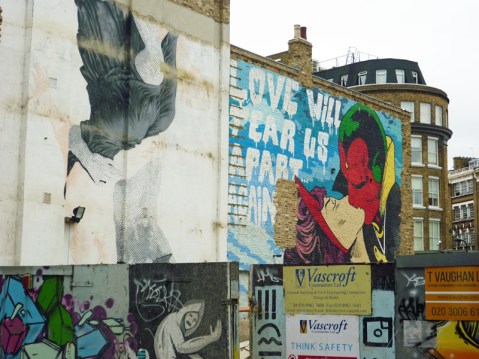
So next we track back west along Old Street and turn down Charlotte Road. Then it’s right into Rivington Street which leads out onto Great Eastern Street again where we turn left as far as Garden Walk. Head up here back to Rivington Street then complete the southern stretch of Charlotte Road. Crossing over Great Eastern Street we go west on Leonard Street where Joy Division meet Marvel’s Avengers – a near unbeatable combination in my book.

P1050717

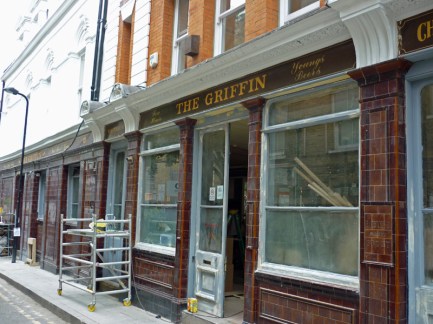
On the corner with Ravey Street (well-named for this part of town) is the Grade-II listed Griffin pub which dates from c.1889. Before its closure for refurbishment in 2014 it was described by Time Out as a “typical old blokes’ boozer”. What odds it will still warrant that description once it re-opens.

P1050718

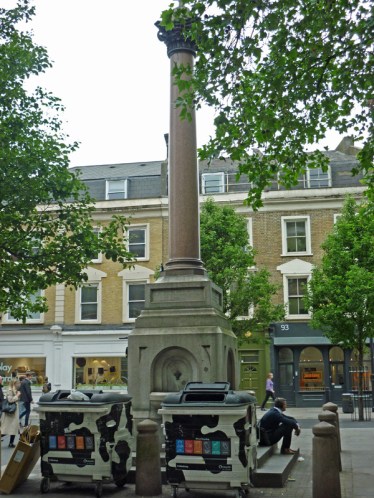
At the top of Ravey Street squeeze past some more new development to get to Willow Street then west to Paul Street and up to the apex of Old and Great Eastern Streets where stands this pink and grey polished granite monument which was originally a drinking fountain installed nearby by the Metropolitan Board of Works in 1880. When it was moved a short distance in 2002 as part of street improvements the fountain aspect seems to have been discarded.

P1050720

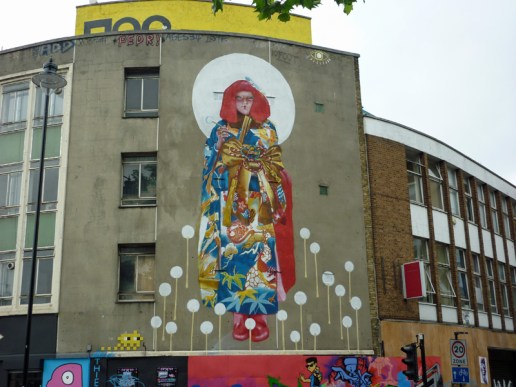
Behind this to the north east is this giant geisha mural by artists Core246 & Kaes on the wall of Red Gallery.

P1050719

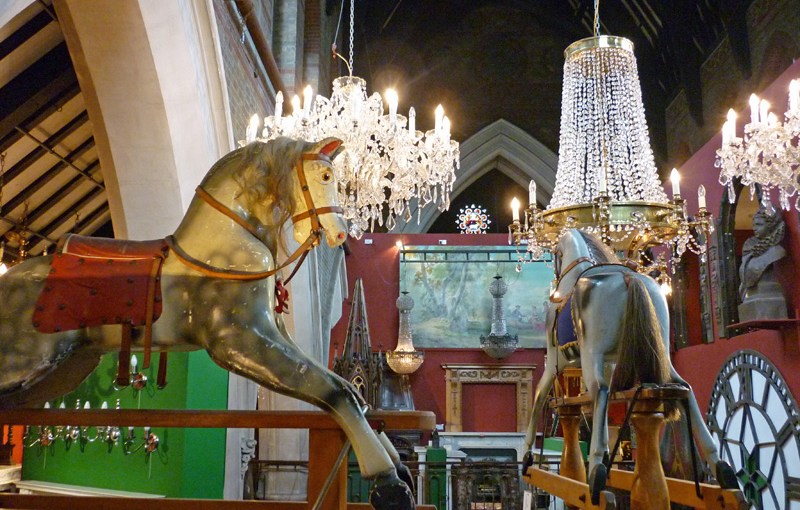
So we retrace our steps down Paul Street, look in briefly on Blackall Street and then return along Leonard Street stopping off at Westland Antiques which occupies the former Church of St Michael and All Angels. This Victorian Gothic revival  church was built in 1865 and designed by James Brooks (1825 – 1901) who was the architect of many East End churches of this era. Westland, who took over the site in 1977, specialise in salvaged Antique Chimneypieces and Fireplaces . But their collection extends far beyond that as you can see  in the pictures below. If you find yourself in the area its more than worth looking in.

This slideshow requires JavaScript.

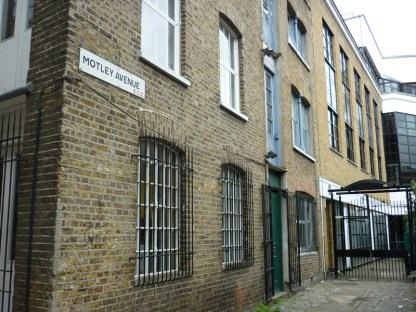
So after a circuit of Mark Square which lies behind the church we turn south down another section of Ravey Street into Luke Street then north east on Phipp Street and east on Gatesborough Street to reach the lower stretch of Curtain Road. From here we weave back and forth along Luke Street and Christina Street passing the splendidly-named but hugely disappointing Motley Avenue.

P1050729

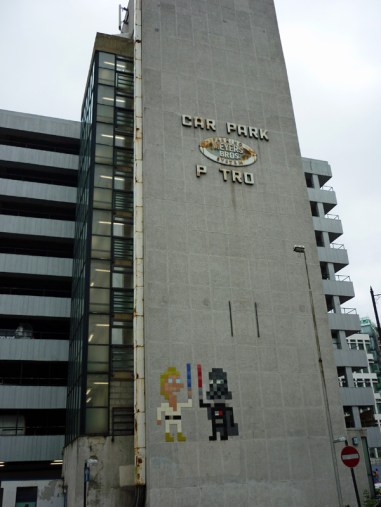
When we return to Curtain Road we find ourselves opposite one of the most decrepit (though presumably still financially viable) NCP Car Parks in the land.

P1050730

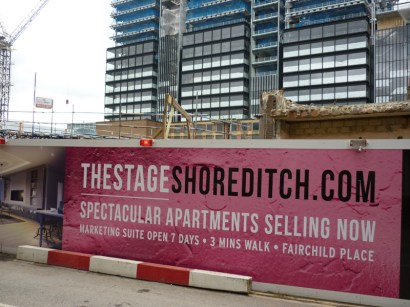
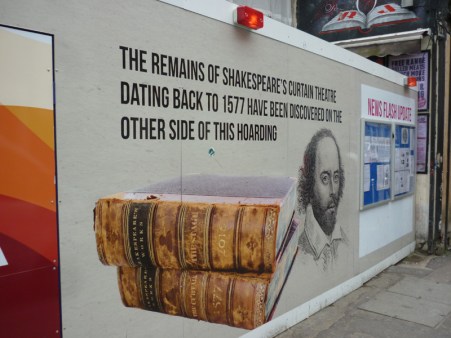
Given everything else that’s going on in the area I can’t help but feel its days are numbered (though I also feel a tinge of regret about that – for the Star Wars mural alone it deserves a shot at survival for a few years yet). Anyway, continuing down Curtain Road we arrive at the site of the absolutely massive new residential, leisure and retail development known as the Stage. In 2011 the remains of Shakespeare’s Curtain Theatre were discovered 3 metres below the surface of the development. The intention now is to incorporate these remains into the development as a tourist attraction with a purpose-built visitor’s centre and sunken amphitheatre.

P1050734

As you can see below, the Curtain Theatre was built in 1577 as London’s second playhouse, just a year after the first, simply known as The Theatre and only a few hundred yards away (and covered in a previous post). The Curtain’s heyday was really only the three years from 1597-1599 when it became the premier venue of Shakespeare’s company, the Lord Chamberlain’s Men, during the time it took for the Theatre to relocate to the South Bank and become the Globe. In this time though it did see the openings of both Romeo and Juliet and Henry V.

P1050733

Hewett Street which was the actual address of the Curtain still survives as does the Horse and Groom pub (more like barely clinging on in truth) but Hearn Street to the south and Plough Yard to the east have both been wiped out by the redevelopment (though they still show up on Google maps).

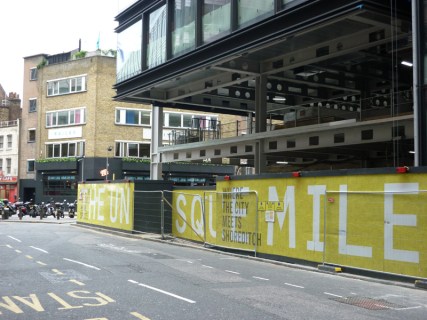
That partially completely development you can see in the background above is Principal Place which some marketing genius has branded as the Unsquare Mile. It’s also subtitled (with rather more legitimacy) as the place where the City meets Shoreditch. (For the purposes of entitling this post you will note that I’ve switched that around).

P1050735

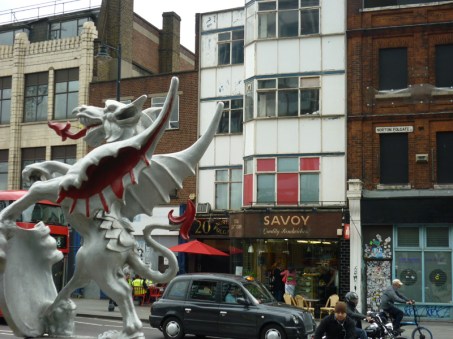
In the background above is the well-known music venue, the Queen of Hoxton (teetering on the right side of the line for now). Moving on; at the eastern end of Worship Street we meet the junction of Shoreditch High Street and the wonderfully-named Norton Folgate (more of that another time).

P1050736

Turning away from the City dragon we go up the A10 and revisit Great Eastern Street this time turning west down Holywell Lane. On the other side of Curtain Road this turns into Scrutton Street and where that forks into Holywell Row we have today’s pub of the day, the Old King’s Head – half of Estrella and a bacon, chicken and avocado sandwich for £5.95.

P1050739

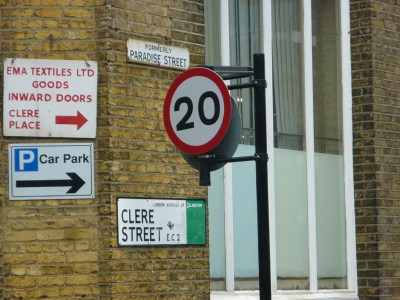
Holywell Row merges into Clifton Street which takes us back to Worship Street. After a brief stint westward we turn north again on Paul Street then east for the remainder of Scrutton Street and then left up New North Place. Emerging back on Luke Street we resume west into Clere Street (which was formerly Paradise Street – and you can see why they changed the name).

P1050742

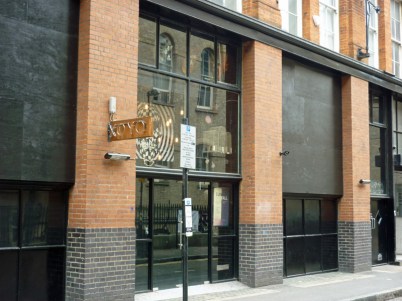
We then find ourselves on Tabernacle Street and veering northward takes us right back up to the Old Street/Great Eastern Street nexus. After turning briefly west on Old Street we take a left down Singer Street and then a right into Cowper Street which is home to one of my favourite music venues, XOYO, though this puts on far more club nights than gigs these days.

P1050740

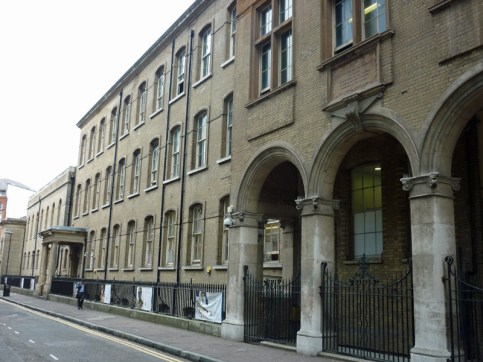
Across the road is the Central Foundation Boys’ School established in the 1860’s by the Reverend William Rogers to provide affordable secondary education (£4 a year) for the sons of skilled workers and tradesmen. It was originally called the Middle Class School (back when becoming Middle Class was still an aspiration).

P1050741

We’re now at the Old Street roundabout and from here we head a short way south before turning east down Leonard Street. At the junction with Tabernacle Street we resume southward as far as Epworth Street which crosses over to Paul Street and then switch back via Bonhill Street. The final yards of Tabernacle Street run down to Worship Street almost at the apex with City Road and turning back up the latter represents the final stage of today’s journey. The western side of this stretch of City Road is dominated by the home of the Honourable Artillery Company. The HAC is the oldest regiment in the British Army and the second most senior unit of the Territorial Army. It traditionally traces its origins to 1537, when Henry VIII granted a charter to the ‘Fraternity or Guild of Artillery of Longbows, Crossbows and Handguns’ which was also to be a perpetual fraternity of St George. The building you can see below, which fronts onto City Road is the Finsbury Barracks designed by the architect Joseph Jennings and completed in 1857. Behind this is the gargantuan Armoury House, most of which dates back to 1735, and in front of that the extensive Artillery Garden (and sports grounds).

A little way further up, on the other side of the road, is our final stop of the day, Wesley’s ChapelJohn Wesley (1703 – 1791), the founder of the Methodist branch of Protestantism, built the chapel in 1778 to be his London base. Its designer was George Dance the Younger, surveyor to the City of London. Although it has undergone some alteration the Grade I -listed chapel is still one of the finest extant examples of Georgian architecture. Margaret Thatcher was married here in 1951 and the communion rail was presented by her as a gift. To the right of the chapel is the house in which John Wesley lived for the last eleven years of his life. Wesley’s tomb is in the garden at the rear of the chapel alongside the graves of six of his preachers, and those of his sister Martha Hall and his doctor and biographer, Dr John Whitehead. The statue of Wesley which stands at the entrance to the courtyard bears the inscription “the world is my parish”. The ground floor of the chapel houses the Museum of Methodism which is well presented but, if I’m being honest, not exactly a riveting experience. It may be sacrilegious to say so but perhaps  the best reason to visit the chapel is to take a look at the toilets; specifically the gents which are the only surviving original Victorian conveniences in London. These were installed at the end of the nineteenth century with cisterns by the one and only Thomas Crapper (1836 – 1910) who provided the colloquial name for the W.C even if he didn’t invent it as such.

This slideshow requires JavaScript.


Day 27 (part 2) – Leicester Square – National Portrait Gallery

So this is the second leg of the jaunt round the epicentre of West End Theatreland; picking up where we left off in Leicester Square then heading round its southern end for a visit to the National Portrait Gallery.

Day 27 Route pt2

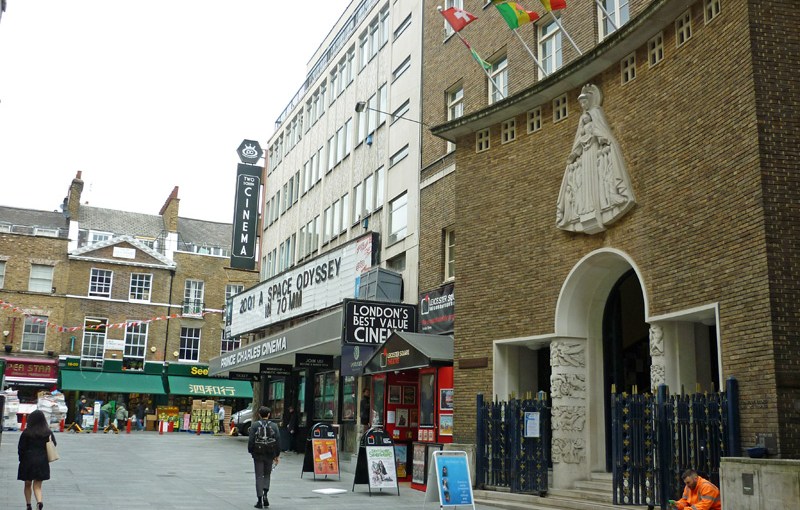
We finished the last post at the Queen’s House and turning the corner there we enter into Leicester Place which definitely punches above its weight in terms of points of interest. First up is the church of Notre Dame de France which serves the French-speaking Catholic communities of London. The parish has been in existence since the 1860’s but the original church building was severely damaged during the WW2 bombings of 1940. Although it reopened a year later after extensive repairs a full reconstruction was ultimately required and in 1953 Maurice Schumann, French Foreign Secretary, laid the foundation stone of the new building, which was brought from the Cathedral of Chartres. The architect was Hector Corfiato of Beaux Arts de Paris.

P1050642

The most famous aspect of the church are the murals created by the artist, filmmaker and all-round renaissance man Jean Cocteau (1889 – 1963) during a week’s visit to London in November 1959. The murals depict scenes from the life of the Virgin Mary and are divided into three panels portraying the Annunciation, the Crucifixion and the Assumption. In front of the murals is an altar decorated with a mosaic of the nativity by the Russian artist Boris Anrep (1863-1969), best known for his giant works in the National Gallery, Westminster Cathedral and the Bank of England. This mosaic was created in 1955 but was then covered over in 1960 by a painted wooden panel of Cocteau’s a decision which unsurprisingly outraged Anrep. When the mosaic was rediscovered in 2003 in was decided to move the Cocteau panel to elsewhere in the church. The tapestry which hangs above the main altar is the work of the Benedictine Monk (and friend of Cocteau’s) Dom Robert (Guy de Chaunac-Lanzac 1907-1997). The theme of the tapestry is Paradise on earth with a reference to the Creation and to Wisdom. The New Eve, title given to Mary by the Church, is walking towards us as pure as a new bride.

This slideshow requires JavaScript.

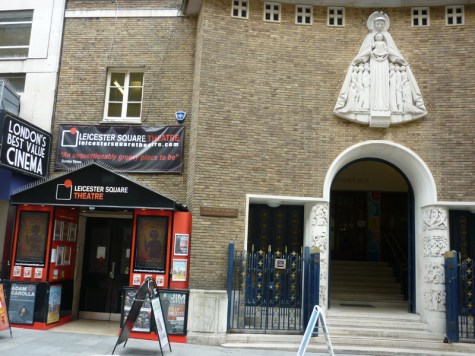
As you can see in the photograph above, part of the building which houses the church is given over to the Leicester Square Theatre. The LST is one of the top comedy venues in the capital, specialising in one-man stand up shows (I’ve seen Stewart Lee here a couple of times) or sketch group performances.

Next building along is the Prince Charles Cinema which these days is the only remaining repertory cinema in central London. Just lately I’ve spent quite a few afternoons there watching just-off new releases for a measly £4 (for members). The cinema started life as a small basement theatre in the early sixties then after a few years had a brief and equally unsuccessful stint as a music hall. Following rebuilding it opened as a cinema in 1969 eventually falling prey to the winds of change in the seventies and resorting to playing porn flicks. Its current incarnation began in 1991 and has enjoyed great success with a repertory mix of cult classics, arthouse second runs and themed programming.

P1050643

Staying with cinemas, next up when we return to Leicester Square and turn left towards the north east corner is the Vue West End. Currently a nine-screen complex this started life as the Warner Theatre, built in 1938 to the design of architects Thomas Somerford and E.A Stone. First presentation on opening was Errol Flynn in “The Adventures of Robin Hood”. The frontage was faced with reconstructed marble with a large relief panel by sculptor Bainbridge Copnall in each corner depicting spirits of sight and sound. When the cinema was redeveloped in the 1990’s this frontage was just about all that was retained of the original building.

P1050640P1050655

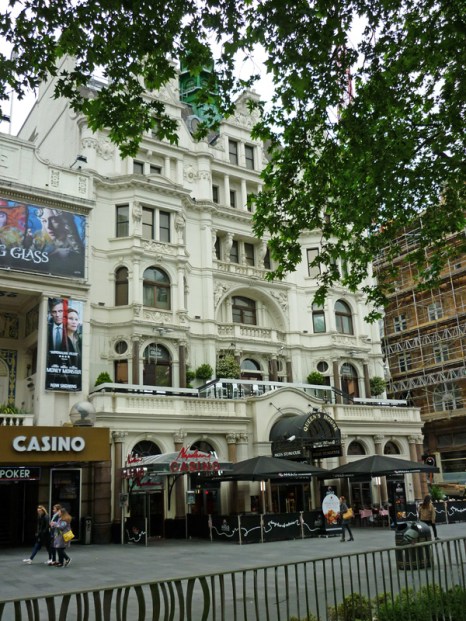
This brings us on to the Hippodrome which looms large over this corner of the square. The London Hippodrome was designed for the theatre impresario Edward Moss by architect Frank Matcham and opened its doors to the public 15 days into the start of the twentieth century. At the outset it specialised in a mixed programme of variety and circus performers including (as the name suggests) a number of equestrian acts. In 1958 the interior was completely remodelled and the venue was reborn as the Talk of the Town nightclub showcasing stars from Frank Sinatra and Judy Garland at one end of the spectrum to Val Doonican and The Seekers at the other. The T.o.t.T lasted until 1982 when after a brief closure and another renovation Peter Stringfellow opened a new nightclub and restaurant, reinstating the original name. He in turn sold out to a company called European Leisure who cashed in during the height of club culture in the late eighties and nineties by making the Hippodrome one of the highest profile (and also naffest) destinations in London. When that boom was over the Hippodrome had a few years in the noughties riding the burlesque wave before, following a £40m investment, it converted to a casino in 2012.

P1050656

Here’s a copy of a contemporary press report covering the impending opening night of the theatre in 1900 – Hippodrome2.

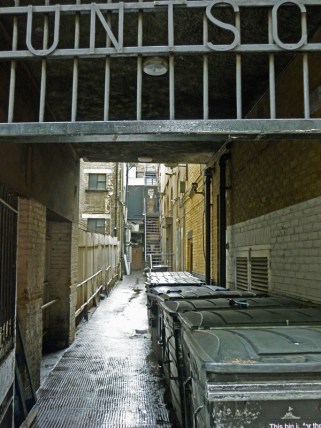
Head out of the square through Bear Street (which is really just a passage) and turn right on Charing Cross Road past Hunts Court which has a claim as one of the least inviting alleyways in London.

P1050658

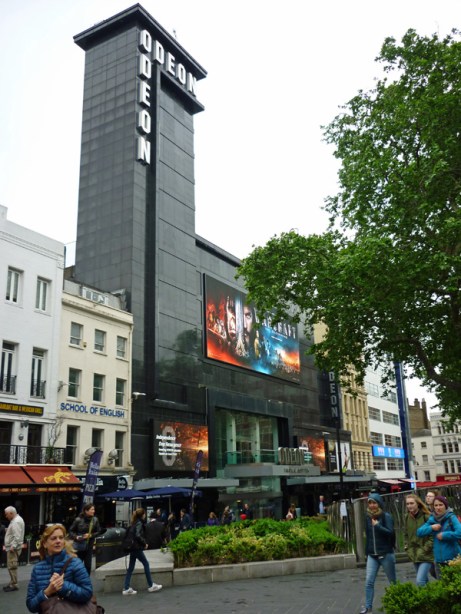
Turn right again up Irving Street, which is lined with tourist-trapping restaurants, and arrive back at the east side of the square which is home to the daddy of all West End cinemas, the Odeon Leicester Square. This iconic black monolith with its polished granite façade and 37m high tower was built in 1937 to the design of Harry Weedon and Andrew Mather. Weedon was the architect that Oscar Deutsch charged with overseeing the building programme for his  new chain of Art Deco Odeon Cinemas in the thirties. (Side note – it is apocryphally believed that the Odeon name is an acronym for Oscar Deutsch Entertains Our Nation but it almost certainly comes from the term Nickelodeon coined in the US in the early years of the century and itself derived from Ancient Greek). The cinema took seven months to build at a cost of £232,755 and had 2,116 seats and the film shown on the opening night was The Prisoner of Zenda. The grand interior was desecrated in a cack-handed 1967 modernisation but at least some of the original styling was restored in the Eighties.

P1050653

Leicester Square was originally laid out in 1670 and named after (the then) nearby Leicester House built in 1631-35 by Robert Sidney 2nd Earl of Leicester. Its renown as a hub of popular entertainment began in the 19th century and was enhanced by the building of the imposing Alhambra Theatre in 1854 (it was demolished in 1936 to make way for the Odeon). In the latter part of the 20th century the square came to be a byword for seediness and urban menace. During the 1979 winter of discontent it effectively became a temporary rubbish dump, earning the nickname Fester Square. Eventually Westminster Council woke up to the fact that having this running sore in the heart of tourist London was something of an embarrassment and in 2010 a major redevelopment was undertaken and completed 2 years later to coincide with the London Olympics. The improvements included 12,000 square metres (130,000 sq ft) of granite paving and a water feature surrounding the Shakespeare statue. The Shakespeare statue itself was erected during a previous renovation of the square in 1874.  It was sculpted by Giovanni Fontana after an 18thC. original by Peter Scheemakers which stands in Poets’ Corner in Westminster Abbey.

In the background of the bottom right photo above you can see the empty space where the Odeon West End cinema used to stand. This site is currently being developed as a new cinema and “guess what” complex.

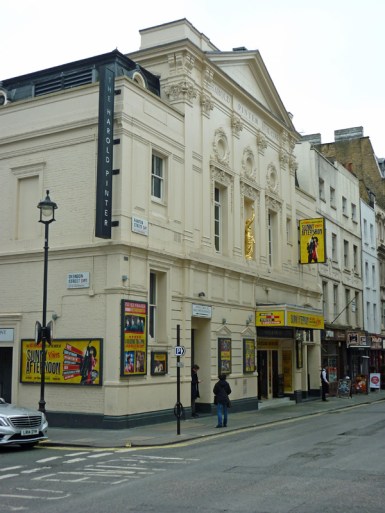
Exit the square’s south west corner via Panton Street where you will find the Harold Pinter Theatre (formerly The Comedy Theatre). This one opened in 1881, again designed by Thomas Verity, and atypically still has most of its auditorium in the original form. The change of name occurred in 2011 three years after the death of the playwright. Current production is the Kinks’ musical “Sunny Afternoon”.

P1050663

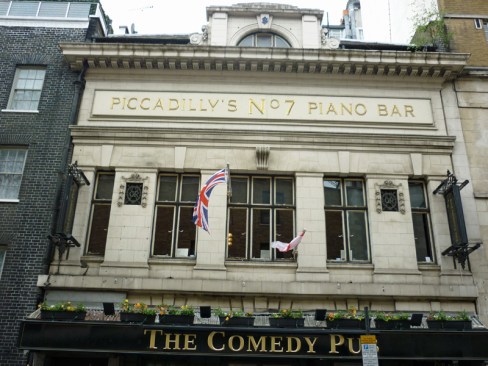
Comedy is still represented in the area in the form of The Comedy Pub and The Comedy Store which both inhabit Oxendon Street; the former was previously the rather classier Piccadilly’s No.7 Piano Bar (as the frontage still reflects).

P1050664

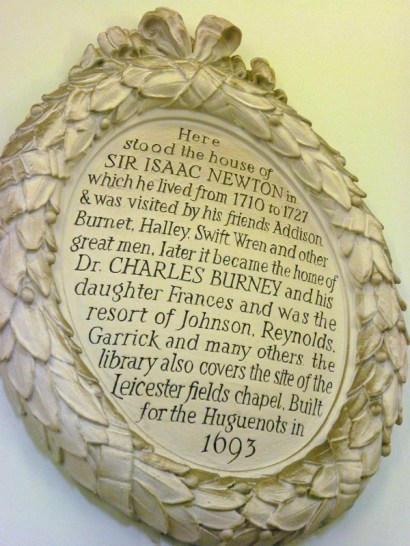
After a quick up and down of Oxendon Street we continue along Panton Street to Haymarket then turn south and head east again along Orange Street. The passageway that is the northern section of St Martins Street is closed off due to the new development so we have to skirt round Longs Court to get to no.35 which is now the Westminster Reference Library. However the building which formerly stood on this site was the home of Sir Isaac Newton from 1711 until his death in 1727. He had a small observatory built at the top of the house and a laboratory in the basement. Later residents of the house were the Burney family including Fanny Burney (later known as Madame D’Arblay) (1752 – 1840) the novelist and diarist. That building was demolished in 1913.

P1050671

The library holds over 15,000 books covering the performing arts and a wide range of film, theatre, dance, radio & TV publications, some (such as The Stage and Era) going back to the 19th century. It also houses The Sherlock Holmes Collection (which contains a far greater wealth of material than the tawdry museum on Baker Street which we ignored in our very first post). The library was also bequeathed the ballerina Anna Pavlova’s collection of books on dance which is kept in a separate section that was opened by Dame Alicia Markova in 1957.

This slideshow requires JavaScript.

Back on Orange Street is the Orange Street Congregational Church founded in 1693 by Huguenot refugees who fled France following the Revocation of the Edict of Nantes. Given the current furore concerning migrants from Syria and North Africa I thought the passage (included in the slideshow above)  which I discovered in one of the books on Isaac Newton’s house that I looked at in the library had a timely poignancy.

Reaching the end of Orange Street we turn right on Charing Cross Road past the statue of the stage actor Henry Irving (1838 – 1905) (who gives his name to the aforementioned street of course) to get to the National Portrait Gallery.

P1050674

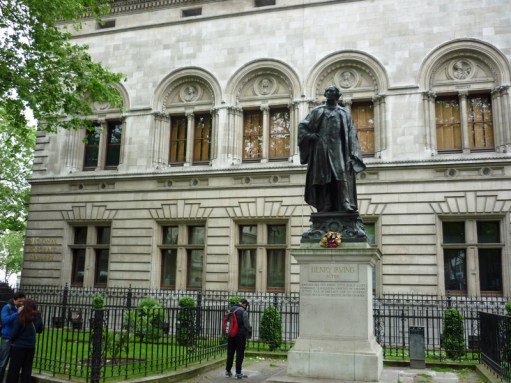
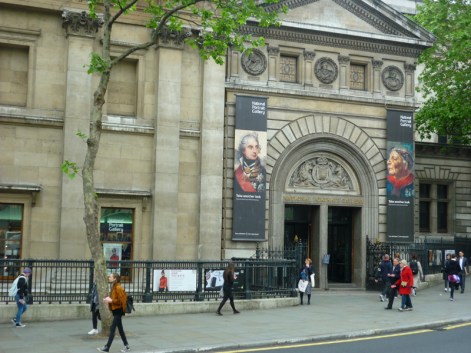
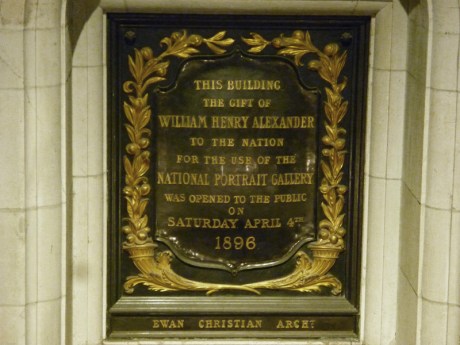
The NPG was the brainchild of three men, Philip Henry Stanhope, Thomas Babington Macauley and Thomas Carlyle, whose efforts are commemorated in three busts above the main entrance to the gallery. Although the idea for a national gallery dedicated to portraits of famous Britons was first mooted in 1846 it was another ten years before it was actually founded. And then it wasn’t until 1896 that it established a permanent residence on the current site, funded by a donation from the philanthropist, William Henry Alexander. Both the architect, Ewan Christian, and the gallery’s first director, George Scharf, died shortly before the building was completed.

P1050694

P1050678

There are over 200,000 works in all in the NPG’s collection though only a fraction of these are on display at any one time. On the second and first floors the portraits of the great and famous are displayed more or less chronologically from the Tudor period up to the 20th century. The ground floor is devoted to special exhibitions and contemporary works.

The following slideshow presents the individual portraits of all the British monarchs from Henry VIII through to William IV (excluding a couple of Georges) but starts with a compendium set of portraits depicting all the rulers from William the Conqueror to Mary Tudor which was probably created between 1590 and 1620 (after the last of them had died).

This slideshow requires JavaScript.

And since we were just looking round where his old gaff used to be here’s Sir Isaac Newton (bottom) with his contemporary, the philosopher John Locke.

P1050688

Finally, for this time, here are the so-called Medieval Stairs with their busts on the main protagonists in the Wars of the Roses, for the Houses of York and Lancaster respectively.


Day 27 (part 1) – Leicester Square – Chinatown – Shaftesbury Avenue

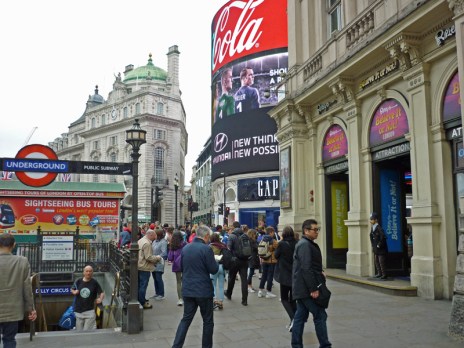
Back again and into the heart of tourist London; running the gauntlet of the yellow properties on the Monopoly board – Leicester Square, Coventry Street and Piccadilly – along with the streets that make up the capital’s Chinatown.

Day 27 Route pt1_a

P1050607

Starting point for today is Piccadilly Circus and as we head east along Coventry Street the first thing we pass is the massive London Trocadero complex, a site with a long and chequered history. In the 1820’s and 30’s there were various attempts to establish a theatre here but by the mid century it was being mainly used as an exhibition space. It was then leased to a wine merchant by the name of Robert Bignell, who reconstructed the existing buildings into Assembly Rooms called the Argyll Subscription Rooms. Thirty years later the place had degenerated into a haunt of prostitutes and their clients and in 1878 was raided and then closed down by the police. Despite losing his license, Bignell was not one to let go lightly and four years later he managed to re-open the building as the Trocadero Palace music hall. Bignell died in 1888, the music hall failed to flourish in his wake and seven years later his daughter sold the building on a 99-year lease to J. Lyons & Co. who converted it into the Trocadero Restaurant. This was decorated in an opulent baroque style with murals on Arthurian themes alongside the grand staircase and a Long Bar which catered to gentlemen only. During World War I, the Trocadero initiated the first “concert tea” served in the Empire Hall and accompanied by a full concert programme. The restaurant lasted right up until 1965 and after its demise the building played host variously to a dance hall, bowling alley and casino. Then in 1984, the Trocadero was redeveloped as a tourist-oriented entertainment, cinema and shopping complex; the largest in the UK at the time. Sadly for the owners, visitor numbers for attractions such as the Guinness World Records Exhibition and later the Segaworld arcade failed to match the scale of the ambition. By the mid-noughties the place was in a sorry state and, as you can see in the pictures below, most of it is now boarded up. In 2015 however the opening of a new Picturehouse cinema on the Shaftesbury Avenue side of the building at least provided signs of rejuvenation.

P1050608

P1050609

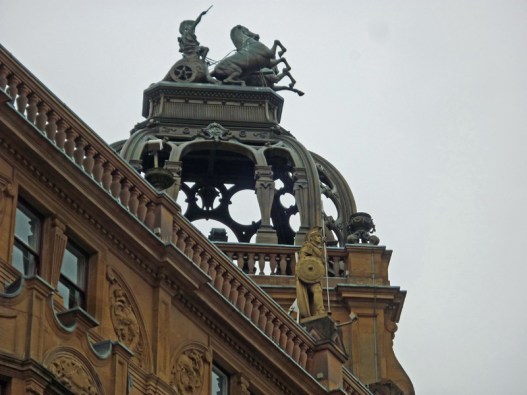
Turn north up Rupert Street passing this elaborate roof-top embellishment about which I can find no information on whatsoever.


P1050610

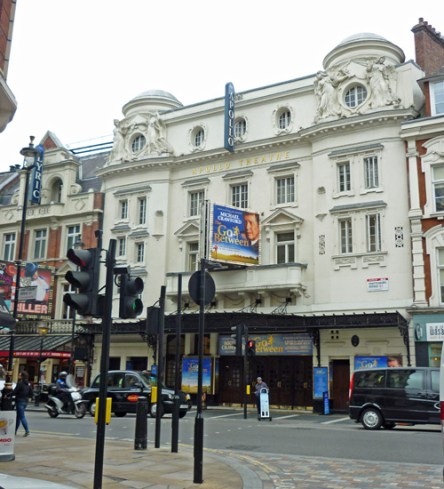
Emerge on to Shaftesbury Avenue opposite the run of three theatres that we covered briefly in one of the Soho posts. First of these, moving west to east, is the Lyric which opened in 1888 but retained the façade of the house built in 1766 by  Dr William Hunter, an anatomist, partly as a home and partly as an anatomical theatre and museum. Amazingly, “Thriller Live”, the current production has been running since 2009 which means it could soon become the most successful show this theatre has ever hosted (takes all sorts I guess).

Bang next door is the Apollo which opened three years later with an exterior designed in the Renaissance style. The four figures on the top of the facade were created by Frederick Thomas, of Gloucester and Cheltenham, for the Theatre’s opening and represent Poetry, Music, Comedy and Dance.

P1050611

In 2013 part of the auditorium ceiling collapsed during a performance of ‘The Curious Incident of the Dog in the Night-time’ and nearly 80 people were injured. The Theatre was subsequently closed for investigation and repairs for over 3 months and by the time it reopened the National Theatre-spawned smash had moved to the Gielgud just a block down.

P1050613

The Gielgud started life as the Hicks Theatre in 1906 but within three years had been renamed the Globe. It was renamed again in 1994 after the eponymous theatrical knight; partly in celebration of the renowned thespian (who still had six years to live at the time) but also to avoid any confusion with the newly opened Shakespearean Globe Theatre on the south bank. (For this information and most of the rest on the history of London theatres I am greatly indebted to www.arthurlloyd.co.uk).

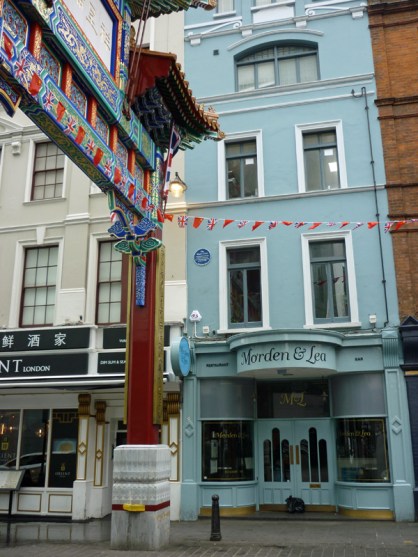
Next we cut through Rupert Court to the lower end Wardour Street which marks the western boundary of Chinatown,

P1050616

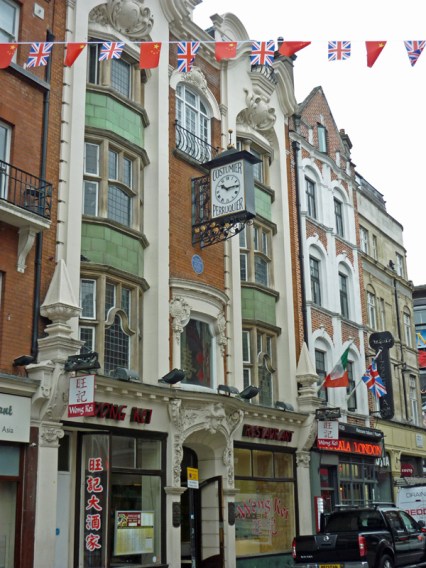
No 41-43 is the home of the Wong Kei restaurant, renowned back in the day for the “alleged” rudeness of its waiting staff. This was said to only increase the popularity of the restaurant which is generally full but that probably has more to do with the reasonableness of their prices. You can’t expect both value for money and over-politeness.

The building is another designed in the baroque style (with added touches of Art Nouveau) and as the blue plaque attests was once owned by Willy Clarkson (1861 – 1934), theatrical costumier and perruquier (that’s wigmaker to you).

P1050614

Dansey Place is basically just a back alley that runs behind the restaurants on the north side of Gerrard Street and emerges into Macclesfield Street. Despite all the visits I’ve made to this area I’d never even noticed it before but it has a distinct dingy, unchanged for decades charm to it.

P1050618

Next we’re on to Gerrard Street itself which at mid-morning with a parade of white vans lined up making deliveries manages, if anything, to look slightly tackier than normal. Though I have to confess to a bit of a soft spot for its gaudy accoutrements.

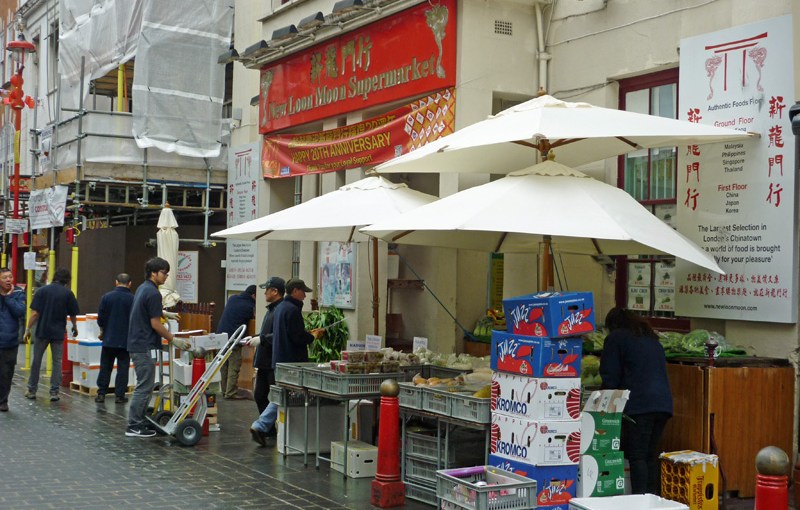
The part of London originally known as Chinatown was down in Limehouse in the East End and consisted of businesses that catered to Chinese sailors visiting the docks. It wasn’t until the Seventies following an influx of immigrants from Hong Kong and a growing taste for oriental cuisine that Gerrard Street and the surrounding area began to assume the name.

This slideshow requires JavaScript.

Those two carved Chinese lions in the one of the slides above were donated by the People’s Republic of China and were unveiled by the Duke of Gloucester in 1985 at a formal naming ceremony (which coincided with the quatercentenary of the City of Westminster). Appropriately, given the Chinese fondness for gambling, they are now backdroppped by a  Betfred bookmakers.

There are a couple of atypical commemorative plaques on Gerrard Street. At no.37 is one to John Dryden (1631 – 1700), England’s first Poet Laureate. The phrase “blaze of glory” is believed to have originated in Dryden’s 1686 poem The Hind and the Panther (which celebrated his conversion to Catholicism), in that it refers to the throne of God as a “blaze of glory that forbids the sight.”

(The portrait of Dryden above was taken in the National Portrait Gallery which will feature in the next post.)

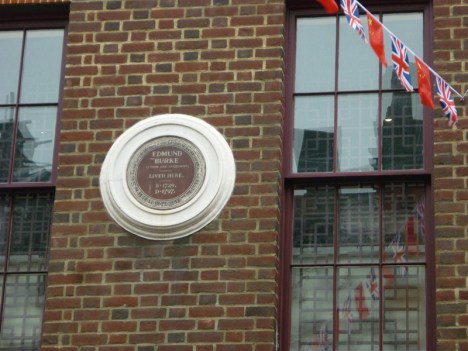
The second plaque is at no.37 in honour of the Anglo-Irish statesman Edmund Burke (1729 – 1979). Burke, who was both a philosopher and politician, was supportive of American independence and Catholic emancipation but vehemently antipathetic to the French Revolution. Although a member of the Whigs he is widely touted as the “father of modern conservatism”.

P1050622

As noted in an earlier post, the original Ronnie Scott’s Jazz Club was at no. 39.

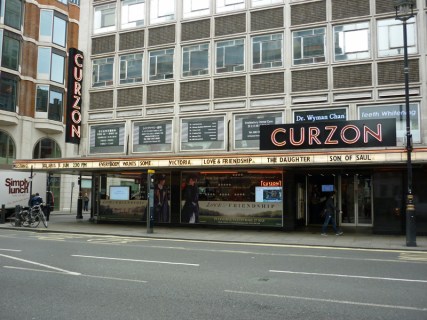
If you nip up Gerrard Place, at the western end of the street, you hit Shaftesbury Avenue opposite the Curzon Cinema which, to my mind, is one of the best in London. Its existence is under threat from the proposed Crossrail 2 (Gawd help us) and though the building it occupies the basement of is nothing to write home about, the cinema would be sorely missed. (So go on – sign the petition).

P1050626

Next we go south down Newport Place and veer left down the alleyway that is Newport Court. This brings us out onto Charing Cross Road where we turn right almost immediately back up Little Newport Street. The building on the corner that is now a branch of Pizza Express is Grade II listed and was once an outlet of the costumiers, Morris Angel & Son.

P1050627

Pass round the back of the Hippodrome (more of that next time) and continue along Lisle Street which probably has a better selection of Chinese restaurants than its parallel neighbour.

At the end we’re back out on Wardour Street opposite what used to be the Chuen Cheng Ku restaurant which served the best Dim Sum in Chinatown in bamboo baskets wheeled round on trolleys. Not sure what it is now and the splendid Dragon Pole is gone, in its place a plaque commemorating the building as the site where the Magic Circle was founded in 1905. Bizarrely a website for the restaurant still lives on as a ghostly reminder so you can see what’s been lost here.

P1050631

A couple of doors down no. 9 was once the residence of Benjamin Smart, a goldsmith and dealer in bullion, who wasn’t shy of advertising the fact as you can see.

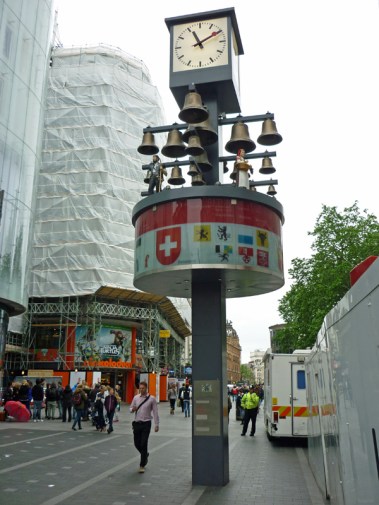
A left turn at the southern end of Wardour Street and Swiss Court takes you into Leicester Square and face-to-face with the Swiss Glockenspiel, a 10m high structure, with 27 bells, an automated musical clock with a procession of herdsmen and their animals ascending an alpine meadow. This rather charmless confection was only erected here in 2011 in an attempt to replace the far more impressive glockenspiel and clock which in 1985 was installed on the front of the Swiss Centre that occupied the north-west corner of the square, from 1966 until its demolition in 2008.

P1050634

I don’t think I ever really understood the purpose of the Swiss Centre but its demise seems to be lamented by quite a few online commentators. In any event it was preferable to the building which has replaced it and incorporates yet another luxury hotel and M&M’s World which stretches to a mind-boggling four floors. About as necessary as another Teenage Mutant Ninja Turtles movie.(For people of a certain age – M&Ms are like an American version of Smarties).

P1050635

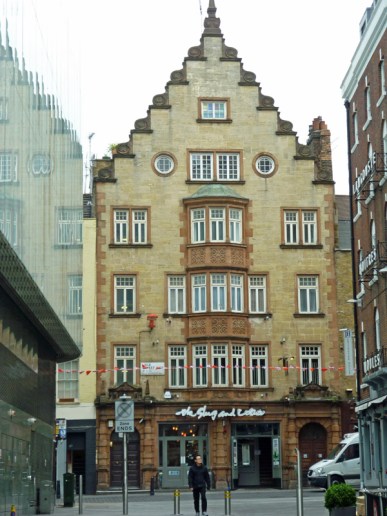
Leicester Street runs north from the square to Lisle Street emerging opposite no.5 which was designed by Frank T. Verity in 1897 in the early Renaissance style of northern Europe. The building was first occupied in 1900 by the French Club and subsequently by Pathé of France and Pathéscope Limited, film-makers. From 1935 to 1989 it was the home of St. John’s Hospital for Diseases of the Skin. After that it became the aptly-named Crooked Surgeon pub until in 2007 it was (sigh) taken over by the owners of the ubiquitous Slug and Lettuce Chain.

P1050636

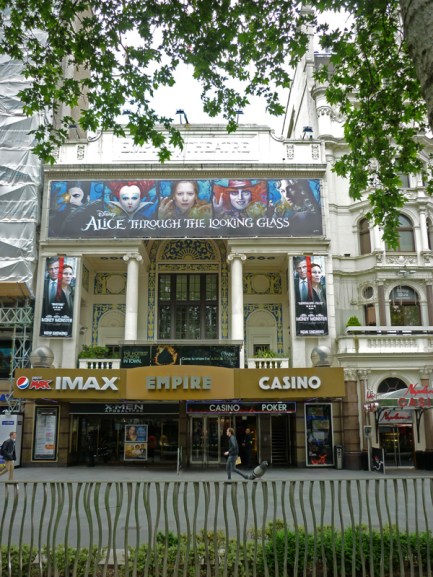
In the next block down on the square itself is the Empire Cinema and Casino. The current building is the third incarnation of the Empire Theatre to occupy this site. The first version opened in 1884 as a high-end variety theatre but within three years had repositioned itself as a popular music hall. That building was demolished in 1927 and the second Empire Theatre which opened a year later operated primarily as a cinema. After WW2 the theatre became known for its Cine-Variety programmes – a combination of film showings and live performances – and example of which you can see here. In 1959, the Empire installed 70mm projectors and a new screen in front of the proscenium to show Ben-Hur, which ran for 76 weeks. Following this, in 1961, the Empire was closed for extensive internal reconstruction to a design by Architect George Coles. It reopened in 1962 with a new 1,330 seat auditorium in place of the circle and a Mecca Ballroom where the stalls used to be. The latter is now the Casino. The cinema today comprises 9 screens, one of which is an IMAX.

P1050638

Next door to the Empire is Queen’s House which was built in 1897 and opened as the Queen’s Hotel in 1899. In 1920 the socialist MP Victor Grayson vanished mysteriously after telling friends that he had to pay a quick visit to hotel. It was rumoured that the MP, who had made a number of enemies in high places, was killed to stop him revealing details of government corruption.

In 1936 the building was remodelled to accommodate office space on the upper floors but today it is once again a hotel (wait for it) as part of the Premier Inn stable. It also plays host to yet another casino (Napoleon’s).

P1050639

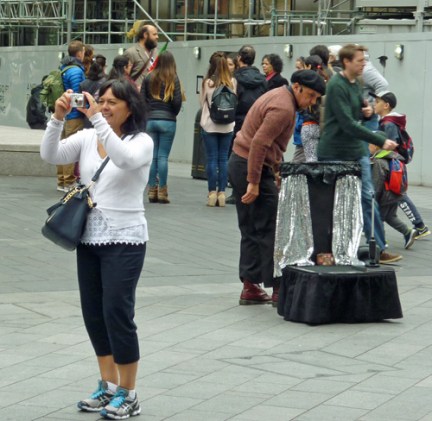
On that note it’s time to bring things to a conclusion but we’ll be back with more of Leicester Square in the next post. Until then here’s a reminder of what it’s really all about – foreign tourists and half-baked street performers.

P1050637


Day 26 – St Giles – Shaftesbury Avenue – Drury Lane – Denmark Street

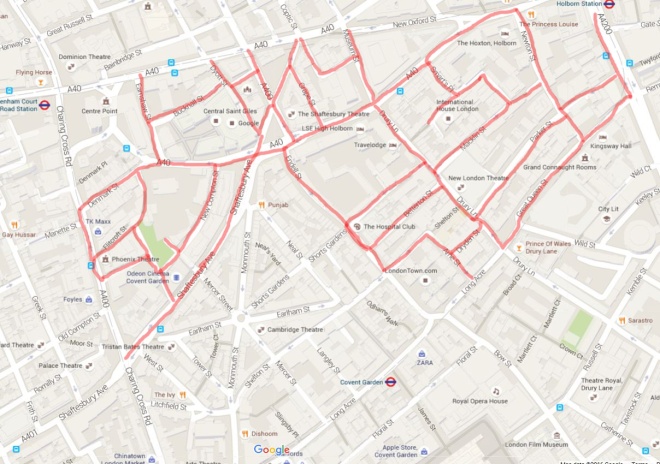
Another brief one in terms of distance but a lot of stuff to pack in nonetheless. Area covered is split into two main sections; firstly the territory to the north of Covent Garden in between Long Acre and High Holborn and then the streets squeezed into the angle formed by the eastern side of Charing Cross Road and Shaftesbury Avenue. Along the way there is a visit to the Freemasons’ Hall , “Tin Pan Alley” and the church of St-Giles-In-The-Fields, which gives its name to this district.

Day 26 Route

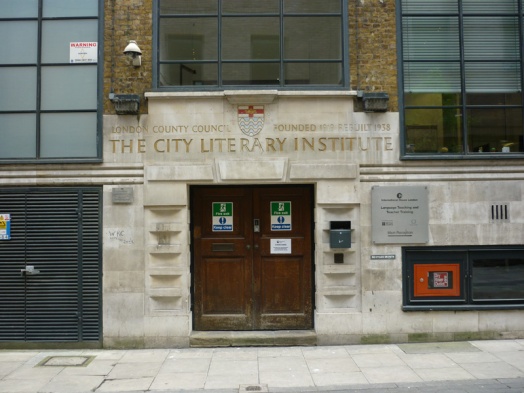
We start on Kingsway and head briefly west along Great Queen Street before turning north up Newton Street. This ends at High Holborn where we turn west again before veering left into Smart’s Place which leads into Stukeley Street. Formerly known as Goldsmith’s Street this was the site of the original permanent residence of the City Lit. , one of five literary institutes set up after WW1 to cater to the need for adult learning provision. City Lit moved in here in the late twenties but had outgrown the original building within a few years so that was demolished and a new purpose built facility constructed. Opened in 1939 by Poet Laureate John Masefield, the new building contained a theatre, concert hall and gym and remained the home of City Lit. until 2005 when they moved to new premises in the Covent Garden area.

P1050539

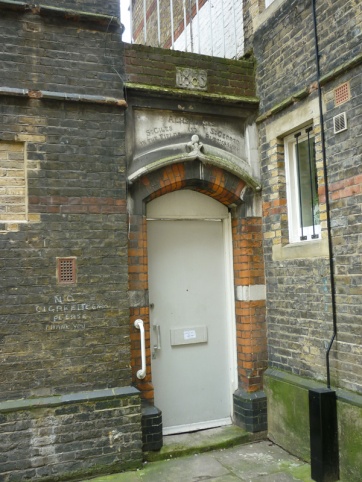
Just round the corner on Smart’s Place is what remains of the almshouses built here by the parishes of St Giles and St George Bloomsbury in 1895.

P1050540

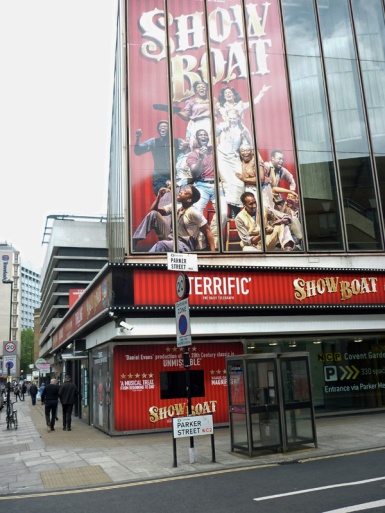
Westward again on Macklin Street brings us out onto the northern stretch of Drury Lane. We’re on the fringes of “Theatreland” here and first of the three (current) theatres we pass on our travels today is the New London Theatre. One of the most modern of London’s West End theatres this was built in 1973 on the site of the old Winter Garden Theatre. Probably best known for hosting the original run of Cats from 1981 to 2002 it’s currently playing the critically-lauded revival of Showboat.

P1050542

So we turn east down Parker Street and make our way back to Great Queen Street. Heading west again we pass the Grade II listed Grand Connaught Rooms at nos. 61-63. Currently a conference, weddings and events venue owned by a hotel group this retains the façade of the Freemason’s Tavern, Britain’s first Grand Lodge, which originally stood here (until 1905).

P1050543

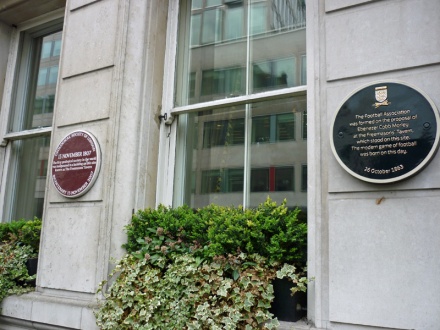
On that façade are two plaques commemorating events which took place at the Freemasons’ Tavern – the creation of the Football Association in 1863 and the first geological society in 1807. It was also where the Anti-Slavery Society was founded apparently. Surely you’d want to make more noise about that than the geological thing (or the FA for that matter).

P1050544

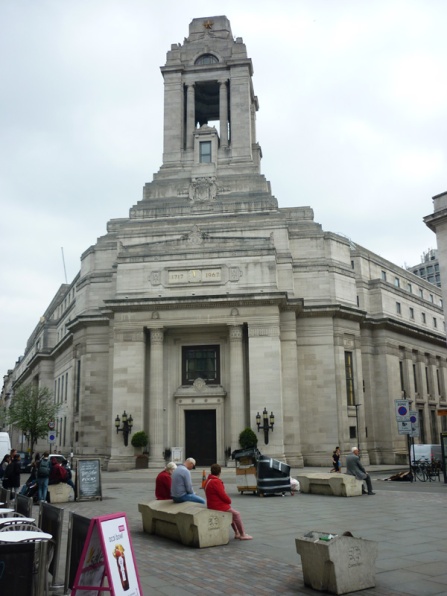
Which brings us to the Freemasons’ Hall and to be honest I hadn’t expected any part of this to be accessible but there is a Museum of Freemasonry on the first floor that you can visit free of charge as well as an extensive library both of which are full of some quite remarkable artefacts. The current art-deco behemoth is the third incarnation of the Freemasons’ Hall on the site since 1775 and was built during 1927-32 in honour of the Freemasons who died in the Great War. Its Grand Temple seats up to 1,700 – that’s a lot of aprons.

P1050567

Now I think it’s fair to say that the Freemasons have enjoyed a somewhat ambivalent reputation throughout their history. I myself have shared some of the prejudices inspired by the whole regalia, funny handshake and initiation ceremony schtick – not to mention the secret brotherhood aspect that (allegedly) wields influence in the upper echelons of the police, the judiciary and certain political institutions. In the interests of balance therefore it needs to be noted that the Masons is a secular (and supposedly non-political) organisation with all members free to practice their own religion; it emphasises personal moral responsibility and does a lot of work for charity. The United Grand Lodge of England (UGLE) is of course exclusively male. There is an Order of Women Freemasons which has been around since the turn of the 20th century but UGLE doesn’t officially recognize it (though they did acknowledge its existence in 1999 which was nice of them). However you wouldn’t necessarily gather that from the materials on display in the museum which include a number of items relating to women freemasons. I haven’t room to go into the history of Freemasonry but you can read up on it here.

This slideshow requires JavaScript.

Just a couple of things to note from the slide show above: that chair (Grand Master’s Throne) is one of three commissioned in 1791 to mark the election of the Prince of Wales (later George IV) as Grand Master of the Moderns Lodge, the silver elephant is a cigar lighter made from smelted rupees and one of three gifted by an Indian Maharajah to the Lodge of Humility with Fortitude, the pentagon symbol I can find no information on but I suspect is a stand-in for the sacred pentagram (five pointed star inside a pentagon inside a circle) with its Da Vinci Code associations. You probably also saw today’s reflection of the day (“selfie” has now been retired).

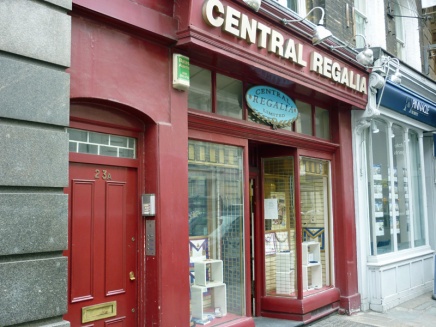
Should you ever seek to become a mason yourself then all the gear can be found in the Central Regalia emporium, conveniently situated just across the road. Special offer on masonic candles at the moment.

P1050545

Also opposite is the HQ of the Royal Masonic Trust for Boys and Girls one of the four charitable institutions established by the Freemasons in the 18th century.

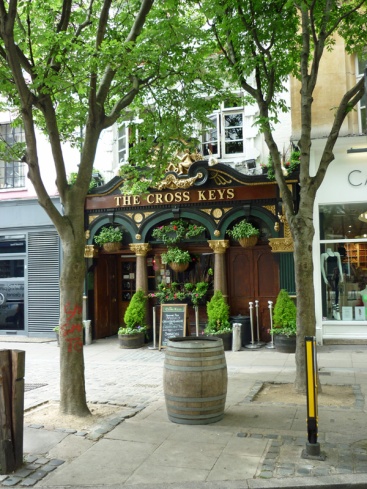
We’re back up Drury Lane again next then turning left down Shorts Gardens as far as Endell Street. The Cross Keys pub with its splendidly ornate exterior has occupied no. 31 Endell Street since 1848 and by all accounts is well worth a visit.

P1050568

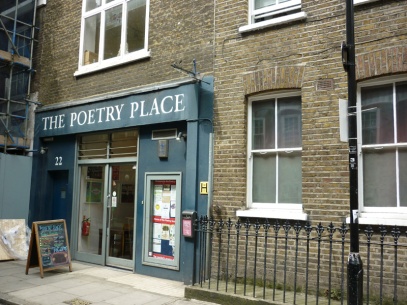
Another place worth trying is the Poetry Place (aka the Poetry Café) on Betterton Street which runs back to Drury Lane.

P1050569

A circuit of Dryden Street, Arne Street and Shelton Street finds us back on Endell Street at the northern end of which resides the Swiss Church (or Eglise Suisse if you prefer). Just about every major European nationality seems to have established its own ecclesiastical home here in London. This one dates from 1762 and has occupied this site since 1855 though has undergone major rebuilding after WWII and between 2008 and 2011 when the architects, appropriately enough, were the practice of Christ and Gantenbein. True to national form the all-white interior is the epitome of calm reflection (though I believe they will be showing Switzerlands Euro 2016 fixtures live in here.)

Next door, on the corner with High Holborn, is the former St Giles National School built in 1859 to the design of Edward Middleton Barry.

P1050571

Across the other side of High Holborn is our second theatre of the day, the Shaftesbury, which opened in 1911 as the New Prince’s Theatre. Longest run here seems to have been the musical Hair which started in 1968 and was curtailed in 1973 (two short of its 2,000th performance) when part of the ceiling fell in. Despite the threat of redevelopment in the immediate aftermath of this the theatre survived and was granted listed status a year later. It is currently host to yet another jukebox musical in the form of Motown though perhaps one with a classier songbook to draw on than most.

P1050573

Head past the theatre eastward along High Holborn before turning left up Museum Street and taking a dog-leg round West Central Street which is a cherishably rare corner of scruffiness in the heart of town.

P1050574

Having emerged onto New Oxford Street we cut back down the first few yards of Shaftesbury Avenue before skirting round the back of the theatre along Grape Street, apparently so-named because it once ran alongside the vineyard belonging to St Giles Hospital.

Leave the theatre behind and make our way west via Bloomsbury Street, Dyott Street, Bucknall Street and Earnshaw Street bypassing the Crossrail mayhem and the redevelopment of Centrepoint.

P1050580

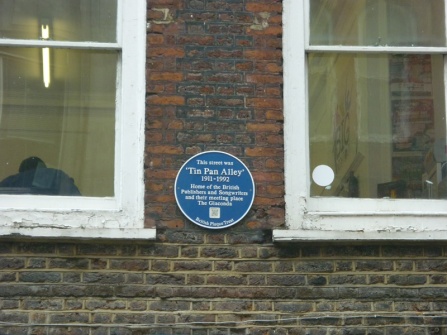
This brings us to Denmark Street which, as noted in the intro, was colloquially known as the UK’s “Tin Pan Alley” for much of the twentieth century. The first music publisher set up home here in 1911. That was Lawrence Wright who founded the Melody Maker in 1926. In 1952 the New Musical Express was also started from an office here and during that same decade music publishers and songwriters took over most of the street.

P1050585

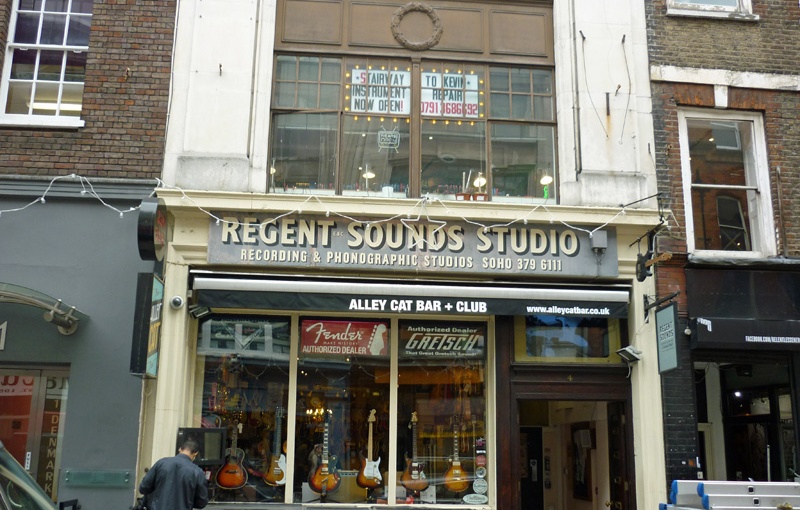
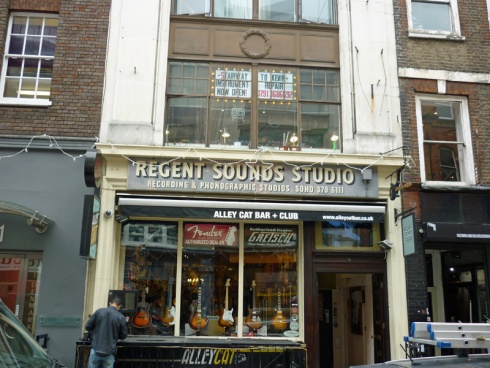
In the sixties groups who began to pen their own material and the predominance of recorded music helped to bring about a decline in both music publishing and songwriting for hire. Taking their place, a number of recording studios opened including Regent Sound Studio at no.4. This was where the Rolling Stones recorded their first album in 1964, under the guiding hand of manager Andrew Loog Oldham.

P1050584

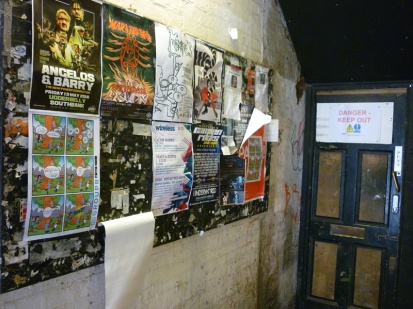
In the mid 1970’s the Sex Pistols lived above in the upper floor of no.6 and rehearsed in its basement. Graffiti by Johnny Rotten depicting other members of the band was recently uncovered and has inspired the Department of Culture to grant Grade 2 listed status to the building. Just a little bit of that spirit still lives on.

P1050583

In 1992 the last of the publishers moved out and the focus shifted to musical instrument vendors (principally guitars). In the wake of Crossrail plans were drawn up for a redevelopment of the street which though committed to preserving the fabric of the street brought protests from those concerned that it would wreck the character of the place and force out many of the existing businesses. This struggle is still ongoing but for now at least the guitar shops seem to be hanging on tenaciously.

Double back down Denmark Street and you arrive at St-Giles-In-The-Field church. This was originally the site of a church leper hospital founded in 1101 by Queen Mathilda, wife of King Henry 1. The present church was designed and built in the Palladian style (after the 16th century Italian architect Andrea Palladio) in 1730-34 by Henry Flitcroft, who went on to design Woburn Abbey. Back in the day St Giles was the last church en route to the gallows at Tyburn and the churchwardens paid for the condemned to be given a draft of ale from the Angel pub next door before their execution. Whether or not Oliver Plunkett, Archbishop of Armagh was granted this benefice before being hung, drawn and quartered in 1681 and then buried in the churchyard is unknown.

Among the many memorials inside the church are those to Richard Penderell who accompanied Charles II on his flight from Cromwell and the watchmaker Thomas Earnshaw (1749 – 1829). There is also the tomb of Lady Frances Kniveton who was the daughter of Sir Robert Dudley (1574 – 1649) the illegitimate son of the man of the same name who was the first Earl of Leicester and favourite of Elizabeth I.

This slideshow requires JavaScript.

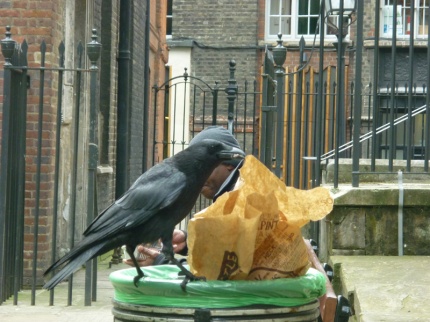
After this it’s time for lunch, an Indonesian pulled chicken satay salad from one of the food stalls in the churchyard. While I eat this on a bench in the grounds the nearby bin is visited by a crow who has worked out that a meal is to be had by pulling out the discarded food trays and bags and spilling their remaining contents on the ground. Clever things crows. Your average pigeon hasn’t got a handle on that yet.

P1050596

Head away from the church down Flitcroft Street which takes us to the Pheonix Garden – a community garden and registered charity, managed by volunteers drawn from the local community and workers in the area. It’s currently closed for building works but is due to re-open this summer (2016).

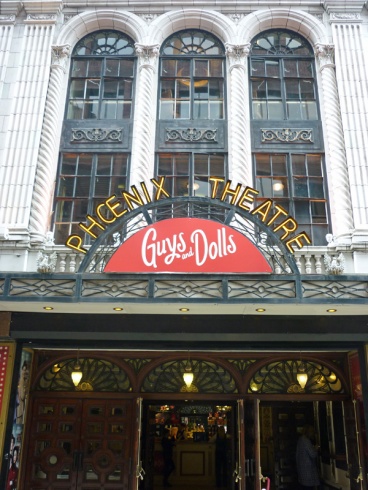
Stacey Street runs alongside the garden passing Pheonix Street with its eponymous theatre. I don’t think I’d ever been down here before and so had only seen the theatre from the Charing Cross Road side which presents the main entrance and a incongruously functional office block sandwiched between it and the similarly neo-classical but superior Pheonix Street façade. The Pheonix Theatre was built on the site where the Alcazar music hall previously stood and opened in 1930 with a production of Noel Coward’s Private Lives.  The exterior was designed by Sir Giles Gilbert Scott, Bertie Crewe and Cecil Masey, whilst the interior, often considered to be one of London’s finest, was designed by director Theodore Komisarjevsky in an Italianate style with golden wall engravings and plush, red carpets. Currently showing, as you can see, is the classic Guys and Dolls.

P1050600

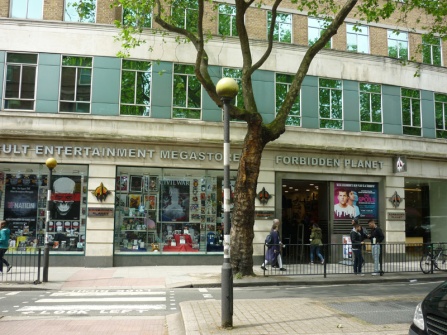
Returning to Stacey Street we head a short way further south to New Compton Street which is as non-descript as Old Compton Street is exuberant. At the end of this we turn right then right again down Shaftesbury Avenue. On the west side we pass by the institution that is Forbidden Planet, which started out as a comic shop in Denmark Street in 1978 but now styles itself as a “cult entertainment megastore” (yes that’s a “c” missing from the left-hand side of the picture not an “ad”).

P1050602

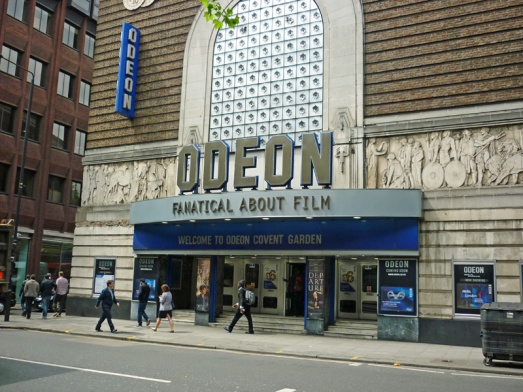
And a bit further down is what I will always think of as the ABC Shaftesbury Avenue but was rebranded in 2001 as the Odeon Covent Garden . The building, which opened in 1931, actually started life as the Saville Theatre (perhaps just as well that didn’t last).  The sculptured frieze which extends for nearly 40 metres along the façade of the building is by Gilbert Bayes and represents ‘Drama Through The Ages.’ In the sixties the theatre was often leased by the Beatles’ manager, Brian Epstein, who promoted gigs there by the likes of The Who, The Bee Gees and the Jimi Hendrix Experience as well as the Fab Four themselves. In 1969 the theatre was bought by ABC Cinemas (then owned by EMI) and converted into the 2-screen ABC1 and ABC2. The takeover of ABC by Odeon Cinemas in 2001 resulted in a further conversion into four screens and the change to its current name (ignoring the fact that it can’t by any stretch of the imagination be considered to fall within the borders of Covent Garden).

P1050603

And with that it’s Roll Credits for today.


Day 25 -Shoreditch High Street – Arnold Circus

More than a touch of serendipity about this excursion as a couple of days after the last walk, on Bank Holiday Monday to be precise, I went along to the Secret 7″ sale at Sonos Studios in Shoreditch and therefore found myself only a couple of hundred yards away from the previous finishing point. Before we get into that though here’s another of the periodic updates on overall progress so far.

Covered so far May 2016 copy

Back to today’s trip which takes in the western side of the area wedged between Columbia Road and Bethnal Green Road and the streets enclosed within the quadrilateral of Old Street, Shoreditch High Street, Curtain Street and Great Eastern Street.

Day 25 Route

First up, from Bethnal Green Road we head north up Club Row which is where the Sonos Studios live. Secret 7″ has been running for a few years now but this is the first time at this location. Principle is similar to the RCA’s Secret Postcard fundraiser but this involves record covers designed for one of seven specially chosen tracks and is in aid of Amnesty International. You can get the full lowdown here. Didn’t get there until an hour after the start by which time I would say around 65% of the covers had already been snapped up. Happy enough though with my two acquisitions, which you can see in the selection below. Actual singles were the offerings by The Jam and Tame Impala.

This slideshow requires JavaScript.

Having bagged my two 45’s continue north up Club Row to Arnold Circus, of which more later. Circle anti-clockwise and exit along Pallissy Street. This leads into Swanfield Street where at no.74 stands an isolated remnant of the past in the last remaining weaver’s house in the area (the East End being a hub of the weaving industry in the 18th and early 19th centuries). These days it’s a foam shop.

IMG_20160502_123808

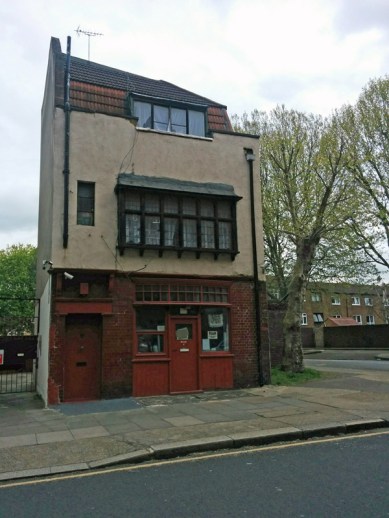
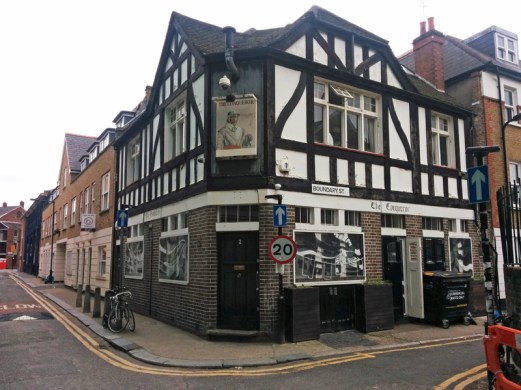
At top of Swanfield Street turn right along Virginia Road which emerges onto Columbia Road and then almost immediately double-back down Gascoigne Place. Going westward Virginia Road forks off into Austin Street and at the junction of Boundary Street, which rejoins the two, there is, seemingly, another member of the Dead Pubs’ Society. Some commentators have suggested that the Conqueror is named after William I of that soubriquet but judging from the sign I would be more inclined towards Oliver Cromwell.

IMG_20160502_124438

Continuing along Austin Street brings us out onto the bottom end of Hackney Road again and a left turn takes us round the corner to the entrance to St Leonards Church. This will of course be familiar to all fans of one of the best sitcoms of recent years, Rev (starring Tom Hollander and Olivia Colman). St Leonard is the patron saint of prisoners and the mentally ill and there is evidence of a church on this site since Anglo-Saxon times though that was demolished by the Normans who built their own replacement. It was the Norman church which became known as the actors’ church. Many of the Elizabethan theatrical fraternity are buried in the remains under the current crypt. This includes three Burbages, James who built the first English theatre (again more of that later), his son Cuthbert who built the Globe theatre and his other son Richard who was the first to play Macbeth, Hamlet, Richard 3rd, Othello and especially Romeo. These associations are commemorated in a stone memorial on a wall inside the present-day church which dates from around 1740. The splendid organ was built by Richard Bridge in 1756 and is one of the few surviving examples of a tracker organ without pedals.

This slideshow requires JavaScript.

The somewhat macabre monument in white marble with two grinning skeletons tearing into the “tree of life” is in memoriam of one Elizabeth Benson, died 1710, and is the work of Wren’s favourite sculptor, Francis Bird. The final part of the Latin inscription roughly translates as “hale and hearty and regardless of old age she accidentally tripped and fell, alas, at the age of 90 ; and the stem of life was not gently withdrawn but torn asunder.”

There is a very timely exhibition on inside the church at the moment which runs until June 2016. Entitled Development Hell this shines a light on the on-going planning battles concerning a number of areas adjacent to the City of London and Boris Johnson’s role in greenlighting a number of controversial schemes.

Across the road on Shoreditch High Street are a number of fine Victorian buildings including Wells & Company Commercial Ironworks built in 1877 but only retaining its industrial function until 1895.

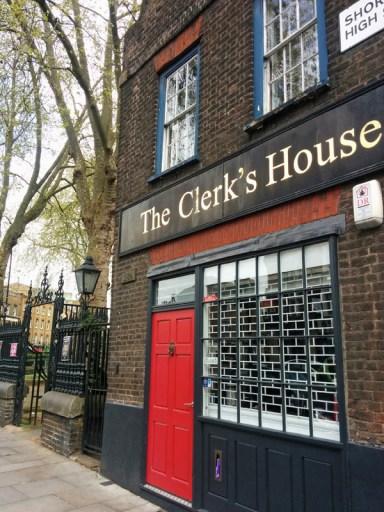
Back on the east side adjacent to the church (at no 118 and 1/2) is the Clerk’s House. This dates from 1735 and so is a couple of years older than the church itself. Current occupancy is by a fashion boutique.

IMG_20160502_130559

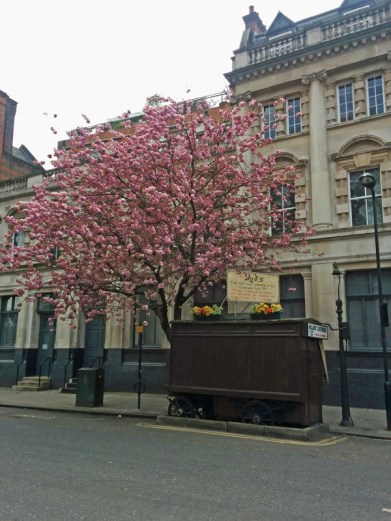
On the corner with Calvert Avenue you’ll find Syd’s Coffee Stall. Named after its first proprietor, Sydney Edward Tothill, who set up the business just after the First World War financed with his invalidity pension. The stall’s not open today as it’s a Bank Holiday but this is more than compensated by the resplendent blossom on the tree behind.

IMG_20160502_130640

Calvert Avenue links back with Virginia Road and then Hocker Street returns us to Arnold Circus with its bandstand and gardens which sits as the hub in the wheel of the Boundary Estate. Cited as the world’s oldest social housing project, Boundary Estate was developed between 1890 and 1900 on the site of the Old Nichol Rookery slum. The redbrick tenements are all now Grade II listed and although around of the 500-odd flats are now in private hands the rest are still under the control of Tower Hamlets council. The separate tenement buildings are all named after towns or villages on the River Thames such as Sunbury, Chertsey & Hurley.

This slideshow requires JavaScript.

Leave the circus this time via the 4 o’clock spoke which is Rochelle Street and then head south back toward the Bethnal Green Road down Montclair Street. This bit of Shoreditch is the home of (mostly) officially sanctioned graffiti art and, regardless of whether or not you consider these to be sanitised hipster versions of the original ‘street’ art form, they undoubtedly make for an arresting sight.

This slideshow requires JavaScript.

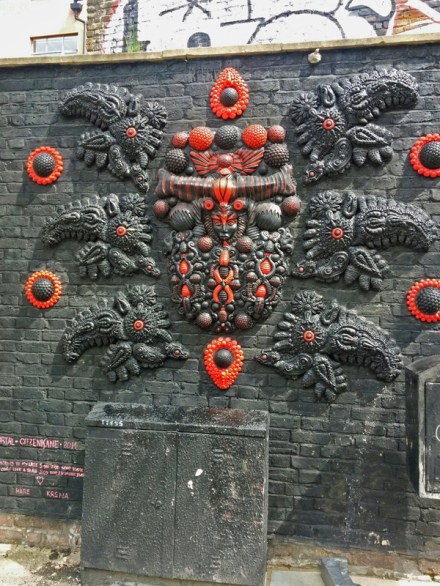
So the above examples can all be found on the route back up to Arnold Circus that takes in Turville Street, Redchurch Street, Whitby Street, Chance Street and Camlet Street. This route also includes another turn down Club Row where we pass this singular three-dimensional piece by the artist, Cityzen Kane, which takes inspiration from African art and the late eighties rave scene.

IMG_20160502_131757

Finishing off this section to the east of Shoreditch High Street we visit Navarre Street, Ligonier Street, Old Nichol Street, another stretch of Boundary Street, Redchurch Street again and finally Ebor Street. And here’s another selection of graffiti art encountered along the way – taking us from Marvel’s Avengers to Winston Churchill via the Cycle of Futility.

This slideshow requires JavaScript.

Back on Shoreditch High Street we cross over by the old garage which is now home to a pop-up food festival (says it all really) and head south to the junction with Great Eastern Street.

IMG_20160502_133244IMG_20160502_133930

Right on that junction (and purportedly still open for business appearances to the contrary) is Chariots Roman Spa – self proclaimed as England’s biggest at best men’s health spa. Which  makes you hope that you never find yourself in the worst.

IMG_20160502_134015

The graffiti is a little bit more anarchic in the enclave between Curtain Road and Shoreditch High Street which is crossed initially by Fairchild Street and Holywell Lane. The latter is also home to music venue, Village Underground, which sits beneath the railway arches. Have only been here once and wouldn’t rate it as one of my favourite concert venues mainly because the auditorium is far too narrow.

Next up is King John Court which adjoins with New Inn Yard at its north end. This is reliably believed to be the site of the first permanent theatre built in England (as mentioned earlier) courtesy of James Burbage. Known simply as The Theatre it opened in 1576. Some of Shakespeare’s early works were performed here as well as plays by Marlowe and Thomas Kyd.  From 1594 it was home to the famous players known as the Lord Chamberlain’s Men (after their patron Henry Carey who fulfilled that office at the time). However the theatre only lasted for four further years until after a series of disputes between the Burbages, Shakespeare and the Lord Chamberlain’s Men the former had the playhouse taken down and rebuilt as the first Globe Theatre across the river. All of this is, I think it is fair to say, commemorated in a somewhat low-key style.

IMG_20160502_134618

Northward on New Inn Street takes us past the back entrance to the old Curtain Road primary school.

IMG_20160502_134710

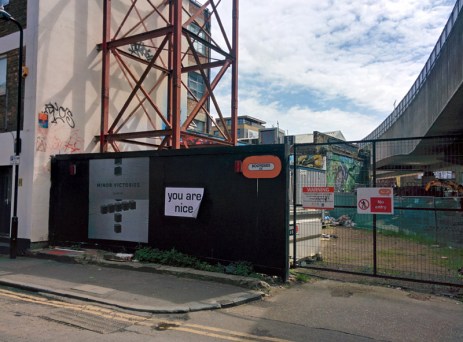
Then it’s on to Bateman’s Row where there is a sign of encouragement (but not perhaps genuine insight).

IMG_20160502_135225

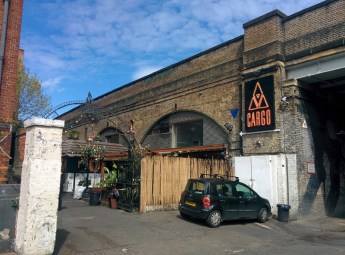
South on Anning Street then back up along Shoreditch High Street past French Place to get to Rivington Street, which is the final call for today. This is the location for a couple of Shoreditch institutions; after-hours club Cargo and the Rivington Place Gallery. The former no longer at the cutting edge of club culture by all accounts. The latter we shall return to on another visit.

IMG_20160502_135621

And once again that’s all folks !


Day 24 – Shoreditch – Hoxton Square – Kingsland Road

For this latest outing we move from one extreme to another both geographically and culturally; from Mayfair with its embassies and swanky hotels in the south-west to the Shoreditch/Hackney gentrification frontline in the north east. Today’s walk is another meandering affair covering a broad but narrow stretch of territory demarcated by City Road, Old Street, Hackney Road and the northern perimeter of our designated target area. Distinct lack of blue plaques to distract us on this occasion you may be relieved to hear.

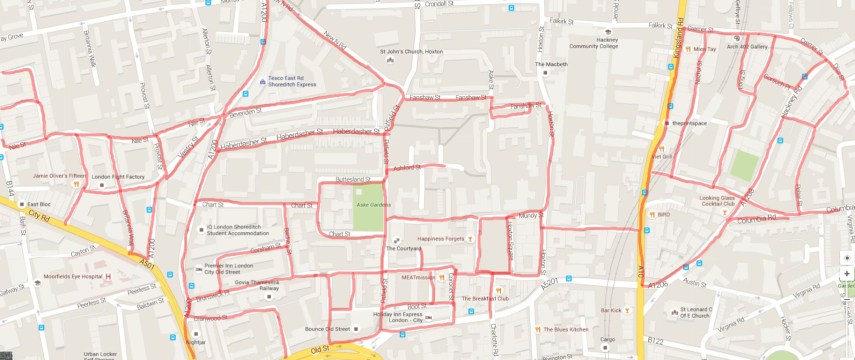
Day 24 Route

Starting point for today is the southern end of City Road from where we head up Westland Place past Jamie Oliver’s Fifteen restaurant and into Nile Street. A quick circuit of Underwood Street, Underwood Row, Britannia Walk and Ebenezer Street gets us back to City Road without troubling the photographer. At the junction with Provost Street there is another phase of the new developments we looked at last time we were around this area.

P1050495

Provost Street splits into itself and Vestry Street with those two forks joined by a bit more of Nile Street that has offshoots in Custance Street and Allerton Street which must be among the most truncated thoroughfares in the capital. Continue further north on East Road just beyond the boundary of the prescribed target area where the Hackney estates dominate.

P1050496

P1050497

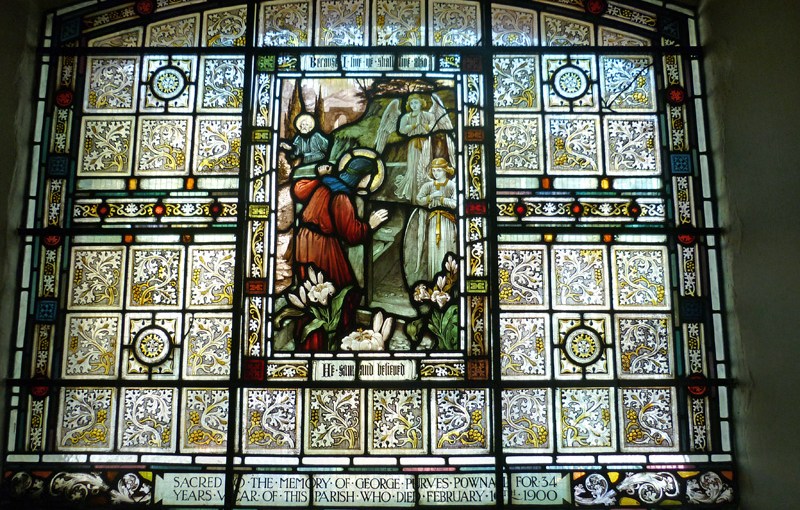
Get back on piste via New North Road which takes us as far as the splendid St John the Baptist Church, Hoxton. The church was built in 1826 but the impressive painted ceiling was created in the early 20th century by the architect Joseph Arthur Reeve. The parish  has had continuous patronage from the Worshipful Company of Haberdashers (another of the City of London’s twelve Great Livery Companies. The stained glass window shown in the selection below is one of my favourites so far on these travels and was installed in commemoration of George Purves Pownall who was the first dean of Perth Cathedral (the one in Australia) before becoming vicar of this parish after returning to England.

This slideshow requires JavaScript.

From the church we head west again along Bevenden Street back to East Road and then double back along Haberdasher Street, named in honour of merchant and City of London Alderman Robert Aske (1619 – 1689) a prominent member of the aforementioned Livery Company. And turning right onto Pitfield Street takes us down to another memorial to the 17th century local benefactor in Aske Gardens. The gardens are bounded to the north by Buttesland Street, the south by Chart Street and west by Hoffman Square. The latter was built as almshouses by the WC of H in 1825-27, designed in a proud Greek Revival style by D R Roper. The building has undergone several enlargements and modifications since and for a century or so it functioned as a furniture design college. (I think we all know what’s coming next don’t we). In the late nineties the Grade II listed building was converted into a gated apartment development.

P1050504P1050505

Across the road on Pitfield Street stands one of the free libraries created by the journalist, newspaper owner and philanthropist John Passmore Edwards (1823 – 1911). The building is now home to the Courtyard Theatre.

P1050506

Westward again on Chart Street back to East Road then south to where this merges into City Road and there’s further stark evidence of the changing nature of the area with one of those luxury blocks dwarfing Moorfields Eye Hospital in the background.

P1050507

Turn off down Cranwood Street then hook a right into Vince Street (got to write a script about a failed 1956’s pop star so I can nick that name). Not entirely sure what this is but it appears to be London’s smallest tower block.

P1050508

Back on Old Street now and a right turn takes us down to the tube station and the so-called Silicon Roundabout, the centre of which, it has to be said, is a right old tip.

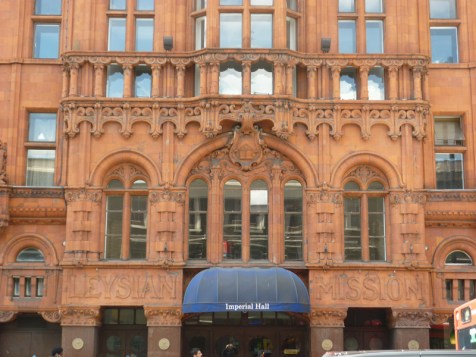
Across the other side of City Road, as we head back up it, is the Imperial Hall (see left hand picture above). This was originally the home of the Leysian Mission which moved  here in 1904, having been founded in 1886 by the Methodist Church as a welfare centre for the East End poor (one of around a hundred in industrial cities around the country).  Four years earlier the building next door was built to the order of tea magnate and philanthropist, Thomas Lipton  (1848 – 1931) and opened as the Alexandra Hall Dining Trust which provided affordable hot meals to the poor. Spread over three floors, some 100 waitresses could serve up to 12,000 meals per day. This building is unused today. The Leysian Mission wound itself up in 1989 and its building, which had been granted Grade-II listed status two years earlier, was (surprise, surprise) converted into loft apartments and retail units in 1998 (and renamed Imperial Hall).

P1050513

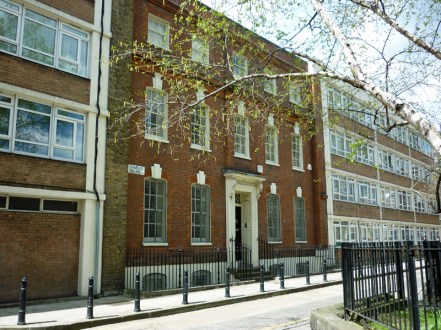
Turn right in to Brunswick Place then fork left into Corsham Street and hang right down Bache’s Street to get to Charles Square. This small square was completed in the 1770’s and unfortunately only one of the original Georgian houses has survived, no.16, which is sadly hemmed in by some particularly unlovely 1950’s flats.

P1050515

Leave the square via the south side in order to return to Old Street with the first example of the graffiti that is going to become something of a signature of this post and the next.

P1050514

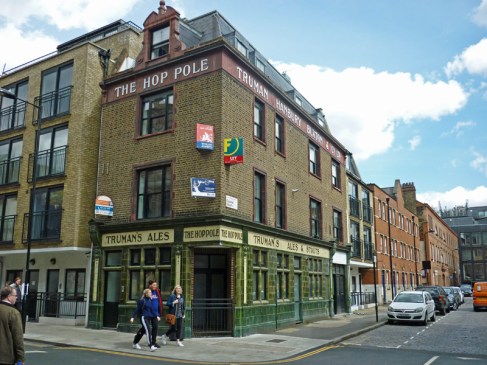
Move northward again on Pitfield Street passing another of those distinctive green-tiled Truman’s pubs that is being put out to pasture – by the look of it.

P1050516

Ashford Street on the right just heads into the estate of the same name so that’s a quick shuffle back and forth and we then turn right proper down Fanshaw Street. Bi-secting Aske Street (him again) this emerges into Hoxton Street. Turning southward the view brings the proximity to the City of London into sharp relief.

P1050517

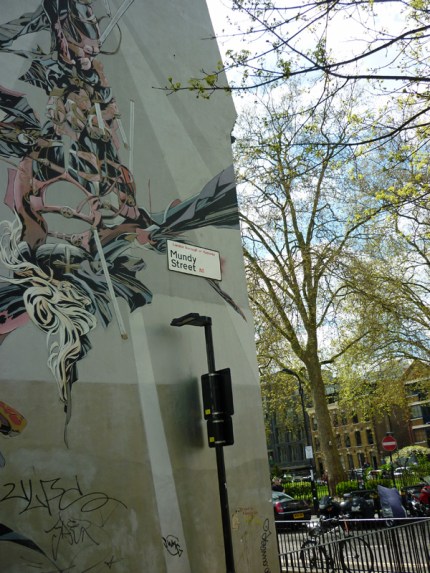
Route into Hoxton Square is via Mundy Street with some graffiti of a more intricate persuasion en route.

P1050518

Hoxton Square is one of London’s earliest garden squares, details of which can be traced back to 1709. From the 1990’s onwards it was the epicentre of an eastward shift in London’s arts, media and clubbing scene but in the last few years it has lost most of its edge. The White Cube gallery decamped in 2012 and the hipster fraternity has largely moved on. St Monica’s Roman Catholic Church has occupied no.19 on the north side of the square since 1866. Major restoration work has only recently been completed.

After a quick up and down Rufus Street on the south side we leave the square via the north-west corner along Bowling Green Walk. After a brief revisit of Pitfield Street return towards the square along Coronet Street. Here we find the former Shoreditch Electric Light Station, an electricity generating station established in 1896. These days it’s the National Centre for Circus Arts.

Coronet Street forms the northern edge of Hoxton Market. At no.13 Hoxton Market (aka Shaftesbury House) is a plaque commemorating its original incarnation as a Victorian Christian Mission. Nowadays this former life is echoed in the name of the restaurant/bar which currently occupies the premises – Meatmission.

P1050524

Boot Street runs the southern end of Hoxton Market and this joins up with Coronet Street again to the east. This is the home of the Standpoint Gallery (one of the few that haven’t been priced out of this area). You have until 04/06/2016 to catch the current show, Megan Broadmeadow’s A Corruption of Mass.

(Did you spot the extremely subtle selfie of the day).

Follow Old Street round to Hoxton Street again where there is this increasingly rare reminder of the old East End.

P1050526

Turn right down Drysdale Street  and stop at today’s Café of the Day (like to ring the changes occasionally), the highly recommended Enjoy Café where I did just that in relation to a massive plate of grilled chicken, chips and salad for a measly £5.50.

P1050527

Drysdale Street runs straight across to Kingsland Road where we head north as far as Cremer Street then turn briefly eastward before veering south down Nazrul Street. I am going to take a punt and say this is named after the Bengali poet, writer, musician and revolutionary Kazi Nazrul Ismal (1899 – 1976). This enclave that we’re entering now, between Kingsland Road and Hackney Road, and intersecting by the mainline railway is one of the few semi-derelict areas encountered on my travels and none the worse for it. Nor surprisingly it is also home to a collection of quite vibrant graffiti. So before we get out onto the Hackney Road we navigate through Union Walk, Waterston Street, Long Street, Gorsuch Street and Gorsuch Place.

This slideshow requires JavaScript.

There’s just the very north-eastern apex of our designated area to go now which involves crossing over Hackney Road to Diss Street then heading south down Pelter Street past Strouts Place as far as Columbia Road.

P1050535P1050536

It then only remains to return to the junction of Hackney Road and Kingsland Road which is the site of the original Shoreditch Railway Station that was a stop on the old North London Railway from 1865 to 1940. It is now a coffee-shop cum wine and whiskey bar alongside pop-up retail space and you can’t get any more Shoreditch than that in the 21st century.

P1050537

Though not every drinking and dining concept  manages to thrive here…
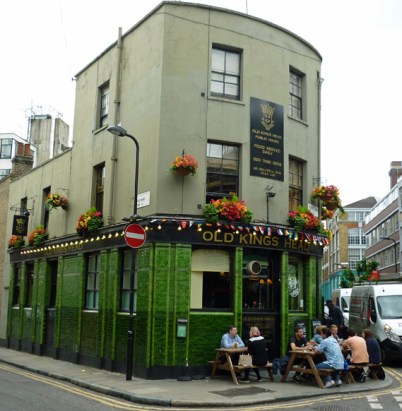
P1050538


Day 23 (part 2 ) – Mayfair – Curzon Street – Park Lane – Shepherd’s Market

So here’s the second instalment of this particular walk. As a reminder we finished last time on South Street; in the top left hand corner of the marked out area below. From here we’re going to crisscross between Park Lane and Piccadilly and spiral in to finish in Shepherd’s Market.

Day 23 Route

First up a circuit of Aldford Street, Balfour Mews, Rex Place and Park Street which brings us back onto South Street and past the Egyptian Embassy.

P1050467

Also on South Street, at no.25. is this elaborate art deco doorway. The mansion it adorns was built in 1932-33 for Sir Bernard Eckstein to designs by E.B Musman.  The iron and glass porch by W. Turner Lord Company arrived a bit later, in 1936. The somewhat risqué relief bearing the house number is reputedly (and perhaps appositely) the work of Scottish sculptor Sir William Reid Dick (1879 – 1961). At no.10 there is a blue plaque honouring the fact that Florence Nightingale (1820 – 1910) lived and died in a house that previously occupied the site and at no.15 (on the corner with Rex Place) is one which commemorates a woman perhaps diametrically opposite Florence on the spectrum of female achievement, Catherine Walters aka “Skittles” (1839 – 1920), proclaimed as the last great courtesan of Victorian London. The nickname is thought to derive from her time working at a bowling alley in nearby Chesterfield Street.

P1050468

P1050469

Turn right down South Audley Street where at no.72 is another blue plaque (this post is awash with them) commemorating the fact that Charles X (1757 – 1836), the last Bourbon king of France, lived in exile there during the reign of Napoleon. Charles was a younger brother of the executed Louis XVI and of Louis XIII who was crowned king following the 1814 restoration (briefly interrupted by Naploeon’s 100 day comeback). Charles himself acceded to the throne in 1824 but was overthrown by the July Revolution of 1830.

P1050465

Next, Deanery Street takes us down to the Dorchester Hotel on Park Lane. The hotel opened in 1931 and swiftly established itself as one of the most prestigious in London. Over the years it has had myriad associations with the world’s rich and famous. General Eisenhower set up his HQ here in 1944 as the D-Day landing plans were being formulated. Prince Philip held his stag night here on the eve of his wedding to Princess Elizabeth (as she was then). Elizabeth Taylor and Alfred Hitchcock were among the regular guests in the fifties and sixties, the former sometimes with Richard Burton, sometimes not. Roman Abramovich and Ken Bates are reported to have sealed the deal for the sale of Chelsea F.C at a meeting here in 2003. Since the mid-Eighties the hotel has effectively been owned by the Sultanate of Brunei and its celebrity appeal has faded somewhat since the introduction of Sharia law in Brunei in 2014. (Biographical detail – some years ago I attended a corporate awards ceremony here and won a case of champagne for bagging most chips at the pop-up Casino tables).

P1050470

Middle Eastern connections abound in this part of town so it’s no surprise on returning to South Audley Street via Tilney Street and Stanhope Gate to come across the Qatari Embassy.

P1050471

Continuing south we reach the western end of Curzon Street and head east, stopping off at Chesterfield Gardens before turning left onto the aforementioned Chesterfield Street. Not sign of that bowling alley but at no.4 we have a rare double blue plaque scenario. Once the home of Regency dandy George “Beau” Brummell (1778 – 1840), a man who allegedly took five hours to get dressed every day, this was also a residence of Anthony Eden (1897 – 1977) the Prime Minister from 1955-57 and forever associated with the ignominy of the Suez Crisis.

P1050472

And at no.6, not contemporaneously with either of those two, lived William Somerset Maugham (1874 – 1965). This was between 1911 and 1919 at the height of his fame and when Of Human Bondage was writtenDuring this period he also married Sylvie Wellcome, former spouse of Henry Wellcome (of Wellcome Trust fame and who we covered in Day 7). Maugham was cited as co-respondent in the divorce suit having fallen into a relationship with Sylvie despite being at least ambivalent in his sexual proclivities. Needless to say the marriage was not a happy one.

Not quite finished with Chesterfield Street as we have the High Commission of the Bahamas at no.10 (breaking up the Middle Eastern hegemony).

P1050474

At the top turn right on Charles Street passing no.20 which was the birthplace of Archibald Primrose, 5th Earl of Rosebery (1847 – 1929) who managed 14 months as Prime Minister following Gladstone’s final stint. This and many of the adjacent properties are Grade II listed.

P1050475

Another resident of Charles Street, albeit briefly, was the Duke of Clarence (later King William IV) (1765 – 1837) the third son of George III and Queen Charlotte. The Sailor King tag is a result of his career in the Royal Navy which he began at age 13 and ended with him becoming Admiral of the fleet in 1811. As he never expected to accede to the throne he merrily went ahead and sired ten children with his mistress, the actress Dorothy Jordan. But then, also in 1811, he married Princess Adelaide of Saxe-Meiningen and following the deaths of his two elder brothers, the eldest being George IV the Prince Regent, neither of whom had living heirs he was crowned in 1830. His reign was a mere ten years and on his death he was succeeded by his niece Victoria (daughter of one of his younger brothers).  The ten illegitimate children, surnamed Fitzclarence, all appear to have done fairly well for themselves though their mother ended up dying in poverty in France in 1816.

P1050476

Final thing to note on Charles Street is this bust of the Emperor Nero, who is perhaps not the most obvious figure to choose to memorialise above your front door.

P1050477

Next we turn briefly south on Queen Street before veering left into Clarges Mews which leads in turn to Clarges Street which takes us all the way back down to Piccadilly. From here the next street heading north is Half Moon Street which you may vaguely recall as the title of a 1986 erotic thriller starring Sigourney Weaver and Michael Caine.

Half_moon_street

Opposite the top end, on Curzon Street again, is the Third Church of Christ Scientist which was built between 1910 and 1913 but pretty much all of it apart from the façade you see below was demolished in 1980.

P1050479

Just along from this G.F. Trumper’s gentleman’s barber and perfumer which has occupied no.9 Curzon Street since the late 19th century.

P1050480

Next door at no. 10 is where Nancy Mitford (1904 – 1973) worked (i.e. wrote) during the war years. Nancy, best known for Love In A Cold Climate, was the eldest and most talented of the six infamous Mitford sisters. She was also less politically controversial than at least three of her siblings though she did briefly flirt with Mosley’s Blackshirt movement before becoming a vociferous opponent of fascism.

Head down the alleyway opposite to arrive at Shepherd’s Market for the first time leaving again swiftly via White Horse Street where Mayfair Cobblers makes a decent fist of trying to look like its been around longer than a couple of decades.

P1050482

Then we’re back on Piccadilly and turning west pass by no. 100 which was developed into private apartments in 1984. It’s a grand address to have but the listed façade is looking pretty dingy these days.

P1050484

Right next door is the Embassy of Japan, currently hosting a Manga exhibition which I popped in to take a look at. This required the presentation of ID and a security scanner check.

So we’re now on to Brick Street pausing briefly at Yarmouth Place before reaching Down Street which is home to another of London’s phantom tube stations. The station was opened in 1907 but when the Piccadilly Line was extended in the late 1920’s its proximity to both Green Park and Hyde Park Corner made it effectively redundant and it closed in 1932. During WWII it was used as a bunker by Churchill and his war cabinet prior to the creation of the Cabinet War Rooms. Back at the tail end of the eighties I went on a tour of the station and its hidden depths and I’m sure I recall them getting a train to stop at the disused platform to allow our orange-suited party to board. TFL are currently touting for ideas for a new permanent use for the space.

P1050485

Back on Piccadilly we pass by both the Cavalry & Guards Club and the Royal Air Force Club. You can see their respective flags in the picture below along with the sign for some restaurant or other.

P1050487

So next we’re going north up Old Park Lane then cut through Hamilton Mews to Hamilton Place and continue north on to Pitt’s Head Mews. As we swoop round this one take a quick look at Derby Street before making a dog-leg left into Market Mews. At the end of this we double back along Shepherd Street and emerge into Stanhope Row via an archway in what is now a boutique hotel. The green plaque above the archway reads :  On this site, until destroyed by bombing during the winter of 1940, stood an archway and Mayfair’s oldest house. ‘The Cottage 1618 A.D.’ from where a shepherd tended his flock whilst Tyburn
idled nearby.

P1050489

Now we’re heading west on Hertford Street where yet another blue plaque is affixed to no.20 in honour of Sir George Cayley (1773 – 1857). I was going to let this one pass but the combination of “pioneer of aviation” and “died 1857” piqued my interest. As early as 1799 he set forth the concept of the modern aeroplane as a fixed-wing flying machine. He also designed the first glider to carry a human being aloft and he discovered and identified the four aerodynamic forces of flight, which act on any flying vehicle: weight, lift, drag and thrust.

P1050488

Moving swiftly on we loop round further sections of Old Park Lane, Brick Street and Down Street (passing the Playboy Club of London en route) before heading back into Shepherd’s Market via the eastern stretches of Hertford Street and Shepherd Street. Incidentally, Shepherd’s Market doesn’t take its name from that shepherd referenced earlier but from Edward Shepherd, an architect and builder, who established a produce market here in 1735 on part of the site of the old May Fair.

P1050493

Where Hertford Street joins Shepherd Street is today’s pub of the day, the Shepherd Tavern, chosen not for the excellence of its victuals but because of the penultimate blue plaque on this route which commemorates the fact that the actress Wendy Richard (1943 – 2009) lived above the pub as a child.

P1050490

After a couple of drinks circumnavigate Shepherds Market, calling at Carrington Street and Trebeck Street, before returning onto Curzon Street opposite the back of the Saudi Arabian Embassy which occupies Crewe House on Charles Street (designed by the aforementioned Edward Shepherd).

P1050492

On the other side of the street and along a bit is the Curzon Cinema which has been operating on this site since 1934.

P1050491

And that’s nearly it. Just time for one final blue plaque on the way back to the tube which is at no.94 Piccadilly(aka Cambridge House), the one-time residence of Henry John Temple (1784 – 1865) better known as Lord Palmerston. Palmerston lived here during his two stints as Prime Minister – 1855-58 and 1859 until his death in 1865. He had previously served as Foreign Secretary under three separate PMs and it is in connection with matters of British foreign policy that he is best remembered. Despite often being an advocate (and possibly the originator) of gunboat diplomacy this was generally in the cause of so-called liberal interventionism. The most notable exception to this being the forcing of China to open up to free trade, in particular the importation of opium.

P1050494


Day 23 (part 1) – Mayfair – Royal Academy – Piccadilly

Back in Mayfair today and looking at the south west corner of that district which is a triangle with the Royal Academy, the Dorchester hotel and Hyde Parker Corner as its vertices. And as there’s such a wealth of material in this compact area I’m going to split this into two posts again.

N.B Mayfair, unsurprisingly, gets its name from the annual May fair that was held here from the late 17th century (when this was still largely open ground) until the mid 18th century when it was suppressed due to the increasingly lewd and riotous behaviour that became associated with it.

Day 23 Route

Start out from Piccadilly tube station and head west down Piccadilly towards the Royal Academy. On the way is Albany House more commonly known as just “the Albany”. Set back from the street behind a courtyard this probably goes unnoticed by most passers-by (I certainly hadn’t paid it much attention until now). The house was built for Viscount Melbourne in the 1770’s but in 1802 was converted by the architect Henry Holland into 69 bachelor apartments known as “sets”. These sets have had numerous well-known occupants in their time, Lord Byron and William Gladstone amongst them. Officially, women were not even allowed on the premises until the 1880’s. In these more enlightened times, residents no longer need to be bachelors (though children under the age of 14 are not permitted to live there). They still guard their privacy highly though – read more of that here. Nothing on the exterior of the building indicates that this is private residences – that was only made clear to me, in no uncertain terms, by some uniformed flunkey when I approached the entrance.

P1050431

Just before we get to the RA pass by the home of the Geological Society and around the courtyard in front of the RA itself, going anti-clockwise, can be found the Royal Astronomical Society, the Society of Antiquaries and the Royal Society of Chemistry.

In case you were wondering, the Society of Antiquaries is all about “The encouragement, advancement and furtherance of the study and knowledge of the antiquities and history of this and other countries”. And it’s been doing that since 1707.

The Royal Academy itself was established in 1768 by a founding group of 36 artists and architects. These included Sir Joshua Reynolds (1723 -1792) who was its first president and whose statue stands in front of Burlington House where  the RA moved in 1867, having secured an annual rent of £1 for 999 years. The RA is probably best known for its Summer Exhibition which is the largest open submission exhibition in the world and has been running every year since 1769. Any artist can enter and 12,000 submissions are accepted each year (though you’ve missed the deadline for 2016).

P1050435

Of course the RA also puts on other exhibitions and the current blockbuster, as you can see above, is Painting the Modern Garden. In its final week this has, inevitably, sucked in every pensioner within a 50-mile radius of London so although I got in free as a guest I gave that one a miss. Had a quick scoot round In the Age of Giorgione but that was pretty rammed with golden-oldies as well; some of whom you can see crowding the lift in the selection below. Amongst these are also today’s selfie-of-the-day and several shots of the fantastic giant ferns that inhabit the Keeper’s House garden.

This slideshow requires JavaScript.

After leaving the RA next stop is the Burlington Arcade; built to the order of Lord George Cavendish, younger brother of the 5th Duke of Devonshire, and opened in 1819 “for the sale of jewellery and fancy articles of fashionable demand, for the gratification of the public and to give employment to industrious females”. It also had the collateral effect of preventing the hoi-polloi from throwing their rubbish into the garden of Burlington House. (The Dukes of Devonshire inherited Burlington House in the 1750s and sold it to the British Government for £140,000 in 1854). Random pop culture trivium of the day – The Arcade was used as a location in the first episode of the Danish TV drama Borgen.

Emerge at the other end of the arcade on Burlington Gardens and turn left to reach Old Bond Street. Here’s a quick reminder of what that’s all about :

P1050452

Next door to Tiffany’s we find this appropriately large-scale advert for the Moncler fashion-house (and no it’s not the bloke from Poldark). Still can’t work out what the chap in the suit’s got over shoulder.

P1050453

At no.44 in a charming shade of lilac is Glyn’s House which dates from 1906 and follows the fashion of that time for reviving the English baroque style of the early 18th century reign of Queen Anne. The naked ladies are perhaps more typically Edwardian though.

P1050454

Return to Piccadilly then head north again up Albemarle Street. No. 50 was the home (from 1812 to 2002) of the publishers John Murray founded by the first of seven consecutive eponymous owners in 1768. The firm was responsible for putting the likes of Jane Austen, Arthur Conan Doyle and Charles Darwin into print. The imprint still exists but as part of the Hodder & Stoughton business within the Hachette empire to which it was sold by John Murray VII.

Cut through Stafford Street to Dover Street where Victoria Beckham’s London flagship store occupies no. 36.

P1050456

Hay Hill links to Berkeley Street where we head south again. On the corner with Stratton Street, site of the Mayfair Hotel, are these rather unstrategically placed old school taxi rank signs and a blue plaque commemorating the bandleader Bert Ambrose (1896 – 1971). A Jewish émigré from Poland, Ambrose enjoyed his greatest success in the thirties and forties and is credited with the discovery of Vera Lynn.

P1050458

From Stratton Street turn left down Mayfair Place to return to Berkeley Street. At no.1 Mayfair Place sits Devonshire House which was designed by Thomas Hastings and built in 1926. This was named after the building which it replaced on the site, the home of the Dukes of Devonshire (possession of which meant that weren’t that fussed about keeping Burlington House). The original Devonshire House was sold by the 9th Duke, who was the first to be subject to payment of death duties. It went for £750,000 (not an insubstantial sum in 1920). The purchasers were wealthy industrialists, Shurmer Sibthorpe and Lawrence Harrison, who demolished the mansion to build a hotel and block of flats. When accused of an act of vandalism Sibthorpe, echoing the buildings 18th century critics replied: “Archaeologists have gathered round me and say I am a vandal, but personally I think the place is an eyesore”. The current Devonshire House is now an office block. 

P1050459

Head back to Piccadilly along Berkeley Street then west all the way past Green Park tube station to Bolton Street where we turn northward again until we hit Curzon Street. Where this merges into Fitzmaurice Place lies the Landsdowne Club. This private members’ club was created in 1935 and was unusual in admitting both men and women from the outset. Before its opening, White Allom, the firm who were responsible for the fitting out of the great Cunard liners Queen Mary and Queen Elizabeth, were commissioned to refurbish the interior of the building in an Art Deco style many of the features of which endured into the present. The building was originally built in 1761 to a design of Robert Adam as a residence for the 18th century Prime Minister, the Marquess of Bute. Just a couple of years later he sold it to another Prime Minister (in waiting), William Petty 1st Marquess of Landsdowne (1737 -1805) who unlike his predecessor is deemed deserving of a blue plaque. As is Gordon Selfridge (1858 – 1947) who leased the house in the 1920’s and made it famous for the dancing parties he hosted starring his protégés, Hungarian cabaret artistes the Dolly Sisters.

P1050461

Moving on we track back down Landsdowne Row then round the southern end of Berkeley Square before continuing west first on Charles Street then Hays Mews. At the end of the latter turning right onto Waverton Street brings us into South Street. At no.38 is the former home and workplace of J. Arthur Rank (1888 – 1972) founder of the Rank Organisation which dominated British Cinema in the 1940s and 50s both on the production and the distribution side of things. The company was responsible for releasing most of the canon of Powell and Pressburger but subsequently became more determinedly commercial in producing Norman Wisdom comedy vehicles and the Doctor… series. (Like Ruby Murray, J. Arthur also has the (even more) dubious honour of being co-opted into the lexicon of Cockney rhyming slang.)
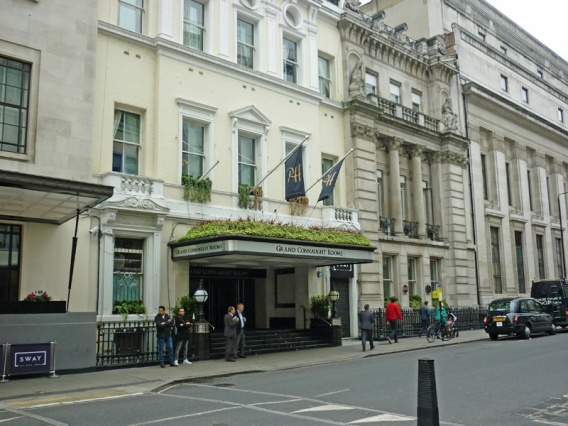
To end this post on a somewhat more edifying note; the corner of South Street and South Audley Street hosts the premises of T. Goode & Sons purveyors of fine porcelain and china tableware since 1827 and possessors of two royal warrants. South Street also features some impressive cut-brick reliefs on several of its buildings.

To be continued…..


Day 22 (part 2) – Gray’s Inn – High Holborn – Red Lion Square

So with an hour so in hand there was just time for a second leg of today’s journey which took care of the streets within the more or less rectangular area bounded by Southampton Row to the west, Theobalds Road to the north, Gray’s Inn Road to the east and High Holborn to the south. A large proportion of this territory is occupied by the land and buildings owned by the Honourable Society of Gray’s Inn, one of the four Inns of Court (all in London) which are the professional associations that all barristers in England & Wales must belong to one of. By contrast, in the western section of the quadrant lies Red Lion Square which has associations altogether less aligned with the establishment.

Day 22 Route 2

So I hop off the bus on Theobalds Road and turn left down Drake Street which is part of both the A40 and the Holborn one-way system. It’s also where you’ll find the second abandoned site of Central St Martin’s School of Art (the one that won’t be hosting a pop-up theatrical performance in May starring James Norton 0f War & Peace and Happy Valley fame – that’s the site on Charing Cross Road that featured a couple of posts back).

P1050428

Swiftly take another left to skirt the northern side of Red Lion Square including a trip up  and down Old North Street. In the north eastern corner of the square sits the Conway Hall which is owned by Conway Hall Ethical Society and was first opened in 1929. The name was chosen in honour of Moncure Daniel Conway (1832 – 1907), anti-slavery advocate, out-spoken supporter of free thought and biographer of Thomas Paine. Nowadays it hosts a wide variety of lectures, classes, performances, community and social events and is renowned as a hub for free speech and independent thought. Its Library holds the Ethical Society’s collection, which is the largest and most comprehensive Humanist Research resource of its kind in the United Kingdom.

P1050408

Head east away from the square via Lambs Conduit Passage then briefly south on Red Lion Street before resuming eastward along Princeton Street. No.1a (aka Tudor House) is now the London home of Novelty Automation which is a collection of, frankly, bonkers alternative amusement arcade machines. Didn’t have time to go in but having experienced the delights of the sister operation on Southwold pier would recommend a visit if you’re ever in the vicinity.

P1050409

Next up is a circuit of Bedford Row which has to be one of the widest residential streets in the capital. If you were wondering who can afford properties like these then the clue is in the opening paragraph.

P1050410

Continuing east we get to Jockey’s Fields, one side of which is taken up by the western wall of Gray’s Inn. The equestrian origins of the name of this former mews of Bedford Row have unfortunately been lost in the mists of time. As you will note, the entrance to Gray’s Inn, at the southern end of the wall, is suitably forbidding.

P1050411

Just inside the gate to the left is a private road on the right side of which are the series of chambers known as Raymond Buildings. And behind you, on the wall itself, is a sign which continues the forbidding theme. The Servants of the Inn are a bit like the Deatheaters from Harry Potter I believe.

The Inn’s substantial gardens are known as The Walks and are only accessible to the general public between 12.00 and 2.30 on weekdays.

Apparently none of the Inns has a verifiable date of foundation. For many centuries it was the view that the starting point of the Inns of Court was a writ of Edward I made on the advice of his Council in 1292. The formal records of Gray’s Inn only date back to 1569 however. During the 16th century when Queen Elizabeth I herself was the Inn’s patron lady there were many more members than those who went on to be admitted to the bar including Lord Burleigh, the Queen’s First Minister, Lord Howard of Effingham, the Admiral who defeated the Spanish Armada in 1588, and Sir Francis Walsingham, the Chief Secretary who founded the Queen’s secret service.

Passing the southern entrance to the gardens we head through the arch leading into Gray’s Inn Square.

P1050419

On your right as you enter the square is the Chapel at Gray’s Inn which predates the Inn itself in that its earliest in carnation is purported to have been around from 1315. The current building is largely a post-WW2 bombing reconstruction however.

P1050420

Behind the chapel is the South Square which houses the Library of over 75,000 books and journals. In the centre of the square is a statue of Francis Bacon (1561 – 1621 ) which was erected in 1912. Bacon was admitted to the Inn in 1576 and called to the bar in 1582. He was elected Treasurer of the Inn in 1608 and held the position until 1617, when he was appointed Lord Privy Seal.

Exit the square by its south-west corner and emerge out onto High Holborn. Turning right we pass the Cittie of Yorke  which, although it looks (especially inside) like something from medieval times, actually dates from the 1920’s. Nonetheless this Samuel Smiths’ pub is distinctive enough to have earned a Grade II listing.

P1050426

Duck back up the alley that is Fulwood Place, the north end of which (opposite the entrance to the Walks) is guarded by these stone griffins. The badge of Gray’s Inn  (as opposed to a true coat of arms) is a gold griffin on a black background encircled with the motto Integra Lex Aequi Custos Rectique Magistra Non Habet Affectus Sed Causas Gubernat, or “Impartial justice, guardian of equity, mistress of the law, without fear or favour rules men’s causes aright”.

P1050418

Make our way back to Red lion square now traversing en route Warwick Court, Brownlow Street, Hand Court, Sandland Street, Red Lion Street and Princeton Street (again). Despite its small size, Red Lion Square has something of a colourful history. Legend has it that beneath this site lie the bodies (but not the heads) of Oliver Cromwell, his son-in-law Henry Ireton and the judge John Bradshaw, the chief architects of the regicide of Charles I. After the restoration of the monarchy in 1660, parliament had the bodies of the three men disinterred and posthumously tried and executed at Tyburn. Their heads were then cut off and displayed on the roof of Westminster Hall while the bodies were initially buried near the gallows. Rumour has it though that the bodies were exchanged while being kept at the Red Lion Inn the night before the hanging and the real remains buried behind the inn where the square is now situated.

The square itself was laid out around 25 years later by a property speculator by the name of Nicholas Barbon. This didn’t go down that well with the lawyers of Gray’s Inn however. Ironically though their legal attempt to prevent the development of the land failed and they ended up taking the law into their own hands. Around 100 of them attacked the workmen on the site, armed with bricks and other building materials. In the ensuing pitched battle the workmen came out on top and the building work carried on.

In the 1850’s Dante Gabriel Rossetti, founder of the Pre-Raphaelites lived here as did his friends William Morris and Edward Burne-Jones.

Back in the present day; there is a bust of our old friend Bertrand Russell on the eastern side of the square (which the local pigeons have shown scant respect to) and on the west side a statue of the politician and anti-war activist Fenner Brockway (1888 – 1988). Living to the ripe old age of 99 meant that he got to be one of the few people to unveil their own statue.

After circling the square it just remains to visit Dane Street, Eagle Street, Catton Street and Fisher Street before calling time on today’s excursions.